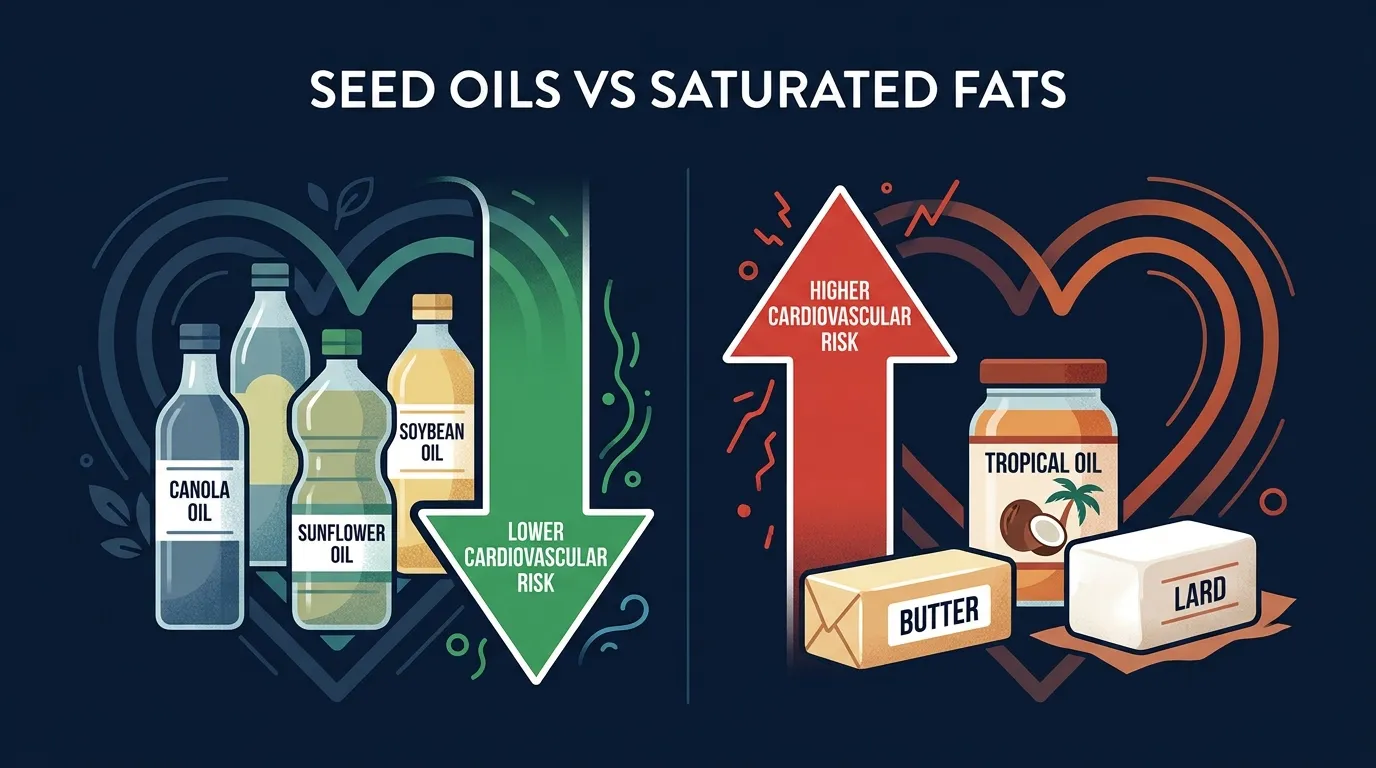
Scroll any wellness corner of the internet for ten minutes and you will hear the same message: seed oils are poisoning you. They cause inflammation. They wreck your gut. They will give you a heart attack. Throw out the canola. Cook everything in butter, beef tallow, or coconut oil. The reels are confident, the infographics are colorful, and the science is barely related.
The seed-oil panic is one of those cases where the loudest voices and the actual evidence are not on the same page. The biochemistry textbook story (omega-6 makes you inflamed) is real at the level of cellular pathways. The human intervention trial story (people who eat more linoleic acid get fewer heart attacks, not more) is also real. Both can be true because biochemistry pathways and whole-body outcomes are not the same thing.
This article walks through what seed oils actually are, what the meta-analytic evidence on cardiovascular outcomes shows, what the inflammation studies in humans say, where the doubters have their strongest case, and what to actually do in your kitchen if you want to make a fat decision that the research supports.
What Seed Oils Actually Are
"Seed oils" is a wellness-internet umbrella term that usually refers to refined cooking oils extracted from seeds via mechanical pressing and solvent extraction: canola (rapeseed), soybean, corn, sunflower, safflower, cottonseed, grapeseed, and rice bran. The shared feature is that they are high in polyunsaturated fat, and most of that polyunsaturated fat is linoleic acid, an essential omega-6 fatty acid.
Olive oil and avocado oil are technically also seed-derived (olives have pits, avocados have seeds), but the internet usually exempts them because they are mostly monounsaturated and harder to attack rhetorically.
Linoleic acid is the molecule the seed-oil debate is really about. It is one of two fatty acids the human body cannot synthesize and must obtain from food, alongside alpha-linolenic acid (an omega-3). Linoleic acid is the precursor to arachidonic acid, which is itself the precursor to several pro-inflammatory signaling molecules called eicosanoids. That precursor pathway is where the "omega-6 is inflammatory" framing comes from.
The wrinkle is that the conversion from linoleic acid to arachidonic acid in humans is heavily regulated and slow. Eating more linoleic acid does not appear to meaningfully raise arachidonic acid levels in tissue, which is the first hint that the textbook pathway and the real-world outcome are not the same thing.
The Research: Seed Oils and Cardiovascular Outcomes
The Cochrane 2018 Review
The most rigorous synthesis on omega-6 fats and cardiovascular outcomes is the 2018 Cochrane review by Hooper and colleagues. The review pooled 19 randomized trials with about 6,500 adults, all of which compared higher omega-6 intake (from seed oils, supplements, or modified foods) against lower omega-6 intake or other dietary fats.
The pooled result: higher omega-6 intake produced a small reduction in myocardial infarction (relative risk around 0.88) and no meaningful effect on overall cardiovascular mortality. The authors graded the evidence as low quality (long follow-ups are scarce, trial quality varied), but the direction of effect was toward protection, not harm. If seed oils were silently driving cardiovascular disease at typical dietary intakes, this is where it would show up. It does not.
The Marklund 2019 Circulation Biomarker Pool
A complementary line of evidence comes from biomarker studies that measure actual blood levels of linoleic acid rather than relying on diet questionnaires. Marklund and colleagues (2019) in Circulation pooled individual-participant data from 30 prospective cohort studies covering more than 68,000 adults across 13 countries.
Higher circulating linoleic acid was associated with lower risk of total cardiovascular disease, cardiovascular mortality, and ischemic stroke. The associations were graded across quintiles, so this was not a small-difference story driven by outliers. People in the highest linoleic-acid quintile had roughly 7 to 22 percent lower risk across the outcomes measured, compared to those in the lowest quintile. Higher arachidonic acid did not increase any outcome risk either, which directly contradicts the "linoleic acid converts to arachidonic acid converts to disease" narrative.
The AHA 2017 Presidential Advisory
The American Heart Association reviewed the totality of randomized trial and prospective cohort evidence on dietary fats and cardiovascular disease in its 2017 Presidential Advisory by Sacks and colleagues in Circulation. The advisory concluded that replacing saturated fat with polyunsaturated vegetable oils (the seed oils the internet is mad at) reduces cardiovascular disease by about 30 percent, similar to the effect of statins.
That is not a fringe document. It is the consensus position of the cardiology establishment, based on the four core randomized trials that swapped saturated fat for polyunsaturated vegetable oils (Finnish Mental Hospital, Wadsworth Veterans, Oslo Diet-Heart, Los Angeles Veterans) plus prospective cohort data. The advisory specifically calls out tropical oils (coconut, palm) and recommends polyunsaturated vegetable oils as the replacement.

Knowing what to do is the easy part.
FitCraft, our mobile fitness app, pairs you with an AI coach who builds you a personalized plan around your goals, schedule, and fitness level. Every FitCraft program is designed by Domenic Angelino, MPH (Brown University) and NSCA-CSCS, with research published in the Journal of Strength and Conditioning Research and Medicine & Science in Sports & Exercise.
Take the Free Assessment Free • 2 minutes • No credit cardWhat About Inflammation?
The inflammation argument is the most popular reason people cite for avoiding seed oils. The argument goes: linoleic acid converts to arachidonic acid, which produces pro-inflammatory eicosanoids, which raises baseline inflammation, which drives chronic disease.
Every step in that chain is technically a real pathway. The question is what happens when you measure inflammation in actual humans eating actual amounts of seed oil.
Innes and Calder (2018) in Prostaglandins, Leukotrienes and Essential Fatty Acids reviewed the human intervention trial evidence. The pattern across the literature: feeding adults additional linoleic acid (from 7 to 21 grams per day above baseline, in some studies for up to 12 weeks) does not raise circulating C-reactive protein, interleukin-6, tumor necrosis factor alpha, or other standard inflammation markers. Tissue arachidonic acid levels barely change either. The conversion pathway from linoleic to arachidonic acid is too tightly regulated for dietary input to swing it meaningfully.
Which is a strange result if the textbook story is right. It is not a strange result if the textbook story is a pathway that exists but does not translate to whole-body effects at normal dietary doses. The strong "omega-6 causes inflammation" claim relies on extrapolating from cellular biochemistry to clinical outcomes without checking the studies that actually measured the clinical outcomes.
Where the Doubters Have Their Strongest Case
Steelman the other side. There is one trial that the seed-oil-skeptic side leans on heavily, and it deserves a fair treatment.
Ramsden and colleagues (2016) in BMJ published a reanalysis of recovered data from the Minnesota Coronary Experiment, a 1968-1973 randomized trial in 9,400 institutionalized patients that replaced saturated fat with corn-oil-based linoleic acid. The original trial reported the diet-heart hypothesis was supported. The Ramsden reanalysis, using recovered raw data, found that lower cholesterol in the intervention group did not translate to lower mortality. People in the corn-oil arm had similar or slightly worse mortality outcomes.
That is a real, peer-reviewed study with troubling implications for the simple "swap saturated fat for seed oil and save lives" framing. But there are caveats worth flagging:
- It is one trial from the 1960s, conducted in mental institutions on people with high baseline mortality from many causes other than heart disease.
- The corn-oil arm received margarine heavy in trans fats by the standards of the time. Trans fats are now known to be uniquely cardiotoxic and were not separated from the linoleic acid effect.
- The trial follow-up was short. Most participants were tracked for under 5 years.
- It is one trial among 19 in the Cochrane review. Singling it out as definitive while ignoring the pooled meta-analytic result is selective.
The Minnesota reanalysis is a legitimate piece of contrary evidence. It is not strong enough to overturn the Cochrane meta-analysis and the Marklund biomarker pool combined.
The Bigger Story: Ultra-Processed Food, Not the Oil Bottle
The seed-oil discourse is partly a misdirection. Most people who consume large amounts of seed oils are doing so through ultra-processed packaged foods: fried snacks, packaged baked goods, salad dressings, fast-food fryer oil, processed meats, instant noodles. The same foods are also high in refined carbohydrates, sodium, additives, and engineered hyperpalatability.
When epidemiological studies find associations between high seed-oil intake and worse outcomes, the seed oil is rarely the only thing varying. It travels with a whole pattern of food choices that independently predict worse health. Untangling "the seed oil caused this" from "the donut caused this" is hard when most seed oil comes packaged inside donuts. This is the same epidemiology problem covered in our piece on foods that seem healthy but aren't: the marketing-health gap matters more than any single ingredient.
The actionable framing is to reduce ultra-processed food intake. That move drops seed-oil intake too, as a side effect, without requiring you to scour ingredient labels for canola. Cooking more whole food at home with whatever oil you prefer (olive, avocado, canola, butter in moderation) is a bigger health move than swapping one oil for another.
Common Misconceptions About Seed Oils
Misconception 1: "Our ancestors didn't eat seed oils"
Probably true in industrial volumes. But that argument also applies to refined sugar, refined wheat, alcohol at modern doses, and pasteurized dairy. "Ancestors didn't eat X" is a heuristic, not an outcome study. The outcome studies on seed oils exist, and they mostly point the other direction.
Misconception 2: "Seed oils are oxidized and full of free radicals"
Fresh, properly stored seed oils contain antioxidants (vitamin E, tocopherols) precisely because polyunsaturated fats need them. Repeatedly reused fryer oil that has been heated to high temperatures and re-used for days is a different product than a fresh bottle of canola oil. The oxidation concern is real for chronically reused commercial frying oil. It is not a meaningful concern for home cooking with fresh oil at normal temperatures.
Misconception 3: "Switching to tallow or coconut oil is healthier"
Tallow and coconut oil are mostly saturated fat. The AHA 2017 advisory specifically reviewed the evidence and concluded that replacing saturated fat with polyunsaturated vegetable oils reduces cardiovascular disease. Swapping canola for tallow is, on average, the wrong direction for heart health. Coconut oil's marketing as a "superfood" rests on weak evidence about lauric acid and ignores the LDL-raising effect that has been documented in randomized feeding trials.
Misconception 4: "The omega-6 to omega-3 ratio is what matters"
This is a popular reframe that lets the seed-oil-bad argument survive the cardiovascular evidence. The claim is that the ratio of omega-6 to omega-3 is what matters, and modern diets have too much omega-6. The problem with the ratio framing: when researchers have manipulated the ratio in trials, the outcomes track absolute omega-3 intake, not the ratio. Adding more omega-3 (from fish or supplementation) helps. Cutting omega-6 to fix the ratio without adding omega-3 does not. The actionable move is "eat more omega-3," not "cut omega-6."
What to Actually Do in Your Kitchen
Translating the research into the actual food in your house:
- Olive oil for most cooking and dressings. Strongest outcome data (Mediterranean diet trials), pleasant flavor, fine at moderate-heat cooking.
- Avocado oil for higher-heat searing if you want a neutral-flavored alternative. Similar fatty-acid profile to olive oil.
- Canola, sunflower, soybean for baking and high-heat cooking where flavor neutrality matters. Cheap, well-studied, and not the villain.
- Butter in moderate amounts for flavor where it actually matters (eggs, finishing dishes). Not as a primary cooking fat at every meal.
- Tropical oils (coconut, palm) as occasional ingredients in specific recipes, not as your daily cooking oil.
- Reused fryer oil and packaged ultra-processed foods are where the real concern lives. Reduce those and you have addressed most of the seed-oil question without thinking about the oil itself.
The bigger nutrition picture for fitness outcomes is total calories, protein intake, fiber, and the whole-foods share of your diet. None of those hinge on whether your salad dressing contains canola oil.

How FitCraft Supports the Bigger Picture
Most fitness apps shout about a single macronutrient or food group like it is the lever that determines everything. Seed oils. Carbs. Protein timing. The truth is that the lever that matters most for almost everyone is showing up to train consistently and not undoing it with chaotic eating. That is the part that breaks.
FitCraft programs are designed to make the consistency part feel automatic. Your AI coach builds your training around your goals, your schedule, and your fitness level, then keeps the calendar honest with progress that actually shows up. The nutrition decisions are yours, but the training rhythm that lets nutrition compound is what the app handles.
Frequently Asked Questions
Are seed oils bad for you?
Based on the current weight of evidence, no, not in the way the viral narrative suggests. A 2018 Cochrane review of 19 randomized trials by Hooper and colleagues found that increasing dietary omega-6 fatty acids (the main fat in seed oils) produced a small reduction in cardiovascular events compared to lower-omega-6 diets. A 2019 Circulation meta-analysis by Marklund and colleagues pooled blood-level data from 30 prospective cohorts and found that higher circulating linoleic acid was associated with lower cardiovascular mortality. The American Heart Association's 2017 Presidential Advisory concluded that replacing saturated fat with polyunsaturated vegetable oils reduces cardiovascular disease risk. The seed-oil-as-poison story is much louder than the evidence supporting it.
Are seed oils bad for your heart?
The randomized trial and biomarker evidence points the other direction. Hooper et al. (2018, Cochrane) found a modest reduction in cardiovascular events with higher omega-6 intake. Marklund et al. (2019, Circulation) pooled 30 cohorts and reported inverse associations between blood linoleic acid and cardiovascular mortality. The AHA 2017 advisory recommended replacing saturated fats with polyunsaturated vegetable oils for heart health. The contested Minnesota Coronary Experiment reanalysis (Ramsden et al., 2016, BMJ) is the main counterweight, but it is one trial from the 1960s where the corn-oil arm received margarine high in trans fats. The overall picture: seed oils replacing butter or lard slightly reduces heart-disease risk.
Do seed oils cause inflammation?
The biochemistry textbook says yes, the human-trial evidence says no, and the textbook story turns out to be wrong at the level you actually eat. Linoleic acid (the main omega-6 in seed oils) is a precursor to arachidonic acid, which can produce pro-inflammatory eicosanoids. But Innes and Calder's 2018 review in Prostaglandins, Leukotrienes and Essential Fatty Acids summarized human intervention trials and found that increasing dietary linoleic acid does not raise circulating inflammatory markers like CRP or arachidonic acid concentrations in tissue. The pathway exists; the dose-response in real humans does not produce the predicted effect.
Are seed oils bad for your gut?
There is little high-quality human evidence that seed oils harm gut health at normal dietary intakes. Most of the gut-health claims trace back to rodent studies using massive doses of oxidized oils, which do not reflect what humans typically eat. Reused fryer oil and chronically high-temperature-degraded oils are a different question and warrant moderation. The bigger gut-health story is fiber intake, fermented foods, and overall dietary diversity, not whether you switched from canola to avocado oil.
Which oils are the healthiest to cook with?
Extra-virgin olive oil has the strongest outcome data, anchored to Mediterranean diet trials like PREDIMED. Avocado oil is a reasonable high-heat alternative with a similar fatty-acid profile to olive oil. Canola, sunflower, and soybean oils are not the villains the internet says they are. The AHA 2017 advisory recommends them over butter, coconut oil, palm oil, and lard for heart health. Tropical oils (coconut, palm) are high in saturated fat and should be a smaller share of total intake. The bigger lever is total calories and the overall pattern of your diet, not which specific oil is in the pan.