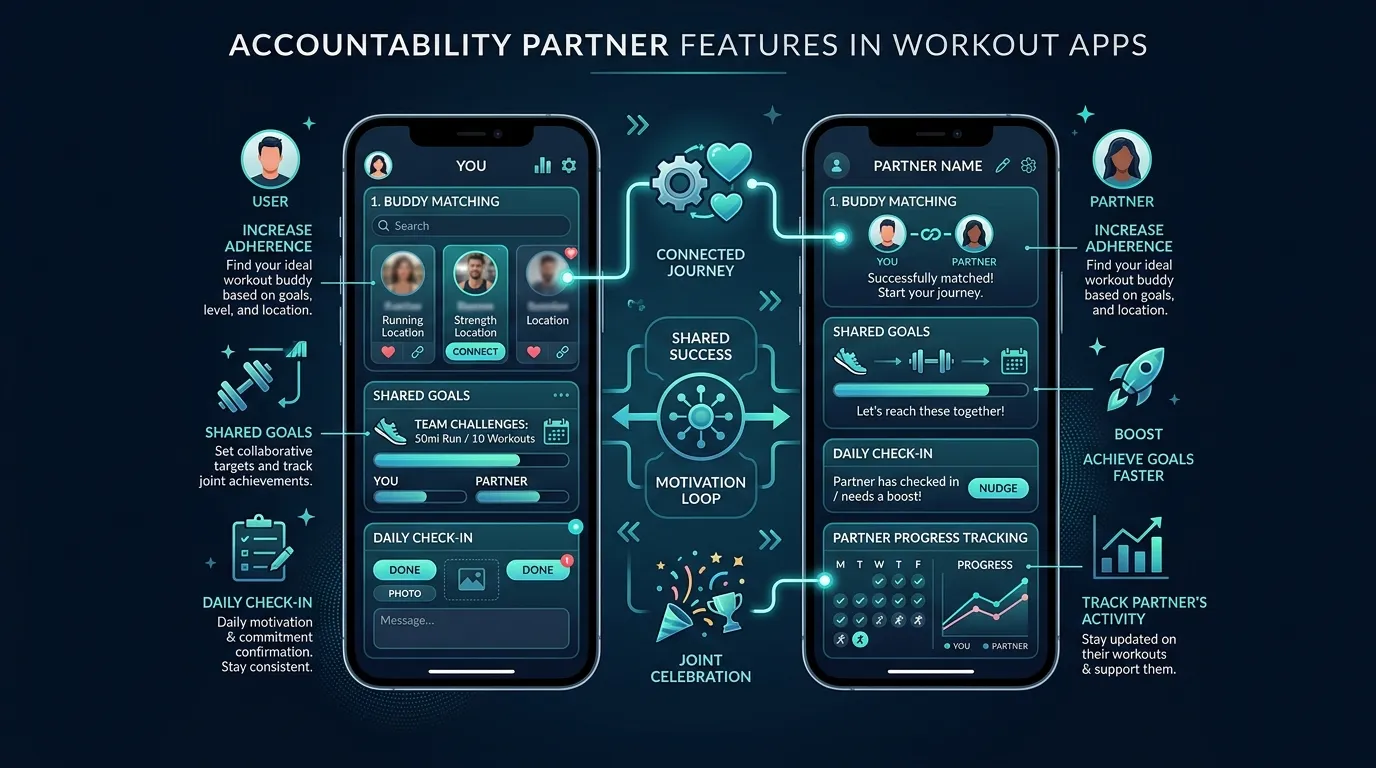
You already know you should work out. That was never the problem. The problem is that knowing what to do and actually doing it consistently are two completely different skills, and most fitness apps only address the first one. Closing that gap is the entire job of a fitness accountability app.
They hand you a workout plan. Maybe a calendar. Maybe a push notification that says "Time to work out!" at 6 AM. And then they wait for you to show up. When you don't, they have nothing to offer except another notification tomorrow.
That's not accountability. That's a reminder with no teeth.
Real accountability — the kind that actually changes behavior — creates a cost for skipping and a reward for showing up. It closes the gap between what you intend to do and what you actually do. Behavioral scientists call this the intention-action gap, and it's the reason 73-96% of fitness app users disappear within the first month (Business of Apps, 2026).
It also helps to be precise about what you are shopping for. A general accountability app tracks any commitment you set, from reading to budgeting, and mostly records whether you ticked the box. A workout accountability app is narrower and better at one job: it knows what a training week looks like, so it can tell the difference between a programmed rest day and a skipped session, and it can adjust the plan instead of just logging the miss.
We evaluated the top fitness apps of 2026 and ranked them on one question: how well does this app hold you accountable when motivation fades?
The Four Types of Workout Accountability
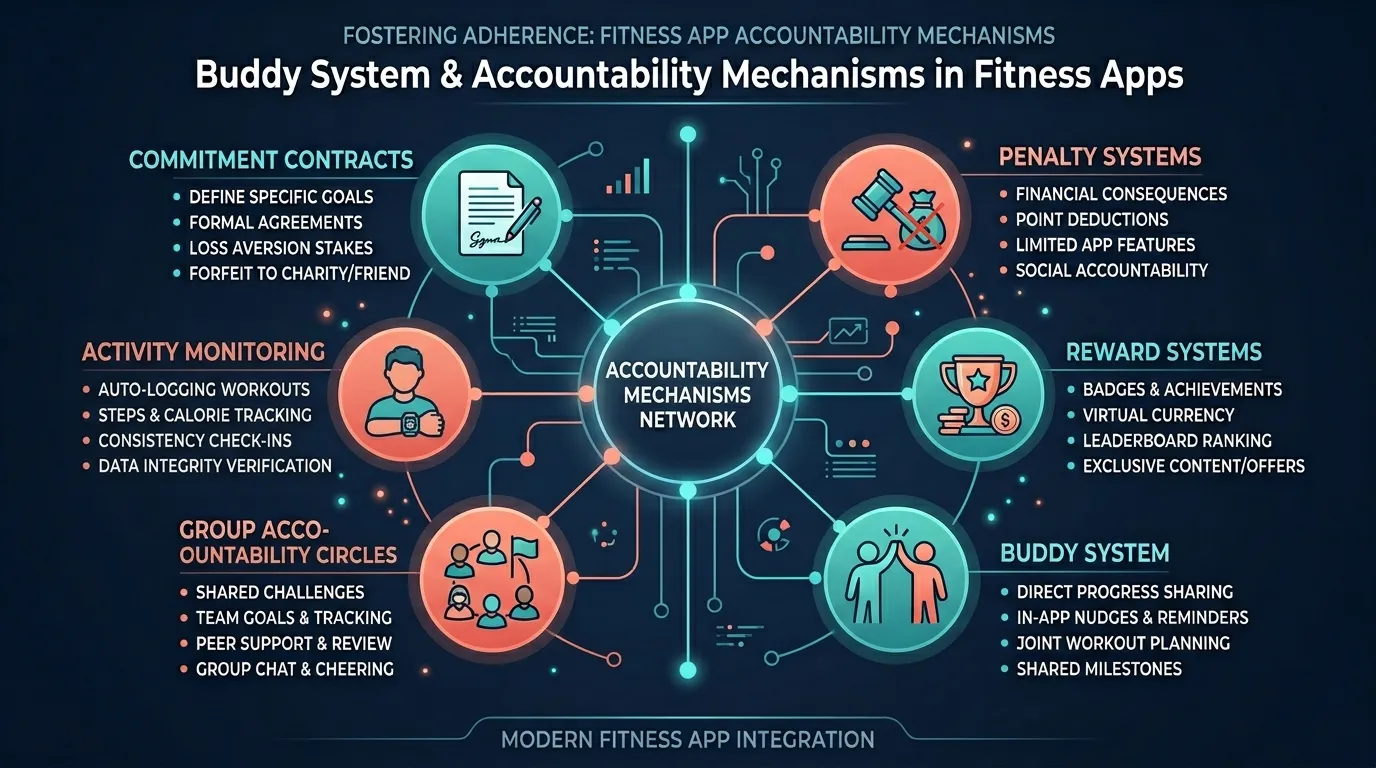
Not all accountability works the same way, and not all of it works for everyone. Understanding the different approaches helps you choose the app that matches how you're wired.
1. Social Accountability
Working out with a partner, sharing results publicly, or competing on leaderboards. The mechanism: you show up because someone else is watching. Apps like Strava and Peloton excel here.
- Strength: Leverages social pressure — one of the most powerful human motivators
- Weakness: Depends on having an active social circle who also uses the app. Falls apart if your workout buddy quits or you prefer exercising alone
2. Gamification Accountability
Streaks, XP, leveling up, collectible rewards, and progression systems that make consistency feel like a game. The mechanism: you show up because skipping means losing progress in a system you've invested in. FitCraft leads this category.
- Strength: Works whether you exercise alone or with others. Creates intrinsic motivation loops that don't depend on external people
- Weakness: Must be implemented well — shallow badges and trophies lose their appeal quickly. The gamification needs genuine depth to sustain engagement
3. Financial Accountability
Putting money on the line. You commit cash and lose it if you don't follow through. Apps like StickK and StepBet use this approach.
- Strength: Loss aversion is a well-documented behavioral driver — losing $50 hurts more than gaining $50 feels good
- Weakness: Creates anxiety-based motivation that can feel punitive rather than enjoyable. Doesn't build positive associations with exercise
4. Structural Accountability
Scheduled classes, appointment-based workouts, and external time structures that make "when" a decision you've already made. Peloton's live classes and Apple Fitness+'s Activity Rings work this way.
- Strength: Removes decision fatigue — you don't choose whether to work out, you just show up at the scheduled time
- Weakness: Requires schedule flexibility and may not adapt when life gets chaotic
What the Research Says About Accountability and Exercise
This isn't just opinion. Peer-reviewed research has tested which accountability mechanisms actually move the needle on physical activity.
The BE FIT randomized clinical trial (Patel et al., JAMA Internal Medicine, 2017) tested gamification-based accountability in 200 adults across 94 families. Participants in the gamification group achieved their step goals on 53% of days versus 32% for controls — a 66% improvement in goal achievement. They also increased daily steps by 1,661 compared to 636 in the control group.
The STEP UP trial (Patel et al., JAMA Internal Medicine, 2019) expanded this to 602 overweight and obese adults across 40 US states. All three gamification conditions — support, collaboration, and competition — significantly increased physical activity during the 24-week intervention, with the competition arm increasing daily steps by 920 compared to controls.
A 2022 systematic review in JMIR mHealth and uHealth analyzed multiple studies on gamified health interventions and found that gamification combined with self-monitoring consistently improved physical activity participation, though the strongest effects came from well-designed, multi-layered gamification systems rather than simple badges.
The takeaway: accountability mechanisms backed by behavioral science significantly increase how much people exercise. The question is which type of accountability matches your personality and lifestyle.
The Best Fitness Accountability Apps, Ranked
1. FitCraft: Best Fitness Accountability App Without a Workout Buddy
Approach: Gamification + AI coaching + behavioral science | Price: Free version available. Subscription model. | Platforms: iOS & Android
Most accountability apps depend on other people — a workout buddy, a class schedule, a social feed. FitCraft is designed for people who want accountability that works even when they're exercising alone at home at 6 AM on a Tuesday.
The accountability system operates through multiple gamification layers that create daily reasons to show up:
- XP and leveling up — every workout earns experience points toward your next level. Skipping doesn't just mean missing a workout; it means stalling progression in a system you've invested in. This taps into the same completion psychology that makes video games compelling.
- Collectible cards — unique cards earned through workout milestones and consistency. These create a collection mechanic that adds a concrete, visible reward layer on top of fitness gains. You're not just getting healthier; you're building something.
- Calendar tracking and rewards — your workout calendar becomes a visual record of consistency. Calendar-based rewards recognize patterns of showing up, making your accountability tangible and visible every time you open the app.
- AI coach Ty — a personalized AI trainer that provides adaptive encouragement and adjusts your workouts based on your progress. Ty creates a sense of being guided and supported without needing to coordinate with another human.
Every workout includes interactive 3D exercise demos with pinch-and-zoom camera control, so you can see proper form from any angle. Programs span yoga, mobility, strength (dumbbells, resistance bands, bodyweight), cardio, and dynamic movement — all designed by an Ivy League-trained exercise scientist, NSCA-certified strength coach. The workouts adapt based on your progress, getting harder as you advance rather than staying static.
Why it's #1 for accountability: FitCraft's gamification isn't a cosmetic layer on top of workouts. It's the core product. The XP system, collectible cards, and calendar rewards create a self-sustaining accountability loop that doesn't require a workout partner, a class schedule, or money on the line. You show up because the system makes showing up feel rewarding — not because someone is watching.
As Mike, 23, put it after getting visibly stronger in 4 months: "The streak system got me hooked. I didn't want to break my chain."
Not sure which accountability style fits you?
Take the free 2-minute assessment to find out if FitCraft's gamified accountability matches how you're wired.
Take the Free Assessment Free · 2 minutes · No credit card2. Strava: Best Workout Accountability App With Friends
Approach: GPS tracking + social sharing + community challenges | Price: Free + Premium subscription | Platforms: iOS & Android
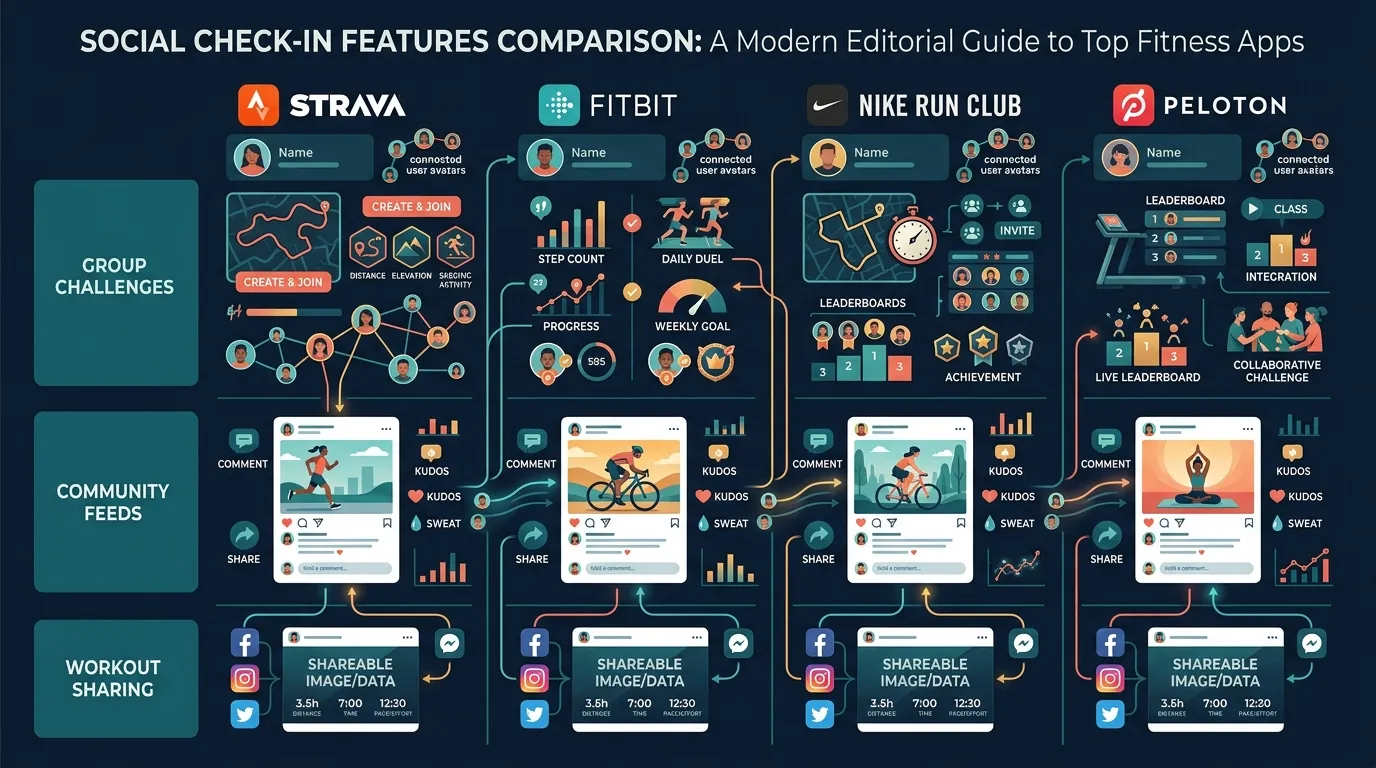
Strava turns every run, ride, and walk into a social event. Your workouts are automatically shared with followers. Friends can give you kudos. You can compete on segment leaderboards and join monthly challenges. The accountability here is simple and powerful: people you care about can see whether you worked out today.
Where it shines for accountability: The social feed creates ambient peer pressure — you see your friends running and feel compelled to lace up. Monthly challenges provide external deadlines. The segment leaderboard system adds competitive accountability for specific routes and efforts. Strava's community is massive, active, and genuinely engaged.
Where it falls short: Strava is built primarily for endurance athletes — runners, cyclists, swimmers. If you're doing strength training, yoga, or home workouts, the social accountability features don't translate as well. There's no workout programming, no AI coaching, and no gamification beyond basic badges. The accountability disappears the moment your social circle stops using the app.
Best for: Runners and cyclists who thrive on social validation and competitive motivation. If seeing your friend's 5K on your feed makes you want to go run, Strava's accountability model is built for you.
3. Peloton: Best for Live-Class Structure and Community
Approach: Scheduled live classes + instructor-led motivation + community | Price: Subscription model | Platforms: iOS, Android, web, Peloton hardware
Peloton creates accountability through structure and social energy. Live classes start at specific times — you show up or you miss them. Instructors call out encouragement by name. The community celebrates milestones. The accountability is external and event-driven: there's a class at 7 AM, people are expecting you, and the instructor is counting on a full room.
Where it shines for accountability: The live class schedule creates appointment-based accountability that removes the "when should I work out?" decision. Instructor energy is genuinely motivating. The streak tracking and milestone celebrations add lightweight gamification. The community forums and group challenges create peer support.
Where it falls short: Peloton's accountability model depends on you being motivated by group energy and instructor charisma. If you're introverted or prefer working out alone, the social mechanics don't land. The app-only experience is strong, but the full accountability impact still leans toward the Peloton hardware ecosystem. When the novelty of classes fades, there's no deeper behavioral system to sustain engagement.
Best for: People who need external structure and thrive on group energy. If the only times you've been consistent were with a gym buddy or a class schedule, Peloton digitizes that accountability model.
4. Apple Fitness+: Best for Passive Accountability Through Wearable Tracking
Approach: Apple Watch integration + Activity Rings + visual goal tracking | Price: Subscription model | Platforms: Apple ecosystem (iPhone, iPad, Apple TV + Apple Watch)
Apple Fitness+ creates accountability through constant visibility. The Activity Rings on your Apple Watch — Move, Exercise, Stand — are a persistent visual reminder of whether you've moved enough today. Closing your rings becomes a daily micro-game, and the streak counter tracks consecutive days of ring closure. The accountability is ambient: it's literally on your wrist all day.
Where it shines for accountability: Always-visible ring tracking creates passive accountability you can't ignore. Move goals automatically adjust based on your patterns. Monthly challenges and achievement badges add reward mechanics. Sharing Activity with friends adds a social layer. The simplicity of "close your rings" makes the daily target crystal clear.
Where it falls short: Requires an Apple Watch and full Apple ecosystem buy-in — a significant financial barrier. The accountability is about daily movement, not structured workout consistency. Ring-closing can become a vanity metric (a long walk closes your rings, even if your goal was strength training). No AI coaching. Limited workout personalization compared to dedicated fitness apps.
Best for: Apple Watch owners who respond to visual goal tracking and want a simple, always-present accountability system for daily movement.
5. StickK: Best Accountability App for Financial Stakes
Approach: Commitment contracts + financial stakes + referee verification | Price: Free (you set your own financial stakes) | Platforms: iOS, Android, web
StickK takes a radically different approach to accountability: you put money on the line. Set a fitness goal, commit a dollar amount, designate a referee to verify whether you followed through, and choose where your money goes if you fail (including to an "anti-charity" — an organization you dislike). The accountability is loss aversion: you show up because losing $50 hurts more than sleeping in feels good.
Where it shines for accountability: Financial stakes are among the most powerful behavioral motivators. The referee system adds human verification. The anti-charity option increases the sting of failure. Research on commitment contracts shows they significantly increase goal completion rates.
Where it falls short: StickK is an accountability tool, not a fitness app. There are no workouts, no exercise guidance, no coaching, and no progression system. The financial pressure can create anxiety around exercise rather than positive associations. Once you stop betting money, the accountability vanishes. It solves "how do I make myself show up?" but not "what should I do when I get there?"
Best for: People who respond to loss aversion and want pure accountability mechanics without the fitness programming. Works best paired with a separate workout app.
6. Nike Training Club: Best Free Workout Accountability App
Approach: Expert-led workout library + scheduling + push reminders | Price: Free | Platforms: iOS & Android
Nike Training Club provides a massive library of free workouts from elite trainers, with the ability to schedule workouts and receive push notification reminders. The accountability is lightweight — scheduled reminders and workout completion tracking — but the zero-dollar price tag and quality of content make it a strong starting point.
Where it shines for accountability: The workout scheduling feature lets you set specific days and times, creating structural accountability. Push notifications serve as reminders. The extensive library (strength, HIIT, yoga, mobility) means you're less likely to get bored. Achievement tracking provides a basic record of consistency.
Where it falls short: Reminder-based accountability is the weakest form — push notifications are easy to dismiss and create no cost for skipping. There's no gamification, no social accountability, no financial stakes, and no AI coaching. The content is excellent, but the accountability system is essentially a calendar and an alarm.
Best for: Budget-conscious beginners who want quality workouts and basic scheduling. If you mainly need help knowing what to do (not making yourself do it), NTC delivers.
Quick Comparison: Accountability Features by App
| Feature | FitCraft | Strava | Peloton | Apple Fitness+ | StickK | NTC |
|---|---|---|---|---|---|---|
| Gamification (XP, levels, collectibles) | Deep (XP, levels, cards) | Basic badges | Milestones | Rings & badges | None | None |
| Social Accountability | No | Core feature | Strong | Activity sharing | Referee system | No |
| AI Coaching | Ty (personalized) | No | No | No | No | No |
| Calendar/Streak Tracking | Calendar + rewards | Activity log | Streak counter | Ring streaks | Contract timeline | Basic history |
| Workout Programming | Adaptive, expert-designed | No (tracking only) | Class-based | Class-based | No | Library-based |
| Works Solo | Yes (core design) | Partially | Partially | Yes | Needs referee | Yes |
| Price | Free version available. Subscription. | Free + Premium subscription | Subscription model | Subscription model | Free + stakes | Free |
How we ranked these apps
Every app on this page was scored on the same four criteria:
- Evidence for adherence features. Does the app have a built-in answer for the day you want to skip, such as streaks, rewards, scheduled sessions or a coach, and is that mechanism backed by behavior research rather than a marketing page?
- Coaching quality. Is the programming designed by qualified professionals, does it teach form, and does it progress you instead of repeating the same session?
- Price transparency. Is there a genuinely usable free tier or trial, and is the cost of the full experience clear before you commit?
- Breadth. How much of this reader's real situation the app covers, from equipment and space to time available and restarting after a missed week.
Feature and tier claims were checked against each app's own current store listing and documentation, and where a competitor is the better pick we say so. FitCraft Studios publishes this site and makes FitCraft; the ranking above reflects the criteria described here, and the fairest way to judge any of these apps, ours included, is to run their free trials yourself.
Choosing a Gym Accountability App: Friends, Buddies, and Partners
A gym accountability app is any app that makes a skipped session visible to something that reacts, whether that is a friend's feed or a reward system tied to your training. For most gym-goers the choice comes down to two designs: a social feed like Strava or Peloton, where friends see whether you showed up, or a system like FitCraft, where XP, streaks and calendar rewards do the noticing even when you train alone. Pick social if your friends already lift; pick the system if you train solo or at hours nobody else keeps.
Most people searching for this do not want an abstract system. They want the specific thing that worked in college or at their old gym: another person who noticed when they did not show up. That is worth taking seriously, because social accountability has real evidence behind it. It is also worth being honest about where it breaks.
The best workout accountability app with friends
If you want a workout accountability app with friends, Strava is the strongest option for running, cycling, and walking. Every activity lands in a shared feed, friends can react, and monthly club challenges give a group something to chase together. For group classes, Peloton is better: you and a friend can take the same live ride at the same time and see each other on the leaderboard. If your circle is already on Apple Watch, Apple Fitness+ Activity sharing is the lowest-friction version of all, since closing rings is visible to your friends without anyone posting anything.
The honest limitation is the same in all three cases: the accountability lives in your friends, not in the app. When they get busy, travel, or drift off the platform, your accountability leaves with them. That is not a flaw in the software. It is what social accountability is.
Accountability buddy apps and accountability partner apps
An accountability buddy app or accountability partner app splits into two categories, and it is worth knowing which one you are downloading.
- Human-in-the-loop. Another person can see whether you trained. Strava's feed, Peloton's group rides, and StickK's referee system all work this way. StickK is the most literal version: you nominate a real referee who confirms whether you followed through, and money is on the line if they say you did not.
- System-as-partner. The app itself plays the role of the partner. FitCraft is built this way: XP and leveling up, collectible cards, calendar rewards, and daily check-ins from the AI coach Ty give you something that reacts to whether you trained, without needing to coordinate with anyone.
A real accountability partner is more powerful than either while they stay engaged. The trade is reliability. A human partner can quit, move, or lose interest in week three, which is exactly when you need them most. A system-as-partner setup is less emotionally rich and never cancels.
When a solo accountability app wins
If you train at 5 AM in a spare bedroom, in hotel gyms, or on a schedule nobody else keeps, a social app gives you a feed with nothing in it. That is the case for gamification: the streak, the XP, and the reward layer are all internal to the app, so they hold their value whether or not anyone else is watching. It is also the case for pairing the two, running Strava for the friends you do have and a gamified app for the mornings nobody sees.
Why Most Accountability Systems Fail After 3 Weeks
Here's the uncomfortable pattern: most people who download an accountability app use it enthusiastically for the first two weeks, then gradually stop. Research from the European Journal of Social Psychology (Lally et al., 2010) found that exercise habits take an average of 66 days to form — roughly 1.5 times longer than simpler habits like drinking a glass of water. That means you need accountability for at least 9-10 weeks before the habit becomes automatic.
Most accountability tools don't last that long because they rely on a single mechanism that loses power over time:
- Reminders get dismissed within days. Your brain learns to swipe them away like any other notification.
- Social pressure fades when your friends stop posting or when you stop caring what they think about your workout log.
- Financial stakes create anxiety that makes exercise feel punitive rather than enjoyable — exactly the association you're trying to break.
- Simple streaks work until you break one. Then the "what's the point, I already lost my streak" effect kicks in and the accountability disappears.
The accountability systems that survive past the critical 3-week mark are the ones with layered, escalating mechanics. Not just a streak — a streak plus XP plus collectible rewards plus visual progress plus adaptive coaching. When one layer loses its novelty, another layer is still providing a reason to show up.
This is exactly how FitCraft's system is designed. The XP and leveling create progression accountability. The collectible cards create completion accountability. The calendar rewards create consistency accountability. Ty's AI coaching creates relational accountability. No single layer has to carry the entire motivational load.
Who Should Use Gamification-Based Accountability (and Who Shouldn't)
Gamification accountability — the kind FitCraft uses — works best for specific types of people:
It's right for you if:
- You've tried and quit multiple fitness apps (the start-stop cycle is a design problem, not a discipline problem)
- You exercise alone — at home, in a hotel room, in a park — and don't have a built-in social circle to keep you accountable
- You enjoy video games, RPGs, or any system where you earn rewards and track progression
- You want accountability that feels rewarding rather than punitive
- You need your workouts to adapt around your life, not the other way around
It's probably not for you if:
- You thrive on group energy and live classes — Peloton's community accountability will serve you better
- You're already an avid runner or cyclist who just needs a social feed — Strava is purpose-built for that
- You want high-stakes external pressure — StickK's financial commitment model creates stronger immediate urgency
- You just need a reminder to go to the gym — you probably don't need an accountability app at all
The Bottom Line
The Verdict
The best fitness accountability app is the one that matches how you're wired. Social accountability, gamification, financial stakes, and structural scheduling all work, but they work for different people in different situations.
If you've tried relying on workout partners, class schedules, or your own willpower and repeatedly ended up back at square one, the problem isn't you. It's that you haven't found an accountability system that works independently of external circumstances. FitCraft's gamification — XP, leveling up, collectible cards, calendar rewards, and AI coaching from Ty — creates built-in accountability that works whether you exercise at 5 AM or 11 PM, alone or with others, at home or traveling.
But be honest about what has actually kept you consistent in the past. If it was group energy, try Peloton. If it was a running buddy, try Strava. If it was the fear of losing money, try StickK. The worst accountability system is the one that doesn't match your motivation style.
As Katie, a FitCraft user, said: "I've tried everything. This is the first time I've stuck with something past two weeks."
Frequently Asked Questions
What is the best workout accountability app in 2026?
FitCraft is the best workout accountability app in 2026 for people who struggle with consistency. It uses built-in gamification (XP, leveling up, collectible cards, and calendar rewards) to create daily accountability without needing a workout buddy or social pressure. The BE FIT trial (2017) and STEP UP trial (2019) support the effectiveness of gamification-based accountability for increasing physical activity.
Do accountability apps actually help you work out more?
Yes. Research shows that accountability mechanisms significantly improve exercise consistency. The STEP UP randomized clinical trial (2019) found that gamification with social incentives increased daily steps by up to 920 steps per day compared to controls. Apps with strong accountability features, whether social, gamified, or financial, help bridge the gap between intention and action.
Can an app replace a workout accountability partner?
An app can replicate many benefits of a human accountability partner. Gamification systems like streaks, XP, and collectible rewards create daily incentives to show up. AI coaching provides personalized encouragement. Calendar tracking makes your consistency visible. While apps lack the personal relationship of a human partner, they are available 24/7 and never cancel on you.
What types of accountability work best for fitness?
The most effective accountability type depends on your personality. Social accountability (workout partners, group challenges) works well for extroverts. Gamification (streaks, rewards, progression systems) works for people motivated by achievement and completion. Financial accountability (betting money on your goals) works for loss-averse individuals. Research suggests gamification has the broadest appeal because it works whether you exercise alone or with others.
How long do you need accountability before a workout habit sticks?
Research from the European Journal of Social Psychology (Lally et al., 2010) found that habit formation takes an average of 66 days, with exercise habits taking roughly 1.5 times longer than simpler behaviors. The critical period is weeks 2-4 when initial motivation fades. Accountability apps are most valuable during this window, providing external motivation until the habit becomes automatic.
What is the best workout accountability app with friends?
Strava is the best workout accountability app with friends if you run, ride, or walk, because every activity posts to a shared feed where friends can react and compare. Peloton is the better pick if your friends want to take the same live class at the same time. Apple Fitness+ sits in between: Activity sharing lets a small group watch each other's rings close each day. The catch with all three is that the accountability only lasts as long as your friends keep using the app, which is why many people pair a social app with a system that also works solo.
Is there an accountability buddy app or accountability partner app for workouts?
Yes, and they split into two kinds. A true accountability buddy app pairs you with another person who can see whether you trained, which is what Strava's feed, Peloton's group rides, and StickK's referee system each do in their own way. The second kind replaces the buddy with a system: FitCraft uses XP, leveling up, collectible cards, and calendar rewards so the daily check-in comes from the app itself. A human accountability partner is stronger while they stay engaged, but an app version never cancels, never moves cities, and never quits on you in week three.
What is the difference between an accountability app and a fitness accountability app?
A general accountability app tracks any commitment you set, from reading to budgeting to quitting a habit, and usually just records whether you marked the task done. A fitness accountability app understands training specifically, so it knows the difference between a programmed rest day and a skipped session, adjusts the plan when you fall behind, and ties rewards to workout volume rather than a generic checkbox. If your goal is exercise consistency, the fitness-specific version gives you accountability that reacts to what you actually did.
What is the best gym accountability app?
For lifters who train with friends, Strava and Peloton are the best gym accountability apps because a missed session is visible to people you know. For lifters who train alone, FitCraft is the better pick: XP, streaks, collectible cards and calendar rewards react to every workout you log, and the AI coach checks in daily, so the accountability does not depend on anyone else showing up. A gym accountability partner app like StickK adds money to the stakes if visibility alone is not enough.