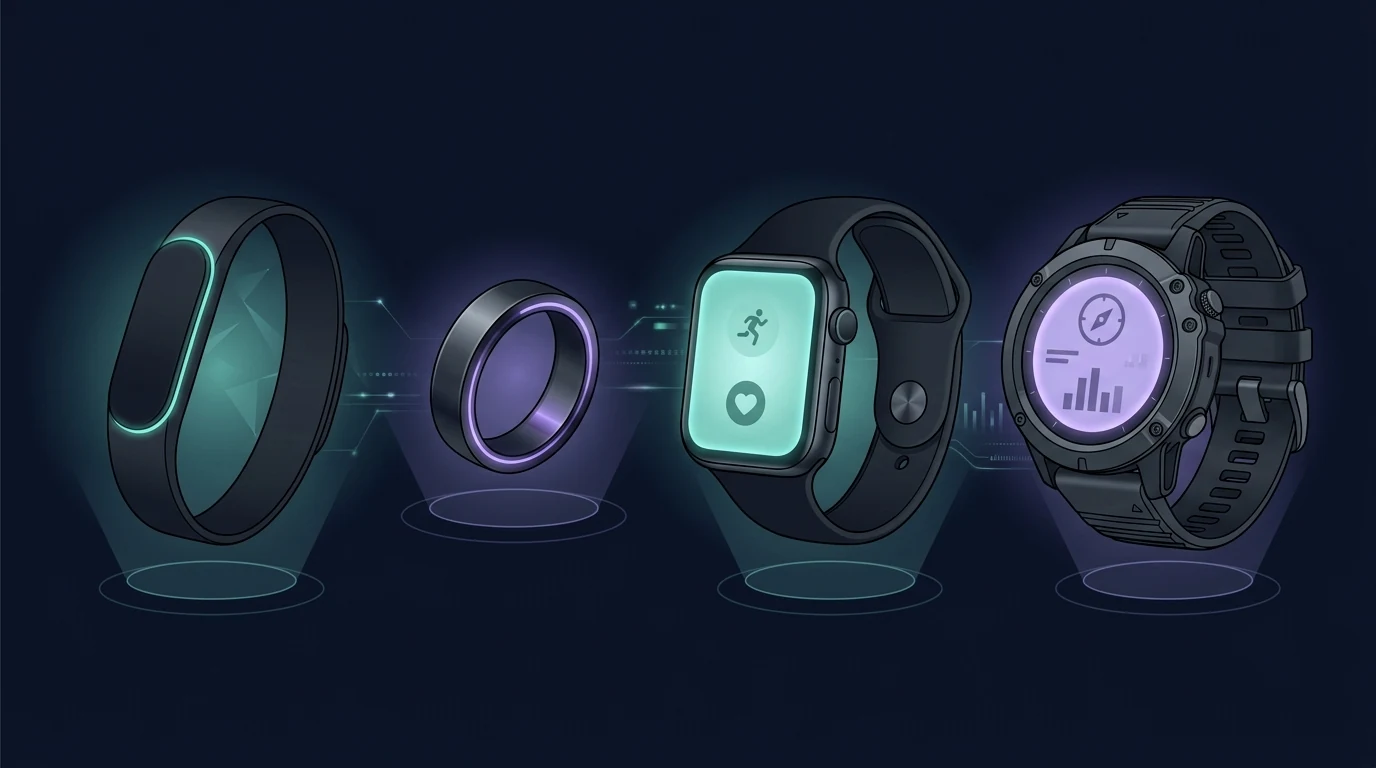
Recovery tracking has become the headline feature of the wearable market, and WHOOP, Oura, Apple Watch, and Garmin all promise to tell you how recovered you are each morning. They do it in genuinely different ways, with different sensors, different form factors, and different proprietary scores. This comparison focuses on the thing that actually matters for recovery: how accurately each device captures the raw signals, how it turns them into guidance, and who each one suits.
One honest framing up front. A recovery wearable is a monitoring tool, not a training plan. The research on HRV-guided training shows only small fitness gains over a well-designed fixed plan, so no device on this list will make you fitter by itself. What a good one does is give you a reliable trend to inform small adjustments. We cover why the scores diverge in why recovery scores differ between devices, and what the underlying HRV number means in our heart rate variability training research.
Quick Comparison
| Factor | WHOOP 4.0 | Oura Ring | Apple Watch | Garmin |
|---|---|---|---|---|
| Form factor | Screenless wrist/bicep band | Smart ring | Full smartwatch | Sport GPS watch |
| Recovery metric | Recovery % (0 to 100) | Readiness score (0 to 100) | No unified score (Vitals + third-party apps) | Body Battery + Training Readiness |
| Overnight HRV accuracy* | Good (CCC ~0.94) | Best (CCC ~0.97 to 0.99) | Fair from wrist (~29% error) | Moderate (CCC ~0.87) |
| Resting HR accuracy* | Good | Best | Good | Good |
| Sleep staging | Solid | Among the best | Among the best (per Schyvens 2025) | Weaker in testing |
| VO2max estimate | Limited | Basic (via workouts) | Yes (~13% error) | Yes, most detailed (best with chest strap) |
| Built-in GPS | No | No | Yes | Yes (best in class) |
| Display | None | None | Full touchscreen | Full display |
| Battery life | ~4 to 5 days | ~4 to 7 days | ~1 to 2 days | ~7 to 20+ days |
| Cost model | Membership-based | Device plus membership for full insights | One-time hardware purchase | One-time hardware purchase |
| Best for | Recovery-first, no distractions | Accuracy, sleep, ring wearers | All-rounders in the Apple ecosystem | Endurance and multi-sport athletes |
*Overnight HRV and resting heart rate accuracy figures from Dial et al. (2025), validated against ECG across 536 nights. Apple Watch wrist HRV error from O'Grady et al. (2024). Sleep staging from Schyvens et al. (2025). Battery and form-factor details reflect current generations and vary by model.
The Core Difference
The four devices split cleanly along two axes: form factor and focus. WHOOP and Oura are recovery-first devices that strip away the smartwatch and concentrate on 24/7 physiological monitoring. Apple Watch and Garmin are watches first, with recovery features layered onto a broader device.
WHOOP is the purist. No screen, no notifications, nothing to check on your wrist except through the app. It is built around one loop: measure strain, measure recovery, guide tomorrow. Oura takes the accuracy crown by moving the sensor to your finger, where the optical signal is cleaner, and adds body temperature for illness and cycle tracking. Apple Watch is the connected all-rounder: excellent general smartwatch, good sleep, but weaker raw HRV from the wrist and no single recovery number. Garmin is the athlete's tool, with the deepest training-load, VO2max, and GPS features of the group, though its ring-level HRV accuracy sits in the middle of the pack.
Where Each Device Wins
Oura: accuracy and sleep
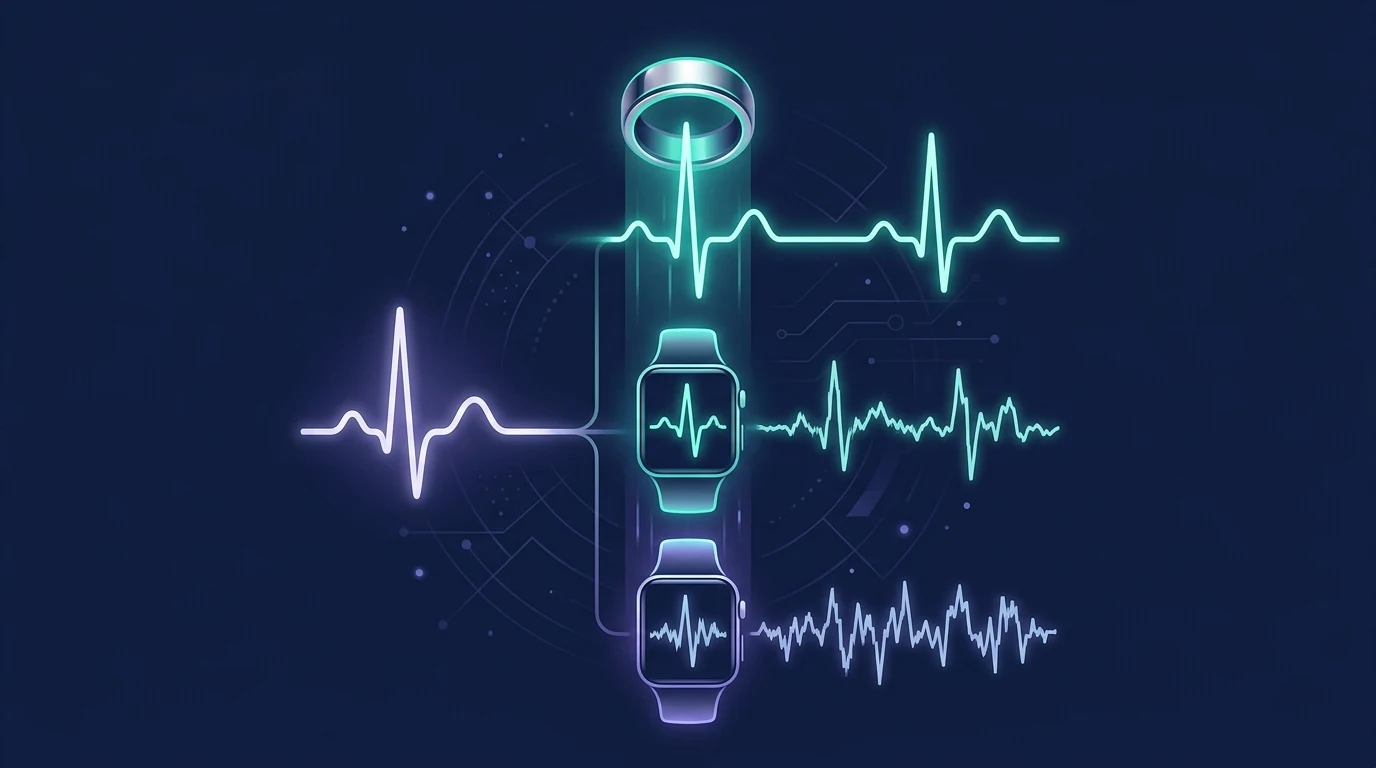
Oura's ring form factor gives it the cleanest optical signal of the group. In Dial et al. (2025), Oura Gen 4 and Gen 3 tracked overnight HRV within about 6 to 7 percent of ECG, the best of the five devices tested, and resting heart rate within about 2 percent. Independent sleep-staging work also ranks Oura among the most accurate consumer trackers. If your priority is trustworthy raw data and sleep detail, and you like a ring, Oura leads.
WHOOP: recovery focus and no distractions
WHOOP does one job and does it well. Its Recovery percentage is a clean, HRV-weighted single number, and its HRV accuracy was solid in Dial et al. (2025), just behind Oura. Because it has no screen, it is the least distracting device here, which some people strongly prefer. It is the natural pick for someone who wants a recovery-and-strain coach without another notification machine on their wrist.
Apple Watch: the all-rounder
The Apple Watch is the best general-purpose device and a capable health tracker. Its sleep-staging performance was among the best in Schyvens et al. (2025), and its Vitals feature flags overnight metrics outside your normal range. Its weakness is raw HRV from the wrist: O'Grady et al. (2024) found about 29 percent error versus a chest strap, and its VO2max carries roughly 13 percent error (Lambe et al., 2025). Great if you want one device for everything and live in the Apple ecosystem.
Garmin: endurance and training tools
Garmin owns the serious-athlete niche. Body Battery, Training Readiness, Training Load, race predictors, and best-in-class multi-sport GPS make it the deepest training toolkit here. Its VO2max is the most detailed, especially paired with a chest strap. The trade-off: its overnight HRV accuracy (CCC ~0.87 in Dial et al.) and its sleep staging trailed the leaders. Best for runners, cyclists, and triathletes who want training analytics more than pure recovery accuracy.
Where Each Device Falls Short
Being honest about the weaknesses matters more than the marketing:
- WHOOP: no screen means no glanceable data or watch features, and it is entirely membership-dependent, so it stops being useful if you stop paying.
- Oura: a ring cannot show workout metrics live, has no GPS, and can be awkward for heavy lifting; full insights sit behind an ongoing membership.
- Apple Watch: the weakest raw HRV of the group from the wrist, short battery life that complicates overnight tracking, and no single recovery score without third-party apps.
- Garmin: mid-pack HRV and sleep-staging accuracy, and the depth of data can overwhelm people who just want a simple recovery signal.
See what FitCraft would build for you
FitCraft, our mobile fitness app, pairs you with an AI coach who builds you a personalized plan around your goals, schedule, and fitness level. Every FitCraft program is designed by Domenic Angelino, MPH (Brown University) and NSCA-CSCS, with research published in the Journal of Strength and Conditioning Research and Medicine & Science in Sports & Exercise.
Take the Free Assessment Free • 2 minutes • No credit cardWhich Device Should You Choose?
Choose Oura if you want the most accurate overnight HRV and sleep data, you like a ring, and body-temperature or cycle tracking appeals to you. It is the accuracy-and-sleep pick.
Choose WHOOP if you want a recovery-and-strain coach with zero screen distraction and you are comfortable with a device that lives entirely in its app. It is the recovery-purist pick.
Choose Apple Watch if you want one device that does everything, you are in the Apple ecosystem, and recovery is one feature among many rather than your whole reason for buying. It is the all-rounder.
Choose Garmin if you are a runner, cyclist, or triathlete who wants deep training analytics, long battery life, and best-in-class GPS, and you value training-load tools over pure HRV precision. It is the endurance-athlete pick.
Where a Wearable Ends and a Plan Begins
Here is the part the device marketing skips. A recovery tracker tells you how you are recovering. It does not tell you what to do, and it will not make you consistent. Plenty of people buy a WHOOP or an Oura, obsess over the daily score for a month, and still never build a training habit that sticks. The number is not the plan.
That is a different job, and it is where an app-based coach fits. FitCraft builds you a structured, multi-week program around your goals, schedule, and fitness level, with progression and recovery built into the plan itself, and an AI coach that adapts the program as you advance. If you also wear a recovery tracker, the research-supported way to combine them is to use your device's rolling weekly trend as one input for small adjustments, not as a daily on-off switch. The wearable measures. The plan is what you actually follow.
The Bottom Line
For raw recovery accuracy, Oura leads, WHOOP is close, Apple Watch is the versatile all-rounder, and Garmin is the endurance specialist. No device wins outright, and none of their proprietary recovery scores has independent validation as "most accurate," so buy for form factor and focus, then commit to one device and follow its trend. And remember the ceiling: a tracker is a monitor, not a coach. The consistency that actually changes your fitness comes from a plan you follow, not a score you check.
Frequently Asked Questions
Which wearable is most accurate for HRV and recovery?
For the raw signals that drive recovery, finger rings lead. Dial et al. (2025) validated five devices against ECG across 536 nights and found Oura Gen 4 and Gen 3 tracked overnight HRV most closely (concordance around 0.97 to 0.99), with WHOOP 4.0 acceptable and wrist watches less consistent. No independent study has crowned any brand's overall recovery score as most accurate, because those scores are proprietary. For accurate raw HRV during sleep, Oura and WHOOP have the edge.
Is Oura or WHOOP better for recovery?
Both are strong recovery-first devices with a clean single morning score. Oura is a ring, validated as the most accurate for overnight HRV, and adds body temperature and a readiness score. WHOOP is a screenless wrist or bicep band built entirely around recovery and strain, with strong HRV accuracy just behind Oura. Choose Oura if you prefer a ring and want temperature tracking; choose WHOOP if you want a training-strain focus and do not mind a device with no display.
Can an Apple Watch track recovery like WHOOP?
Partly. The Apple Watch measures HRV and resting heart rate and, with third-party apps or the Vitals feature, can flag when your overnight metrics are outside your normal range. But its wrist HRV is less accurate than a ring (O'Grady et al. 2024 found about 29 percent error versus a chest strap), and it does not produce a single unified recovery score out of the box. It is a capable all-rounder, not a dedicated recovery tracker.
Do I need a wearable to train well?
No. A wearable can add a useful recovery trend, but the biggest driver of results is simply training consistently with a sensible plan. The research on HRV-guided training shows only small fitness gains over a well-designed fixed plan. If you are choosing between spending on a device and building a consistent routine, the routine matters far more. A free app-based plan you actually follow beats an expensive tracker you check anxiously.