Quick Facts: Back Extensions
- Equipment needed: None for the floor version (mat optional). Roman chair / 45-degree back extension bench for the advanced variation.
- Difficulty: Beginner (floor) to Advanced (weighted Roman chair).
- Modality: Bodyweight, controlled dynamic spinal extension. Isolation pattern; not a hip hinge.
- Body region: Posterior chain (lower back, glutes, hamstrings).
- FitCraft quest category: Core & Posture Strength.
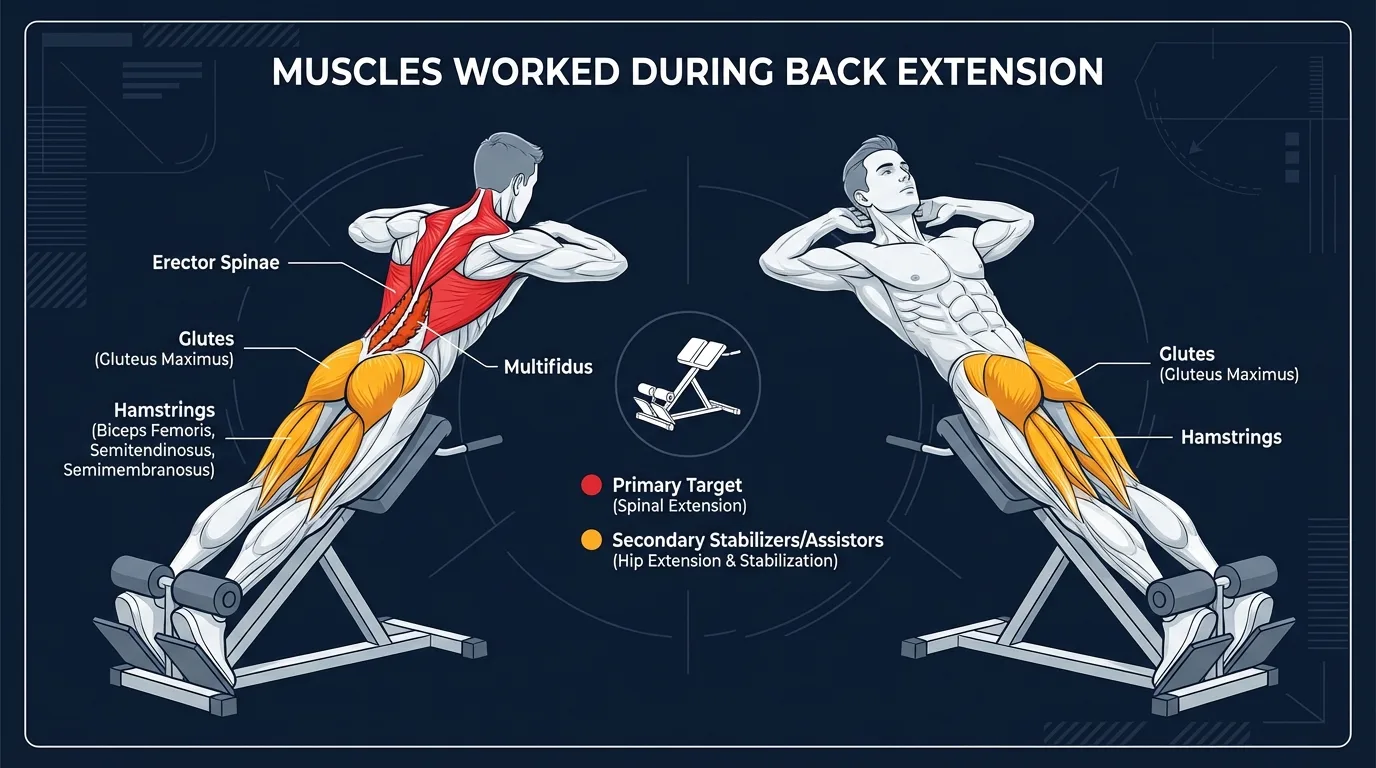
Muscles Worked
Primary movers. The erector spinae group (spinalis, longissimus, and iliocostalis) runs in three vertical columns from the sacrum to the base of the skull. In a back extension, these muscles contract concentrically to lift your chest off the floor and eccentrically to lower it back down with control. Both phases build strength; the slow descent is where most of the connective-tissue adaptation happens.
Secondary movers. The gluteus maximus extends the hip and is the partner muscle that takes pressure off the lumbar spine when you cue "glutes first." The hamstrings (biceps femoris, semitendinosus, semimembranosus) contribute lightly by stabilizing the hip and assisting with extension, especially in the Roman chair variation where the hip is also moving.
Stabilizers. The deep spinal stabilizers (multifidus and quadratus lumborum) fire isometrically to control segmental movement and prevent the lumbar spine from collapsing into hyperextension. The transverse abdominis braces the front of the trunk, and the diaphragm coordinates with the breath. The legs press into the floor to anchor the pelvis.
Evidence and mechanism. A 2015 study in the Journal of Physical Therapy Science trained chronic low back pain patients in regular back extension exercises and observed a 47% reduction in pain scores plus measurable gains in functional capacity over 8 weeks (Ko et al., 2015). A 2006 study in Physical Therapy reached a similar conclusion: lumbar extensor strengthening improved functional outcomes and reduced disability in chronic low back pain patients (Hides et al., 2006). The mechanism is straightforward: the erector spinae act like guy-wires for the spine, and stronger guy-wires mean less load passes through passive structures (discs, ligaments, facet joints) during everyday bending and lifting.
How to Do a Back Extension (Step-by-Step)
- Lie face down. Get on the floor or a mat with your legs extended straight behind you, toes pointing down. Place your fingertips lightly behind your ears with elbows pointing out to the sides. If that's too challenging, cross your arms over your chest or extend them along your sides. Keep your forehead hovering just above the mat.
Coach Ty's cue: "Breathe in here. The prone position makes breathing feel awkward, so set the rhythm before you start moving." - Lift your chest off the floor. Squeeze your glutes first, then engage your lower back muscles to slowly lift your chest and upper torso off the ground. The lift comes from your spinal erectors, not from pushing with your hands. Keep your neck in a neutral position by looking at the floor a few feet ahead of you. Lift until you feel a strong contraction in your lower back, but stop before you feel pinching or compression.
Coach Ty's cue: "Glutes first, then back. Every rep. Firing the glutes first stabilizes the pelvis and takes pressure off the lumbar spine." - Hold briefly at the top. Pause for 1-2 seconds at the peak. You should feel the contraction running from your lower back through your glutes. Don't try to set a height record; controlled contraction matters more than range of motion here. Your hip bones stay on the floor throughout.
Coach Ty's cue: "Think long, not high. Imagine someone gently pulling your head forward and up at a 45-degree angle." - Lower with control. Take 2-3 seconds to lower your torso back down. Don't just flop. The slow descent is where your erectors build endurance and control. Touch down lightly and go directly into the next rep without fully relaxing.
Coach Ty's cue: "The eccentric is the exercise. If you're dropping back down, you're skipping half the work."
Get this exercise in a personalized workout
FitCraft, our mobile fitness app, uses its AI coach Ty to program mobility work like this into your plan at the right volume and intensity, based on your level, goals, and equipment. Ty was designed and trained by Domenic Angelino, MPH (Brown University) and NSCA-CSCS, with research published in the Journal of Strength and Conditioning Research and Medicine & Science in Sports & Exercise.
Take the Free Assessment Free · 2 minutes · No credit card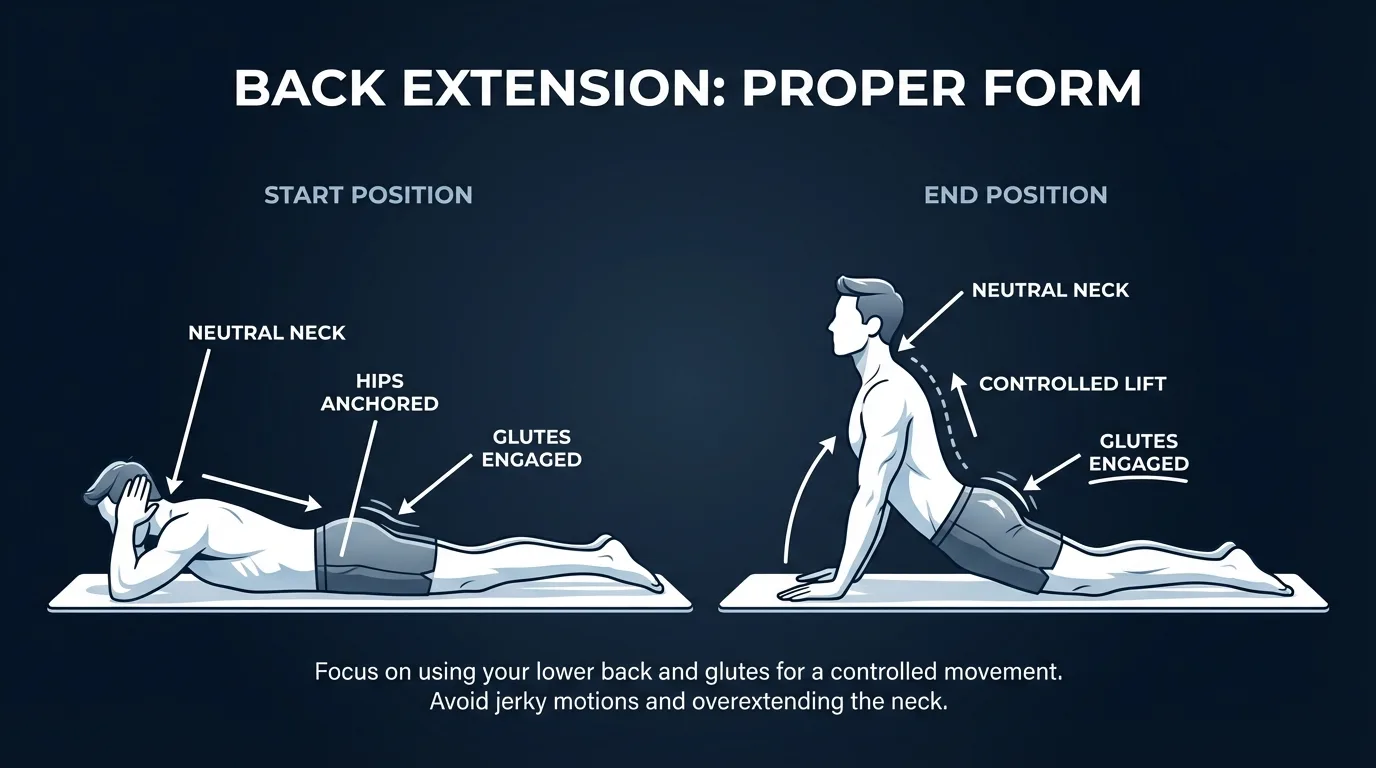
Common Mistakes to Avoid
- Hyperextending at the top. Cranking your back into a deep arch compresses the lumbar discs and facet joints. The back extension is not a flexibility test. Lift to the point of strong muscular contraction and stop. If you're going higher than about 30 degrees off the floor, you've gone too far.
- Yanking the head up. Leading with the chin strains the neck and creates a false sense of range. Your neck stays neutral throughout. Pick a spot on the floor ahead of you and keep looking at it for the entire rep.
- Using arm momentum. If your hands are behind your head and you're pulling your head forward to initiate the lift, your arms are doing the work. Fingertips touch the head lightly and provide zero pulling force. If you can't lift without pulling, cross your arms over your chest instead.
- Rushing through reps. Speed kills the exercise's effectiveness. Fast reps use momentum and bypass the muscles you're actually trying to train. Every rep should take about 4-5 seconds total: 2 seconds up, 1-second hold, 2 seconds down.
- Forgetting to breathe. The prone position makes breathing feel awkward, and people hold their breath without realizing it. Exhale as you lift, inhale as you lower, and keep the rhythm going for the whole set.
- Letting the feet fly up. If your feet are leaving the mat as you lift your chest, you're using momentum and losing the isolation. Press the tops of your feet into the mat. The legs stay quiet.
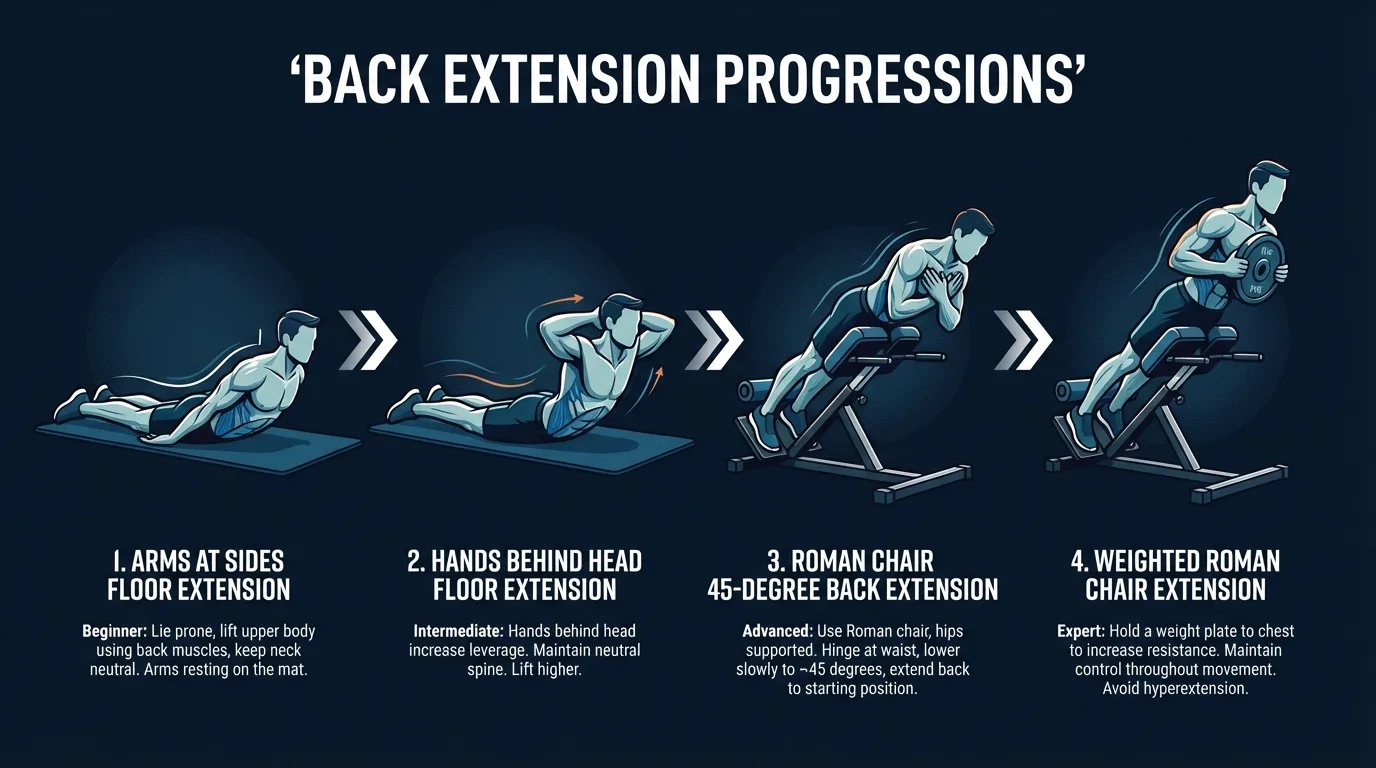
Variations: From Floor to Roman Chair
Arms at Sides (Beginner)
Keep your arms along your body with palms facing up. This shortens the lever arm and makes the lift easier. It's the best starting point if you can't complete 10 reps with hands behind your ears. Focus on squeezing the glutes and controlling the tempo.
Hands Behind Head (Beginner-Intermediate)
The standard version described above. Fingertips behind the ears, elbows wide. This lengthens the lever arm and increases demand on the erectors. Most people should aim to master 3 sets of 15 here before progressing.
Roman Chair / Back Extension Bench (Intermediate-Advanced)
If you have access to a gym, the 45-degree back extension bench changes the game. Your hips are supported on the pad, legs locked in, and you hinge forward and extend back against gravity through a much larger range of motion. This version loads the erectors meaningfully more than the floor version. It's a staple in serious strength programs for a reason.
Weighted Back Extension (Advanced)
Hold a weight plate against your chest on the Roman chair. Start light. Even 10 lbs changes the difficulty dramatically. This is how you build real lower back strength that transfers to deadlifts, squats, and heavy carries.
Alternative Exercises
- Superman hold: Lifts both arms and legs simultaneously. More total body engagement but harder to progressively load. Good complement, not a replacement.
- Bird dog: Trains spinal extension with anti-rotation. Lower intensity but excellent for building stability and motor control in the core.
- Glute bridge: Targets the glutes from a supine position. Pairs well with back extensions for complete posterior chain work without equipment.
When to Avoid or Modify Back Extensions
Back extensions are safe for most healthy adults and are often used in lower back rehab protocols. A few conditions warrant modification or medical clearance. Always consult your physician or a physical therapist before starting or returning to any exercise program, especially if any of these apply.
- Diagnosed disc herniation or active radiculopathy. Some disc pathologies respond well to extension (the McKenzie approach is built on this), but others worsen with extension. The only safe path is a personal exam by a spine specialist or PT. Don't self-prescribe.
- Acute lower back pain. Wait for the acute phase to settle before loading the area. Substitute with bird-dogs and deadbugs, which build deep-core stability without aggressive spinal loading.
- Spinal stenosis. Extension narrows the spinal canal and often reproduces symptoms in people with stenosis. Flexion-bias exercises are usually better tolerated. Consult your physician.
- Spondylolisthesis (any grade). Loaded extension can worsen vertebral slippage. Get specific clearance and exercise selection from a spine PT.
- Pregnancy (second and third trimesters). Prone positions become uncomfortable and can compress the abdomen. Substitute with quadruped exercises like bird-dogs or standing posterior-chain work.
- Recent abdominal surgery or active hernia. The prone position and trunk extension can place uncomfortable pressure on healing or weakened tissue. Wait for surgical clearance.
If you're not in any of these categories but the movement still reproduces pain, dial back the range first. A two-inch lift with a strong glute squeeze is a productive rep. You don't need height to get the work.
Related Exercises
- Same plane, isometric extension: Superman holds work the same posterior-chain pattern as a sustained hold instead of dynamic reps.
- Anti-extension foundation: Deadbugs teach you to brace against extension under load, which translates directly into controlling the top of every back extension.
- Anti-rotation foundation: Bird-dogs build segmental spinal control in a quadruped position and are a near-universal starting point for back rehab.
- Glute partner: Glute bridges hit the same posterior chain from a supine position and pair naturally with back extensions in a beginner-friendly circuit.
- Anterior balance: Forearm planks provide the anterior-core counterpart to back extensions; the two together build balanced front-to-back trunk strength.
- Loaded carryover: Dumbbell deadlift is the compound hip hinge that back extensions feed directly into; stronger erectors mean a safer, more controlled deadlift.
How to Program Back Extensions
Programming for the back extension follows the resistance-training principles in the ACSM Position Stand on Resistance Training (Ratamess et al., 2009): progress volume and intensity gradually, leave a rep or two in reserve, and recover adequately between sessions. Because the floor variation is bodyweight only, most people can train it more frequently than a heavily loaded compound lift.
| Level | Sets × Reps | Rest between sets | Frequency |
|---|---|---|---|
| Beginner | 2-3 × 10-12 (arms at sides or crossed over chest) | 45-60 seconds | 2-3 sessions/week |
| Intermediate | 3 × 12-15 (hands behind head, 2-3 sec top hold) | 60 seconds | 3-4 sessions/week |
| Advanced | 3-4 × 10-15 (Roman chair, weighted as needed) | 60-90 seconds | 2-4 sessions/week |
Where in your workout. Beginners can use back extensions as a warm-up activation before squats or deadlifts (a couple of light sets to wake up the erectors and glutes) or as a finisher after a pulling session. Intermediates often slot them into a posterior-chain circuit with glute bridges and bird-dogs. Advanced lifters use the Roman chair variation as accessory work after the main compound lifts to add posterior-chain volume without further taxing the spine the way more deadlifts would.
Form floor over rep targets. If your form breaks down (hyperextending, yanking the head, losing the glute squeeze), stop the set. A clean set of 8 is more productive than a sloppy set of 15. As you fatigue, the temptation is to chase reps with momentum; that's exactly when the lumbar spine takes the load you wanted the muscles to take.
Frequently Asked Questions
Can I do back extensions if I have lower back pain?
For many people with mild, non-specific lower back discomfort, controlled bodyweight back extensions can actually help by strengthening the erector spinae and glutes that support the spine. A 2015 study in the Journal of Physical Therapy Science found that regular back extension exercises reduced chronic low back pain scores by 47% over 8 weeks (Ko et al., 2015). But if you have a diagnosed disc herniation, acute pain, radiating leg pain (sciatica), spinal stenosis, or any condition where extension reproduces your pain, stop and consult a physical therapist or your physician before progressing. Start with a tiny range of motion, prioritize the glute squeeze, and never push into discomfort.
What muscles do back extensions work?
Back extensions primarily target the erector spinae group (spinalis, longissimus, iliocostalis) that runs along your spine. The glutes assist as a secondary mover by extending the hip during the lift. The hamstrings contribute lightly, especially in the Roman chair variation. The deep spinal stabilizers (multifidus, quadratus lumborum) and the transverse abdominis fire isometrically to control the position. It's one of the most accessible posterior chain exercises you can do with no equipment.
How many back extensions should I do per week?
Most people benefit from 2-3 sets of 10-15 repetitions, performed 2-3 times per week. Beginners should start with fewer reps and focus on form. Daily training isn't necessary; the erector spinae respond well to moderate frequency with adequate recovery between sessions. Per the ACSM Position Stand on Resistance Training (Ratamess et al., 2009), 2-4 sessions per week is the productive frequency window for most adults training a given muscle group.
Can back extensions replace deadlifts?
Not exactly. Both train the posterior chain, but deadlifts are a compound hip hinge that loads the entire body under heavy resistance. Back extensions isolate the spinal erectors and glutes with lighter loads. They complement each other well; back extensions are excellent for building the lumbar endurance and control that makes deadlifts safer.
What's the difference between a back extension and a Superman hold?
In a back extension, only the upper body lifts while the legs stay on the ground. In a Superman hold, both the arms and legs lift off the floor simultaneously and the position is held isometrically. Back extensions allow more controlled loading and are generally better for progressive strengthening. Superman holds demand more total body coordination and bias toward endurance and stability.