Plank twists, also called plank hip dips, add controlled rotation to a standard forearm plank. The base position trains anti-extension. The twist adds rotational control, which is why your obliques light up fast.
The exercise works best when it stays small and precise. Your hips dip toward the floor, your shoulders stay quiet, and your spine stays long. If the set turns into rocking, rushing, or sagging, you have gone past the useful range.
Quick Facts: Plank Twists
- Equipment needed: None (mat optional)
- Difficulty: Intermediate to Advanced
- Modality: Core strength
- Body region: Core, shoulders, and hips
- FitCraft quest category: Core
Muscles Worked
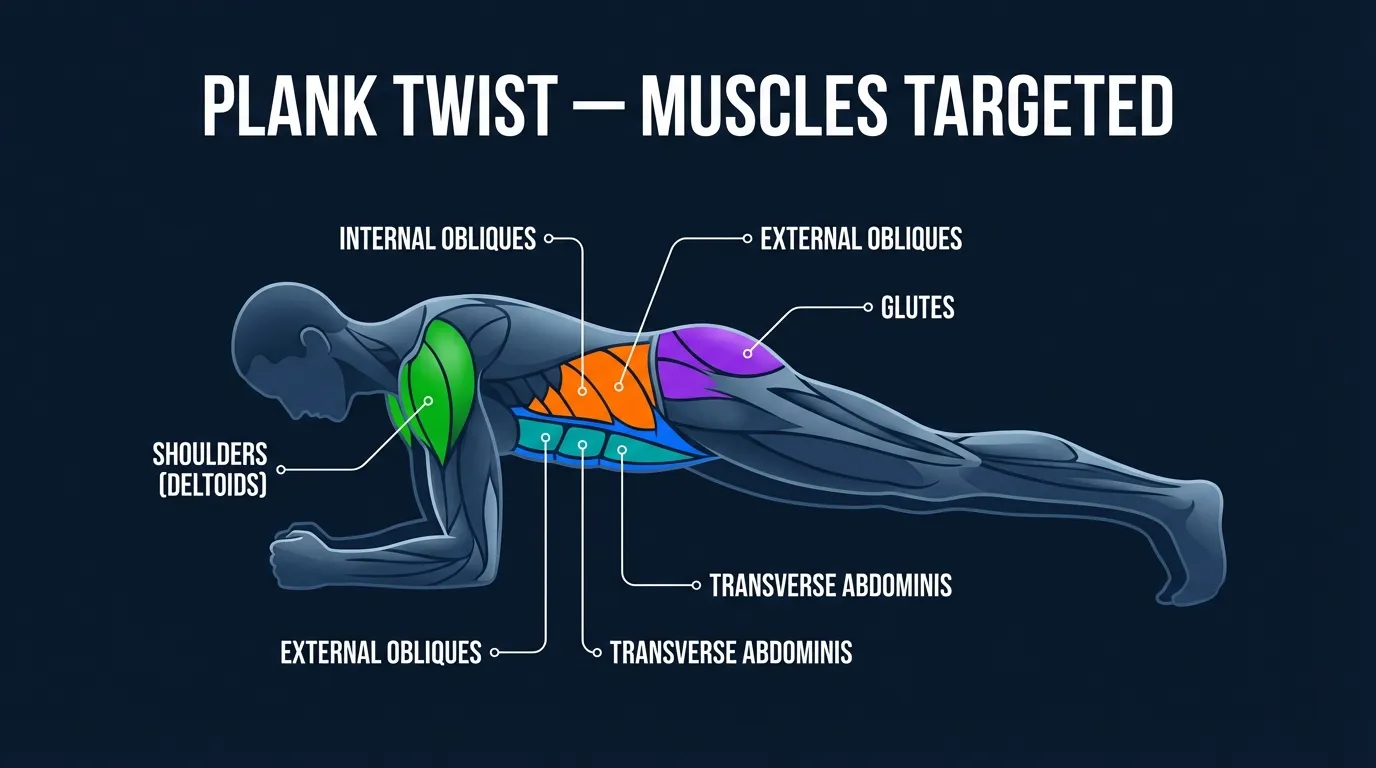
Primary movers: the internal and external obliques drive and control the side-to-side hip dip. The rectus abdominis and transverse abdominis help keep the front of the trunk braced as the hips rotate. During each twist, these muscles shorten slightly as you pull back toward center and lengthen under tension as you lower toward the floor.
Secondary movers: the hip flexors and quadriceps help keep the legs long and steady. The serratus anterior, anterior deltoids, and rotator cuff help keep the shoulders stacked over the elbows while the lower body moves underneath you.
Stabilizers: the glutes, spinal erectors, diaphragm, and pelvic floor all work isometrically to keep the pelvis from dropping into lumbar extension. Your breath matters here. Exhaling during the twist reinforces transverse abdominis activation and helps you control intra-abdominal pressure without bearing down.
Mechanism: plank twists combine an anti-extension plank with controlled trunk rotation. The useful training stimulus comes from resisting collapse while moving the pelvis through a small arc. A shorter, cleaner twist does more for core control than a big hip drop that pulls the shoulders out of position.
Step-by-Step: How to Perform Plank Twists
Step 1: Set Up in a Forearm Plank
Place your forearms on the floor with elbows directly under your shoulders. Extend your legs behind you, set your feet about hip-width apart, and make a straight line from head to heels.
Coach Ty's cue: "Elbows under shoulders. Ribs down. Make the plank quiet before you add the twist."
Step 2: Brace Your Core and Glutes
Tighten your abs like you are about to cough. Squeeze your glutes enough to keep your pelvis from dumping forward, and press both forearms firmly into the floor.
Coach Ty's cue: "Lock the middle first. The twist only works if the plank is stable."
Step 3: Lower One Hip Toward the Floor
Rotate your hips to the left and lower the left hip toward the floor. Stop before the hip touches. Keep both shoulders square and stacked over your elbows.
Coach Ty's cue: "Dip the hip, but keep your chest facing the floor."
Step 4: Pull Back to Center
Use your obliques to return your hips to the starting plank. Pause for a beat at center so you can rebuild the brace before the next side.
Coach Ty's cue: "Own the middle. Do not bounce through it."
Step 5: Rotate to the Other Side
Lower your right hip toward the floor with the same range of motion. One controlled dip left and one controlled dip right equals one full rep.
Coach Ty's cue: "Match both sides. Same depth, same speed."
Step 6: Continue Without Losing the Plank
Alternate sides for the target reps. Exhale on each twist, inhale as you return to center, and end the set as soon as your hips sag or your shoulders start to rock.
Get this exercise in a personalized workout
FitCraft, our mobile fitness app, uses its AI coach Ty to program core stability work like this into your plan at the right volume and intensity, based on your level, goals, and equipment. Ty was designed and trained by Domenic Angelino, MPH (Brown University) and NSCA-CSCS, with research published in the Journal of Strength and Conditioning Research and Medicine & Science in Sports & Exercise.
Take the Free Assessment Free • 2 minutes • No credit card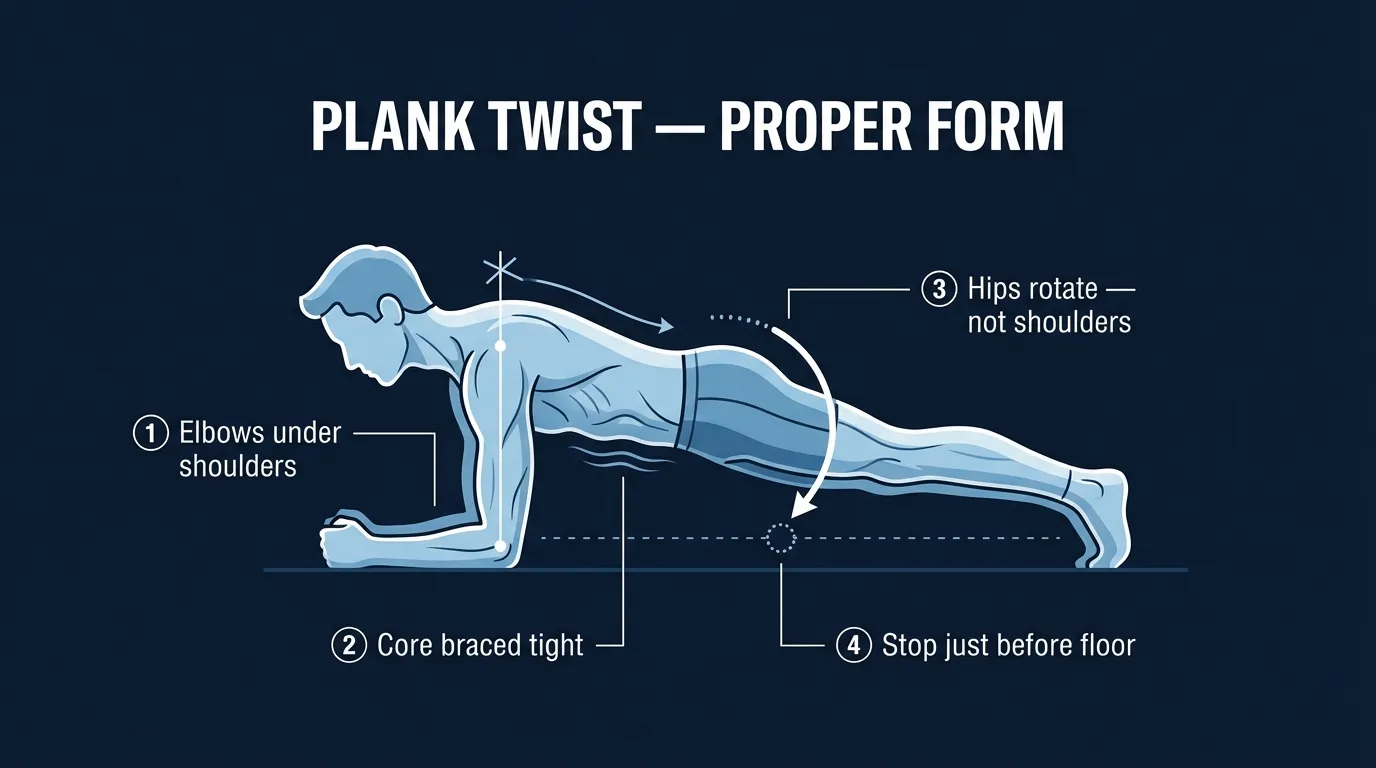
Common Mistakes (and How to Fix Them)
- Letting the hips sag between reps. Once the pelvis drops, your lower back starts taking the load. Fix it by squeezing your glutes and shortening the set before form breaks.
- Piking the hips too high. Lifting your hips shifts the demand away from the abs. Reset to a straight head-to-heel line at the top of every rep.
- Rocking through the shoulders. Your shoulders should stay quiet while the hips move. Press your forearms down and reduce the twist range until the upper body is stable.
- Touching the floor at the bottom. Resting the hip on the floor removes tension. Hover close to the floor, then pull back to center with control.
- Rushing the reps. Fast twists usually become momentum. Use a steady tempo and make each side match.
- Holding your breath. Breath-holding can spike pressure and make the set feel unstable. Exhale into the twist, then inhale at center.
Plank Twist Variations: Regressions and Progressions
Pick the version that lets you keep a clean plank. The right variation is the one you can control.
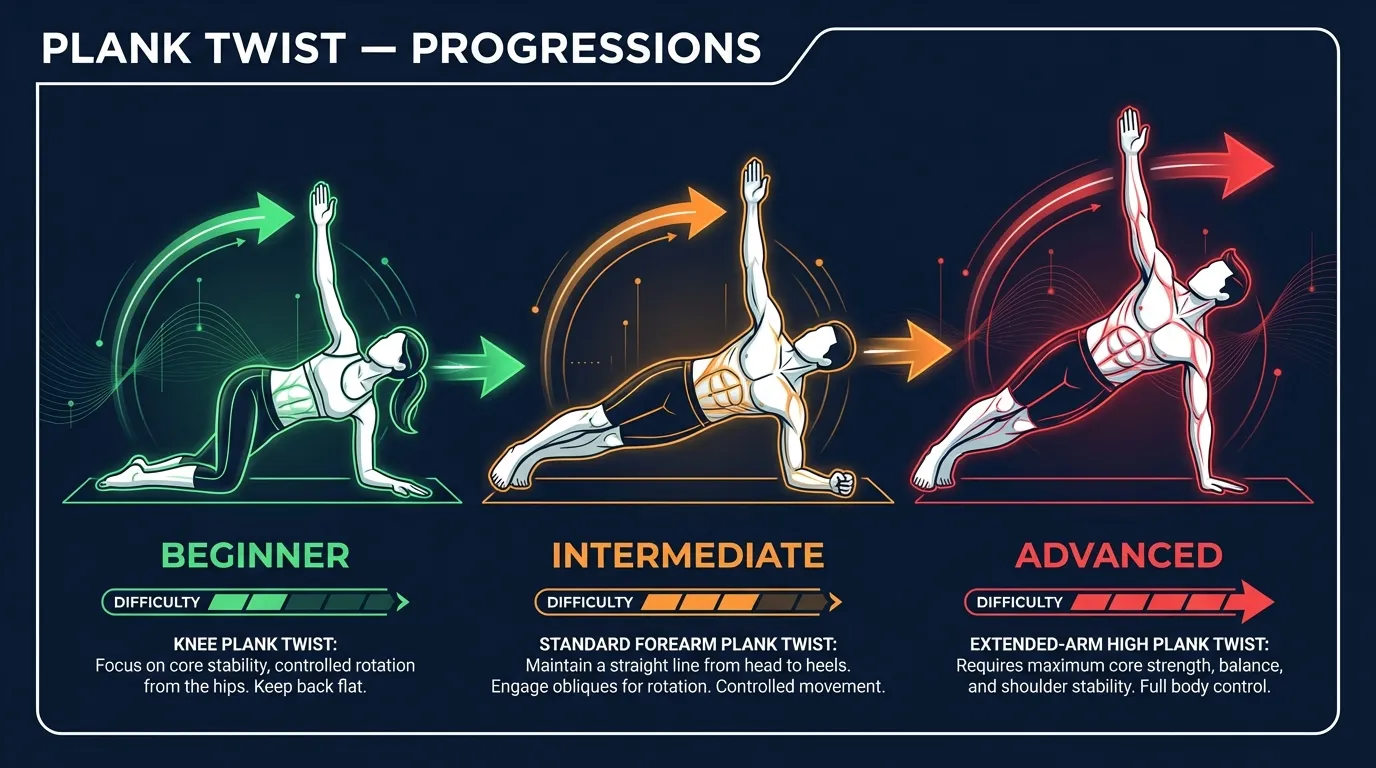
Knee Plank Twist (Beginner Regression)
Do the movement from your knees instead of your toes. This shortens the lever arm and reduces the load on your core and shoulders. Use it if you cannot yet hold a clean forearm plank for 30 seconds.
Reduced-Range Plank Twist (Skill Builder)
Dip the hip only a few inches to each side. This keeps the shoulders stable while you learn how to rotate from the pelvis without collapsing through the lower back.
Slow-Tempo Plank Twist (Intermediate)
Use a 2-second lower and a 1-second pause near the bottom. The slower tempo increases time under tension and makes every rep easier to audit.
Extended-Arm Plank Twist (Advanced)
Do the same hip dip from a high plank on your hands. This increases shoulder and wrist demand, so build the base with hand planks first.
Weighted Plank Twist (Advanced)
Use a light weighted vest only after bodyweight reps are clean. Keep the load modest. Extra weight magnifies every small plank fault.
When to Avoid or Modify Plank Twists
Plank twists are safe for most healthy adults, but the combination of bracing and rotation means a few situations call for a smaller range, an easier variation, or a different core exercise. Always consult your physician or physical therapist for personalized guidance.
- Acute lower-back pain or known disc pathology. Rotation under fatigue can aggravate the lumbar spine. Swap in forearm planks, deadbugs, or bird-dogs until you can brace pain-free.
- First 6-8 weeks postpartum or active diastasis recti. Rotational plank work can increase abdominal wall strain. Rebuild deep-core control first with breathing drills, deadbugs, and bird-dogs, then return with the knee variation.
- Recent abdominal surgery or hernia repair. Get medical clearance before returning to loaded bracing. Start with gentle breathing, bracing, and short forearm plank holds before adding hip rotation.
- Shoulder or elbow pain in the forearm plank. The supporting arm position has to be comfortable before the twist matters. Use a shorter set, add padding under the elbows, or choose deadbugs if weight-bearing bothers the joint.
- Pregnancy in the second or third trimester. Prone plank positions often become uncomfortable, and rotational bracing can raise pressure through the abdominal wall. Use standing core work, side-lying options, or clinician-approved prenatal modifications.
- Pelvic-floor symptoms or pelvic-organ prolapse. High-pressure bracing can worsen symptoms. Keep the effort low, avoid breath-holding, and work with a pelvic-floor physical therapist.
Related Exercises
If plank twists fit your routine, these exercises build the same core qualities from easier, stricter, or more advanced angles:
- Easier anti-extension base: Forearm Planks teach the exact bracing position plank twists depend on.
- Foundational deep-core control: Deadbugs and Bird-Dogs build spinal control with less shoulder loading.
- Oblique endurance: Side Planks train the lateral trunk in a static position before you add dynamic rotation.
- Rotational core strength: Russian Twists train rotation from a seated position with less demand on the shoulders.
- Dynamic plank progression: Spider Planks and Mountain Climbers add hip movement from a plank while changing the angle and tempo.
- Glute support for bracing: Glute Bridges strengthen hip extension, which helps keep the pelvis from sagging during planks.
How to Program Plank Twists
Plank twists are a dynamic core exercise, so program them with the same progression logic used for resistance training: start with controlled volume, add reps only while technique holds, and keep enough rest to avoid form breakdown. The ACSM Position Stand on resistance training covers progressive overload, rest, and frequency across training levels (Ratamess et al., 2009).
| Level | Sets × Reps | Rest between sets | Frequency |
|---|---|---|---|
| Beginner (knee or reduced range) | 2-3 × 8-12 per side | 45-60 seconds | 2-4 sessions/week |
| Intermediate (standard) | 3 × 10-20 per side | 45-60 seconds | 3-5 sessions/week |
| Advanced (slow tempo or light load) | 3-4 × 15-30 per side | 60 seconds | 4-6 sessions/week |
Where in your workout: place plank twists near the end of a resistance-training session or inside a dedicated core block. Doing high-fatigue rotational core work before squats, deadlifts, or loaded presses can make bracing worse when you need it most.
Form floor over rep targets: stop the set when the plank changes. Sagging hips, shoulder rocking, breath-holding, or uneven range of motion means the useful reps are done.
How FitCraft Programs This Exercise
Knowing how to do plank twists is one piece. Knowing when to use them, when to regress them, and when to swap them for a quieter core drill is where programming matters.
During your personalized diagnostic assessment, FitCraft maps your level, goals, training history, and available equipment. Ty then slots core stability work into a balanced plan at a variation you can control. That might mean forearm planks and deadbugs first, knee plank twists next, then standard or slow-tempo plank twists once your bracing is solid.
As you get stronger, Ty adjusts the variation and volume to match your level. Every program is designed by an Ivy League-trained exercise scientist and NSCA-certified strength coach using evidence-based periodization, then adapted to you by the AI.
Frequently Asked Questions
Can I do plank twists if I have lower-back pain?
Do not push through sharp, radiating, or worsening lower-back pain during plank twists. The exercise adds rotation to a braced plank, so poor control can irritate the lumbar spine. Reduce the range of motion, use a knee plank twist, or switch to forearm planks, deadbugs, or bird-dogs until you can brace without pain. See a physical therapist if symptoms persist.
What muscles do plank twists work?
Plank twists primarily train the internal and external obliques, rectus abdominis, and transverse abdominis. The shoulders, serratus anterior, glutes, quadriceps, hip flexors, diaphragm, and pelvic floor help stabilize the plank while the hips rotate.
How many plank twists should I do?
Start with 2 to 3 sets of 8 to 12 controlled reps per side. Intermediate trainees can use 3 sets of 10 to 20 reps per side. Advanced trainees can use 3 to 4 sets of 15 to 30 slow reps or add a brief pause near the bottom of each twist.
Are plank twists better than Russian twists?
They train similar rotational core qualities from different positions. Plank twists add oblique rotation to a face-down forearm plank, so shoulder and full-body stabilization matter more. Russian twists are seated and let you bias trunk rotation with less shoulder loading.
Why do my shoulders move during plank twists?
Your shoulders usually move when the twist range is too large or your brace has faded. Keep elbows under shoulders, press the forearms down, shorten the hip dip, and move slower. If you still rock side to side, build endurance with forearm planks first.