Tree pose looks calm from the outside. Inside the pose, your standing foot is busy. The ankle makes tiny corrections, the side hip keeps your pelvis from drifting, and your trunk keeps your ribs stacked over your hips.
That is why tree pose is useful even if you do not think of yourself as a yoga person. It gives you a controlled way to practice single-leg balance, foot pressure, and hip control with no equipment.
The pose should feel steady, not forced. If the full version turns into breath-holding or knee pressure, lower the foot, use a wall, and build the skill from there.
Quick Facts: Tree Pose
- Equipment needed: None
- Difficulty: Beginner to Intermediate
- Modality: Yoga and balance
- Body region: Lower body, hips, and core
- FitCraft quest category: Yoga
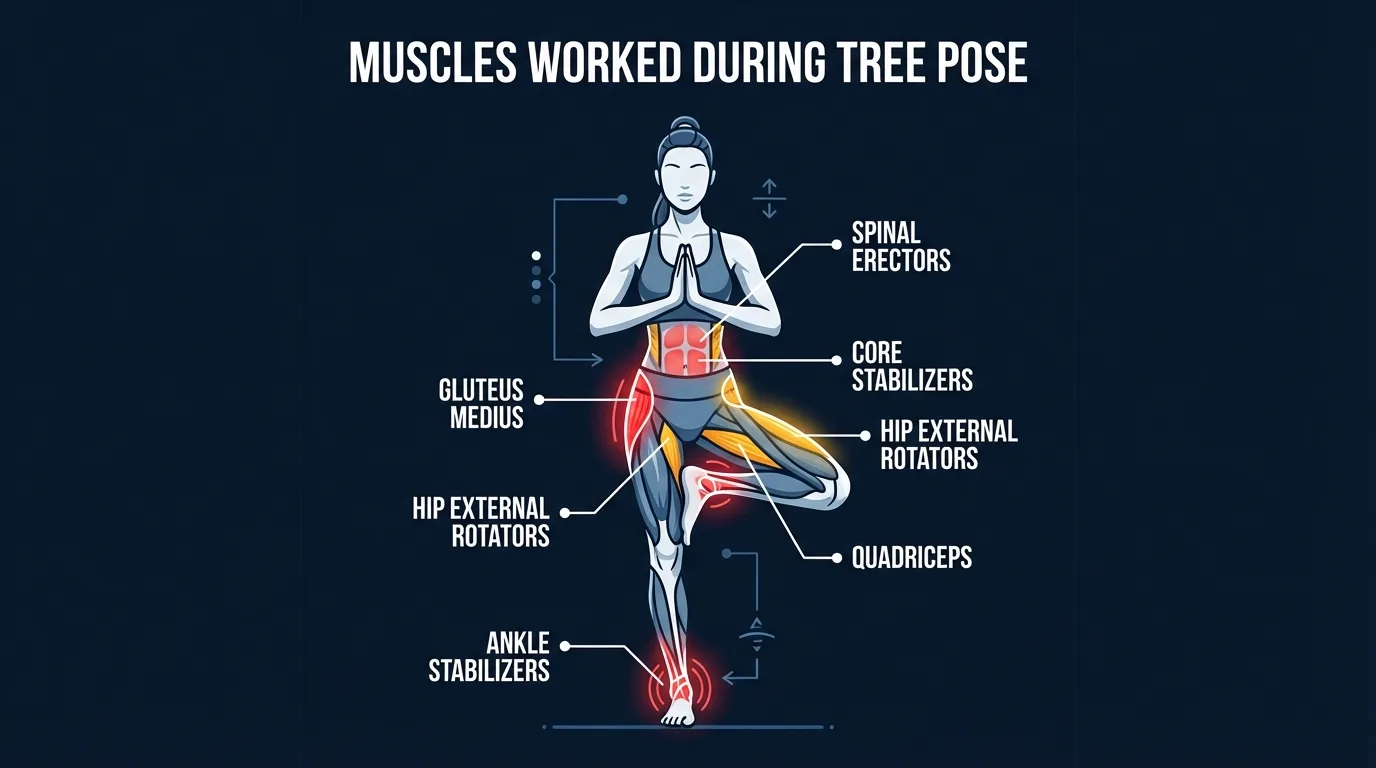
Muscles Engaged & Stretched
Primary movers: the ankle stabilizers and gluteus medius of the standing leg do most of the balance work. They do not shorten and lengthen like a lifting rep. They work isometrically to keep the foot rooted and the pelvis level.
Secondary movers: the deep hip external rotators and adductors help hold the lifted leg in position. The quadriceps and hamstrings of the standing leg co-contract around the knee so the leg feels strong without locking out.
Stabilizers: the rectus abdominis, transverse abdominis, obliques, erector spinae, deep hip stabilizers, and intrinsic foot muscles all help maintain posture. Your breath matters too. Slow diaphragmatic breathing keeps the trunk engaged without turning the pose into a stiff brace.
Balance mechanism: tree pose challenges proprioception because the base of support narrows to one foot. A steady gaze gives the nervous system a visual anchor, while even foot pressure gives the ankle better information to correct small shifts.
How to Do Tree Pose (Step-by-Step)
Step 1: Stand Tall and Root One Foot
Stand with both feet together. Shift your weight onto your left foot, spread the toes, and press through the big toe mound, little toe mound, inner heel, and outer heel. Keep a soft bend in the standing knee.
Coach Ty's cue: "Spread the standing foot before you lift anything. Balance starts at the floor."
Step 2: Place the Lifted Foot Safely
Turn your right knee out and place the sole of your right foot against the inner left calf or inner left thigh. Keep the foot off the knee joint. Press the foot into the leg and the leg into the foot with equal pressure.
Coach Ty's cue: "Above the knee or below the knee. Never into the side of the knee."
Step 3: Set Your Hips and Gaze
Keep both hip points level and your tailbone pointing down. Bring your hands to prayer at your chest, then fix your gaze on one still point at eye level.
Coach Ty's cue: "If your eyes wander, your balance will follow."
Step 4: Reach Only When Stable
If your balance feels steady, reach your arms overhead with your shoulders relaxed. Keep your ribs stacked over your pelvis instead of leaning back or flaring the chest.
Coach Ty's cue: "Earn the arms. Keep the chest quiet before you reach overhead."
Step 5: Hold, Breathe, and Switch Sides
Hold for 3 to 10 steady breaths, then lower the lifted foot with control. Repeat on the other side. It is normal for one side to feel less coordinated.
Coach Ty's cue: "Come out of the pose as slowly as you went in."
Get this exercise in a personalized workout
FitCraft, our mobile fitness app, uses its AI coach Ty to program yoga poses like this into your plan at the right volume and intensity, based on your level, goals, and equipment. Ty was designed and trained by Domenic Angelino, MPH (Brown University) and NSCA-CSCS, with research published in the Journal of Strength and Conditioning Research and Medicine & Science in Sports & Exercise.
Take the Free Assessment Free · 2 minutes · No credit card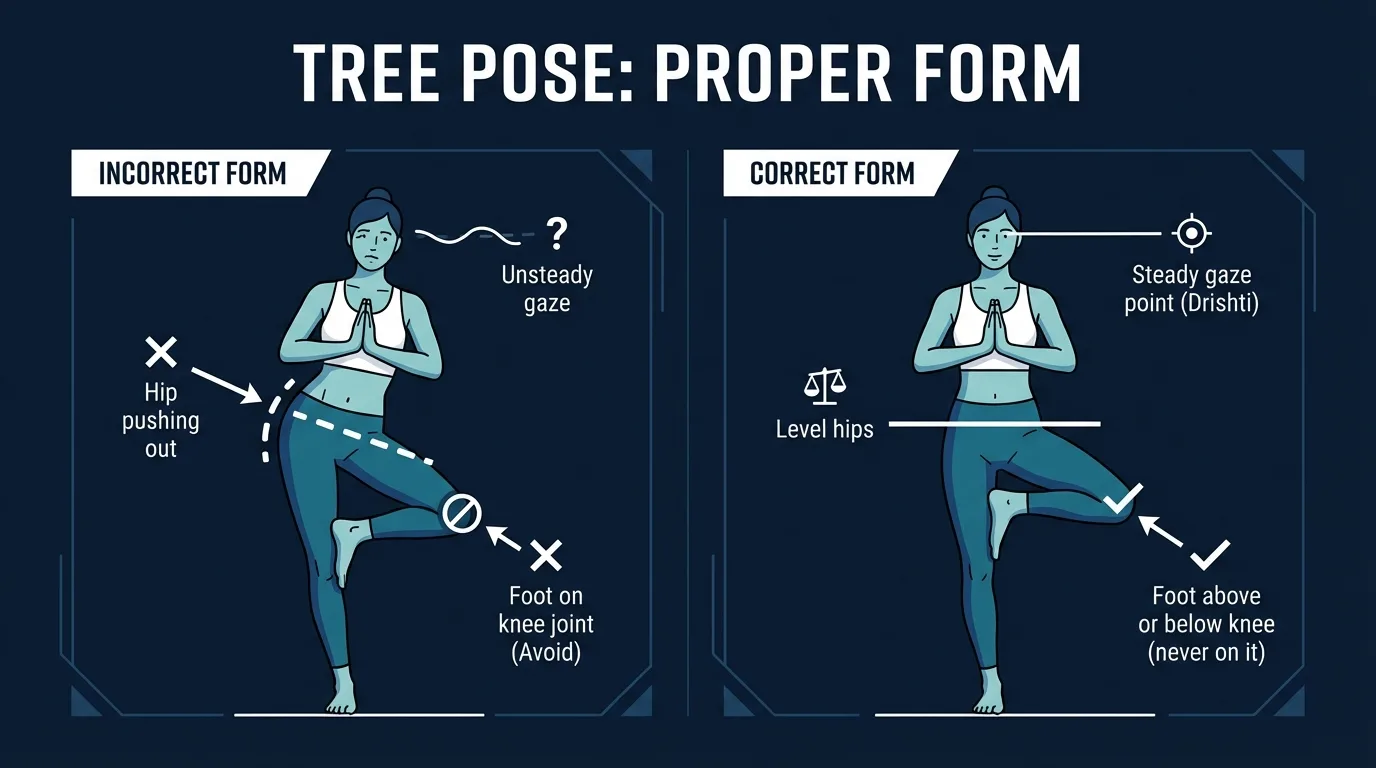
Common Mistakes (and How to Fix Them)
- Putting the foot on the knee. The knee is built to bend and straighten. Side pressure from the lifted foot can irritate the joint. Move the foot to the inner calf or inner thigh.
- Letting the standing hip drift out. Hanging into the hip can feel stable, but it bypasses the side-hip muscles you are trying to train. Stack the hip over the ankle and lightly firm the outer hip.
- Gripping the toes. Curling the toes narrows your base and makes the foot tense. Spread the toes, press the whole foot down, and let the ankle make small corrections.
- Holding your breath. Breath-holding adds tension and can make wobbling worse. Use slow nasal breaths and lower the arms if you cannot breathe smoothly.
- Rushing into the pose. Swinging the foot up uses momentum. Lift the foot slowly, pause at the calf if needed, and only move higher when the pelvis stays level.
- Looking around the room. Moving your eyes changes your balance input. Pick one steady point and keep your gaze there through the hold.
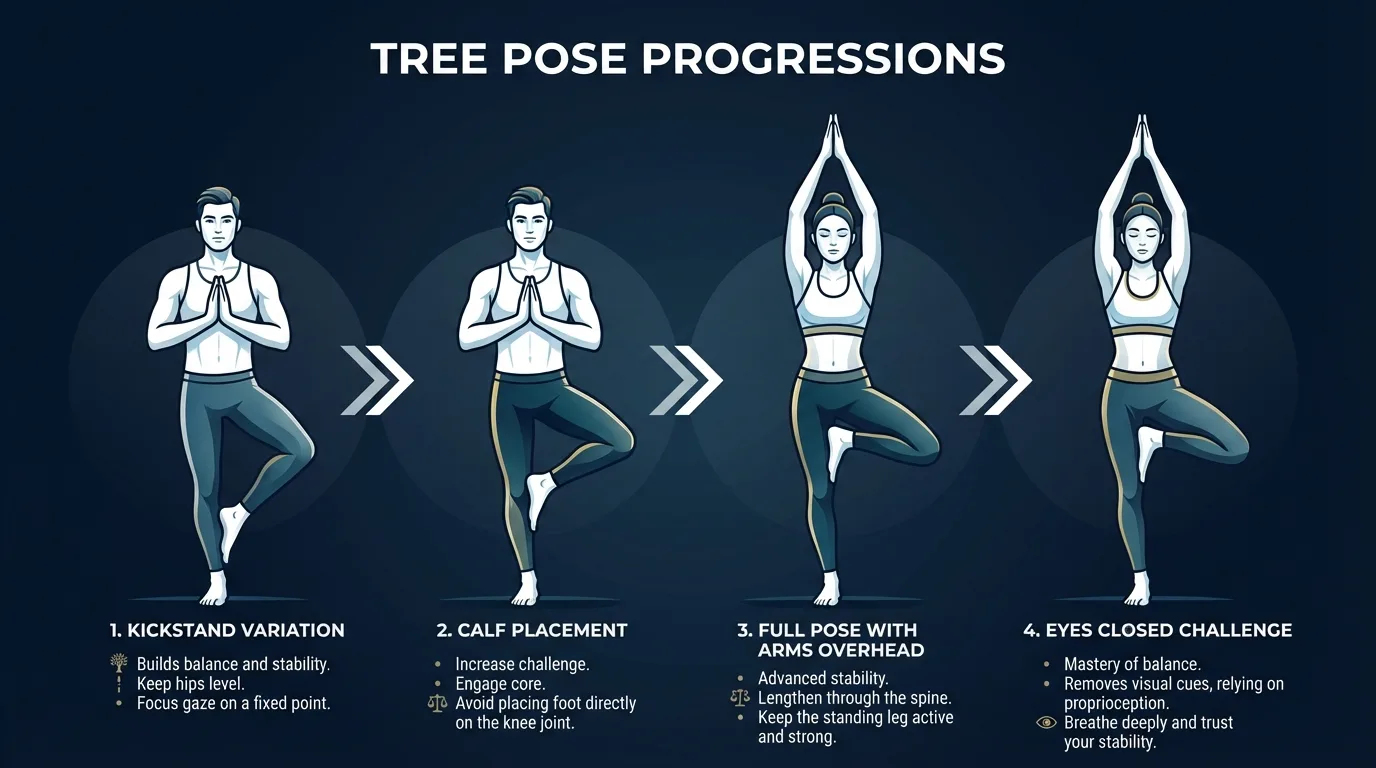
Tree Pose Variations: Regressions and Progressions
Kickstand Tree Pose
Keep the toes of the lifted foot on the floor and rest the heel against the standing ankle. This gives you a light support point while you practice rooted foot pressure and level hips.
Foot on Calf
Place the lifted foot against the inner calf. This shortens the lever and makes balance more manageable than the thigh version while still training the same pattern.
Classic Tree Pose
Place the lifted foot on the inner thigh, press foot and leg into each other, and reach the arms overhead if your ribs and pelvis stay stacked.
Eyes-Closed Tree Pose
Hold classic tree pose, then close your eyes for a few breaths. Removing visual input makes the foot, ankle, and hip work harder. Practice near a wall.
Wall-Supported Tree Pose
Stand beside a wall and keep one fingertip on it. This is the best option when you want the hip and foot benefits without turning every hold into a fall-risk test.
When to Avoid or Modify Tree Pose
Tree pose is safe for most healthy adults, but balance work gets risky when falling, joint irritation, or breath-holding enters the picture. Always consult your physician or physical therapist for personalized guidance.
- Active vertigo, vestibular symptoms, or high fall risk. Skip the unsupported version. Practice near a wall, use kickstand tree, or choose a seated balance drill until you are cleared.
- Recent ankle, knee, hip, or spine injury. The standing leg carries the whole pose. Use wall support, keep the lifted foot low, or substitute wall sits if single-leg standing is not appropriate yet.
- Knee pain from foot pressure. Do not press into the side of the knee. Keep the foot below the knee on the calf, or use kickstand tree until the hip can externally rotate without knee strain.
- Late pregnancy. Balance shifts as the center of mass changes. Use wall support, widen the stance, or work with a prenatal yoga instructor.
- Uncontrolled hypertension or known cardiovascular disease. Keep the hold short, breathe continuously, and ask your clinician which held poses are appropriate.
- Hypermobility or connective tissue disorders. Avoid chasing depth. Keep the standing knee soft and use muscle engagement rather than hanging into the hip or knee.
Related Exercises
Use these exercises to build the same balance, hip-control, and yoga-positioning skills that support tree pose:
- Same body region: Eagle Pose and Warrior 3 add standing balance with more hip, ankle, and trunk demand.
- Easier regression: Wall Sits train lower-body endurance with back support when unsupported balance is not the right entry point.
- Mobility prep: Hip Abductor Stretch and Butterfly Pose help prepare the hip opening needed for comfortable foot placement.
- Core foundation: Side Planks and Forearm Planks build the trunk stability that keeps the ribs stacked over the pelvis.
- Yoga balance progression: Dancer Pose adds a back-body reach and stronger balance challenge once tree pose feels steady.
How to Program Tree Pose
Tree pose is a yoga balance drill, so you do not program it like a heavy strength lift. The broader progression principle still applies: increase challenge gradually and keep technique clean. The ACSM resistance-training position stand describes progressive overload as matching volume and intensity to training status (Ratamess et al., 2009).
| Level | Sets x Reps | Rest between sets | Frequency |
|---|---|---|---|
| Beginner | 1-2 holds of 3-5 breaths per side | 30-60 seconds | 3-5 sessions/week |
| Intermediate | 2-3 holds of 5-10 breaths per side | 30-60 seconds | 4-6 sessions/week |
| Advanced | 3-5 holds of 10-15+ breaths per side | 30-90 seconds | 5-7 sessions/week |
Where in your workout: tree pose fits in a yoga sequence, warm-up, or cool-down. In a warm-up, use short holds to wake up the feet and hips. In a cool-down, use slower breathing and longer holds to downshift.
Form floor over hold time: stop the hold when the foot presses into the knee, the standing hip drifts, or the breath gets stuck. A clean 20-second hold builds more useful balance than a shaky 60-second hold.
How FitCraft Programs This Exercise
FitCraft can place yoga poses like tree pose inside a broader program so balance work supports the rest of your training. Ty adjusts the variation and volume to match your level, then keeps the cueing focused on foot pressure, hip position, and steady breathing.
Frequently Asked Questions
Can I do tree pose with balance issues or vertigo?
Use caution. Tree pose is a balance drill, so active vertigo, vestibular symptoms, or a high fall risk are reasons to modify or skip it until you have medical guidance. If you practice, stand near a wall and use the kickstand version.
What muscles does tree pose work?
Tree pose works the ankle stabilizers, gluteus medius, deep hip rotators, and core muscles of the standing side. The lifted leg also gets an inner-thigh and hip-opening stretch.
Should I put my foot on my knee in tree pose?
No. Place the foot above the knee on the inner thigh or below the knee on the inner calf. Pressing into the knee joint creates side pressure that the knee is not built to handle.
Why do I wobble so much in tree pose?
Wobbling is normal. Your foot, ankle, hip, and trunk are making small corrections to keep you upright. Use a wall, lower the lifted foot, and keep your gaze fixed until the corrections get smaller.
How long should I hold tree pose?
Beginners can start with 3 to 5 breaths or about 15 to 30 seconds per side. Intermediate practitioners can hold 30 to 60 seconds. Advanced practitioners can hold 60 to 90 seconds or add eyes-closed work.