Quick Comparison
| Modality | Best for | Space needed | Intensity |
|---|---|---|---|
| Bodyweight HIIT | Max calorie burn, minimum time | 6 ft x 6 ft | Moderate to very high |
| Dynamic Movement Flows | People bored by repetition | 8 ft x 4 ft | Low-moderate to moderate-high |
| Dance-Style Cardio | People who hate traditional exercise | 6 ft x 6 ft | Low to moderate-high |
| Jump Rope | Max cardio benefit per minute | 4 ft x 4 ft, ceiling clearance | Moderate to very high |
| High-Rep Bodyweight Circuits | Combined strength and cardio | 6 ft x 4 ft | Moderate to high |
You want to do cardio at home. But you hate running, you don't own a treadmill, and the idea of jogging in place in your living room feels absurd. You've scrolled through apps that are basically "follow along with this running plan" or "here's a stationary bike program" — none of which help when your equipment list is: floor, body, done.
If that sounds familiar, you're not broken and you're not making excuses. You're looking for something that the fitness industry has been surprisingly bad at providing: genuine cardio variety that works in a small space with zero equipment.
The good news? The science is clear that you don't need to run at all. A 2023 systematic review and meta-analysis published in BMC Sports Science, Medicine and Rehabilitation analyzed 15 randomized controlled trials and found that home-based HIIT significantly improved cardiorespiratory fitness — with results comparable to both gym-based HIIT and moderate-intensity continuous training (Blackwell et al., 2023). Your living room is not a compromise. It's a legitimate training environment.
The real question isn't whether home cardio works. It's whether you'll still be doing it in six weeks — which is where most people quit. That's a design problem — and it's where the right app makes all the difference.
Indoor Cardio Options That Don't Require Running or a Treadmill
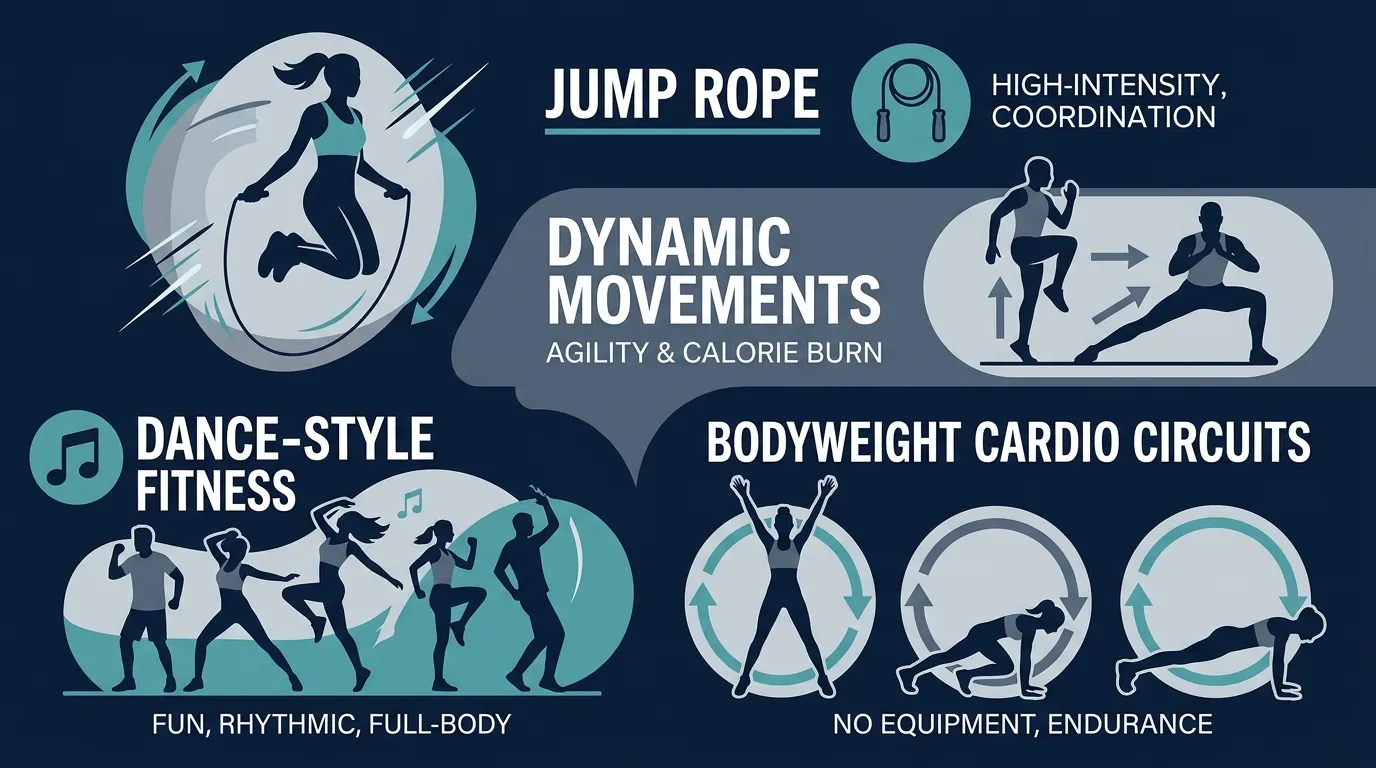
When people hear "cardio," they picture running. But cardio is just any activity that elevates your heart rate and sustains it. There are dozens of ways to do that without taking a single running step. Here are five categories that work in any living room, apartment, or small home space.
1. Bodyweight HIIT (High-Intensity Interval Training)
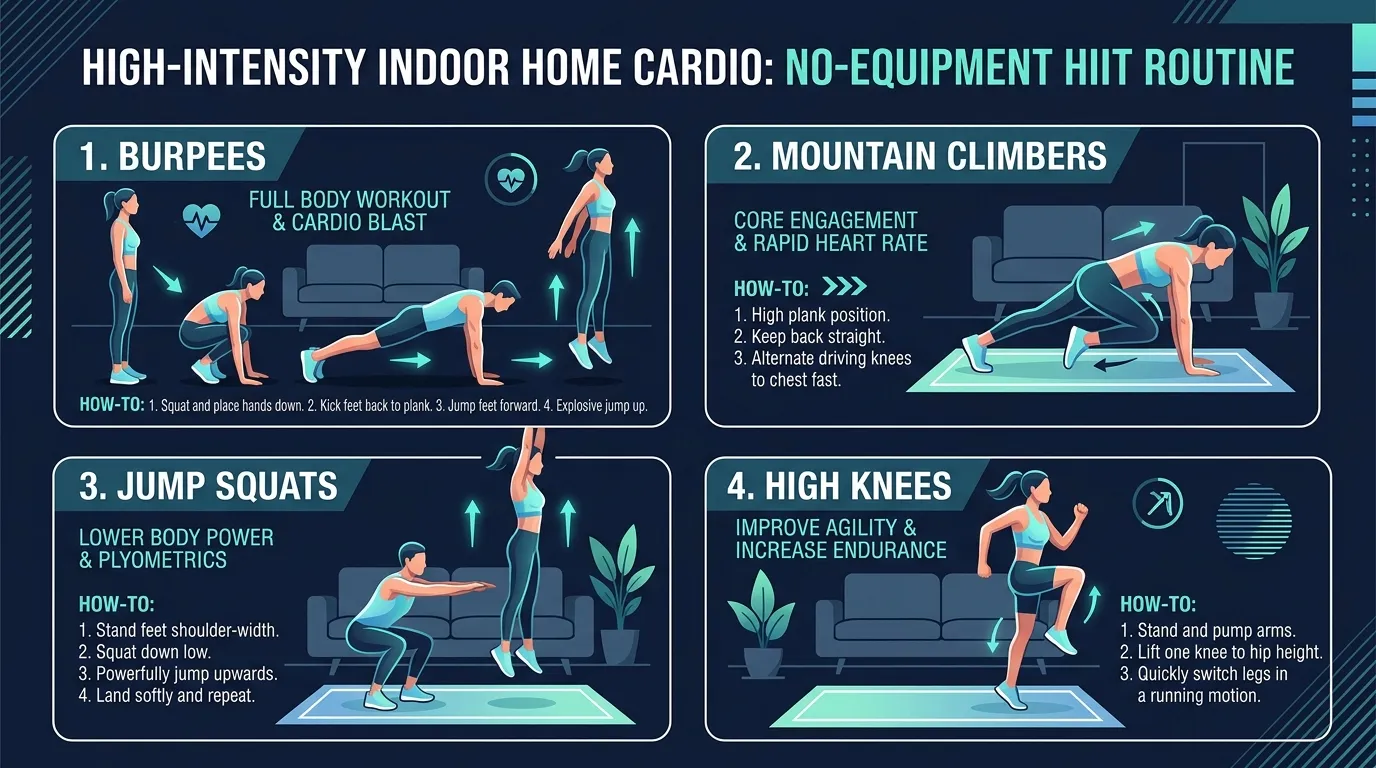
HIIT alternates short bursts of all-out effort with brief rest periods. A typical bodyweight HIIT session uses moves like burpees, mountain climbers, jump squats, high knees, and tuck jumps — performed for 20-40 seconds with 10-20 seconds of rest.
The efficiency is staggering. Research shows that HIIT sessions as short as 10-20 minutes can match or exceed the cardiorespiratory benefits of 30-45 minutes of steady-state jogging (Su et al., 2023). For people who are time-poor — which is most people — this is a genuine advantage.
- Best for: Maximum calorie burn in minimum time
- Space needed: About 6 feet by 6 feet
- Equipment: None
- Intensity range: Moderate to very high (scalable by choosing lower-impact variations)
2. Dynamic Movement Flows
Dynamic movement combines mobility work with continuous, flowing sequences that keep your heart rate elevated. Think: bear crawls transitioning into inchworms, into squat-to-stand, into lateral lunges. It's not traditional "cardio" in the way most people imagine it, but your cardiovascular system doesn't care about labels — it responds to sustained effort.
Dynamic movement is particularly effective for people who find repetitive exercises boring. Each sequence feels different, engages multiple movement planes, and builds coordination alongside cardiovascular fitness.
- Best for: People who get bored with repetitive exercises; building mobility and cardio simultaneously
- Space needed: About 8 feet by 4 feet
- Equipment: None
- Intensity range: Low-moderate to moderate-high
3. Dance-Style Cardio
If traditional exercise feels like punishment, dance-style cardio flips the script entirely. A 2024 systematic review with meta-analysis in Sports Medicine found that dance-based exercise improved psychological and cognitive outcomes as effectively as — and sometimes more effectively than — other forms of physical activity (Koch et al., 2024). Even more telling: dance interventions consistently showed higher adherence rates because participants actually enjoyed doing them.
That last finding matters more than most people realize. The best cardio format is the one you'll actually repeat three to four times per week for months. If dance-style movement makes that happen when burpees never did, the science says go with what you'll stick to.
- Best for: People who hate traditional exercise; improving mood alongside fitness
- Space needed: About 6 feet by 6 feet
- Equipment: None
- Intensity range: Low to moderate-high (depends on tempo and complexity)
4. Jump Rope
Jump rope is one of the most calorie-efficient exercises available. Research indicates that 10 minutes of jump rope provides cardiovascular benefits roughly equivalent to 30 minutes of jogging, burning approximately 15-20 calories per minute. It also builds coordination, agility, and lower-body power in ways that running simply doesn't.
The one caveat: jump rope does require a rope and ceiling clearance. If you have both, it's one of the most time-efficient cardio tools that exists. If you don't, the other four options on this list need nothing at all.
- Best for: Maximum cardiovascular benefit per minute; coordination and agility
- Space needed: About 4 feet by 4 feet with ceiling clearance
- Equipment: A jump rope (optional: the only equipment item on this list)
- Intensity range: Moderate to very high
5. High-Rep Bodyweight Circuits
Take standard strength exercises — squats, lunges, push-ups, planks — and perform them in rapid succession with minimal rest. When you do 15 squats immediately followed by 10 push-ups, 20 high knees, and a 30-second plank, your heart rate climbs into genuine cardio territory. You're building muscular endurance and cardiovascular fitness simultaneously.
This is the bridge between strength and cardio that most apps completely ignore. You don't have to choose between building muscle and improving your heart health. High-rep circuits do both.
- Best for: Combined strength and cardio; people who want to build muscle while improving endurance
- Space needed: About 6 feet by 4 feet
- Equipment: None
- Intensity range: Moderate to high
What Makes a Good Home Cardio App
There are hundreds of fitness apps. Most of them fail at home cardio for one or more of these reasons:
Problem 1: They Assume Equipment
Too many apps treat "cardio" as synonymous with "treadmill workout" or "cycling class." If you don't have the hardware, the app is useless. A genuinely good home cardio app lets you tell it what you have — even if the answer is "nothing" — and builds around that.
Problem 2: They Offer One Modality
An app that only offers HIIT will bore you within a month. An app that only offers dance will leave you under-trained. The body adapts to repetitive stimulus, and your brain adapts to repetitive boredom. Variety is not a luxury — it's a consistency mechanism. The best cardio apps offer multiple workout types so you can rotate between HIIT, dynamic movement, bodyweight circuits, and other modalities.
Problem 3: They Don't Adapt
Week 1 and week 12 should not look the same. A good app tracks your progress and adjusts difficulty, volume, and intensity over time. If you're still doing the same 20-minute beginner HIIT circuit three months in, you've stopped progressing — and you'll probably stop showing up.
Problem 4: They Rely on Motivation
Here's the uncomfortable truth the fitness industry doesn't like to say out loud: motivation is unreliable. It shows up for week 1, maybe week 2. By week 3, it's gone. The apps that keep people consistent long-term don't rely on motivational quotes or "you got this!" push notifications. They use system design — reward structures, progress visualization, and behavioral hooks that make showing up feel inherently rewarding.
Find out what's really holding you back
FitCraft's free diagnostic identifies your specific consistency patterns — the real reasons behind the quitting cycle — and builds a home cardio plan matched to your goals.
Take the Free Assessment Free · 2 minutes · No credit card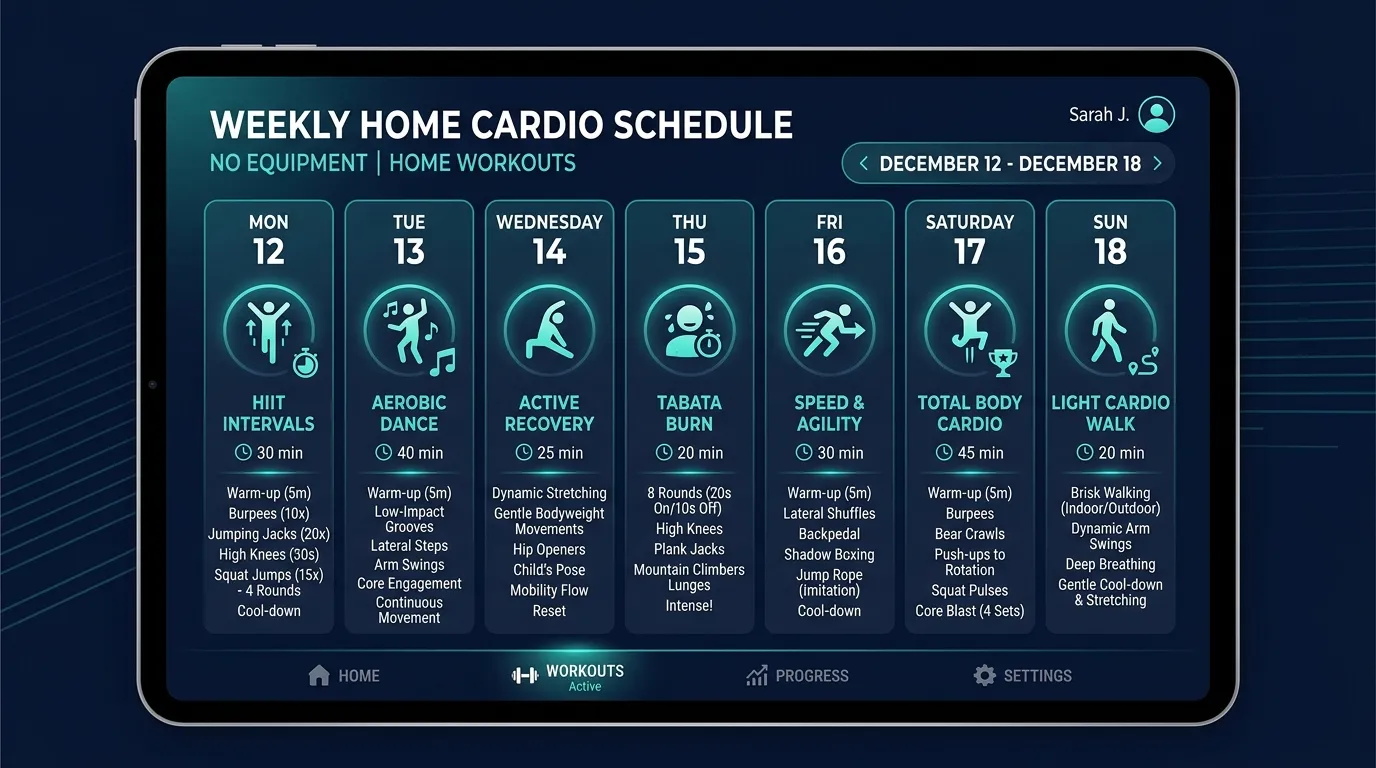
How FitCraft Handles Home Cardio Without Equipment
FitCraft was built for exactly this scenario: someone who wants to get fit at home, doesn't own cardio equipment, and needs more than a generic YouTube playlist to stay consistent.
Dedicated Cardio and Dynamic Movement Workout Types
FitCraft includes both cardio and dynamic movement as distinct workout types — alongside strength (dumbbells, resistance bands, or bodyweight), yoga, and mobility. This means your weekly plan can include a HIIT-style cardio session on Monday, a dynamic movement flow on Wednesday, and a bodyweight strength circuit on Friday. Variety is built into the system, not something you have to figure out yourself.
AI Coach Ty Personalizes Every Session
When you take the initial assessment, FitCraft's AI coach Ty learns your fitness level, goals, schedule, and available equipment. If you select no equipment, Ty builds your cardio sessions entirely around bodyweight movements — and adapts the difficulty as you progress. The workouts get harder because you're getting stronger, not because an arbitrary timer ran out on the "beginner" phase.
Ty also provides personalized, adaptive encouragement throughout your sessions. This isn't a generic "keep going!" overlay. Ty responds to your actual progress, acknowledging milestones and adjusting tone based on where you are in your fitness journey.
Interactive 3D Exercise Demos
Every exercise in FitCraft comes with an interactive 3D demo that you can rotate and zoom with pinch-and-zoom camera controls. This is not a pre-recorded video from a single angle. You can examine the movement from any direction — front, side, behind, above — to understand exactly what proper form looks like for each cardio move. When you're doing a burpee variation or a lateral bound for the first time, being able to see the movement from your preferred angle makes a real difference.
Gamification That Sustains Consistency
This is where FitCraft diverges most from standard fitness apps. Every workout earns you XP and levels you up. You earn collectible cards as you hit milestones. Your calendar tracks your activity and rewards you for showing up consistently. These aren't gimmicks — they're behavioral science applied to fitness.
A study published in JMIR Serious Games (2022) found that gamification elements in fitness apps significantly increased exercise adherence and engagement compared to non-gamified alternatives. FitCraft's system is designed around these findings: make the act of completing a workout inherently rewarding through progress mechanics, and consistency becomes something you look forward to instead of something you have to force.
Programs are designed by an Ivy League-trained exercise scientist, NSCA-certified strength coach, so the science behind the workouts is rigorous — you're not sacrificing quality for fun.
Sample No-Equipment Home Cardio Week
Here's what a well-rounded week of equipment-free home cardio could look like. This is a template — your AI coach would personalize the specific exercises, sets, and intensities to your level.
Day 1 — Bodyweight HIIT (20 minutes)
- Jump squats: 30 seconds on / 15 seconds rest
- Mountain climbers: 30 seconds on / 15 seconds rest
- Burpees (or step-back variation): 30 seconds on / 15 seconds rest
- High knees: 30 seconds on / 15 seconds rest
- Repeat circuit 4 times
Day 2 — Dynamic Movement Flow (25 minutes)
- Bear crawl to inchworm: 5 reps flowing
- Lateral lunge to rotation: 8 per side
- Squat-to-stand with overhead reach: 10 reps
- Crab walk to bridge: 6 reps
- Flow through 3-4 rounds at a steady pace
Day 3 — Rest or Light Mobility
Day 4 — High-Rep Bodyweight Circuit (25 minutes)
- Bodyweight squats: 20 reps
- Push-ups: 12 reps
- Reverse lunges: 10 per leg
- Plank with shoulder taps: 10 per side
- Star jumps: 15 reps
- Minimal rest between exercises. 60-second rest between rounds. 4 rounds.
Day 5 — Cardio Variety Day (20 minutes)
- Skater hops: 30 seconds
- Tuck jumps (or squat pulses for lower impact): 30 seconds
- Lateral shuffles: 30 seconds
- Broad jump to backpedal: 30 seconds
- 15 seconds rest between moves. Repeat 5 rounds.
Days 6-7 — Rest
Four sessions, 20-25 minutes each, zero equipment, genuine cardiovascular improvement. That's not a compromise — that's an efficient program.
What to Expect When You Start
Week 1 will feel exciting. You'll discover exercises you've never tried. Your heart rate will climb, you'll sweat, and you'll feel accomplished afterward. That's the easy part.
Week 3 is where most people quit. The novelty fades. Life gets busy. You start telling yourself you'll "get back to it Monday." This is the consistency cliff — and it's where 80% of home workout plans go to die. It's not a willpower failure. It's what happens when the only thing keeping you going is motivation, and motivation is a depleting resource.
This is exactly why system design matters more than workout design. A cardio app that makes every session feel like progress — through XP, leveling up, collectible cards, and calendar rewards — gives you a reason to show up that doesn't depend on how motivated you feel on a given Tuesday. You show up because the system makes showing up feel good.
By week 6, something shifts. The workouts stop being something you schedule and start being something you do. You stop wondering if you'll work out today and start wondering which workout you'll do. That's the identity shift that turns a habit into a lifestyle.
What Real People Say
Katie: "I've tried everything. This is the first time I've stuck with something past two weeks."
Matt: "The real win is I actually want to work out now. That's never happened before."
Sarah, 27: "-18 lbs, 3 months — First app that made exercise feel like something I chose, not forced."
The Bottom Line
You don't need a treadmill, a track, or running shoes to get an effective cardio workout at home. Bodyweight HIIT, dynamic movement flows, dance-style cardio, jump rope, and high-rep circuits all deliver real cardiovascular benefits — backed by peer-reviewed research. The format you choose matters far less than whether you keep doing it.
The best cardio workout app for home use isn't the one with the fanciest exercises. It's the one that gives you genuine variety, adapts to your progress, and — critically — keeps you coming back after the initial excitement fades. That's the problem most fitness apps ignore entirely. And it's the one FitCraft was built to solve.
Your living room has everything you need. The only question is whether your system keeps you using it.
Frequently Asked Questions
Can you get a good cardio workout at home without running or a treadmill?
Yes. A 2023 systematic review in BMC Sports Science, Medicine and Rehabilitation found that home-based HIIT significantly improved cardiorespiratory fitness, with results comparable to gym-based training. Bodyweight cardio moves like burpees, mountain climbers, jump squats, and dynamic movement sequences raise your heart rate effectively without any running or cardio machines.
What is the best indoor cardio exercise that does not involve running?
Bodyweight HIIT circuits are among the most effective indoor cardio options. Exercises like burpees, high knees, jump squats, and mountain climbers elevate heart rate rapidly and can burn 400-600 calories per hour depending on intensity. Jump rope is another excellent option, burning roughly 15-20 calories per minute — more than most forms of running.
How many minutes of home cardio per day do you need to see results?
As little as 15 to 20 minutes of high-intensity bodyweight cardio can produce meaningful cardiovascular improvements. Research shows that HIIT sessions as short as 10-20 minutes can match or exceed the cardiorespiratory benefits of 30-45 minutes of steady-state jogging, making home cardio extremely time-efficient.
Is dance-style cardio as effective as traditional cardio workouts?
Yes. A 2024 systematic review in Sports Medicine found that dance-based exercise improved psychological and cognitive health outcomes as effectively as — and sometimes more effectively than — other forms of physical activity. Dance cardio also showed higher adherence rates because participants enjoyed it more, which translates to better long-term results.
Does FitCraft have cardio workouts you can do at home without equipment?
Yes. FitCraft offers dedicated cardio and dynamic movement workout types designed for home use with no equipment required. Your AI coach Ty builds personalized cardio sessions based on your fitness level and goals, with interactive 3D exercise demos showing proper form. Gamification features like XP, leveling up, and collectible cards keep you consistent even on days when motivation is low.