Medical disclaimer: This article is for informational purposes only and does not constitute medical advice. Cancer survivors should consult their oncologist or healthcare provider before beginning any new exercise program. Individual circumstances vary, and your care team is the best source of guidance for your specific situation.
If you've been through cancer treatment, you already know what hard looks like. The surgeries, the chemo, the radiation, the waiting rooms, the uncertainty. You fought through all of it.
And now you're on the other side — or getting there — and someone tells you that exercise is one of the best things you can do for your recovery. You believe it. But fatigue, uncertainty about what's safe, and the sheer weight of what your body has been through make it incredibly hard to start — and even harder to stay consistent.
You're not imagining the difficulty. The barriers are real. But so is the research. The evidence suggests that exercise after cancer can be beneficial for many survivors — though the appropriate type, intensity, and timing of exercise depends on your individual situation, treatment history, and your oncologist's guidance. The question isn't simply whether to move. It's how to build a system that makes movement sustainable when your body and mind are still recovering — and how to do it safely under the direction of your care team.
The ALLSTAR Trial: Gamification Works for Cancer Survivors
In 2025, researchers published the results of the ALLSTAR trial in JACC CardioOncology (PMC12805409) — a randomized controlled trial specifically designed to test whether a gamified physical activity intervention could help cancer survivors move more consistently.
Here's what they found:
The study enrolled 150 breast and prostate cancer survivors — 81% women, 64% Black, and 35% Hispanic, making it one of the most diverse exercise-oncology trials to date. Participants received a loss-framed points system with a weekly endowment: they started each week with points that they would lose if they didn't meet their activity targets. This accountability mechanism taps into a well-established behavioral principle — people are more motivated to protect something they already have than to earn something new.
The results were significant:
- +759 steps per day compared to control (P=.007)
- +16 minutes of moderate-to-vigorous physical activity (MVPA) per week (P=.010)
- Activity gains retained at follow-up: MVPA remained elevated by +11 min/week (P=.048)
The trial was funded by the American Heart Association and specifically noted the low marginal costs of the intervention — meaning this approach can scale to help more survivors without requiring expensive equipment, gym memberships, or in-person supervision.
Why does this matter? Because the biggest challenge for cancer survivors isn't knowing that exercise helps. It's doing it consistently when fatigue, side effects, and fear make every session feel like a negotiation. The ALLSTAR trial demonstrates that gamified accountability systems can bridge that gap — turning intention into action, even in a population facing extraordinary barriers.
Why Exercise Matters After Cancer
The American College of Sports Medicine (ACSM) recommends that cancer survivors engage in at least 150 minutes per week of moderate-intensity physical activity. This isn't a general wellness suggestion. It's based on a substantial body of evidence showing that exercise directly impacts cancer outcomes.
Here's what the research consistently shows:
Potential Recurrence Risk Reduction
Multiple large-scale epidemiological studies have found associations between regular physical activity and lower rates of cancer recurrence — particularly for breast, colorectal, and prostate cancers. For breast cancer survivors specifically, meeting the 150-minute weekly guideline has been linked to meaningful reductions in recurrence risk. However, individual circumstances vary, and exercise should be part of a comprehensive care plan guided by your oncology team.
Cancer-Related Fatigue Management
Cancer-related fatigue is the most common and debilitating side effect of treatment. It's a vicious cycle: fatigue makes you less active, and inactivity makes fatigue worse. Exercise breaks that cycle. Structured physical activity is one of the most effective evidence-based interventions for managing cancer-related fatigue — often more effective than pharmacological approaches.
Improved Quality of Life
Exercise after cancer treatment is associated with improvements across nearly every quality-of-life metric: mood, sleep quality, physical function, body composition, cardiovascular health, and psychological well-being. For many survivors, regaining physical capability is a critical part of reclaiming identity and confidence after treatment.
The Barriers Cancer Survivors Face
If exercise is so clearly beneficial, why don't more survivors do it consistently? Because the barriers are real, specific, and deeply challenging:
Cancer-Related Fatigue
This isn't normal tiredness. Cancer-related fatigue can persist for months or years after treatment ends. It's unpredictable — you might feel capable in the morning and completely drained by afternoon. Any exercise program that doesn't account for energy fluctuations will fail survivors.
Treatment Side Effects
Neuropathy, joint pain, lymphedema, reduced range of motion, bone density loss — the physical aftermath of cancer treatment creates real constraints on what kinds of movement are safe and comfortable. A one-size-fits-all program isn't just ineffective here. It could be harmful.
Fear and Uncertainty
Many survivors worry about pushing too hard, causing injury, or triggering a setback. Without clear guidance on what's safe, the default is often to do nothing — which, ironically, makes recovery harder.
Deconditioning
Months of reduced activity during treatment leads to significant muscle loss, cardiovascular deconditioning, and reduced functional capacity. The gap between where you were before treatment and where you are now can feel overwhelming. Starting "where you are" requires a program that genuinely meets you there — not one that assumes a baseline fitness level you no longer have.
How Gamification Helps Cancer Survivors
The ALLSTAR trial didn't use complicated technology. It used behavioral science — specifically, gamification principles that have been proven across domains to increase engagement and follow-through.
Loss-Framed Accountability
The ALLSTAR intervention gave participants a weekly endowment of points that they would lose if they didn't meet activity targets. This leverages loss aversion — a core principle of behavioral economics. People work harder to avoid losing something they have than to gain something new. For cancer survivors dealing with fluctuating motivation and energy, this kind of gentle accountability structure can make the difference between skipping a session and showing up.
Low Marginal Cost, High Accessibility
The ALLSTAR researchers specifically highlighted the low marginal costs of their intervention. Gamified systems don't require expensive equipment, travel to a clinic, or one-on-one supervision. They can be delivered remotely, scaled broadly, and accessed from home — which is exactly where most cancer survivors need to exercise.
Remote Delivery Removes Barriers
Transportation, immunocompromise concerns, and fatigue all make gym-based programs impractical for many survivors. A home-based, app-delivered intervention meets survivors in the environment where they're most comfortable and most likely to be consistent.
Getting Started Safely
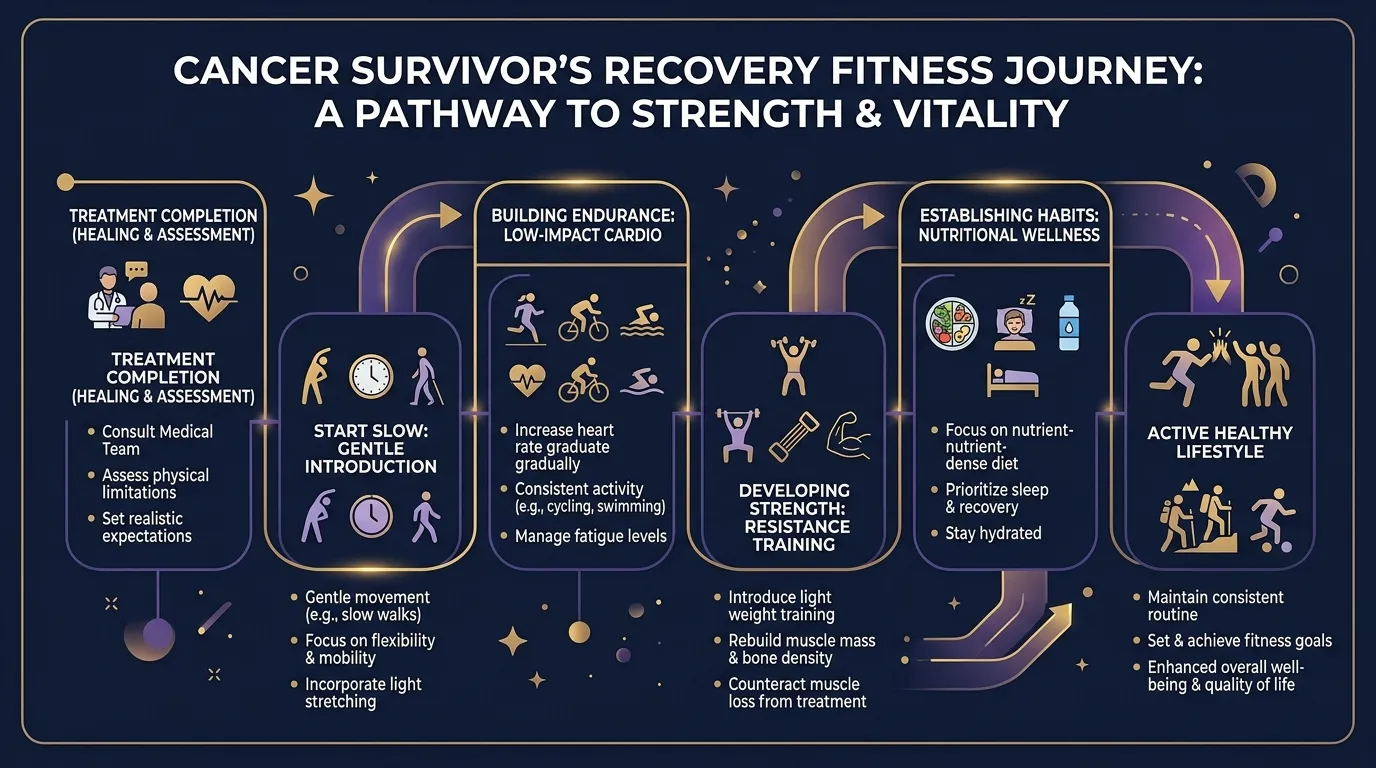
If you're a cancer survivor considering an exercise program, here's how to begin:
Get Medical Clearance
Talk to your oncologist or primary care provider before starting. Share your intention to begin a structured exercise program and ask about any specific precautions related to your treatment history. Most oncologists actively encourage exercise for survivors — but they may have guidance about intensity levels, movements to avoid, or symptoms to watch for.
Start Gradually
You don't need to hit 150 minutes in your first week. Start with what's manageable — even 5 or 10 minutes. The ALLSTAR trial showed significant benefits from relatively modest increases in activity. Every minute counts when you're building from a low baseline.
Listen to Your Body
Some days you'll have energy. Some days you won't. A good program adapts to both. The goal is consistency over time, not intensity on any single day. If today is a 10-minute gentle movement day, that's a win. If tomorrow is a 20-minute strength session, that's also a win.
Prioritize Compound Movements
Exercises that work multiple muscle groups simultaneously — squats, push-ups, rows, lunges — give you the most benefit per minute. They rebuild functional strength, improve cardiovascular fitness, and address the deconditioning that treatment causes. A well-designed program selects these movements based on your current capacity and progresses them safely over time.
Find out where to start
Take the free 2-minute assessment. It maps your current fitness level, any limitations, and your goals — then builds a program that adapts to how you feel each day.
Take the Free Assessment Free · 2 minutes · No credit cardHow FitCraft Applies This Research
The ALLSTAR trial proved the principle: gamified accountability helps cancer survivors move more. FitCraft takes that principle and builds a complete system around it:
- AI that adapts to your energy levels. FitCraft's AI coach Ty adjusts your workout based on how you feel today — not how you felt yesterday. Low energy? You get a lighter session that still counts. Feeling strong? Ty pushes you appropriately. The program never forces you into a session your body isn't ready for.
- Home-based, no equipment required. Like the ALLSTAR intervention, FitCraft is designed to work from home with whatever equipment you have — including none at all. No gym commute. No exposure concerns. No barriers between you and your workout.
- Streak mechanics that build consistency. FitCraft's streak system works on the same behavioral principle the ALLSTAR trial validated — gentle accountability that makes you want to protect your progress. Each consecutive day builds momentum. The longer your streak, the more it means to you. And that's exactly the point.
- Progressive difficulty that respects your starting point. FitCraft's 32-step diagnostic assessment identifies exactly where you are — physically, logistically, and motivationally. Your program starts there and progresses at a pace that's challenging but achievable. Programs are designed by an Ivy League-trained exercise scientist, NSCA-certified strength coach, so every progression is evidence-based and safe.
- Quests and rewards that make showing up feel good. Beyond streaks, FitCraft includes quests, collectible cards, and avatar progression — reward systems that create positive associations with exercise. For survivors rebuilding their relationship with their body, feeling good about movement is just as important as the physical benefits.
The result is a system that takes what the ALLSTAR trial proved in a controlled setting and makes it available to every cancer survivor with a phone. Low cost. High accessibility. Personalized to you.
The Bottom Line
Consistency Matters — With Proper Guidance
Research suggests that exercise after cancer treatment may help reduce recurrence risk, combat fatigue, and improve quality of life — though individual results depend on your specific situation and should be guided by your oncologist. The ACSM recommends 150+ minutes per week, and the ALLSTAR trial shows that gamified accountability systems help survivors get there.
You don't need to do it all at once. You don't need a gym. You don't need to feel 100% to start. You need a program that adapts to your reality — one that meets you on your hardest days and challenges you on your best ones.
You've already proven you can do hard things. Now it's time to rebuild — one session at a time.
Frequently Asked Questions
Is it safe to exercise after cancer treatment?
Yes. The American College of Sports Medicine recommends that cancer survivors engage in at least 150 minutes per week of moderate-intensity physical activity. Exercise has been shown to reduce recurrence risk, alleviate cancer-related fatigue, and improve quality of life. Always get medical clearance from your oncologist before starting a new program.
How much exercise do cancer survivors need?
The ACSM guideline is 150 or more minutes per week of moderate-intensity aerobic activity, plus two or more sessions of resistance training. However, the ALLSTAR trial showed that participants achieved meaningful gains with relatively modest increases in activity. Every minute counts — especially when you're rebuilding from a low baseline. Start where you are and build gradually.
What did the ALLSTAR trial find about gamification and cancer survivors?
The ALLSTAR trial (2025, JACC CardioOncology, n=150) found that a gamified fitness intervention using loss-framed points increased daily steps by 759 (P=.007) and moderate-to-vigorous physical activity by 16 minutes per week (P=.010) among breast and prostate cancer survivors. Activity gains were retained at follow-up, with MVPA still elevated by +11 min/week (P=.048). The study was funded by the American Heart Association and noted the low marginal costs of the approach.
Can I exercise at home during or after cancer treatment?
Absolutely. Home-based exercise is one of the most effective and accessible options for cancer survivors. It removes transportation barriers, allows you to work out when your energy is highest, and lets you adapt session intensity to how you feel on any given day. FitCraft's AI coach Ty builds personalized home workout programs that adjust to your energy levels and available equipment.
How does FitCraft help cancer survivors stay consistent with exercise?
FitCraft uses AI-driven personalization and gamification to help cancer survivors build and maintain an exercise habit. The AI coach adapts workouts to your energy levels and any physical limitations. Streak mechanics, quests, and collectible rewards create accountability without pressure. Programs are designed by an Ivy League-trained exercise scientist, NSCA-certified strength coach and start at whatever level is appropriate for you.