Important: This article is for informational purposes only and does not constitute medical advice. If you have service-related injuries, PTSD, or other health conditions, always consult your physician or a qualified healthcare provider before starting or modifying an exercise program. Exercise can be a valuable complement to professional care, but individual circumstances vary.
Veterans deserve better than generic fitness advice. You served with discipline, structure, and purpose. But transitioning out of the military often means losing the built-in fitness infrastructure that kept you active — the PT schedules, the accountability, the mission-driven motivation.
The result? Many veterans struggle with physical activity after service, despite knowing how important it is. And the standard advice — "just go to the gym" or "download a workout app" — doesn't address the real barriers you face.
But there's good news. The VA has funded clinical research into what actually works — and the results are significant. A randomized controlled trial showed that combining gamification with behavioral economics produced a meaningful, measurable increase in daily physical activity among veterans. This guide breaks down that research, explains why it matters, and shows you how to put it into practice.
The Research: What a VA-Funded Clinical Trial Found
In 2021, researchers published the results of a randomized controlled trial in JAMA Network Open (PMC8271358) — one of the most respected medical journals in the world. The study was funded by the Department of Veterans Affairs, and it asked a simple question: can gamification increase physical activity among veterans?
Here's what the trial looked like:
- Participants: 180 veterans, with a mean age of 56.5 and an average BMI of 33
- Design: Randomized controlled trial — the gold standard of clinical research
- Intervention: Gamification combined with loss-framed behavioral economics, including support partner weekly updates and goal-day tracking
- Published in: JAMA Network Open, 2021
- Funded by: The Department of Veterans Affairs
The results were clear: the gamification group increased their daily steps by 1,224 compared to control (P=.005). Goal-day achievement also improved significantly (P<.001). This wasn't a survey or a self-reported estimate — it was objective step-count data from a rigorous clinical trial.
What makes this especially meaningful is the population. These weren't young, healthy college students. They were middle-aged veterans with elevated BMIs — a group that traditional fitness programs often fail to reach. And yet, a gamification-based approach produced statistically significant improvements in their daily physical activity.
The science is clear: gamification works for veterans. The question is how to apply it.
Why Physical Activity Matters for Veterans
The VA recommends regular physical activity for veteran health — and for good reason. The benefits extend far beyond physical fitness:
- Mental health. Research suggests that exercise may help reduce symptoms of depression and PTSD when used as a complement to professional treatment. Regular physical activity has been associated with improvements in anxiety, sleep quality, and stress resilience — though individual results vary and exercise is not a substitute for mental health care.
- Chronic pain management. Many veterans live with service-related injuries and chronic pain. For some, appropriate exercise — carefully programmed and guided by a healthcare provider — may help improve function and quality of life. However, the right approach depends on your specific condition, and some types of exercise may not be appropriate.
- Cardiovascular health. Veterans face elevated cardiovascular risk, partly due to the stress of service and post-service lifestyle changes. Regular physical activity is the single most impactful modifiable risk factor for cardiovascular disease.
- Community and purpose. Military service provides structure and belonging. Exercise programs that include accountability systems, progress tracking, and social elements can help fill that gap in civilian life.
- Quality of life. The ability to move without pain, play with your kids or grandkids, and feel strong in your body — these aren't luxuries. They're what you earned through your service.
Physical activity isn't just recommended for veterans. It's essential. The challenge has always been finding approaches that help veterans actually do it consistently.
The Unique Barriers Veterans Face
Understanding why veterans struggle with fitness requires understanding what makes your situation different from the general population:
Service-Related Injuries
Joint damage, back injuries, traumatic brain injuries, amputations — these aren't excuses. They're realities that make standard fitness programs dangerous or impossible. A program that doesn't adapt to your specific limitations isn't just unhelpful; it can make things worse.
PTSD and Mental Health Challenges
PTSD doesn't just affect your mood. It affects your motivation, your sleep, your energy, and your ability to start new habits. Crowded gyms can trigger hypervigilance. Unpredictable environments increase anxiety. Any fitness solution that requires you to be in a gym surrounded by strangers is ignoring a barrier that affects millions of veterans.
The Transition Gap
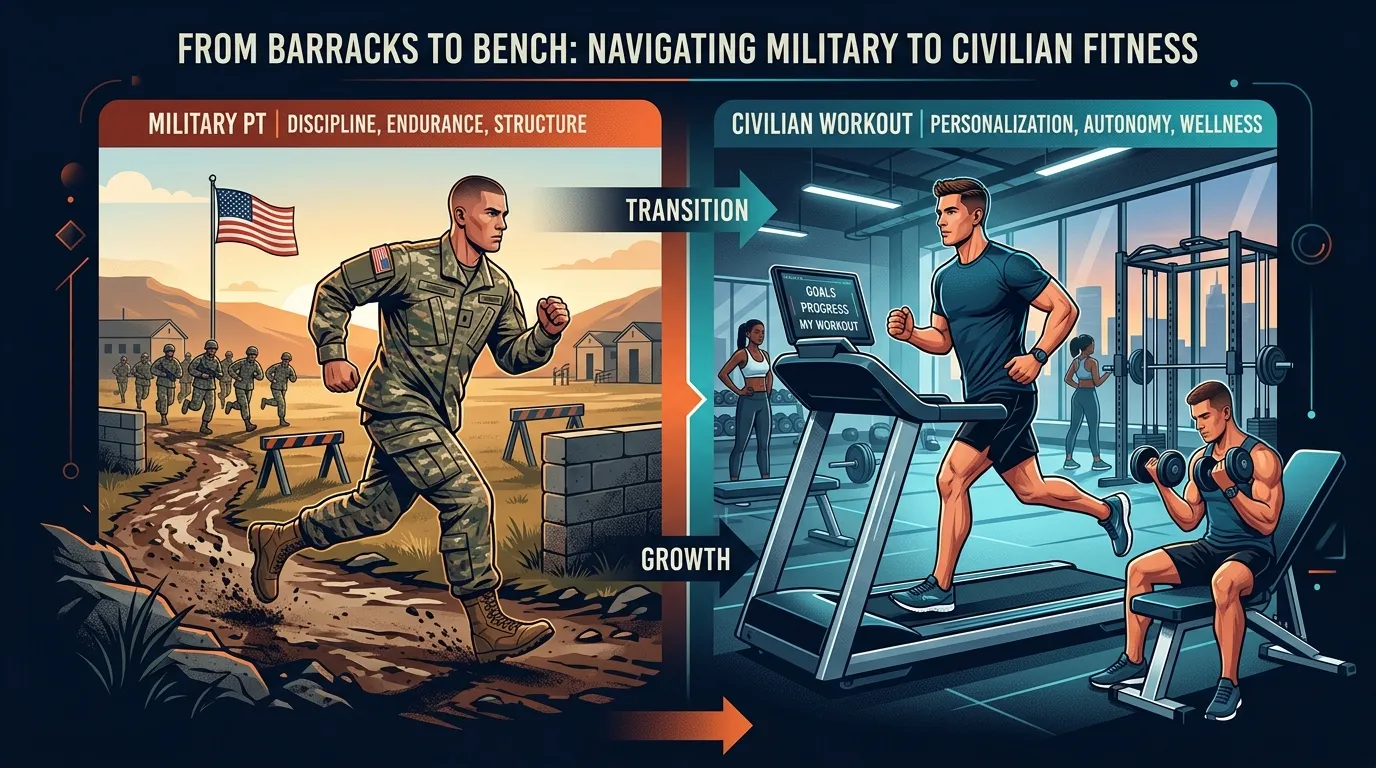
In the military, fitness was built into your life. You didn't have to choose to work out — it was scheduled, mandatory, and social. After separation, all of that structure disappears overnight. You go from daily PT to nothing, and the civilian fitness world expects you to self-motivate from scratch. That transition gap is where most veterans fall off.
Geographic Isolation
Not every veteran lives near a VA facility or a well-equipped gym. Rural veterans, in particular, face limited options for in-person fitness programs. Any effective solution needs to work from home, with minimal or no equipment.
Age and Health Conditions
The average veteran in the VA-funded trial was 56.5 years old with a BMI of 33. This is representative of a large portion of the veteran population. Programs designed for 25-year-olds won't work for someone managing weight, joint health, and the normal challenges of aging — all on top of service-related conditions.
How Gamification Addresses These Barriers
The VA-funded research didn't choose gamification randomly. It was selected because it directly addresses the barriers that make veterans struggle with fitness:
Accountability Without a Drill Sergeant
In the military, external accountability kept you on track. In civilian life, that accountability vanishes. Gamification rebuilds it through a different mechanism: loss-framed motivation. The clinical trial used a system where veterans had points to protect — creating a sense of stakes around daily activity. Streaks, progress tracking, and support partner updates serve the same function: they make inactivity feel like a cost, not just a missed opportunity.
Structure That Replaces Military PT
The transition gap is fundamentally a structure problem. Gamification provides a framework — daily goals, progressive challenges, visible milestones — that replaces the external structure of military fitness with an internal one. You're not following orders. You're pursuing objectives. And for veterans, that distinction matters.
Remote Delivery
The VA-funded trial delivered its intervention remotely, which is critical. Veterans don't need to commute to a gym or live near a VA facility. A phone-based gamified program meets you where you are — at home, on your schedule, with whatever equipment you have.
Motivation That Doesn't Depend on Willpower
PTSD, depression, chronic pain — these drain willpower. On your worst days, willpower is the first thing to go. Gamification doesn't rely on willpower. It creates pull through reward systems, progress visibility, and loss aversion. The VA-funded trial showed this works even in a population dealing with significant health challenges. The 1,224-step-per-day increase wasn't driven by motivation speeches. It was driven by smart system design.
See what the research looks like in practice
Take the free 2-minute assessment. It maps your fitness level, injuries, equipment, and goals — then builds an evidence-based plan designed for your situation.
Take the Free Assessment Free · 2 minutes · No credit card
How FitCraft Applies This Research
FitCraft was built on the same principles validated by the VA-funded research — gamification, behavioral economics, and adaptive programming. Here's how it translates to your daily experience:
- Adapts to injuries and limitations. FitCraft's 32-step diagnostic assessment identifies your injuries, mobility restrictions, and pain points before you do a single rep. Your AI coach Ty builds a program that works around your limitations — not through them. Whether it's a bad knee from airborne, a shoulder from years of rucking, or chronic back pain, your program is built for your body as it is today.
- Works from home, no equipment needed. Like the VA-funded trial, FitCraft delivers everything remotely. No gym required. No commute. No crowded locker rooms. Your living room, garage, or backyard is your training ground. FitCraft adapts to whatever equipment you have — including none at all.
- Streak-based accountability. The VA trial used loss-framed motivation because it works. FitCraft's streak system creates the same dynamic: every day you show up, your streak grows. Every day you skip, you risk losing it. It's the same psychological mechanism that produced the 1,224-step increase in the clinical trial — applied to a complete fitness program.
- AI coaching that meets you where you are. Whether you're 35 and dealing with a knee injury or 60 and managing weight plus joint health, Ty builds a program calibrated to your reality. Session length adapts to your available time. Exercise selection adapts to your equipment and limitations. Progression adapts to your recovery capacity. No two programs are the same.
- Designed by an Ivy League-trained exercise scientist, NSCA-certified strength coach. Every program follows evidence-based principles of progressive overload, periodization, and exercise selection. This isn't random exercises thrown together. It's structured programming — the kind of intentional design that separates results from wasted effort.
- Gamification that creates consistency. Streaks, quests, collectible cards, and avatar progression tap into the same reward loops validated by VA-funded research. You're not relying on discipline alone. You have a system designed to make you want to show up — even on the days when motivation is low and your body hurts.
The VA-funded research proved that gamification significantly increases physical activity among veterans. FitCraft puts that research into practice — every single day, personalized to your body, your injuries, and your goals.
The Bottom Line
You've Already Proven You Can Do Hard Things
You served your country. You endured training, deployments, and sacrifices that most people can't imagine. The discipline is already in you. What you need isn't more willpower — it's a system designed for your reality.
VA-funded clinical research shows that gamification combined with behavioral economics produces significant increases in physical activity among veterans — +1,224 steps per day in a rigorous randomized controlled trial. That's not marketing. That's JAMA Network Open.
You deserve an evidence-based approach that respects your service, adapts to your body, and actually works. The research says it exists.
Frequently Asked Questions
Is gamification effective for veteran fitness programs?
Yes. A VA-funded randomized controlled trial published in JAMA Network Open (2021, n=180) found that gamification combined with behavioral economics produced a significant increase of 1,224 steps per day (P=.005). The approach also significantly improved goal-day achievement (P<.001). These findings support gamification as a powerful tool for increasing physical activity among veterans.
What are the biggest fitness barriers veterans face?
Veterans face unique barriers including service-related injuries and chronic pain, PTSD and mental health challenges that reduce motivation, difficulty transitioning from structured military fitness to civilian exercise routines, geographic isolation from VA facilities, and age-related limitations. Effective programs must adapt to these realities rather than offering one-size-fits-all solutions.
Can veterans with service-related injuries use fitness apps?
Absolutely. The key is using a program that adapts to individual limitations rather than forcing a one-size-fits-all approach. FitCraft's AI coach Ty builds personalized programs based on a 32-step diagnostic assessment that accounts for injuries, mobility restrictions, and available equipment. Every program is designed by an Ivy League-trained exercise scientist, NSCA-certified strength coach with safe progressions built in.
Why does the VA recommend physical activity for veterans?
The VA recommends regular physical activity because research consistently shows it improves both physical and mental health outcomes for veterans. Exercise reduces symptoms of PTSD and depression, manages chronic pain, improves cardiovascular health, and enhances overall quality of life. VA-funded research has explored gamification and behavioral economics as tools to help veterans actually stick with it.
How does FitCraft help veterans stay consistent with exercise?
FitCraft uses the same evidence-based principles validated in VA-funded research: gamification, accountability through streaks and progress tracking, and behavioral economics. The app adapts to service-related injuries, works from home with no equipment required, and provides AI coaching that adjusts to your fitness level and limitations. Programs are designed by an Ivy League-trained exercise scientist, NSCA-certified strength coach, so progressions are safe and effective regardless of your starting point.