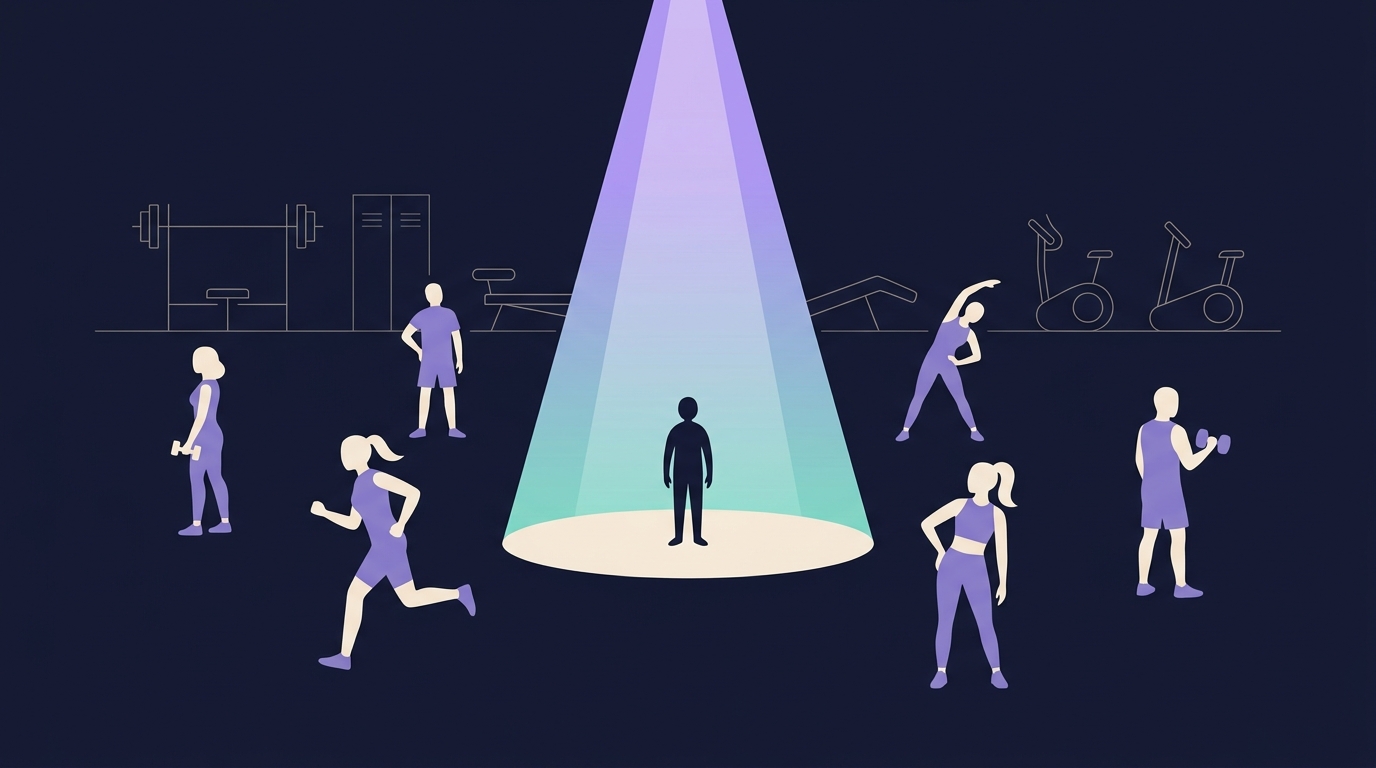
You told yourself this would be the week you finally went. You looked up the hours. You picked an outfit. Maybe you got as far as the parking lot. And then something kicked in: a tightness in your chest, a voice saying everyone would look, a sudden certainty that you'd use a machine wrong in front of people who'd know.
So you drove home. Again.
That reaction is not laziness and it is not a character defect. It is a predictable response to a specific kind of environment, it has been studied, and it responds to specific fixes. This guide covers what gym anxiety is, why it happens, the tactics that actually reduce it, and the home-first route that works well for a lot of people. If your worries about exercise run broader than the gym, our guide on training with anxiety and depression covers that ground.
Gym Anxiety Is More Common Than It Feels
When you're standing in the parking lot, it feels like a personal failing. It isn't. It is one of the most frequently reported barriers to joining a gym at all.
A 2026 paper by Francis Quinn in Frontiers in Sports and Active Living examined social gym intimidation and anxiety directly. It cited a 2025 UK market research survey of non-gym members, representative of the population, in which 47% agreed with the statement that they felt uncomfortable at the thought of joining a gym or leisure facility, and 32% agreed they would feel negatively judged if they joined. A further 17% reported feeling unsafe because of the threat of harassment or intimidation.
Read that again: among people who had not joined a gym, close to half said the very idea of joining made them uncomfortable. You are not the strange one in the parking lot. You're closer to the middle of the distribution.
Researchers have a more precise term for part of what's going on. Social physique anxiety describes the anxiety a person feels when they believe others are evaluating their body. Work by Sabiston and colleagues in the Journal of Adolescent Research (2007) explored how adolescents cope with it, and documented avoidance as one of the strategies people reach for. That detail matters, because it explains the shape of the problem: social physique anxiety rarely announces itself as panic. It shows up as simply not going. Later work by Brunet and Sabiston (2009) in Psychology of Sport and Exercise examined the same anxiety in relation to physical activity motivation.
What Gym Anxiety Actually Feels Like
It doesn't usually look like a panic attack. For most people it's quieter than that, which is exactly what makes it easy to explain away.
- Avoidance dressed up as logic. "I'll go tomorrow when it's less busy." "I should get in slightly better shape first." "I need to research a program before I start." Each one sounds sensible. They just happen to repeat forever.
- Hyperawareness. From the moment you walk in you're conscious of what you're wearing, how you're standing, whether you're doing this right.
- Comparison spiralling. Someone nearby is lifting something heavy or running effortlessly, and your brain immediately files you under "does not belong here."
- Physical symptoms. Raised heart rate, sweaty palms, a tight chest, sometimes nausea, all before you've warmed up. Your body is responding to a perceived social threat.
- Cutting the session short. You go, but you use the one machine you understand, avoid the free weight area completely, and leave after fifteen minutes.
If several of those landed, good. Naming the thing is the part that makes it workable.
Why You Feel So Anxious at the Gym
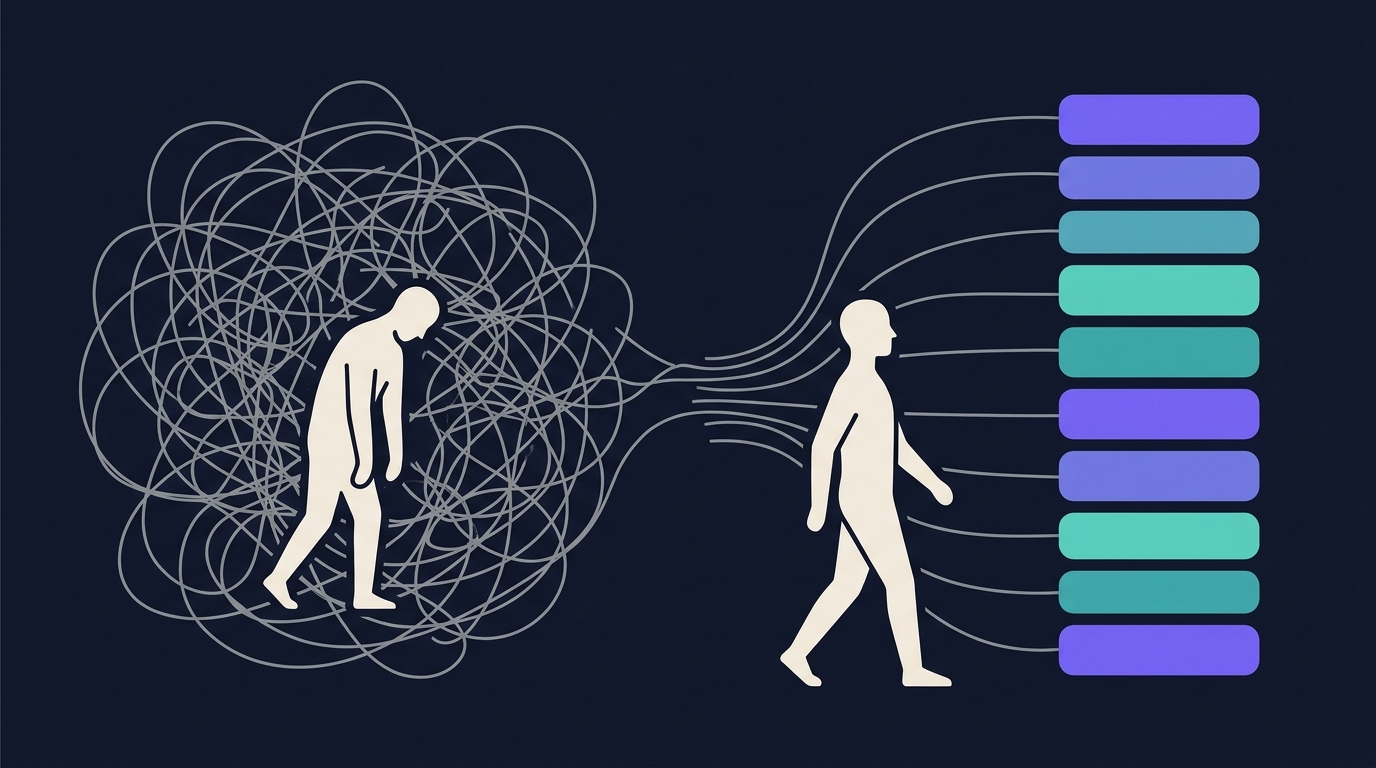
Three things tend to stack on top of each other. Understanding them makes the tactics in the next section make sense, rather than feeling like a list of tricks.
1. The spotlight effect
People consistently overestimate how much other people notice them. This is a documented cognitive bias, and the original experiments are unusually clean. In Gilovich, Medvec and Savitsky (2000), published in the Journal of Personality and Social Psychology, participants were asked to wear an embarrassing T-shirt into a room of other people and then estimate how many had noticed it. They guessed roughly 46%. The actual figure was about 23%. People thought they were about twice as conspicuous as they were.
The gym is a near-perfect setting for that bias to run hot. You're physically active, in fitted clothing, in a room full of strangers, doing something you don't feel good at yet. Your internal estimate of how much attention you're attracting is running about double the truth. Meanwhile the person you're worried about is between sets, counting, or looking at their phone.
2. Being a visible novice in public
Most skills can be learned privately. You can be bad at cooking, at a language, at spreadsheets, and nobody watches you be bad at it. The gym is one of the few places where being a beginner is on open display: how much weight is on your bar is legible from across the room, and so is your technique.
That's a real asymmetry, not an imagined one. Acknowledging it honestly is more useful than being told your fear is irrational, because the fix is not to argue with the feeling. The fix is to shrink the window in which you are a visible novice, which is exactly what learning movements somewhere private does.
3. Not knowing what to do
A large share of gym anxiety is not social at all. It's procedural. You don't know which machine to start on, whether that bench is taken, whether you're meant to wipe it down, how many sets to do, or where to stand while you figure it out. Wandering between machines trying to look purposeful is genuinely uncomfortable, and it's uncomfortable for a mundane reason: you have no script.
This is the most fixable of the three, and fixing it tends to take a surprising amount of the sting out of the other two.
How to Overcome Gym Anxiety: Tactics That Work
Every tactic below does the same underlying job. It removes an unknown. Start with the top of the list, which is the cheapest and highest yield.
Write the session down before you leave the house
Decide the exercises, the order, the number of sets, and the reps while you're still at home. Put it in your phone notes. Now the gym is not a place where you make decisions under observation. It's a place where you execute a list you already made in private. This single change removes most of the procedural anxiety, and it has the side effect of making you move with visible purpose, which feels considerably better than drifting.
Go at off-peak hours
Weekday mid-morning through mid-afternoon is usually quietest, along with early mornings on weekends. Fewer people means less perceived exposure, no waiting for equipment, and room to work something out without feeling rushed. This is not avoidance. You're still going. You're choosing conditions that give the visit a decent chance of going well, which is what makes the next visit likelier.
Start on machines, not in the free weight area
Machines have a fixed path of motion, usually a diagram on the frame, and a much lower chance of being used obviously wrong. They are the low-stakes on-ramp of any gym floor. Build a first month out of machines and cardio equipment, and treat the free weight area as somewhere you graduate to once the building itself has stopped feeling like an event.
Wear headphones
Headphones are the near-universal signal that you're not looking for conversation, they cut ambient noise that can feel overwhelming, and they give your attention somewhere to go other than self-monitoring. Build a playlist you actually like and start it in the car park, so the session begins before you walk through the door.
Do a recon visit
Go in once with no intention of training. Take the tour, find the changing rooms, look at where the machines are, then leave. You've now converted the single biggest unknown, the building itself, into a known quantity, and you did it without having to perform anything. The first real session becomes a second visit rather than a first.
Anchor to one thing you already know
Walking in with a full program you've never done is a lot. Walking in able to do one thing competently is very different. Pick a single movement you've practised, do that first, and build the rest of the session around it. Competence at one thing is enough to stop the room feeling like a test.
Bring someone, if that helps you
For some people a training partner dissolves the problem entirely, because you're now a small group rather than a lone stranger. For others it adds a second person whose opinion you're managing. You know which one you are. If a friend helps, use one. If it would make you more self-conscious, skip it and don't treat that as a failure.
Find out what's really holding you back
FitCraft, our mobile fitness app, pairs you with an AI coach who builds you a personalized plan around your goals, schedule, and fitness level. Every FitCraft program is designed by Domenic Angelino, MPH (Brown University) and NSCA-CSCS, with research published in the Journal of Strength and Conditioning Research and Medicine & Science in Sports & Exercise.
Take the Free Assessment Free • 2 minutes • No credit card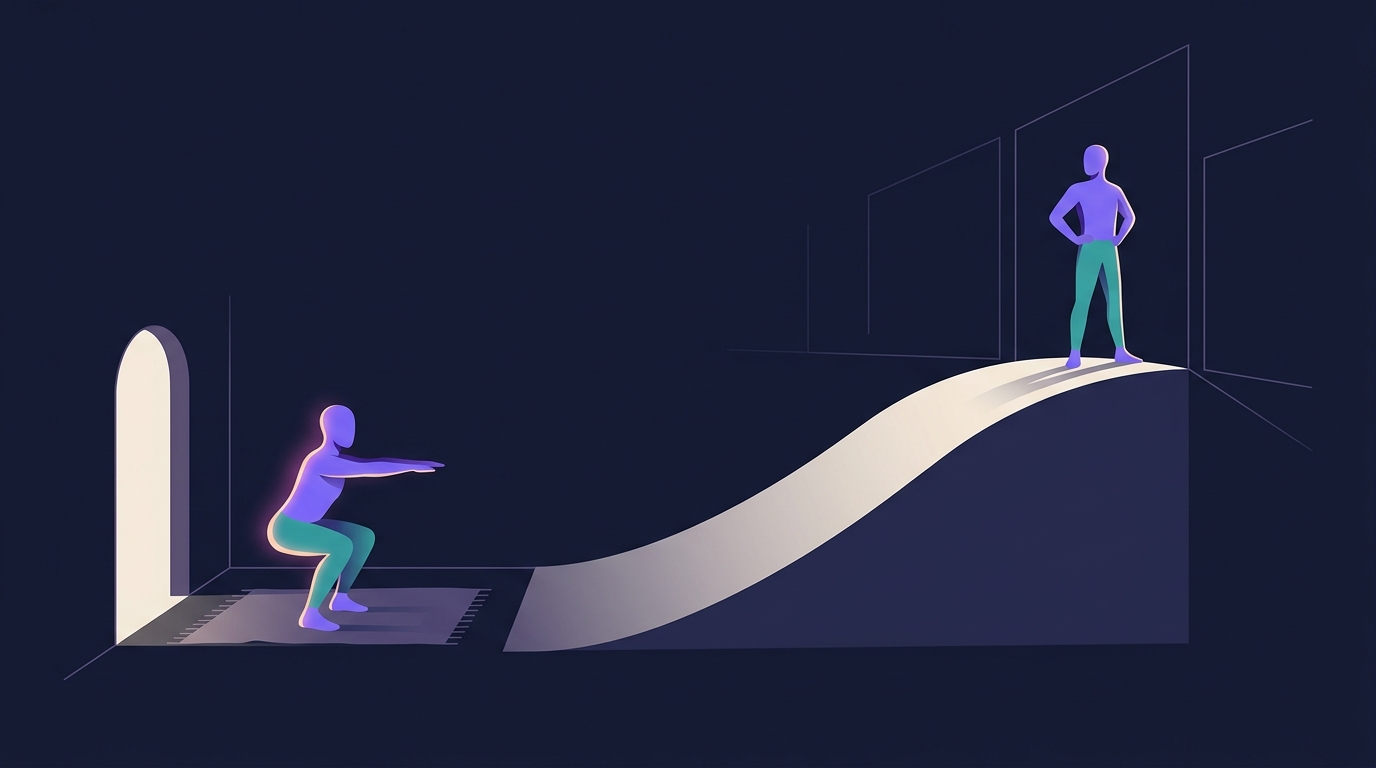
The Home-First Path: Build Competence Before You Need Courage
Most advice about gym anxiety amounts to "just go, and push through it." That works for some people. For a lot of others it is the same instruction that has failed them every January for a decade, and repeating it louder doesn't help.
There's a more practical sequence available: take the gym out of the equation to start with. Build the exercise habit somewhere nobody is watching, learn what the basic movements feel like in your own body, and get to the point where training is just a thing you do. Then decide whether you want a gym at all.
This works for a specific reason rather than a motivational one. Two of the three drivers above, being a visible novice and not knowing what to do, are problems of competence. Competence is buildable in private. When you eventually walk into a gym having already done a hundred squats in your living room, you are not a beginner in public. You're someone who trains, using a new venue. That's a completely different psychological position, and the spotlight effect has much less to work with.
The practical requirement is that the movements need to be taught properly, because practising something wrong at home for three months is its own problem. This is where a structured app earns its place. FitCraft teaches technique rather than just logging sets: the exercises are shown on interactive 3D demos you can rotate and zoom to see what a movement should actually look like from any angle, and your AI coach is a 3D character who talks you through the session and adapts the plan as you progress. The workouts run on bodyweight, resistance bands, or dumbbells, so no gym is required to start, and the multi-week programs mean you're never inventing a session from scratch.
If that's the route you want, our roundup of the best home workout apps for gym anxiety ranks the options built for training entirely at home, and the no-equipment home workout app page covers what a zero-equipment start looks like. If you're starting from a standing start, how to start working out with zero fitness and our home workouts guide are the right first reads, and the beginner side of FitCraft is built for exactly this.
None of this is an argument that gyms are bad. Gyms are excellent, and heavier loading eventually matters if you want to chase maximal strength. It's an argument about sequence. The gym works much better as somewhere you grow into than as a gate you have to force yourself through before you're allowed to start.
When the Anxiety Is Bigger Than the Gym
Everything above assumes the anxiety is situational: it shows up in gyms, and it fades as gyms become familiar. For a lot of people that's accurate, and the tactics are enough.
Sometimes it isn't. If the fear of being watched or judged shows up across many areas of your life rather than just the gym, if you've been avoiding social situations broadly, if it's persisted for months, or if it's meaningfully limiting what you do, that's a different thing from gym nerves. Social anxiety disorder is common and it is treatable: the National Institute of Mental Health estimates that around 7.1% of US adults experienced it in the past year and about 12.1% experience it at some point in their lives.
This guide is about exercise, and it is not a substitute for assessment or treatment. If any of the above sounds like your situation, please raise it with a doctor or a mental health professional. That's not an escalation or an admission of anything. It's the same logic as seeing a physio for a knee that isn't getting better on its own, and effective treatments exist. Exercise can support mental health, and our review of what the research shows about exercise and anxiety covers that evidence, but supporting your mental health and treating an anxiety disorder are two different jobs.
The Real Obstacle Usually Isn't the Gym
Here's the thing gym anxiety distracts you from: for most people the building was never the actual blocker. The missing piece is a system.
When you don't have a plan, don't know which exercises to do, and don't have a structure that survives contact with a busy week, every single workout becomes a decision. And a decision is an opportunity to opt out, which anxious brains are extremely good at taking. That's why willpower is such an unreliable foundation, something we covered in the research on willpower, and why the people who stick with training tend to be running a streak they don't want to break rather than white-knuckling each session. If the pattern of starting and stopping is familiar, why you quit unpacks it.
You don't need to become braver. You need fewer unknowns and a plan you didn't have to invent this morning.
Frequently Asked Questions
How do I get over gym anxiety?
Reduce the number of unknowns before you walk in. Write your session down in advance so you never have to decide what to do on the floor. Go at off-peak hours, usually mid-morning to mid-afternoon on weekdays. Start on machines, which have a fixed path of motion and are easier to use correctly than free weights. Wear headphones. Keep the first few visits short and boringly repeatable. Many people also find it easier to learn the movements at home first, so they arrive already knowing what a squat or a row feels like.
Why do I feel so anxious at the gym?
Three things usually stack up at once. First, the spotlight effect: people systematically overestimate how much others notice them. In the original 2000 experiments by Gilovich, Medvec and Savitsky, participants wearing an embarrassing T-shirt guessed that roughly 46% of observers had noticed, when the real figure was about 23%. Second, you are a visible novice in public, and the gym is one of the few places where your inexperience is on open display. Third, you may not know what to do, and not knowing the script makes any environment feel threatening.
Is gym anxiety normal?
Yes, and it is well documented. A 2026 paper by Francis Quinn in Frontiers in Sports and Active Living examined gym intimidation and cited a 2025 UK market research survey of non-gym members in which 47% agreed they felt uncomfortable at the thought of joining a gym and 32% agreed they would feel negatively judged if they joined. Feeling this way is a common response to a specific environment, not a character flaw.
What is gym intimidation?
Gym intimidation is the everyday name for feeling out of place, watched, or judged in a gym environment. It overlaps with a research concept called social physique anxiety, which describes anxiety that arises when a person believes others are evaluating their body. Research on social physique anxiety in adolescents by Sabiston and colleagues, published in the Journal of Adolescent Research in 2007, documented avoidance as one of the coping strategies people reach for, which is why gym intimidation so often shows up as simply not going.
Can I get fit without ever going to a gym?
Yes. Bodyweight work, resistance bands, and a pair of adjustable dumbbells cover the large majority of what a general fitness goal requires. Gyms offer heavier loading and more equipment variety, which matters if you want to pursue maximal strength, but they are not a requirement for building muscle, improving cardiovascular fitness, or losing fat. For many people the gym is best treated as an option to grow into rather than a gate to get past.
Does gym anxiety go away?
For most people it fades as the environment becomes familiar and the routine becomes automatic, because much of the anxiety comes from novelty and uncertainty rather than from the gym itself. How quickly that happens varies from person to person. If the anxiety is severe, persists across many settings beyond the gym, or is significantly limiting your life, that is worth raising with a qualified healthcare provider rather than trying to push through alone.