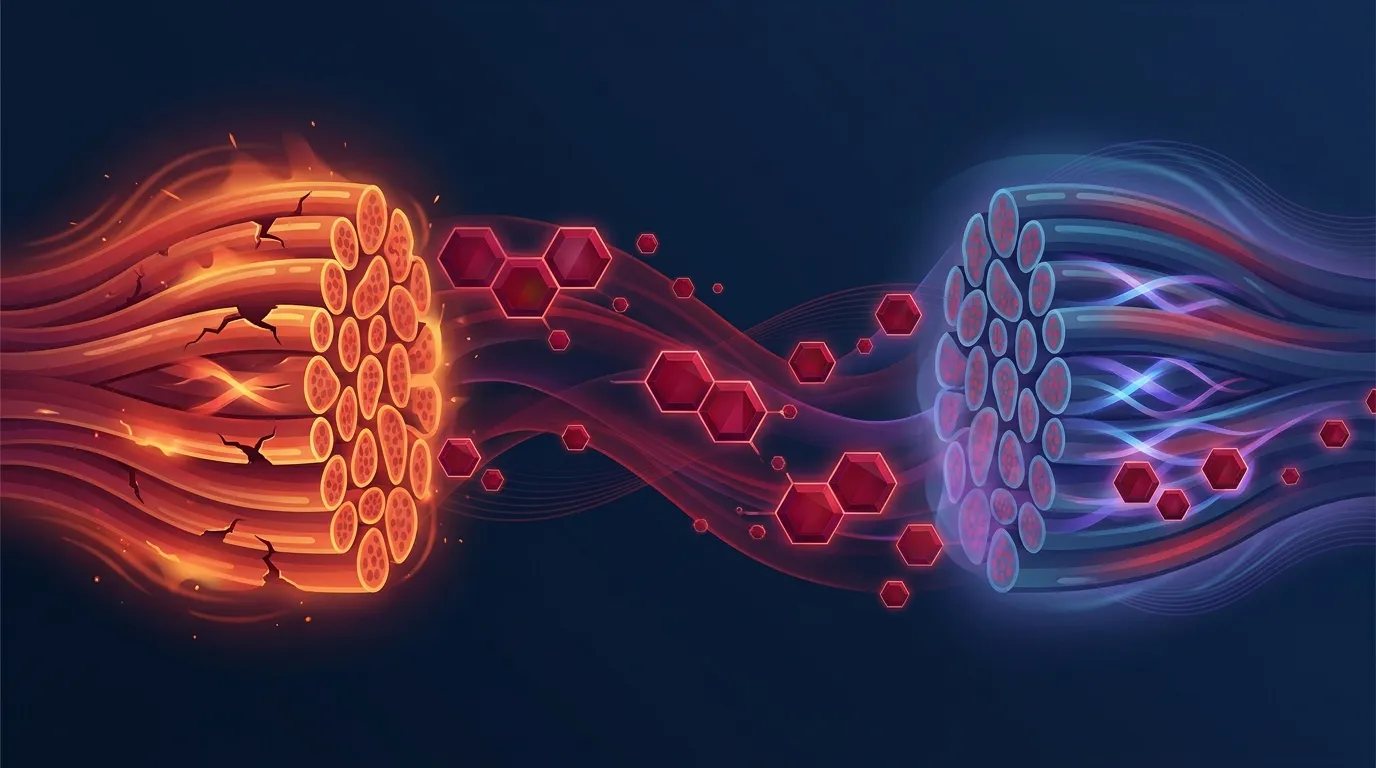
If you've ever finished a marathon or a punishing leg day and wondered why your quads still feel wrecked three days later, you've met the recovery problem the tart cherry literature exists to solve. Hard eccentric exercise (running downhill, controlled negatives, long rides with high cadence variability) damages muscle fibers in a way steady-state cardio does not. The following 24 to 72 hours are a bath of inflammation, oxidative stress, and mechanical weakness. Your legs make less force. Your soreness peaks. And your next workout suffers because of it.
Tart cherry juice, and specifically the Montmorency variety, has been studied against that recovery problem for about 15 years. The literature is now substantial: a 2026 systematic review pooled 19 trials, an earlier 2025 review pooled 10, and roughly a dozen individual studies span marathon runners, cyclists, resistance-trained athletes, and older adults. The pooled result is that tart cherry juice reliably improves how much strength you keep after damaging exercise, and reliably lowers a specific slice of the inflammatory response. What it does not do, at least consistently, is make you feel less sore or drop creatine kinase to normal.
This article walks through the primary studies, what the effect actually looks like on the day-to-day level, who responds most, and when using it may quietly cost you gains.
The Research: What Studies Show
Howatson 2010: The Marathon Study
The tart cherry recovery literature has a clear origin. Howatson, McHugh, and colleagues (2010), publishing in the Scandinavian Journal of Medicine and Science in Sports, gave 20 recreational marathon runners either tart cherry juice or a matched placebo for 5 days before, the day of, and 48 hours after a marathon. The cherry group recovered isometric strength faster over the 48-hour post-race window, showed lower inflammatory markers (IL-6, high-sensitivity C-reactive protein), and had lower oxidative-stress markers than placebo.
Two features of Howatson's design matter for how the field evolved. First, the protocol was a load, not a single dose. Cherry juice twice daily for a week around the race. Second, the outcome that showed the biggest effect was not soreness. It was strength recovery. Runners in the cherry group produced closer-to-baseline maximal voluntary isometric contraction the day after the race, while the placebo group was still down significantly. That distinction, function vs. feeling, keeps showing up.
Kuehl 2010: Muscle Pain During Running
Published the same year, Kuehl, Perrier and colleagues (2010) in the Journal of the International Society of Sports Nutrition ran a slightly different design. Fifty-four runners drank either tart cherry juice or a placebo for 7 days before and the day of a long-distance relay race (the Hood to Coast). The primary outcome was self-reported muscle pain post-race.
The cherry group reported significantly less pain than the placebo group after the run. That's the study most sports-nutrition writers cite when they claim tart cherry juice reduces soreness, and in that specific context it did. But it's worth noting that the Kuehl finding on soreness has proven harder to replicate than Howatson's finding on strength. The subsequent meta-analyses (2025 in Annals of Medicine and Surgery, 2026 in Sports Medicine – Open) both found the muscle-function benefit is robust across trials while the soreness benefit is smaller and less consistent.
Bell 2014 and 2016: The Cycling Trials
Bell, Walshe, Davison, and Howatson (2014), publishing in Nutrients, ran a 4-day simulated cycling race protocol with 16 well-trained male cyclists. Each subject drank Montmorency tart cherry concentrate or an isocaloric placebo for 7 days total, spanning three days of increasingly hard cycling. The cherry group showed significantly attenuated increases in inflammatory markers (IL-6, hs-CRP) and oxidative-stress markers (lipid hydroperoxides fell by roughly 30% versus placebo) across the race protocol.
Two years later, the same group (2016) extended the cycling work with prolonged intermittent exercise (a 109-minute simulated soccer-style protocol). Cherry supplementation again preserved isometric muscle function and reduced markers of muscle damage over the recovery window. The mechanism was consistent: less inflammation, less oxidative stress, better retained mechanical function.
The 2025 and 2026 Meta-Analyses
By the mid-2020s, the literature was big enough to pool rigorously. A 2025 meta-analysis in Annals of Medicine and Surgery (Dehghani et al., 2025) included 10 trials and found tart cherry juice significantly improved maximal voluntary isometric contraction recovery by about 9% versus placebo, and lowered IL-6 and IL-8. It found no significant effect on creatine kinase, C-reactive protein, IL-1β, tumor necrosis factor-alpha, or self-reported soreness on visual analog scales.
The 2026 meta-analysis in Sports Medicine – Open (2026) pooled 19 trials and replicated that pattern. Muscle function recovery: significantly better on tart cherry. Circulating IL-6 and IL-8: significantly lower. Creatine kinase and self-reported soreness: no significant difference. That's the honest current summary. Tart cherries help your muscles work sooner, but they don't make you feel dramatically better.
How Tart Cherry Juice Actually Works
Montmorency cherries are one of the densest natural sources of anthocyanins, a subclass of flavonoid polyphenols responsible for the deep red pigmentation. Anthocyanins have direct antioxidant capacity, but the more interesting mechanism is signaling. They appear to modulate the NF-κB inflammatory pathway, which is the master regulator of the inflammatory cascade after tissue damage. Down-regulate NF-κB signaling, and downstream cytokines (IL-6, IL-8) rise less. Less cytokine amplification means less secondary damage to muscle tissue and faster restoration of mechanical function.
That mechanism explains why the effect is biggest in eccentric-heavy exercise. Concentric-only work (cycling on flat terrain, elliptical) produces less mechanical muscle damage. Downhill running, marathon-distance running, prolonged intermittent sport, and heavy resistance training produce the largest damage response, and therefore the biggest headroom for an anti-inflammatory intervention to move the needle. Studies with pure cycling protocols still show benefit because prolonged high-intensity work produces enough inflammatory response to matter. But the biggest published effect sizes come from running and mixed-modality damage protocols.
The other reason the mechanism matters: it's the same reason the intervention has a downside. Post-exercise inflammation is not purely bad. Some of that cytokine signaling is what tells muscle to remodel and grow. Blanket-suppressing it around every workout, week after week, may reduce adaptation. This concern is the focus of the "when not to use it" discussion later.

Why This Matters for Your Fitness
The honest translation for a recreational athlete: tart cherry juice is a targeted tool, not a daily supplement. If you're training for a marathon, a hard cycling event, or you've stacked a race weekend with limited recovery time between efforts, loading tart cherry juice around those bouts probably lets you show up stronger on the second day and lets you feel less trashed the week after. That's meaningful.
If you're doing 3 to 4 moderate strength sessions a week and some easy zone-2 cardio, and you're not experiencing prolonged post-workout weakness that limits your next session, tart cherry juice will not change your outcomes much. The mechanical damage in that kind of training is not big enough to leave much headroom.
And if you're a lifter chasing hypertrophy, the calculation flips. You want the inflammatory response your training triggers, because that response is what signals muscle growth. Damping it down every session with anthocyanin-heavy anti-inflammatories is directionally the same problem that ice baths taken immediately after every strength session pose. Recovery aids that blunt inflammation are useful around events, less useful during accumulation blocks.
None of this replaces the boring truth that consistency beats optimization. A 9% strength retention advantage on a workout you skipped is still zero. The biggest predictor of fitness outcomes remains whether you keep stringing workouts together week after week. Pair the supplement with a program that gets you to show up, or the supplement does not matter.
Get an evidence-based plan built for you
FitCraft, our mobile fitness app, pairs you with an AI coach who builds you a personalized plan around your goals, schedule, and fitness level. Every FitCraft program is designed by Domenic Angelino, MPH (Brown University) and NSCA-CSCS, with research published in the Journal of Strength and Conditioning Research and Medicine & Science in Sports & Exercise.
Take the Free Assessment Free • 2 minutes • No credit cardHow to Use Tart Cherry Juice in Practice
Translating the trial protocols into a workable strategy:
- Target the load protocol, not a single dose. Roughly 480 ml (two 240 ml servings) of tart cherry juice per day, or the concentrated equivalent of 60 ml per day (30 ml twice daily). This is what Howatson, Kuehl, and Bell used across the strongest trials.
- Start 4 to 5 days before your hardest session. Anthocyanins need to build up in circulation before muscle damage occurs. Loading the day of an event alone is not the protocol that produced the published effects.
- Continue for 24 to 48 hours after. Post-exercise inflammation peaks 24 to 48 hours after damaging exercise. Extending the load window through that peak is what the marathon and cycling studies did.
- Split the dose morning and evening. All the successful protocols used a twice-daily dose rather than one big serving. This keeps anthocyanin availability steadier through the day.
- Concentrate is more practical than juice. Tart cherry concentrate delivers the same anthocyanin dose in about 30 ml (one shot) versus 240 ml of juice. Faster to drink, lower sugar per dose, easier to travel with. Look for products standardized to Montmorency cherries and check the anthocyanin content per serving.
- Do not use it every day, every week. Cycle the protocol around events, races, and hard training blocks. During accumulation phases where you're trying to build muscle or drive adaptation, blanket anti-inflammatory dosing may cost you the response you're training to trigger.
Individual Variation: Who Responds Most
Type of Exercise
The clearest moderator is how much eccentric muscle damage the session produces. Downhill running, marathon-distance running, prolonged intermittent sport (soccer, rugby, tennis tournaments), and high-volume resistance training all produce the largest damage response and the biggest published tart cherry effects. Flat-terrain cycling, easy zone-2 running, and short strength sessions produce smaller damage, so the anti-inflammatory intervention has less to do.
Training Status
Recreationally trained and moderately trained athletes tend to show clearer benefits than either the untrained or the elite. Untrained subjects experience so much damage from any hard bout that a nutritional intervention gets partly swamped. Elite athletes have highly adapted inflammatory-response systems that produce less baseline damage from equivalent relative work. Middle-of-the-bell-curve recreational athletes have the most room for a supplement to move the needle. The 2026 meta-analysis in Sports Medicine – Open flagged this pattern explicitly.
Age and Baseline Inflammation
Older adults (60+) show clearer benefit from anthocyanin-rich foods on inflammatory markers than younger adults do, presumably because baseline chronic inflammation is higher and there's more room to move. This is one of the reasons tart cherries also show up in sleep-quality and blood-pressure trials in older adults. For older adults training seriously, this makes tart cherry a stronger candidate as a routine ingredient rather than a targeted intervention.
Common Misconceptions
Misconception 1: "Tart cherry juice knocks out soreness."
The evidence on soreness is weaker than the marketing implies. Kuehl 2010 did find lower self-reported pain in relay runners, but the 2025 meta-analysis (Dehghani and colleagues) found no significant effect on visual-analog-scale soreness across pooled trials, and the 2026 Sports Medicine – Open meta-analysis reached the same conclusion. What tart cherry does reliably is help you keep more strength the day after damaging exercise. That's a different (and arguably more useful) outcome than "you feel less sore", but if the marketing sold you on soreness relief, expect a smaller effect than the ads promised.
Misconception 2: "Sweet cherries work the same way."
They don't, at least not at anywhere close to the same anthocyanin dose. Montmorency tart cherries are much richer in anthocyanins per gram than the sweet cherries you eat as a snack (Bing, Rainier, etc.). Almost all the published trials use Montmorency specifically. Substituting a bowl of sweet cherries or a glass of black-cherry soda gives you sugar, some polyphenols, and none of the studied dose. If a product label doesn't say Montmorency, assume the anthocyanin content is much lower and the evidence base does not apply.
Misconception 3: "More is always better."
The trial doses cluster tightly around 480 ml of juice or 60 ml of concentrate per day. Doubling the dose has not been shown to double the effect. And doubling the dose does double the sugar (about 30 g per 240 ml of juice, or 15 g per 30 ml of concentrate). If you're training for weight loss or watching added sugar intake for cardiometabolic reasons, this matters. The concentrate is the more sugar-efficient form, and staying near the trial-tested dose captures most of the benefit without overshooting on calories.
What the Research Suggests Going Forward
The tart cherry recovery literature is mature on the basics. The muscle-function benefit is robust. The inflammatory-marker effect is robust. The soreness effect is smaller than early studies suggested. What's still being actively studied:
- Whether chronic year-round use meaningfully blunts hypertrophy or endurance adaptations. The concern is mechanistically plausible and shows up in the ice-bath and high-dose antioxidant literature, but direct long-term data on tart cherry specifically is still thin.
- Whether the same protocol works for pure strength/hypertrophy training as it does for endurance events. Most trials use running and cycling. The resistance-training data is smaller and effect sizes on damage markers are more variable.
- Whether tart cherry stacks additively with other recovery interventions (compression, sleep protein, protein timing) or whether the pathways interfere.
- Whether the sleep benefit of tart cherries (via melatonin content and tryptophan availability) contributes independently to recovery. The sleep effect is documented but usually studied separately.
The takeaway for someone training today: tart cherry juice is a legitimate targeted recovery tool with real evidence behind it. Use it around your hardest sessions and races. Don't use it as a daily supplement during accumulation blocks where you want adaptation. And don't expect it to make you feel dramatically less sore. The benefit shows up in what your legs can do the next day, not in how they feel when you climb out of bed.

References
- Howatson G, McHugh MP, Hill JA, et al. "Influence of tart cherry juice on indices of recovery following marathon running." Scand J Med Sci Sports. 2010;20(6):843-852. doi:10.1111/j.1600-0838.2009.01005.x
- Kuehl KS, Perrier ET, Elliot DL, Chesnutt JC. "Efficacy of tart cherry juice in reducing muscle pain during running: a randomized controlled trial." J Int Soc Sports Nutr. 2010;7:17. doi:10.1186/1550-2783-7-17
- Bell PG, Walshe IH, Davison GW, Stevenson EJ, Howatson G. "Montmorency Cherries Reduce the Oxidative Stress and Inflammatory Responses to Repeated Days High-Intensity Stochastic Cycling." Nutrients. 2014;6(2):829-843. doi:10.3390/nu6020829
- Bell PG, Stevenson E, Davison GW, Howatson G. "The Effects of Montmorency Tart Cherry Concentrate Supplementation on Recovery Following Prolonged, Intermittent Exercise." Nutrients. 2016;8(7):441. doi:10.3390/nu8070441
- Daab W, et al. "Effects of Tart Cherry Juice Supplementation on Recovery from Exercise-Induced Muscle Damage in Athletes: A Systematic Review and Meta-Analysis." Sports Med Open. 2026. doi:10.1186/s40798-026-00993-3
Frequently Asked Questions
How much tart cherry juice should I drink for muscle recovery?
The dose used in the strongest studies is about 480 ml of tart cherry juice per day (240 ml twice daily), or the concentrated equivalent of roughly 30 ml of Montmorency cherry concentrate twice daily. Howatson and colleagues (2010) had marathon runners drink the juice for 5 days before, the day of, and 48 hours after the race. Bell (2014, 2016) used a similar loading protocol around simulated cycling races. Split the dose morning and evening, and start 4 to 5 days before your hardest session.
Does tart cherry juice actually work, or is it hype?
The effect on muscle function recovery is real. A 2026 systematic review and meta-analysis of 19 trials published in Sports Medicine – Open found tart cherry supplementation significantly improved maximal voluntary contraction recovery and reduced inflammatory markers IL-6 and IL-8 after damaging exercise. Effects on subjective soreness and blood markers like creatine kinase and C-reactive protein are smaller and less consistent. So the benefit is real, but it shows up more clearly in how much strength you keep than in how sore you feel.
How does tart cherry juice work for recovery?
Tart cherries are among the richest natural sources of anthocyanins, a class of polyphenol antioxidants that damp down inflammation and oxidative stress. Hard eccentric exercise damages muscle fibers and triggers a large inflammatory and free-radical response over the following 24 to 72 hours. Anthocyanins from tart cherries appear to reduce that response and let the muscle recover mechanical function faster. Bell and colleagues (2014) found tart cherry supplementation lowered oxidative stress markers by roughly 30% after repeated high-intensity cycling versus placebo.
When should I drink tart cherry juice for the best effect?
The evidence base uses a loading protocol, not a single acute dose. Most positive trials had subjects drink tart cherry juice for 4 to 7 days before the target session, on the day of, and for 24 to 48 hours after. That timing lets the anthocyanins build up in circulation before muscle damage occurs. A single glass an hour before a workout does not appear to be enough. If you know when your hardest session is (a race, a heavy leg day, a long ride), start the protocol 4 to 5 days out.
Should I take tart cherry juice every day, even on rest days?
Probably not, and probably not year-round. Post-exercise inflammation and oxidative stress are part of how muscle adapts and grows. A 2015 review in Sports Medicine flagged the concern that blanket anti-inflammatory strategies can blunt training adaptations over long periods. The smarter use is targeted: load tart cherry juice around events, hard training weeks, or during dense competition schedules where recovery beats adaptation. In normal training blocks where you're trying to build fitness, daily anti-inflammatory dosing may quietly cost you gains.