Type "make me a workout plan" into ChatGPT and you'll get something that looks professional in about four seconds. Three days a week, push-pull-legs or full body, sensible exercises, sets and reps in the right ranges. It's honestly not bad. And it's free, instant, and endlessly patient with follow-up questions.
So is that it? Personal training solved?
Not quite. The research on AI-generated training plans has grown fast since 2024, and it tells a consistent story: ChatGPT is a surprisingly accurate exercise encyclopedia, a mediocre program designer, and a nonexistent coach. Knowing where each of those lines sits will save you months of spinning your wheels. Let's take them in order, prompts included.
What ChatGPT Gets Right
Start with the good news, because it's real.
A 2024 study by Zaleski et al. in JMIR Medical Education evaluated AI-chatbot exercise recommendations for 26 different clinical populations against American College of Sports Medicine guidelines. The recommendations were 90.7% accurate. Where the plans fell down wasn't wrongness, it was incompleteness: only 41.2% of recommendations were comprehensive, meaning they covered all six components of a proper exercise prescription (frequency, intensity, time, type, volume, and progression).
The second consistent finding: quality scales with input. When Düking et al. (2024) had coaching experts rate ChatGPT-generated training plans for runners in the Journal of Sports Science and Medicine, no version was rated optimal, but plans generated from detailed athlete information scored dramatically better than plans from a bare request. The difference between a lazy prompt and a thorough one is the difference between a template and something approaching individualization.
In other words: ChatGPT's ceiling is decided by your prompt. So let's raise it.
The Prompts That Actually Work
The rule behind every prompt here is the same: give it what a real coach would ask you in a first session, and make it commit to specifics a template would leave vague.
1. The complete starter prompt
That last sentence matters more than any other. Forcing clarifying questions first mimics the intake conversation that the runner-plan study found was the main driver of quality. Effort targets in reps in reserve keep it from handing you the vague "3x10" that fits everyone and no one. If you would rather skip the prompting, our rule-based workout planner asks the same intake questions (goal, experience, days, equipment and session length) and builds the plan from published training research instead of a language model.
2. The progression prompt (use it weekly)
This prompt is the workaround for ChatGPT's biggest structural weakness, and we'll get to why it's only a workaround in a minute.
3. The exercise-swap prompt
4. The plateau prompt
5. The sanity-check prompt
Asking ChatGPT to attack its own plan catches a surprising number of gaps, precisely because the Zaleski study showed incompleteness, not inaccuracy, is its failure mode.
Knowing what to do is the easy part.
FitCraft, our mobile fitness app, pairs you with an AI coach who builds you a personalized plan around your goals, schedule, and fitness level. Every FitCraft program is designed by Domenic Angelino, MPH (Brown University) and NSCA-CSCS, with research published in the Journal of Strength and Conditioning Research and Medicine & Science in Sports & Exercise.
Take the Free Assessment Free • 2 minutes • No credit card
Where ChatGPT Workout Plans Fall Short
Use those prompts and you'll get ChatGPT's best. Now for the honest part: its best still has three holes that no prompt engineering closes.
It has no memory of your training
A workout plan is a hypothesis. The actual programming happens when reality reports back: you got 8 reps instead of 10, your knee complained, you skipped Thursday. A coach builds next week from that data. ChatGPT never sees it unless you manually paste it in, every session, forever. Prompt 2 above is exactly that: you doing a coach's data-entry job by hand. Most people stop pasting within two weeks, and the moment you stop, the "plan" is frozen paper.
It can't apply real progressive overload
ChatGPT will happily write "add 2.5 kg each week" next to your lifts. That's a rule, not progressive overload. Actual progression reacts to performed work: hold the weight when reps degrade, push when the bar speed says so, back off when three bad sessions stack up. The expert reviewers in the Düking study flagged exactly this: plans lacked individualized progression and adjustment logic. The text predicts. It doesn't measure.
It can't show you anything
Every instruction arrives as prose. If you've never done a Romanian deadlift, "hinge at the hips while maintaining a neutral spine" is a sentence, not a skill. TIME's fitness columnist ran this experiment and landed on the same conclusion: the plan looked fine, but the experience of being trained by a text box left everything that matters about execution up to you.
And the safety gaps are real if you have a condition
Two findings worth taking seriously. In the Zaleski study, most of the inaccuracy that did occur involved missing advice to get medical clearance before starting. And when Akrimi et al. (2025) had coaching experts assess ChatGPT-4o plans for simulated type 2 diabetes patients, most plans skipped medical check-up advice, and one recommended high-intensity exercise for a patient profile with proliferative retinopathy, where that's contraindicated. Healthy adults are mostly fine. Anyone with a condition should treat AI plans as a draft for their clinician, not a prescription.
The Part Nobody's Plan Solves
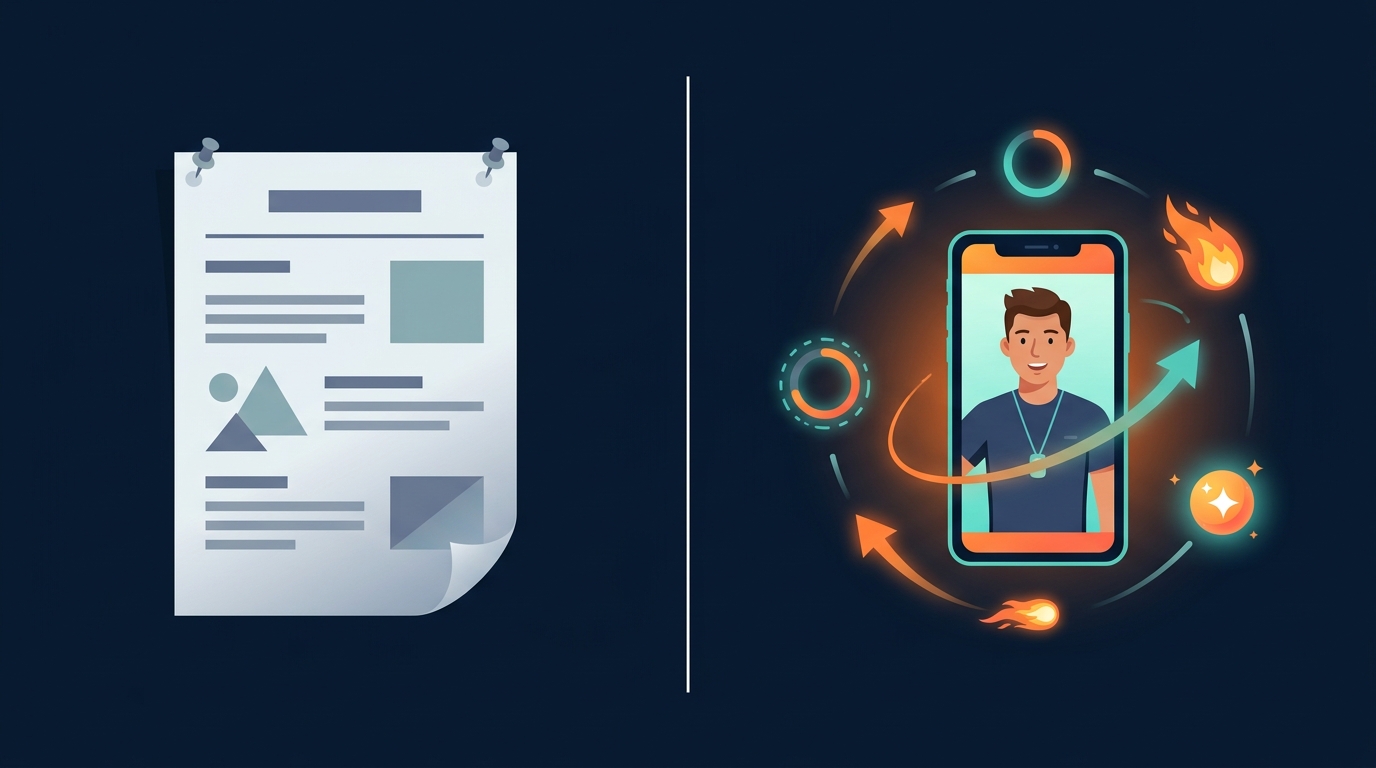
Here's the uncomfortable truth that applies to ChatGPT plans, PDF programs, and expensive one-on-one coaching alike: the plan is rarely why people fail. Adherence is. Most fitness attempts don't die from bad programming, they die quietly in week 3 when motivation drops and nothing pulls you back, a pattern we map in our engagement decay research.
That's a design problem, and it's the one place the research points somewhere specific: a 2022 meta-analysis of 16 randomized controlled trials by Mazeas et al. found gamified exercise interventions significantly increased physical activity, with effects persisting after the intervention ended, and the STEP UP trial (2019) in JAMA Internal Medicine showed competition-based gamification added roughly 920 daily steps for overweight and obese adults. Reward systems change behavior. A chat transcript doesn't.
When a Purpose-Built App Makes More Sense
To be fair to the chat window: for exercise Q&A, quick swaps, and understanding why a program is built a certain way, ChatGPT is genuinely excellent, and it costs nothing. Keep using it for that. I do.
But if the pattern you're trying to break is start-strong-quit-quietly, the tool needs to do the three things the chat can't. FitCraft was built as exactly that kind of tool. Your workouts are logged in the app automatically, and programs adapt as your progress advances, so progression runs on what you actually did rather than what you remembered to paste. An AI coach, a 3D character, demonstrates every exercise on an interactive model you can rotate and zoom, talks you through the session, and encourages you by name. And the gamification layer, streaks, XP, collectible cards, and calendar rewards, applies the same mechanics those randomized trials tested to the exact weeks where plans usually die. Programs themselves are designed by a credentialed human, not generated on the fly. For how that differs from a human trainer, see our honest comparison of AI trainers vs personal trainers and what an AI fitness coach actually does.
Use ChatGPT to get smarter about training. Use a system with memory to actually train. Those are different jobs, and pretending one tool does both is how the graveyard of abandoned plans keeps growing.
Frequently Asked Questions
Can ChatGPT create a good workout plan?
Yes, with caveats. Research shows ChatGPT's exercise advice is about 90% accurate, and plan quality improves substantially when you give it detailed information about your experience, equipment, schedule, and injuries. But expert reviewers consistently rate its plans as suboptimal, and it can't track your workouts, apply real progressive overload, or adapt the plan to your actual performance.
What should I include in a ChatGPT workout plan prompt?
Include your age, training experience, goal, available equipment, days per week, minutes per session, injuries or limitations, and exercises you hate. Then ask for a progression scheme and effort targets for each set. Research shows plan quality rises directly with the amount of relevant input information you provide.
Does ChatGPT remember my workouts?
Not reliably. ChatGPT has no built-in training log. Unless you manually paste your results into the chat every session, it has no idea what you lifted, how it felt, or whether you showed up at all, so it can't progress or adjust your plan the way a coach or a purpose-built training app does.
Is it safe to follow a ChatGPT workout plan?
For healthy adults doing moderate training, generally yes. The bigger risks show up around health conditions: studies found ChatGPT plans often skip medical-clearance advice, and in one evaluation it recommended high-intensity work for a simulated patient with a condition where that's contraindicated. If you have any medical condition, have a clinician review any AI-generated plan first.
What is better than ChatGPT for workout plans?
If you want programming that tracks what you actually do and progresses automatically, a purpose-built training app beats a chat window. FitCraft pairs expert-designed programs with an AI coach who demonstrates every exercise in 3D and a gamification system that keeps you consistent, which is the part of training where most plans, AI-written or not, actually fail.