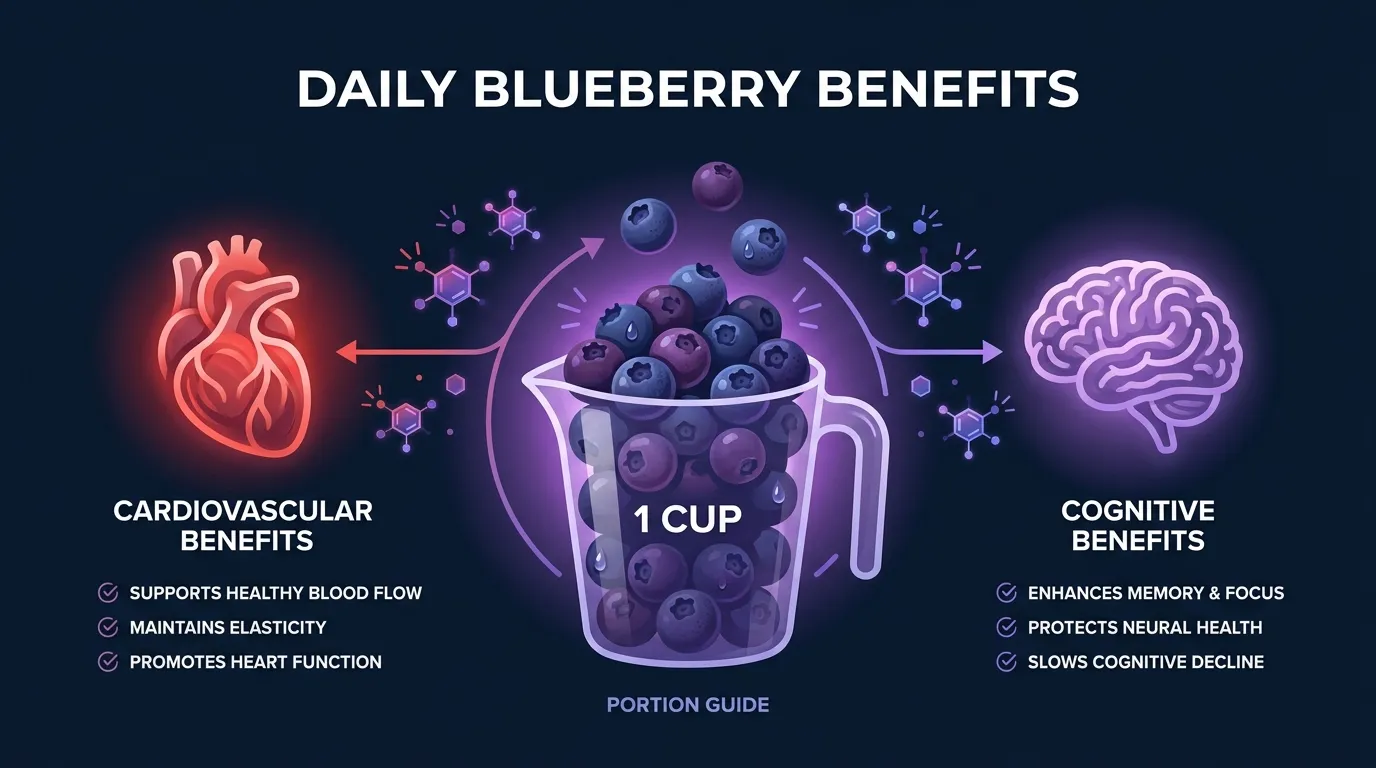
- One cup a day is the trial dose. Roughly 150 grams of fresh blueberries, or about 80 to 100 berries depending on size. This is the intake the heart-health and brain-health trials consistently use.
- Heart benefits show up at modest weekly intake. Cassidy et al. (2013), in Circulation, followed 93,600 women in the Nurses' Health Study II and found that the highest anthocyanin intake group had a 32% lower risk of myocardial infarction than the lowest, equivalent to about three or more half-cup blueberry servings per week.
- Cardiometabolic markers improve at one cup a day. Curtis et al. (2019), in the American Journal of Clinical Nutrition, randomized 115 adults with metabolic syndrome to one cup of freeze-dried blueberries daily for 6 months and saw improvements in arterial stiffness and HDL cholesterol.
- Brain trials are smaller, but consistent. Krikorian et al. (2010), in the Journal of Agricultural and Food Chemistry, gave older adults with early memory decline a blueberry-juice dose equivalent to about one cup of fresh berries for 12 weeks and saw improvements in paired associate learning and word recall.
- Eating "too many" is hard. No realistic intake is toxic. Very high single doses can cause gas or loose stools, and people on warfarin should keep vitamin-K intake consistent. Two or three cups a day is past the studied range with no known extra benefit.
The question lands on r/nutrition every couple of months. Someone notices they've worked up to half a pint of blueberries a day and starts to wonder if they're overdoing it. The replies range from "you can never have too many" to "you're spiking your blood sugar." Both are wrong in different directions. The trial literature on blueberries is actually pretty clean, and the answer that keeps showing up is a tidy one cup per day.
That one-cup number didn't get picked out of a hat. It's the dose researchers settled on after a decade of dose-finding trials, and it's where the cardiometabolic and cognitive endpoints start moving in randomized studies. Going much higher hasn't shown extra benefit in the studies that tried. Going much lower (a serving every few days) still helps at a population level for heart disease but doesn't move the cognitive needle in trials.
Here is the plan. We'll walk through what the heart-health trials actually measured. We'll cover the brain studies, which are smaller but consistent. We'll address the "can you eat too many" question with the actual side-effect data. And we'll close with practical guidance, including the fresh-vs-frozen question that comes up every time.
Why One Cup, and What That Actually Means
A US cup of fresh blueberries weighs about 148 grams, contains roughly 84 calories, 3.6 grams of fiber, and 14.7 grams of carbohydrate (mostly natural sugars). The polyphenol load is what makes the fruit interesting. Blueberries are one of the richest dietary sources of anthocyanins, the deep-purple pigments responsible for both their color and most of their measured health effects. A cup delivers roughly 100 to 200 milligrams of total anthocyanins depending on cultivar, ripeness, and storage.
That anthocyanin number is what links the trial doses across studies. Researchers report blueberry trials in three different units: grams of fresh berries (the typical participant instruction), grams of freeze-dried powder (equivalent to about 4 to 5 times the weight of fresh), and milligrams of anthocyanin (the bioactive load). One cup of fresh ≈ 25 to 30 grams of freeze-dried powder ≈ 100 to 200 milligrams of anthocyanins. That's the trial range, and it's what the modern recommendations are built on.
The Heart-Health Trials
The big-picture observational evidence comes from Cassidy and colleagues (2013) in Circulation. They followed 93,600 women aged 25 to 42 in the Nurses' Health Study II for 18 years, with detailed dietary assessments every four years. Women in the highest quintile of anthocyanin intake (mostly from blueberries and strawberries) had a 32% lower risk of myocardial infarction compared with the lowest quintile, after adjusting for established cardiovascular risk factors. The highest-quintile intake worked out to roughly three or more servings of blueberries or strawberries per week.
That's an association study, not a controlled trial, so it can't prove the blueberries themselves cause the lower risk. The randomized evidence comes from Curtis and colleagues (2019) in the American Journal of Clinical Nutrition. They randomized 115 adults with metabolic syndrome (a cluster of cardiovascular risk factors) into three groups for six months: one cup-equivalent of freeze-dried blueberries daily, a half-cup-equivalent daily, and a calorie- and fiber-matched placebo. The one-cup group showed sustained improvements in endothelial function (how blood vessels relax in response to flow), arterial stiffness markers, and HDL cholesterol. The half-cup group showed smaller, less consistent changes. The placebo group did not improve.
That dose-response signal is the cleanest argument for the one-cup target. A half cup wasn't enough to move the cardiometabolic biomarkers reliably. One cup was. Going higher hasn't been tested in a comparable long-term trial.
Berries also sit at the top of the weight-change rankings in the cohort data, which we cover in our guide to the best fruits for weight loss.
The Brain-Health Trials
The brain literature is smaller but it's been pointing in the same direction for over a decade. Krikorian and colleagues (2010), in the Journal of Agricultural and Food Chemistry, gave nine older adults with early memory complaints a daily dose of wild blueberry juice (about 6 to 9 milliliters per kilogram of body weight, roughly the polyphenol load of one cup of fresh berries for an average adult) for 12 weeks. The participants improved on paired associate learning (a memory task where you connect unrelated word pairs) and verbal recall compared with their baseline. The trial was small and uncontrolled, but it kicked off the modern blueberry-and-cognition line of research.

The cleaner randomized evidence in older adults came from Whyte and colleagues (2018) in Nutrients. They tested low-dose wild blueberry powder (equivalent to about a half cup of fresh berries) in healthy older adults and found both acute and chronic improvements in processing speed and mood. Smaller acute trials in children and young adults have shown similar short-term cognitive effects after blueberry intake, suggesting the mechanism isn't limited to age-related decline.
The proposed mechanism is partly vascular (anthocyanins improve cerebral blood flow) and partly direct (small amounts cross the blood-brain barrier and may interact with hippocampal signaling). The honest picture: the trials are smaller and shorter than the cardiovascular literature, and the effect sizes on cognition are modest. But the direction of effect is consistent across labs, and a daily cup is squarely in the dose range that has produced detectable benefits.
Knowing what to do is the easy part.
FitCraft, our mobile fitness app, pairs you with an AI coach who builds you a personalized plan around your goals, schedule, and fitness level. Every FitCraft program is designed by Domenic Angelino, MPH (Brown University) and NSCA-CSCS, with research published in the Journal of Strength and Conditioning Research and Medicine & Science in Sports & Exercise.
Take the Free Assessment Free • 2 minutes • No credit cardBlueberries, Recovery, and Exercise
A short detour worth knowing about. McAnulty and colleagues (2011), in Applied Physiology, Nutrition, and Metabolism, gave trained runners 250 grams of blueberries daily for six weeks plus an additional 375 grams on the morning of a 2.5-hour run, then measured immune and oxidative-stress markers before and after the run. The blueberry group had higher post-run natural killer cell counts and lower oxidative stress markers than the control group. The dose was meaningfully higher than typical daily intake, but the direction matches the broader pattern: high polyphenol intake around hard exercise may modestly help recovery.
If you're already training hard, a daily cup of blueberries (or any high-anthocyanin fruit like blackberries or tart cherries) is a sensible add-on. It is not going to compete with sleep, protein, or actual recovery time, but the cost is low and the supporting data is real. For more on the recovery hierarchy, see our piece on what actually helps post-exercise recovery.
Can You Eat Too Many Blueberries?
The short version: no realistic intake is toxic, but very high single doses can be uncomfortable. The fiber content (3.6 grams per cup) and the natural sugars (some of which are fermentable) can cause gas, bloating, and loose stools at intakes well above the trial range. People who jump from zero berries to three cups a day are the ones who tend to notice this. Ramp up gradually and the gut tends to adapt within a couple of weeks.
Three specific cautions are worth flagging. Blueberries are moderately high in vitamin K, so people on warfarin or other vitamin-K-sensitive blood thinners should keep their daily intake consistent rather than swinging from zero to large servings. People with a known berry allergy should avoid them. And people with calcium-oxalate kidney stones may want to keep intake moderate because blueberries contain oxalates, though the per-cup oxalate load is modest compared with spinach or beets.
There's a separate online concern that blueberries spike blood sugar. A cup contains about 15 grams of carbohydrate, of which roughly 11 grams are sugars. That's less sugar than a small apple or a banana, and the 3.6 grams of fiber slows absorption. The glycemic load of a cup is in the low range (about 5 to 6 on most scales), well below the threshold where blood-sugar concerns are clinically meaningful for most people. If you have diabetes and you're managing carbohydrate intake, count the cup in your daily total. For everyone else, the sugar concern is overstated.
Fresh vs Frozen vs Wild
Fresh and frozen blueberries are nutritionally near-identical, and in some specific ways frozen is the better daily choice. Berries are flash-frozen at peak ripeness, which locks in the anthocyanin content. The cell-wall damage from freezing can actually slightly increase the bioavailability of the pigments. Frozen blueberries are usually cheaper per gram and have a much longer shelf life, which makes a daily-cup habit substantially easier to maintain.
Wild blueberries (often sold frozen, sometimes called lowbush blueberries) deserve a separate mention. They're smaller than cultivated blueberries, so the skin-to-flesh ratio is higher. Since anthocyanins are concentrated in the skin, wild blueberries contain meaningfully more anthocyanins per gram than the larger cultivated varieties. If you're choosing for maximum polyphenol load per dollar, wild frozen is usually the best option in North America. They're also what most of the brain-cognition trials used (Krikorian's work and the Whyte studies were both wild-blueberry-based).
Dried blueberries are a different story. The drying process concentrates the sugar, often with added sweeteners, and the moisture loss makes them easy to overeat without realizing it. A cup of dried blueberries contains roughly 4 to 5 times the calories and sugar of a cup of fresh, and the practical anthocyanin advantage is much smaller than the calorie penalty. Stick with fresh or frozen for daily intake.

Practical Daily Guidance
The honest, evidence-based protocol comes down to a few rules.
Target one cup per day. Roughly 150 grams. Fresh, frozen, or wild frozen, whichever you'll actually eat consistently. The consistency matters more than the form.
Spread the timing if it makes adherence easier. A half cup with breakfast and a half cup with a snack works the same as a full cup at once. The anthocyanin half-life is short enough that two split doses give slightly more sustained exposure, but the difference is small and the trial doses were single daily intakes.
Don't replace, supplement. Blueberries don't replace other fruit, vegetables, or whole foods. The cardiovascular and cognitive benefits in the trials were on top of typical mixed diets, not instead of them. A varied fruit intake is associated with better outcomes than any single-fruit fixation.
Ramp up gradually. If you're going from zero berries to a daily cup, give your gut two weeks to adjust. The fiber and fermentable carbs are otherwise easy to feel.
Don't expect dramatic weight loss. Blueberries fit into a weight-loss diet because they're low calorie per volume and high in satiety, but the fruit itself isn't doing anything magical to fat metabolism. If weight loss is the goal, the bigger lever is total calorie intake and consistent exercise. The blueberries are a small assist, not the play.
For broader nutrition trade-offs that show up in the same conversations, our pieces on whether beans are good for you and foods that seem healthy but aren't cover the wider context.
Frequently Asked Questions
How many blueberries should you eat per day?
One cup of fresh blueberries per day (about 150 grams, or roughly 80 to 100 berries depending on size) is the dose used in most clinical trials and the intake where the heart-health and brain-health benefits keep showing up. Cassidy et al. (2013) in Circulation followed 93,600 women in the Nurses' Health Study II and found that the highest anthocyanin intake group (roughly equivalent to three or more half-cup servings of blueberries per week) had a 32% lower risk of myocardial infarction than the lowest. Curtis et al. (2019) randomized 115 adults with metabolic syndrome to one cup of freeze-dried blueberries daily for 6 months and saw improvements in arterial stiffness and HDL cholesterol.
How many blueberries per day for weight loss?
A daily cup of blueberries fits naturally into a weight-loss diet. A cup of fresh blueberries is about 85 calories and 3.6 grams of fiber, so the calorie-to-satiety ratio is favorable compared with most snack foods. The 2019 Curtis et al. AJCN trial in metabolic-syndrome adults did not produce weight changes at one cup per day, which is consistent with the broader evidence: whole-fruit consumption is associated with modest weight-maintenance benefits, mostly through displacement (people who eat more fruit eat fewer ultra-processed snacks), not through any direct fat-burning property of the fruit itself.
How many blueberries per day for brain health?
The brain-health trials have used doses ranging from a half cup to a full cup of fresh blueberries per day (or equivalent powder). Krikorian et al. (2010) in the Journal of Agricultural and Food Chemistry gave older adults with early memory decline a blueberry-juice dose equivalent to about one cup of fresh berries for 12 weeks and observed improvements in paired associate learning and word recall. Whyte et al. (2018) tested low-dose wild blueberry powder (equivalent to about a half cup of fresh) in older adults and found acute and chronic cognitive effects. A daily cup is in the middle of the dose range that has produced detectable cognitive benefits in trials.
Can you eat too many blueberries?
For healthy adults, no realistic intake of blueberries is toxic, but very high single doses can cause gas, bloating, and loose stools because of the soluble fiber and natural fermentable sugars. The trials that pushed dosing higher than one cup per day did not report serious adverse events, only mild digestive complaints. Blueberries are also high in vitamin K, so people on warfarin or other vitamin-K-sensitive blood thinners should keep their intake consistent rather than swinging from zero to large servings. People with a known berry allergy or calcium-oxalate kidney stones should also be cautious. Two or three cups a day is past the studied range with no known incremental benefit.
Are frozen blueberries as healthy as fresh?
Yes, and sometimes more. Blueberries are flash-frozen at peak ripeness, which locks in the anthocyanin content. The cell-wall damage from freezing can actually slightly increase anthocyanin bioavailability. Frozen blueberries also tend to be cheaper per gram and have a longer shelf life, which makes consistent daily intake easier. Wild blueberries (often sold frozen) have more anthocyanins per gram than cultivated blueberries because the berries are smaller and the skin-to-flesh ratio is higher. For most practical purposes, fresh and frozen are interchangeable. Pick whichever you will actually eat consistently.