- Use the 10-degree rule: dress for a temperature about 10 to 20°F warmer than the thermometer reads. Your body climbs that much in the first 10 minutes of running.
- Three layers, in order: a moisture-wicking base (synthetic or merino, never cotton), an insulating mid-layer (fleece or wool), and a wind shell only when wind chill demands it.
- The danger is wet clothing, not cold air. Soaked layers strip heat fast once you stop moving. Underdressing slightly is safer than overdressing and sweating through.
- Watch wind chill, not just air temperature. The NATA position statement (Cappaert et al., 2008) puts frostbite risk on exposed skin at about 30 minutes at 0°F wind chill, and under 10 minutes at -18°F.
- Hat, gloves, and a buff are the highest-leverage cold-weather gear. Hands and head lose heat fastest, and cold hands are the #1 reason runners cut winter runs short.

Here's the core problem with dressing for cold runs. You walk outside, the air bites, and your instinct is to put on enough clothes to feel comfortable. Then you start running, your metabolic heat production climbs five-fold or more, and now you're soaked in sweat with eight more miles to go. By mile six the wind picks up, your wet base layer turns into a refrigerator, and you finish the run colder than if you'd worn half the clothes.
This is the cold-weather running paradox. Standing-still warm and running-warm are completely different problems. The whole game is dressing for the second one.
Below is the rule that actually works (the 10-degree rule), the layering system that does the heavy lifting, and the temperature thresholds where it stops being just cold and starts being a real safety question. None of this requires expensive gear. A good base layer, a fleece you already own, a windbreaker, gloves, and a hat will get you through almost any run a recreational runner has any business doing in winter.
The 10-Degree Rule (Why You Should Underdress)
The simplest, most reliable cold-weather running heuristic is the 10-degree rule. Dress for a temperature 10 to 20°F warmer than the actual reading.
So if it's 35°F, dress like it's 50°F. If it's 20°F, dress like it's 35°F. The first 5 to 10 minutes will feel cold. That's the feature, not the bug.
The physiology behind this is straightforward. At rest, your body produces about 60 to 80 watts of metabolic heat. During easy running, it produces 600 to 1000 watts. That's roughly a 10-fold increase, and your body has to dump most of that heat through sweat evaporation and skin convection. If your clothing prevents that heat from escaping, you store it as core temperature rise. Comfortable. Until it's not.
Castellani and Young (2016), in Autonomic Neuroscience, summarize the physiology cleanly: cold exposure produces peripheral vasoconstriction (your fingers and toes get less blood, your core stays warm), and exercise produces a strong heat-production response that easily overrides cold environmental load above about 32°F (0°C) in still air. Translation: if you're running in genuinely freezing-but-not-frigid conditions and you're properly dressed, hypothermia is essentially not a risk for healthy adults. Overheating and the secondary cooling-from-wet-clothes are far more common problems.
What "Dressed Like It's 50°F" Actually Means
The rule is useful because it points at clothing decisions you already know how to make. You know what you'd wear running on a 50°F day. Probably a long-sleeve top, shorts or capris, maybe a light pair of gloves if you run cold. So if it's 35°F, that's still your kit. If it's 20°F, dress like it's 40°F: long-sleeve top plus a thin mid-layer, full tights, gloves, a thin beanie. And so on.
This rule has a soft floor. Below about 10°F (-12°C), the math stops scaling cleanly because you're now defending against frostbite on exposed skin, not just optimizing comfort. At those temperatures the rule becomes "dress warm and cover everything that isn't moving."
The Three-Layer System for Cold Runs
Almost every credible source on cold-weather exercise (the American College of Sports Medicine position stand, the National Athletic Trainers' Association statement, military cold-weather training manuals) lands on the same three-layer architecture. Each layer has one job. Don't make it do two.
Layer 1: The Base Layer (Move Sweat, Not Just Block Cold)
Your base layer is the only piece of clothing that touches your skin. Its only job is to move sweat off your body and out into the next layer where it can evaporate. This is why cotton is the enemy of cold-weather running. Cotton holds 25 times more water than synthetic or merino fibers. Once it gets wet, it stays wet, and wet fabric against skin in cold conditions strips body heat at roughly 25 times the rate of dry fabric.
What works:
- Merino wool. Wicks well, doesn't smell when wet, regulates well in a wide temperature window. Pricey ($50 to $100 for a top) but lasts years.
- Polyester or polypropylene synthetics. Cheaper ($20 to $40), wick fast, dry fast. Smell is a known weakness on multi-day use, less of a concern for a single run.
- Anything sold as a "running base layer" by a real running brand. Don't overthink it.
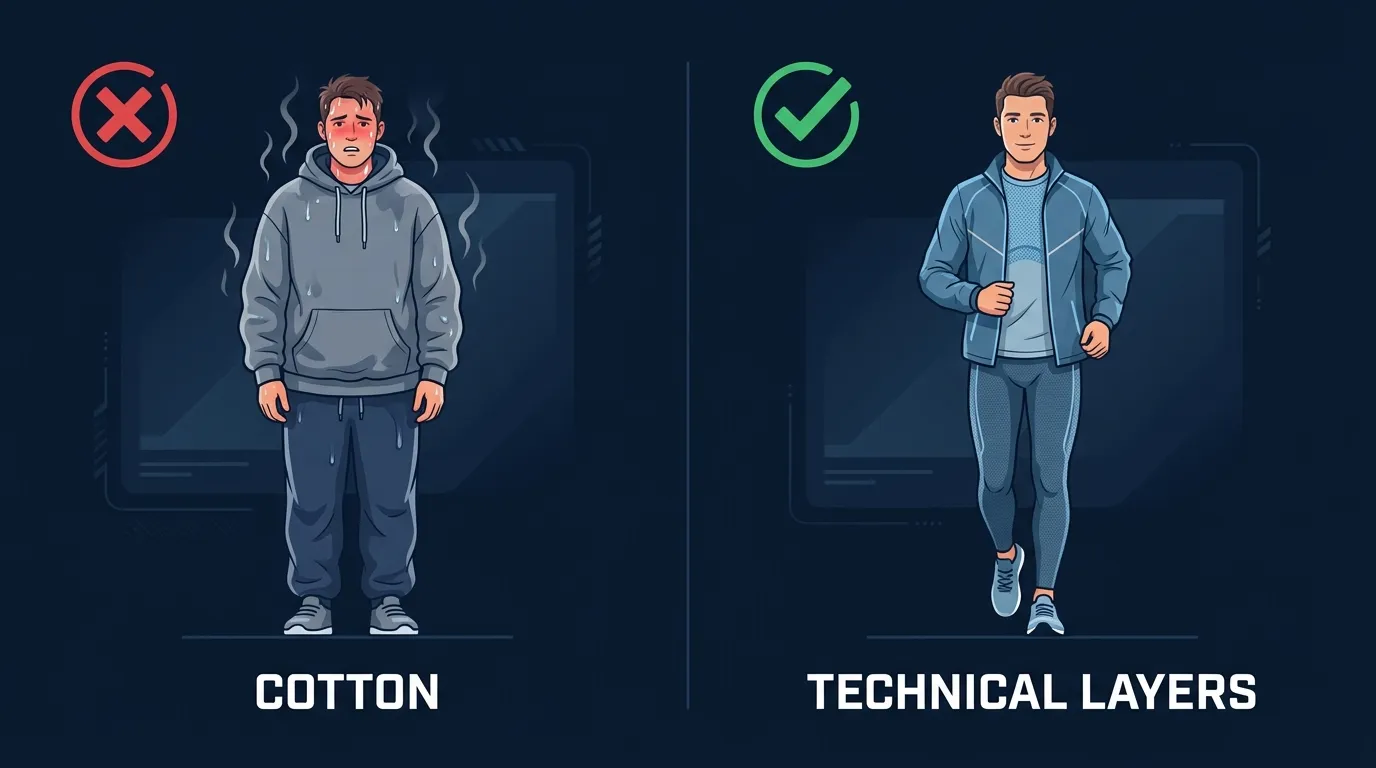
What doesn't work: cotton T-shirts, cotton long-sleeves, hoodies, sweatshirts, and the throwaway "I'll just throw on this old shirt" instinct. They'll feel fine for the first mile. They'll wreck the rest of the run.
Layer 2: The Mid-Layer (Insulation)
This layer holds warmth. It traps a thin pocket of air against your warm base layer, and that warm air is the actual insulator. Mid-layers should breathe (so vapor can keep moving outward) and should be light enough to feel weightless when you're running.
The classics:
- Light fleece (100-weight or "grid" fleece). Cheap, durable, breathes well, holds warmth well even when slightly damp.
- Wool sweater or wool half-zip. Warmer than fleece per weight. More expensive.
- Synthetic puffy (very light, 60g insulation or less). Only above-the-waist, and only for genuinely cold conditions. Most runners overuse these and end up cooked.
Above about 30°F (-1°C), most runners need no mid-layer at all. A long-sleeve base under a wind shell is plenty. Save the mid-layer for the truly cold days.
Layer 3: The Shell (Wind and Precipitation)
The outer shell is the most situational layer. Its job is to block wind and shed light precipitation. It's not for warmth. It's a wind brake.
Skip the shell when there's no wind and the temperature is above about 30°F. Add it when wind picks up, when it's raining or snowing, or when temperatures drop below 25°F. A good running wind shell is light (under 6 oz), packs into its own pocket, and has a small back vent or zip you can open when you start cooking. A waterproof rain shell is overkill for most cold-and-dry runs and traps too much sweat. Wind-resistant beats waterproof for the average runner.
The shell should also be slightly oversized so it doesn't pin your mid-layer down and crush its insulating air pocket. Function over fit, here.
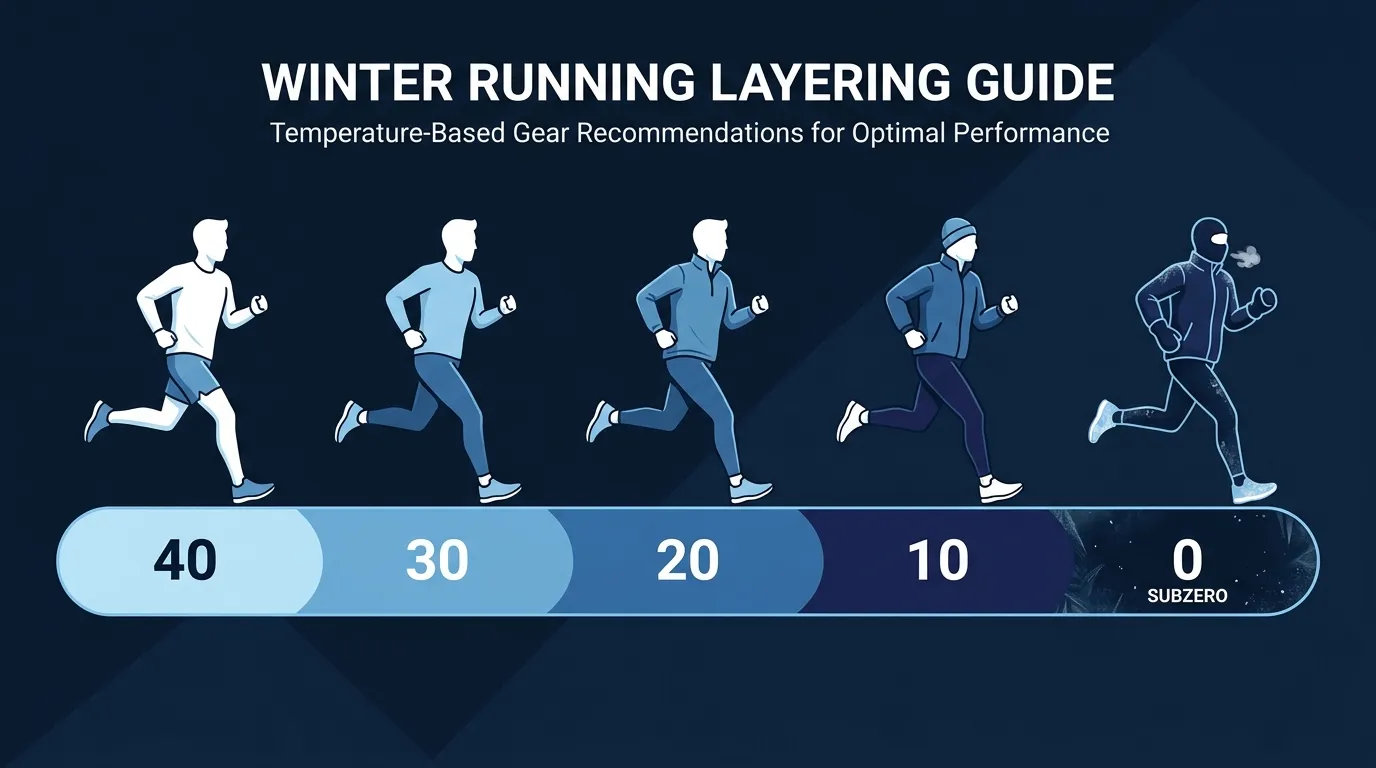
What to Wear for Cold Runs by Temperature
The 10-degree rule plus the three-layer system gives you the framework. Here's how it cashes out at specific temperatures. Treat these as starting points; calibrate for your own cold tolerance over a few runs.
40 to 50°F (4 to 10°C)
Long-sleeve technical top, shorts or light tights, no gloves needed for most runners. Some people add a thin headband or running cap. This is the easiest cold-weather window. You'll be warm two miles in.
30 to 40°F (-1 to 4°C)
Long-sleeve base, full tights, light gloves, thin beanie or ear-cover headband. Wind shell only if the wind is cutting. Add a buff around the neck so you can pull it up if needed.
20 to 30°F (-7 to -1°C)
Base layer plus a light mid-layer (long-sleeve fleece zip or merino), full tights with maybe a thin liner short under, gloves, beanie, buff. Wind shell if wind chill is meaningfully colder than air temp.
10 to 20°F (-12 to -7°C)
Base, mid-layer, wind shell. Heavier tights or a wind-front tight. Insulated gloves or thin glove liners under windproof shell mittens. Beanie that covers the ears, buff up over the chin and nose if breathing cold air bothers you.
0 to 10°F (-18 to -12°C)
Two upper layers plus shell. Wind-front tights or thermal tights with windproof front panels. Insulated mittens (warmer than gloves at this temp). Heavier wind-blocking beanie. Buff or balaclava over the lower face. Goggles or sunglasses if it's very windy. Watch for any exposed skin; the gap between glove and sleeve, between hat and buff, between sock and tight, that's where frostnip starts.
Below 0°F Wind Chill (-18°C+)
This is the threshold where most coaches and the NATA position statement recommend taking it inside. The risk-to-benefit math gets ugly. Frostbite on exposed skin can develop in 30 minutes or less, and even fully covered runners face elevated risk if a layer fails (a glove gets wet, a shell zipper jams). If you're running, run a short loop close to home you can bail from, run with someone, and never run into the wind on the back half (so wind is at your back when you're tired and slowing down).
Want a personalized run-and-strength program?
Take the free FitCraft assessment and get a multi-week program built around your goals, schedule, and equipment. Ty, the 3D AI coach, demonstrates every move in 3D so form is never a guess, and the program adapts as you progress.
Take the Free Assessment Free • 2 minutes • No credit cardCold-Weather Running Temperature Thresholds (When It's Not Just Cold)
Layering for comfort is one thing. Knowing when cold becomes a real safety problem is another. The two key thresholds:
Wind Chill, Not Air Temperature, Is What Matters
The NATA Position Statement on Environmental Cold Injuries (Cappaert et al., 2008, Journal of Athletic Training) is the cleanest summary of the actual numbers. The key risk markers, expressed as wind chill:
- Above 5°F wind chill: low risk. Frostbite on exposed skin is unlikely with normal exposure times under an hour.
- Below -18°F wind chill: increased surveillance. Exposed skin can freeze in 30 minutes or less.
- Below -28°F wind chill: high risk. Exposed skin can freeze in under 10 minutes.
Notice the framing. It's not air temperature, it's wind chill. A 15°F day with no wind is a normal cold-weather run. A 15°F day with a 25 mph wind is a wind chill of about -3°F, which is a different problem. Always check both numbers before you head out.
Hypothermia and Frostbite Aren't the Same Thing
Hypothermia is a core temperature drop (mild starts at about 95°F core temp, severe below 90°F). Frostbite is local tissue freezing on exposed skin. For runners, frostbite is by far the more common problem because running generates so much metabolic heat that core temperature is well-defended in almost all conditions a recreational runner would attempt. The local-tissue problem is what bites first: an exposed cheek, a thin glove, a bare ankle gap above the sock.
This is why "cover everything" matters more as temperatures drop than "wear bigger and bigger jackets." Past about 20°F, every additional layer of bulk on the torso has rapidly diminishing returns, but every patch of exposed skin gets riskier on a near-linear scale.
Cold-Weather Marathon Dressing
Marathon-specific advice is its own genre because the problem is bigger than just "what to wear at mile 1." You'll be in a frozen start corral for 30 to 60 minutes barely moving, then running for 3 to 5 hours through changing conditions. Here's the practical playbook from runners who've done it cold and lived to tell.
Throwaway Layers for the Corral
Buy a thrift-store hoodie or sweatpants for $5 and wear them in the corral. Pull them off and toss them at the start gun (most cold-weather marathons collect and donate them). A trash bag with arm holes also works. The corral wait is the worst part of the cold-weather marathon experience, and overdressing for it is fine because the throwaways are coming off anyway.
Dress for Mile 8, Not Mile 1
You'll be cold for the first mile or two. Don't fix that with extra layers. Apply the 10-degree rule like you'd apply it to a regular run, then add gloves and a hat that you can shed and either tie around your waist or hand to a spectator at a known mile.
Two Pairs of Gloves Is the Move
Wear thin liner gloves under thicker insulated gloves. Once you're warm, peel off the outer pair, stash them in a waist pocket. If conditions worsen later (wind, late-race chill from slowing pace), put them back on. Two pairs costs about $20 and is the cheapest insurance against the most common cold-weather marathon DNF complaint.
Wind Shell That Packs Small
For a marathon, you want a wind shell light enough to tie around your waist for 25 miles without thinking about it. The 4-to-6-oz packable wind shells are designed for this exact use case. Use them.
The Mistakes That Wreck Cold-Weather Runs
Most failed cold-weather runs come from the same handful of avoidable errors. Skip these and you'll handle 90% of winter runs without thinking about it.
1. Overdressing
The single most common error. You feel cold standing on the porch, you add a layer, and 12 minutes in you're cooking. Wet base layer turns into a heat sink the moment you stop, and stopping is exactly what happens at red lights, water fountains, and trail intersections. Underdress slightly. Five cold minutes is fine. Fifty wet minutes isn't.
2. Cotton (Anywhere)
Cotton T-shirts. Cotton hoodies. Cotton socks. Cotton anything. Cotton holds water against your skin and refuses to give it back. There's a reason "cotton kills" is a hiking-and-running mantra. Replace any cotton in your running rotation with synthetic or merino. Even your socks.
3. Ignoring Hands and Head
The hands and head lose heat fast because they're highly vascularized and have a high surface-area-to-mass ratio. Cold hands are the most common reason runners cut a winter run short. A $15 pair of running gloves and a $20 beanie are the highest-leverage cold-weather purchases you can make. Below 20°F, swap gloves for mittens (fingers share heat).
4. Running Into the Wind on the Back Half
Plan your route so the wind is at your back on the way home. Running into a headwind when you're already tired and slightly damp is when cold injuries actually happen. On a typical out-and-back, run into the wind on the way out (when you're warm and dry) and let it push you home.
5. Not Drinking
Cold-weather dehydration is sneaky. You don't feel as thirsty, the air is dry, your sweat evaporates fast, and respiratory water loss spikes. By mile 6 of a winter long run you can be meaningfully dehydrated without noticing. Sip water at the same intervals you would in summer, even if you don't feel like it.
6. Skipping the Warm-Up
Cold muscles are stiffer and the loaded tendons take longer to warm up. Walk for 5 minutes before you start running, or do a slow first mile. The risk of muscle and tendon strains genuinely climbs in cold weather, especially for runners with prior calf or Achilles complaints. We covered the slow-ramp principle in our piece on how to start running when you're out of shape; the same logic applies harder in cold conditions. The injury-prevention basics in our strength-training injury-prevention guide apply to running too: stronger glutes and hips reduce the load your knees absorb every footstrike, and that protection matters more in winter when your stabilizers take longer to fire.
One More Thing: Listen to the Run, Not the Forecast
The forecast is a starting point. The actual conditions decide. Step outside in your planned outfit and stand there for 30 seconds. If you're shivering, add one more thin layer. If you're already warm, drop one. Then run a short loop at the start (a one-block out-and-back) and come back to swap if needed. This 60-second checkpoint costs nothing and saves a lot of bad miles.
Cold-weather running is one of the rare fitness situations where the gear genuinely changes the experience. A good base layer and a windbreaker make 25°F runs into something you actually look forward to. The same run in cotton and a hoodie is misery. Spend the $80 on the right pieces. They'll last you years and they'll protect every winter run you do for the rest of your running life.
If you've been finding excuses not to run because the weather sucks, the answer isn't more willpower. It's better gear. The system is solved. You just have to stop overdressing and start trusting the 10-degree rule. You'll be warm by the end of the block.
Frequently Asked Questions
How should I dress for a cold run?
Use the 10-degree rule. Dress for a temperature about 10 to 20°F warmer than the actual reading, because your body warms up about that much in the first 10 minutes of running. The setup that works in almost every cold-weather scenario is a three-layer system: a moisture-wicking synthetic or merino base layer, an insulating mid-layer (fleece or wool), and a wind-blocking shell only when the wind chill demands it. Add a hat, gloves, and a buff or neck gaiter when temperatures drop below freezing. The biggest rookie mistake is overdressing and ending up sweat-soaked, which is what actually causes cold injuries on long winter runs.
What is the 10-degree rule for running?
The 10-degree rule says to dress as though it's 10 to 20°F warmer than the thermometer reads. The first 5 to 10 minutes of any run will feel cold. After that, your metabolic heat production climbs sharply (running produces 5 to 10 times the heat of standing still), and if you dressed comfortably for standing outside, you're now overdressed and sweating. Wet clothing inside layers strips heat fast once you stop moving, which is why dressing slightly cool at the start is the safer call.
What temperature is too cold to run outside?
There's no single cutoff, but wind chill is what to watch. Per the National Athletic Trainers' Association position statement (Cappaert et al., 2008, Journal of Athletic Training), exposed skin can develop frostbite in about 30 minutes at a wind chill of 0°F (-18°C), and in under 10 minutes at -18°F (-28°C). For most healthy adults dressed correctly, runs in temperatures down to about 10°F to 0°F (-12°C to -18°C) are safe. Below 0°F wind chill, treadmill or postpone unless you're experienced and gear is dialed.
What should I wear for a cold-weather marathon?
Dress for the second half of the race, not the start corral. You'll be cold for the first mile, then warm. Most experienced cold-weather marathoners wear a thin moisture-wicking base, light running tights or pants, two pairs of gloves you can shed, a hat or headband, and a packable wind shell that ties at the waist if needed. Throwaway layers (a thrift-store sweatshirt or trash bag) keep you warm in the corral and get tossed at the gun. Above 35°F start temperature, even a long-sleeve top plus shorts works for many runners.
Do I need to wear a hat and gloves when running in cold weather?
Yes, below about 40°F (4°C). Hands and head lose heat fast because they're highly vascularized and have a large surface-area-to-mass ratio. Cold hands are the most common reason runners cut a winter run short. A thin pair of gloves and a light beanie or headband are the cheapest comfort upgrades you can buy. Below 20°F (-7°C), upgrade to insulated mittens (warmer than gloves because the fingers share heat) and a windproof beanie. Cover ears and the bridge of the nose if it's windy.
Is running in the cold bad for your lungs?
For most healthy adults, no. Cold dry air can transiently irritate the airways and trigger exercise-induced bronchoconstriction in some people, especially those with asthma. The fix is breathing through a buff or neck gaiter pulled up over the mouth, which warms and humidifies inhaled air. People with asthma or cardiovascular conditions should talk to their doctor before running below freezing. Below about 5°F (-15°C), even healthy runners often shift to a treadmill day.
Should I run in the cold or wait for warmer weather?
Run. Consistency is the single biggest predictor of fitness improvement, and "wait for the weather" is the most common reason new runners fall off in winter and never come back. Cold-weather runs feel harder for the first 5 minutes and then settle into a pace that's actually slightly easier on cardiovascular load than summer (cooler temperatures = less heat dissipation work). With the right gear, winter running is one of the most pleasant times of year to run. Just don't quit; just dress better.