- Don't try to "just run." The proven beginner protocol is walk-run intervals: 60 to 90 seconds of slow jogging, 90 seconds of brisk walking, 20 to 30 minutes total, three days a week.
- Walking is not failure. It is the part that lets your tendons, joints, and aerobic system catch up to the new load. Skip the walk breaks and you join the 1-in-5 novice runners who get hurt in their first weeks (Buist et al., 2008).
- Nobody is watching you. The spotlight effect (Gilovich et al., 2000) shows that people consistently overestimate how much strangers notice them, often by 100% or more. The drivers you're worried about are looking at their phones.
- The cardiovascular payoff is enormous. Even 5 to 10 minutes of slow running per day is linked to a 30% lower all-cause mortality risk versus not running at all (Lee et al., 2014, JACC).
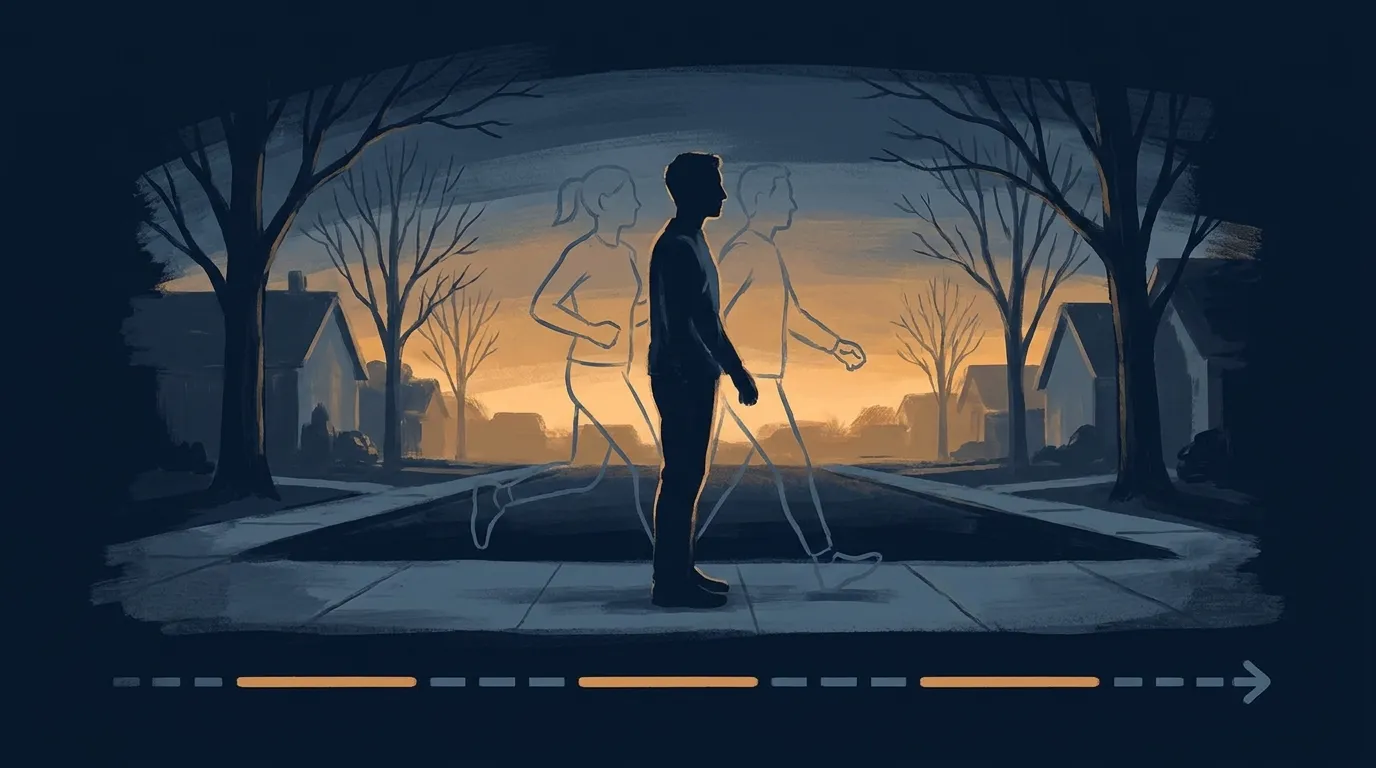
Here's the version of you that asks this question. You're heavier than you'd like. You haven't run since high school gym, and that wasn't fun either. You laced up trainers last Tuesday, jogged for ninety seconds, lost your breath, walked the rest of the way home, and decided everyone in every passing car had clocked you and judged you. By Wednesday the shoes were back in the closet.
This article is for that person. It's also for the person who has tried to start three or four times, gotten a sharp pain in a knee or a shin within two weeks, and given up convinced their body just doesn't run. Both stories are common. Both are fixable. The fix is not "more willpower." The fix is the same protocol that has gotten millions of unfit adults from couch to a slow continuous 5K, plus a quiet correction to the social-psychology assumption you're carrying around with you.
You'll get the walk-run intervals, the weekly progression, what to wear, where to run, and how to handle the part of your brain that thinks the entire neighborhood has assembled to evaluate your form. None of this requires a gym, a trainer, or special gear beyond shoes that fit. Most of it works whether you're 22 and 50 lb overweight or 52 and untrained. Let's go.
What "Out of Shape" Actually Means
Two systems are unfit at the same time, and they recover on different timelines. Pretending they're the same thing is the first mistake.
The Cardio System (Quick to Adapt)
Your heart, lungs, and the small blood vessels in your working muscles get better at moving oxygen within weeks. This is why even very out-of-shape people notice their breathing easing on the same route inside 2 to 3 weeks of consistent walks or jogs. The aerobic engine is responsive. It will reward you fast. If the gasping is the part that scares you off, our guide on how to breathe while running sorts the breathing advice that holds up from the folklore that doesn't.
The Musculoskeletal System (Slow to Adapt)
Your tendons, ligaments, joint cartilage, and small stabilizer muscles adapt to repeated impact much more slowly. We're talking months, not weeks. Every footstrike during running sends roughly 2 to 3 times your body weight through your knees. For a 220 lb adult, that's 440 to 660 lb of force, hundreds of times per kilometer. The cardio system is happy to keep going. The Achilles, the patellar tendon, and the plantar fascia start objecting.
This mismatch is the entire reason novice runners get hurt. Your lungs say "this feels easy now, run more." Your connective tissue is still 6 weeks behind. Listen to the slower system. The Buist research group at the University of Groningen tracked 532 novice runners through a 13-week beginner program and found injury rates around 20% over those first weeks (Buist et al., 2010, American Journal of Sports Medicine). The strongest predictors weren't age or weight. They were prior musculoskeletal complaints and, more controllably, training jumps that outpaced tissue adaptation.
The Mental System (Trickiest of the Three)
And then there's the part of your brain that's convinced everyone is watching. This isn't a small obstacle. It's the single most-cited reason new runners quit, and it shows up in every Reddit thread about running while overweight. The good news is that the social psychology on this is unambiguous, and we'll get to it in a minute.
The Walk-Run Method (Why It's Not Cheating)
The most successful beginner running protocols on Earth, the NHS Couch to 5K, the Galloway run-walk-run method, and dozens of clinic-based programs, all use the same trick. They tell you to walk on purpose.
The pattern looks like this:
- Slow jog for 60 to 90 seconds.
- Brisk walk for 90 seconds.
- Repeat 6 to 8 times.
- Total session: 20 to 30 minutes including warmup.
- Frequency: 3 days a week with full rest days between.
Why this works is not mysterious. The walking interval gives your aerobic system, your form, and your tendons a chance to recover before the next loading round. You end up with more total minutes of movement, less impact stress, and a heart rate that stays in a productive zone instead of redlining and then crashing.
What the Research Actually Shows
The Buist group also ran a randomized trial comparing a graded walk-run progression to a less structured approach in 532 beginners. The headline finding got misreported a lot: a careful graded plan didn't reduce overall injury rates compared to a sensible simple plan (Buist et al., 2008). What actually matters is the floor. Both groups, with structure, kept injury rates around 20% over weeks of new running. Novice runners also get hurt more per hour on their feet than experienced ones: 17.8 injuries per 1000 hours of running against 7.7 for recreational runners, with one novice cohort as high as 33 per 1000 hours. Structure helps. Structure plus walk breaks helps more.
A separate 2023 PLoS One analysis of 6,403 UK Couch to 5K participants found that the people most likely to quit the program were the ones who got injured early, and the people most likely to get injured were the ones who skipped or compressed the walk-run progressions. The walking is not the boring part you tolerate. It's the part that keeps you in the program long enough to finish it.
The 4-Week Starter Ladder
Here's a simple progression you can start tomorrow. Each "session" is roughly 25 to 30 minutes including a 5-minute warmup walk and 5-minute cooldown walk.
- Week 1: 60 sec slow jog / 90 sec walk × 8 rounds. 3 days this week.
- Week 2: 90 sec slow jog / 2 min walk × 6 rounds. 3 days.
- Week 3: 2 min slow jog / 2 min walk × 5 rounds. 3 days.
- Week 4: 3 min slow jog / 90 sec walk × 5 rounds. 3 days.
Two notes on this. If any week feels hard, repeat it. Don't progress on the calendar; progress on how the previous week felt. And if you're carrying significant extra weight or you're over 50, plan to spend 2 weeks at each rung instead of 1. The slower ramp is the whole point. Stiff ankles make that ramp harder than it needs to be, so run through our ankle mobility exercises on your walk days while the tissue catches up.
Pace Cue: Slow Means Slow
The biggest pace mistake new runners make is jogging too fast in the run intervals. The slow-jog effort should feel like you could (just barely) hold a 4-word conversation. If you can't get out a sentence, you're running too fast and you'll burn out before round 4. A useful trick: pick a pace that feels embarrassingly slow. Then slow down another 10%. That's your jog pace.
Once those intervals start feeling repeatable, our 8-week 5K training plan for beginners takes the same run-walk structure and points it at an actual finish line.
The Spotlight Effect (Why Nobody Is Watching)
Now the social anxiety part. The reason this matters is that it's the silent quitting trigger for new runners. People will run through real physical discomfort. They won't run through the conviction that strangers are evaluating them.
So here's the research. In 2000, Cornell psychologists Thomas Gilovich, Victoria Medvec, and Kenneth Savitsky published a now-classic series of experiments in the Journal of Personality and Social Psychology. They asked one group of participants to wear an embarrassing T-shirt (a Barry Manilow shirt) into a roomful of strangers, then guess what fraction of those strangers would later be able to identify the shirt. The participants predicted about 50%. The actual recall was about 25%. People in the room were noticing their shirt about half as often as they thought.
The researchers ran the experiment several more ways with similar results. They named the bias the spotlight effect: we are the main characters of our own lives, so we egocentrically anchor on our own experience and assume everyone else is looking at us with the same intensity. They are not. They are looking at their phones, planning dinner, or thinking about their own anxious-walking-down-the-street moments.

What This Means for the Person Embarrassed to Run in Public
Three practical translations:
- The drivers passing you aren't logging anything. A 2-second glance from a moving car at a stranger doing exercise on a sidewalk does not get encoded in long-term memory. By the time they're a block past you, you're gone.
- The walkers and other runners actively respect you. Anyone who has been a beginner remembers being a beginner. The honest reaction from most experienced runners watching a heavier person walk-run past them is admiration, not judgment. (And the few who do judge are not people whose opinion belongs in your head.)
- Your perceived audience is bigger than your actual audience. Even on a busy park path, the 30 people you "feel watched by" reduces to 2 or 3 people who actually noticed you, none of whom will remember by tomorrow.
If knowing the data isn't enough (and often it isn't, the feelings don't immediately listen), use environment design instead. Run early in the morning, run after dark on lit residential streets, run on a treadmill at home, or run in a quiet park loop. The spotlight effect is real, but exposure is the only thing that actually reduces it long-term. Most new runners report the embarrassment fading dramatically by week 4, mostly because they stop being a stranger to themselves in running clothes.
Ready to put this into practice?
Take the free FitCraft assessment and get a personalized walk-run plan plus the strength work that protects your knees as you build up.
Take the Free Assessment Free • 2 minutes • No credit cardRunning for Overweight Beginners: The Practical Setup
If you're carrying meaningful extra weight, the protocol above still works. A few things change at the margins.
Surface Matters More for You
Asphalt is harder than dirt. Treadmill belts are softer than concrete sidewalks. Grass is softer than both, with the catch that it's uneven and you risk an ankle. The order of preference for a heavier beginner is: treadmill, packed dirt or rubber track, asphalt, then concrete sidewalk last. If concrete is all you have, that's still fine. Just stack the deck where you can.
Shoes Are Worth the One Splurge
You don't need expensive everything. You do need shoes that match your foot. Most running specialty stores will watch you walk and recommend a model in the $90 to $140 range. Replace them every 350 to 500 miles. A poorly fit shoe is the difference between an enjoyable Couch to 5K and a sore arch that ends the experiment in week 3.
Strength Work Protects the Knees
Two short bodyweight strength sessions per week (15 to 20 minutes each) targeting glutes, hips, calves, and core dramatically reduce the load your knees absorb during running. The mechanism is straightforward: a stronger glute medius keeps your hip from collapsing inward at footstrike, which is the exact pattern that drives most runner's knee cases. We've covered this in detail in our guide for starting to work out from zero fitness; the short version is that running plus a tiny bit of resistance training beats running alone for staying injury-free. If you would rather have those sessions programmed for you, our roundup of the best workout apps for weight loss covers which apps pair strength work with a fat-loss goal.
Eat Enough to Recover
This sounds counterintuitive when weight loss is part of why you're running. But too-aggressive calorie cuts during a new running program is one of the fastest ways to get injured (poor recovery, bone-density risk) and quit (energy crashes mid-run). Aim for a moderate deficit, 300 to 500 calories below maintenance, not a starvation cut. Your runs will go better. You'll stick with them. Sustained weight loss on a sustainable plan beats fast weight loss you abandon.
Where, When, and How to Run So You'll Actually Keep Going
The mechanical part is the easy half. The "still doing this in 8 weeks" part is harder. A few rules from experience.
Pick a Short Repeatable Loop
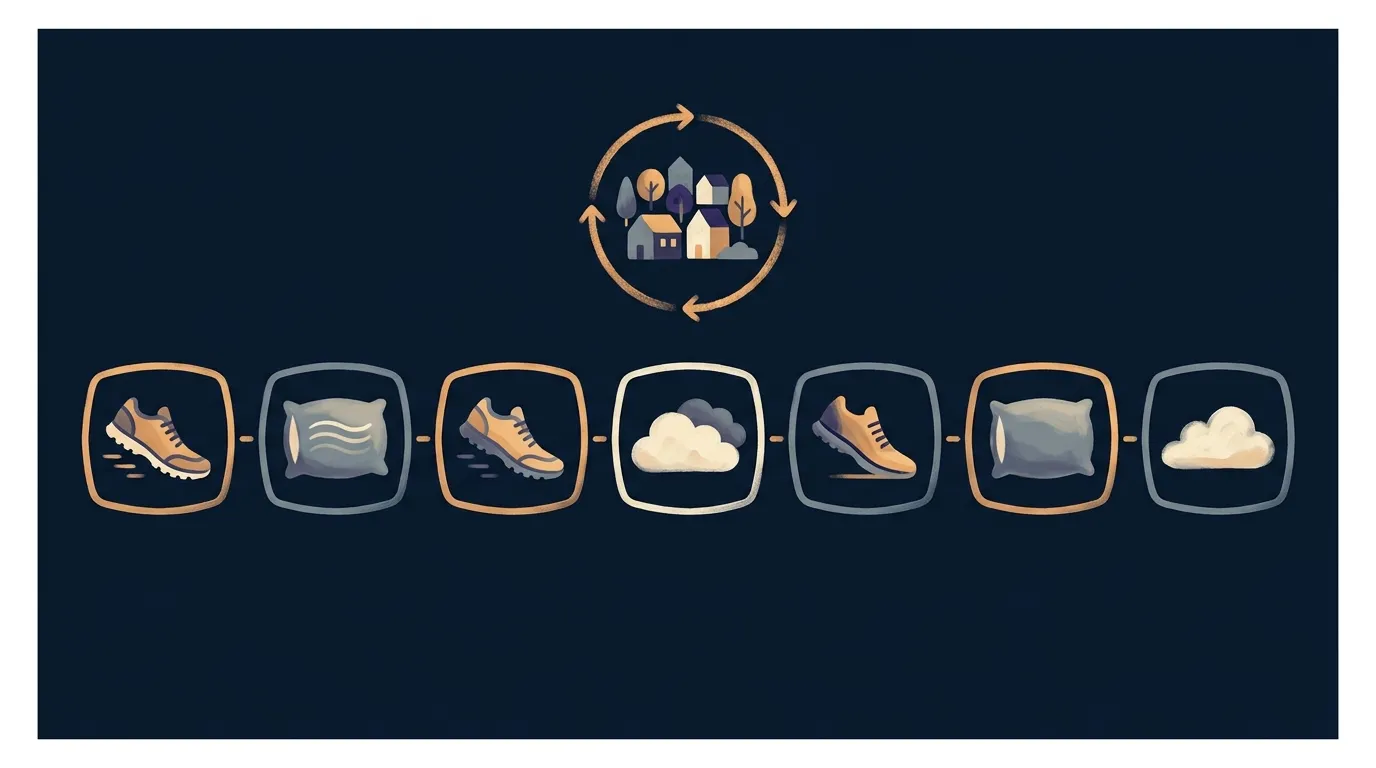
Drive or walk a route near your home that takes about 25 to 30 minutes at walk-run pace. Use that same loop for the first 4 weeks. Familiar routes reduce decision friction. You don't have to plan, you don't have to think, you just leave the house and follow the same line. This is how habit formation actually works: lower the activation energy, then repeat.
Lock the Three Times in Your Calendar
Pick three slots, treat them as appointments, and protect them like meetings. Most successful beginners run early morning before work, on a fixed evening after dinner has settled, or on a weekend morning. Three sessions per week is the magic number that almost every credible novice running protocol converges on; it gives you stimulus and recovery in roughly equal measure. More than 3 days a week as a true beginner is where injuries spike. Once those three runs feel routine, a short session of hill sprints is the least punishing way to add a genuinely hard day.
Don't Track Pace. Track Streak.
This is the single most useful mental shift. Pace numbers are punishing for beginners; they make every run a comparison to a faster fitter version of you that doesn't exist yet. What actually predicts success in the first 3 months is consistency, not speed. Tracking the streak (sessions completed, weeks completed) reframes every run as a checkmark instead of a benchmark. The research on streak psychology shows that this single reframing dramatically improves adherence in early-stage exercise programs.
How Long Until It Stops Sucking
The honest answer: about 3 to 4 weeks before the breathing eases noticeably, 6 to 8 weeks before you finish a session and feel good rather than wrecked, and 8 to 9 weeks before you can hold a continuous slow 30-minute run if that's a goal you have.
Most people quit somewhere in week 2 or 3. They quit because the cardio system has improved enough that they feel like they should be further along, and the visible body changes haven't started yet, and the social anxiety hasn't fully faded yet. This is the dip. Every credible beginner running coach knows about it. The cure is not pushing harder; the cure is doing exactly what week 3 of the plan says to do, even when it feels like you should be doing more.
If you make it to week 5, you almost certainly make it to the end of the program. The biggest predictor of finishing Couch to 5K is finishing the first 4 weeks.
What This Means for You
Three takeaways. One, walk-run is not a beginner version of "real" running. It's the safest, most evidence-based way to build a runner's body, and almost everyone, including elite marathoners on easy days, uses it strategically. Don't treat the walks as cheating.
Two, the people you're worried about watching you are mostly not. The spotlight effect is one of the best-replicated findings in social psychology. Knowing the data won't kill the feeling overnight, but it will help. Exposure does the rest. Most new runners report the embarrassment dropping sharply between week 3 and week 5.
Three, the cardiovascular and longevity payoff for the work you're putting in is huge. Lee and colleagues' 2014 JACC analysis of 55,137 adults over 15 years found that even slow runners doing under 51 minutes per week had a 30% lower all-cause mortality risk and a 45% lower cardiovascular mortality risk than non-runners. You don't need to get fast. You don't need to get long. Just being someone who runs three times a week, slowly, in walk-run intervals, puts you in the population that lives longer and feels better.
Stick with it for 8 weeks. That's the actual recipe. Stop comparing your week 2 to anyone else's week 50. The only person whose past you have to beat is the person who didn't lace up the shoes today.
Frequently Asked Questions
How do I start running when I'm very out of shape?
Start with a walk-run interval, not continuous running. The most-cited beginner protocol uses 60 to 90 seconds of slow jogging followed by 90 seconds of brisk walking, repeated for 20 to 30 minutes, three days a week. The walking is not failure. It is the active ingredient. Buist and colleagues (2008, American Journal of Sports Medicine) showed that injury rates in novice runners are roughly 1 in 5 over the first weeks, and almost all of those injuries trace back to doing too much too soon. Walk-run pacing is the cheapest insurance policy you can buy.
How do I start running when I'm overweight and out of shape?
The protocol is the same as for any beginner, with two extra rules. First, run on softer surfaces when possible (grass, dirt, treadmill) to reduce joint loading. Second, progress on weeks rather than days. Most overweight beginners do best with 2 weeks at each step of the walk-run ladder before adding running time. Pair the runs with low-impact strength work for the hips and core; this builds the support structure that protects your knees and lower back as you load them more.
Is it normal to feel embarrassed to run in public?
Yes, and the research says you are dramatically overestimating how much anyone notices. Gilovich, Medvec, and Savitsky (2000) coined this the spotlight effect: people consistently overestimate the percentage of strangers who clock their appearance or behavior, often by 100% or more. In their experiments, observers noticed a participant's embarrassing T-shirt about half as often as the participant predicted. On a typical city sidewalk, drivers and walkers are looking at their phones or thinking about their own day.
How long does it take to start running again when out of shape?
Most people can run 30 minutes continuously after 8 to 9 weeks of structured walk-run progression, three sessions per week. That is the basic finding behind the NHS Couch to 5K and similar plans. Cardiovascular adaptations show up first; you will notice slightly easier breathing on familiar routes inside 2 to 3 weeks. The musculoskeletal stuff (knees, calves, Achilles) adapts more slowly, which is why the program is paced over weeks, not days.
What is the best way to start running when out of shape?
Three principles. One, use walk-run intervals, not continuous running. Two, run three days a week (not more, not less, while you build base). Three, progress weekly, not daily. The "best" program is the one you actually do, which usually means picking a short, repeatable route near home, locking in three set times each week, and refusing to skip the walk breaks even when you feel like you could run through them.
Will running help me lose weight?
It can, but the calorie math is smaller than people expect. A 30-minute walk-run session burns roughly 200 to 300 calories for a 180 to 200 lb adult. Sustained weight loss still depends mostly on what you eat. Where running shines is cardiovascular health: Lee and colleagues (2014, Journal of the American College of Cardiology) found that even 5 to 10 minutes of running per day at slow paces is associated with a 30 percent lower all-cause mortality risk versus non-runners. Run for the heart and the head; let the kitchen do the weight loss.
Should I be sore after a walk-run session?
A little muscle soreness in the calves and quads is normal in the first 2 weeks, especially the day after. Sharp joint pain (knee, shin, Achilles) is not normal and is the body's request to back off. The general rule: if pain shows up during a run, walk it in. If it's still there 48 hours later, repeat the previous week instead of progressing. Pain that wakes you up at night or worsens day over day means seeing a sports physiotherapist before your next session.