You've thought about it. Probably more than once. Maybe more than a hundred times. You've watched people post their workouts online and wondered if you could ever be one of them. You've scrolled past transformation photos and felt a weird mix of inspiration and dread.
But you haven't started. Because where do you even begin when you've literally never done this before?
Not "haven't exercised in a while." Not "used to play sports in high school." Never. Zero reps. Zero miles. Zero clue what a "set" is or why people seem so obsessed with protein.
If that's you, this guide is specifically for you. Not for someone getting back into shape. For someone starting from absolute scratch. And the first thing you need to hear is: that's not a weakness. It's actually an advantage — because you have no bad habits to unlearn and no old injuries from doing things wrong. You're a blank page, and that's powerful.
Why Starting Feels So Intimidating
Let's be honest about the real reason you haven't started yet. It's not laziness. It's not a lack of information — there's too much information, and that's part of the problem. The real barrier is a combination of three things that feed on each other.
The Intimidation Wall
The intimidation of fitness environments is well documented. A narrative synthesis scoping review published in Obesity Reviews found that fear is a pervasive barrier to physical activity, particularly for people who are new to exercise. Participants in the study described fitness environments as "intimidating" and reported that fears of negative evaluation led them to avoid physical activity altogether (Hamer et al., 2021).
This isn't a personality flaw. Your brain is doing exactly what it evolved to do — flagging unfamiliar, socially exposed situations as risky. The problem is that this protective instinct keeps you stuck in the exact situation you want to escape.
Decision Paralysis
Should you do cardio or strength training? Bodyweight or dumbbells? Three days a week or five? Morning or evening? YouTube or an app? The sheer volume of options available to a beginner is paralyzing. And when every choice feels like it could be the wrong one, the easiest choice is no choice at all.
The "Not Ready Yet" Trap
This is the sneakiest one. "I'll start when I'm in better shape." "I need to research the right program first." "I'll wait until Monday / January / after the holidays." These sound reasonable. They feel like planning. But they're avoidance wearing a smart disguise. The truth is, you will never feel ready. Readiness comes from doing, not from waiting.
Here's the reframe that changes everything: failing to start isn't a discipline problem. It's a design problem. You don't need more motivation. You need a system that's actually built for someone starting at zero.
What Your First Week Actually Looks Like
Forget everything you've seen on social media. Your first week of working out should be almost comically easy. Not because you can't handle more, but because the goal of Week 1 isn't fitness. It's proving to yourself that you can show up.
Day 1: Move for 10 Minutes
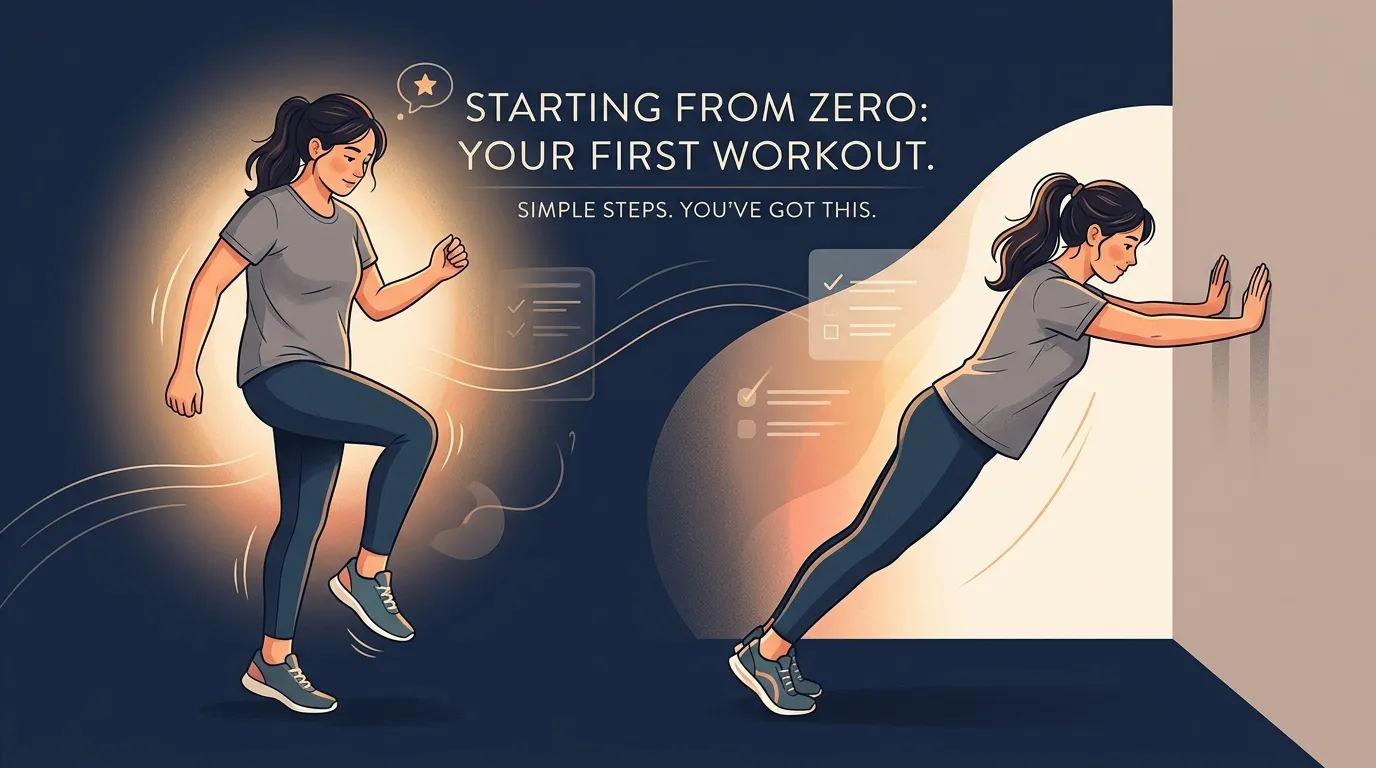
That's it. Ten minutes. Not an hour. Not "until you feel the burn." Ten minutes of intentional movement in your living room, your bedroom, or your backyard. Here's what a Day 1 session might look like:
- 2 minutes: March in place, swinging your arms gently
- 3 minutes: Bodyweight squats (as deep as feels comfortable) — do 5, rest, do 5 more
- 3 minutes: Wall push-ups (hands on the wall, lean in, push back) — do 5, rest, do 5 more
- 2 minutes: Standing toe touches and gentle stretching
Done. You just completed your first workout. It doesn't matter that it was "only" 10 minutes. What matters is that you did it — and that you can do it again tomorrow.
Days 2-3: Repeat and Explore
Do the same session again, or try small variations. Add a plank hold (even 10 seconds counts). Try stepping side-to-side instead of marching. The point is building the neural pathway that says "I am a person who exercises." Research on habit formation shows that consistency in the first 28 days is the single strongest predictor of whether someone sticks with exercise long-term.
Days 4-5: Add 5 More Minutes
Bump your sessions to 15 minutes. Introduce one or two new movements — maybe lunges, maybe a yoga pose, maybe some arm circles with light objects from around the house. You're still not trying to get a "real workout." You're building a streak. You're accumulating evidence that this is something you do now.
Days 6-7: Rest or Move Gently
Take at least one full rest day. If you feel like moving, go for a walk. Stretch. Do some mobility work. Your body needs recovery time — especially when everything is new. Rest isn't quitting. Rest is part of the program.
By the end of Week 1, you've exercised four or five times. You haven't injured yourself. You haven't needed a gym, special clothes, or any equipment. And you've started building the single most important thing in fitness: the habit of showing up.
How to Pick Exercises (Without Overthinking It)
One of the biggest traps for complete beginners is spending weeks researching the "optimal" program before doing a single rep. Here's the truth that experienced trainers know: for someone starting from zero, virtually any movement is beneficial. The best exercise is the one you'll actually do.
That said, some exercises are better starting points than others. Here's a simple framework.
Start With These Five Movement Patterns
Every effective beginner program covers these foundational patterns:
- Squat — Bodyweight squats, chair-assisted squats, or wall sits. Builds your legs and core.
- Push — Wall push-ups, incline push-ups, or kneeling push-ups. Builds your chest, shoulders, and arms.
- Pull — Resistance band rows or doorframe rows. Builds your back and biceps.
- Hinge — Glute bridges or Romanian deadlifts with no weight. Builds your posterior chain (back of your body).
- Core — Dead bugs, bird dogs, or plank holds. Builds stability and protects your spine.
If you do one exercise from each category, two to three times per week, you have a legitimate full-body program. No gym required. No guesswork.
Add Mobility and Yoga
If traditional "strength" exercises feel too intimidating, start with mobility work or yoga. These are legitimate workout types that build flexibility, body awareness, and foundational strength — without the pressure of counting reps or pushing to failure. Dynamic movement sessions that focus on how your body flows through space can be a powerful entry point for people who associate "exercise" with suffering.
How to Know When You're Ready for More
You're ready to progress when your current workouts feel easy — not when Instagram tells you to level up. Signs you're ready:
- You can complete your session without needing extra rest breaks
- You're no longer sore the next day
- You find yourself wanting to do more
- Your form feels natural rather than awkward
When that happens, add time (move from 15 to 20 minutes), add resistance (grab a pair of light dumbbells or a resistance band), or try a new movement pattern. Progressive, gradual challenge is how your body adapts — and it's the foundation of every evidence-based fitness program.
Find out what's really holding you back
FitCraft's free 2-minute assessment identifies your starting point, your schedule, and your available equipment — then builds an adaptive plan that starts exactly where you are. No baseline fitness required.
Take the Free Assessment Free · 2 minutes · No credit cardWhy a Structured App Beats YouTube for Beginners
YouTube is incredible. There are thousands of free workout videos by qualified trainers. So why would anyone pay for an app?
Because YouTube gives you content. It doesn't give you structure. And for a complete beginner, structure is everything.
The YouTube Problem
When you search "beginner workout" on YouTube, you get 50 million results. That sounds like abundance. In practice, it creates the exact decision paralysis that keeps beginners stuck. Which video do you pick? What do you do tomorrow? How do you progress from one video to the next? Is this instructor qualified? Is this workout appropriate for your fitness level, or is it a "beginner" video made by someone who squats 300 pounds and has a different definition of "easy"?
YouTube also has no memory. It doesn't know what you did yesterday. It can't adjust based on your progress. It can't tell you when to push harder or when to rest. Every session starts from zero context.
What Structure Actually Provides
A well-designed fitness app solves every problem YouTube creates:
- No decisions required. Open the app, start the workout. Someone else has already figured out what you should do today.
- Progressive programming. Each workout builds on the last. You're not randomly jumping between videos — you're following a path.
- Adaptive difficulty. The program adjusts based on your progress, ensuring you're always working at the right level — not too easy, not overwhelming.
- Accountability systems. Streaks, progress tracking, and rewards create external motivation that doesn't depend on how you feel on any given day.
- Proper form guidance. Interactive 3D exercise demos that let you rotate the camera and zoom in on form cues are far more useful than watching someone perform an exercise from a single fixed angle in a video.
A systematic review published in JMIR mHealth and uHealth found that gamified mobile health interventions — apps that use game mechanics like points, levels, and rewards — were effective at increasing physical activity participation, particularly when multiple game elements were combined and when the intervention was grounded in behavioral theory (Xu et al., 2022).
A meta-analysis in the Journal of Medical Internet Research confirmed that gamified exercise interventions produced a significant increase of 1,609 additional daily steps compared to control groups — and the effect persisted even after follow-up periods, suggesting it's not just a novelty effect (Mazeas et al., 2022).
In other words: the right app doesn't just give you workouts. It changes whether you actually do them. If you're not sure which one to pick, our roundup of the best fitness apps for beginners compares the top options for people starting from scratch.
How FitCraft Meets You at Zero
Most fitness apps say they're "for all levels." In practice, their easiest setting still assumes you know what a burpee is and can hold a plank for 30 seconds. If that gap sounds familiar, our roundup of the best workout apps for plus-size beginners reviews which apps genuinely start at zero.
FitCraft is different because it was designed by an Ivy League-trained exercise scientist, NSCA-certified strength coach who understands that "beginner" isn't a single category — it's a spectrum. And the absolute bottom of that spectrum deserves a real program, not a watered-down version of an intermediate one.
An AI Coach That Actually Starts Where You Are
When you take FitCraft's initial assessment, the AI coach Ty doesn't just ask about your goals. It maps your current reality — your fitness level, your available equipment (even if that's nothing), your schedule, and the types of movement you're open to. Then it builds a program calibrated to your actual starting point.
If you've never exercised, Ty doesn't hand you a program designed for someone with six months of experience. It starts with foundational movements — bodyweight exercises, mobility work, gentle yoga — and adapts the difficulty as you progress. The workouts grow with you, not ahead of you.
Gamification That Makes the Habit Stick
Here's the part that matters most for complete beginners: the first 28 days are make-or-break. Research on fitness club members shows that 63% of new members quit before their third month, and fewer than 4% are still training after a year (Sperandei et al., 2016).
FitCraft's gamification system is specifically engineered to get you through that danger zone. Every workout earns you XP. You level up. You collect cards. You build streaks on your calendar and earn rewards for showing up consistently. These aren't gimmicks — they're applications of behavioral science. When motivation inevitably dips (and it will, probably around Day 10), the streak you've built becomes its own reason to keep going. Breaking a 10-day streak feels like losing something — and loss aversion is one of the most powerful forces in human psychology.
Interactive 3D Demos, Not Videos
When you've never done a squat before, watching a video from one angle isn't enough. FitCraft uses interactive 3D exercise demonstrations with pinch-and-zoom camera control, letting you rotate around the movement and inspect form cues from any angle. You can see exactly where your knees should track, how deep to go, and what the movement should look like from behind — details that a fixed-camera video simply can't show.
Every Workout Type a Beginner Needs
FitCraft covers yoga, mobility, strength training (bodyweight, dumbbells, and resistance bands), cardio, and dynamic movement. You don't need to piece together programs from five different sources. Everything lives in one place, programmed by an exercise scientist, adapted to your level, and tracked automatically.
What to Expect (Honestly)
Let's set real expectations so you don't quit when the initial excitement wears off.
Week 1-2: The Honeymoon
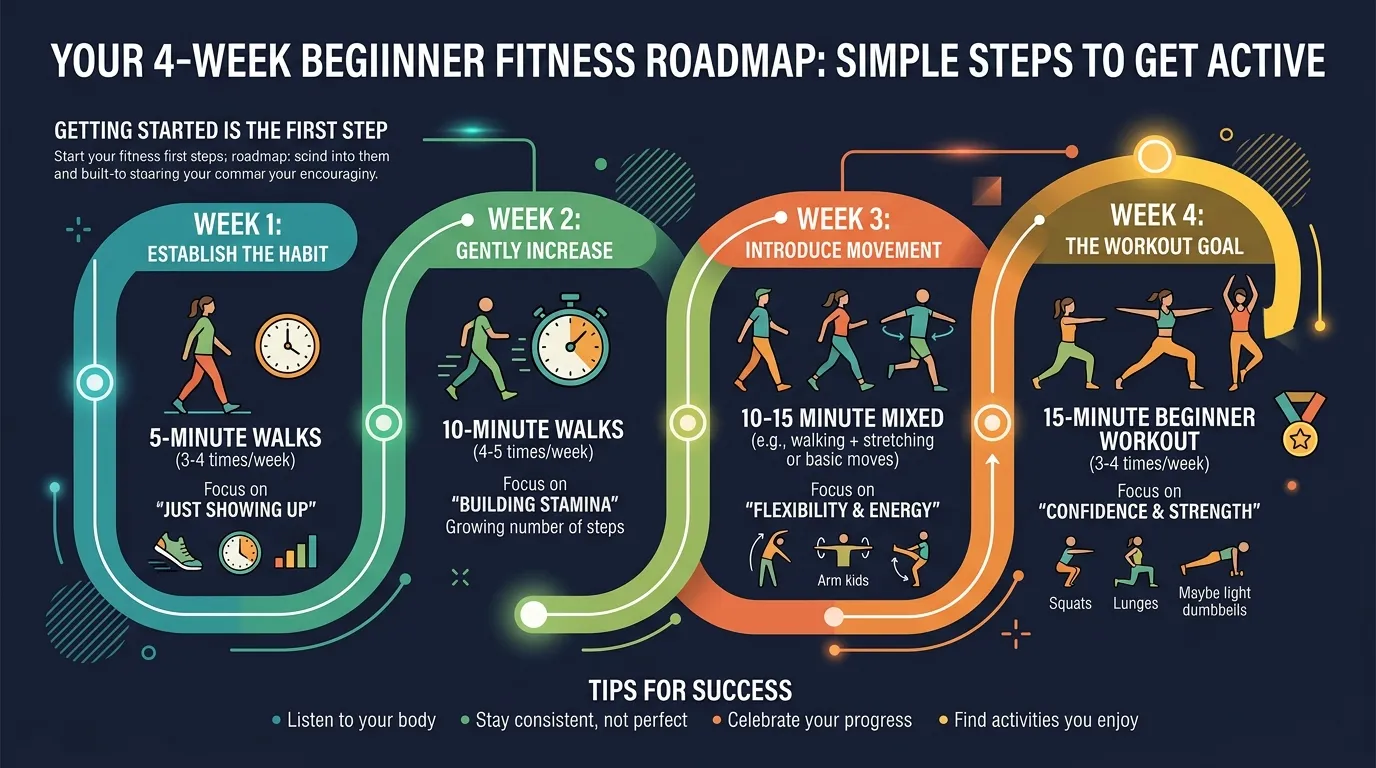
Everything feels new and exciting. You're proud of yourself for starting. You might be a little sore — that's normal and it goes away. Enjoy this phase. Use it to build momentum.
Week 3-4: The Dip
This is where most people quit. The novelty has worn off. You're not seeing dramatic physical changes yet. Life starts competing for your time. This is the moment that separates people who build a lasting habit from people who "tried working out once."
This is also exactly where systems matter more than motivation. A streak you don't want to break. An AI coach that sends you personalized encouragement. A level you're three workouts away from reaching. These aren't replacements for discipline — they're bridges that carry you until the habit becomes self-sustaining.
Month 2-3: The Shift
Somewhere around week six to eight, something changes. Exercise stops being something you force yourself to do and starts being something you notice when you miss. Your energy improves. You sleep better. You might notice your clothes fitting differently. The identity shift begins: you stop thinking of yourself as "someone who doesn't work out" and start thinking of yourself as someone who does.
As Matt, a FitCraft user, put it: "The real win is I actually want to work out now. That's never happened before."
The Bottom Line
Starting from zero isn't a disadvantage. It's the cleanest possible starting line. You don't have bad form to correct, old injuries to work around, or the discouragement of comparing yourself to your former athletic self. You just have a body, a few minutes a day, and the decision to begin.
The fitness industry has made starting feel complicated because complicated sells more products. But the science is clear: short, consistent, progressive workouts — done with proper form and adaptive difficulty — are all you need. The hard part isn't the exercise. The hard part is showing up repeatedly. And that's a design problem, not a willpower problem.
You're not broken. You're not lazy. You're not "too far gone." You're just someone who hasn't found the right system yet.
Katie, another FitCraft user, said it best: "I've tried everything. This is the first time I've stuck with something past two weeks."
If you want the first four weeks handed to you instead, FitCraft's beginner path starts from a full assessment and builds out from there.
Frequently Asked Questions
Can I start working out if I've never exercised before?
Yes. Everyone starts at zero. The key is choosing a program designed for true beginners that adapts to your current fitness level. Research shows that consistency during the first 28 days is the strongest predictor of long-term exercise adherence, so start with short, manageable sessions rather than intense workouts.
How many days a week should a complete beginner work out?
Two to three days per week is ideal for a complete beginner. This gives your body time to recover between sessions while building the habit of regular exercise. As your fitness improves, you can gradually add more days. The most important thing is consistency, not frequency.
What type of exercise is best for someone with no fitness background?
Bodyweight exercises, mobility work, and walking are the best starting points for someone with no fitness background. These require no equipment, carry minimal injury risk, and build the foundational strength and movement patterns needed for more advanced training. Yoga and dynamic movement are also excellent beginner-friendly options.
Is a fitness app better than YouTube for beginners?
For most beginners, a structured fitness app is significantly more effective than YouTube. YouTube offers unlimited content but zero structure — you have to decide what to do, in what order, and how to progress. A good app removes those decisions by building a personalized plan, tracking your progress, and adapting as you improve.
How long does it take to see results when starting from zero?
Most beginners notice improved energy and mood within the first one to two weeks. Visible physical changes typically appear after four to eight weeks of consistent training. The irony of starting from zero is that beginners actually see faster initial progress than experienced exercisers because their bodies respond quickly to any new stimulus.