- 30 grams of fiber a day, by itself, produced 4.6 lb of weight loss at 12 months. Ma et al. (2015) in Annals of Internal Medicine ran a 240-person RCT and the simple fiber target was statistically comparable to a full multi-component AHA diet.
- Viscous fiber drops body weight even without calorie restriction. Jovanovski et al. (2020) meta-analyzed RCTs and confirmed an independent effect on body weight.
- The average American eats ~15g a day. Quagliani & Felt-Gunderson (2017) documented the gap. Most adults would need to roughly double intake to hit the 25-38g target.
- Soluble fiber is the heavy lifter for appetite. Oats, beans, chia, and psyllium form a gel that slows stomach emptying and triggers GLP-1 and PYY release.
- Whole foods beat supplements for weight loss. Fiber comes packaged with protein, water, and chewing time. Powder doesn't replicate that.
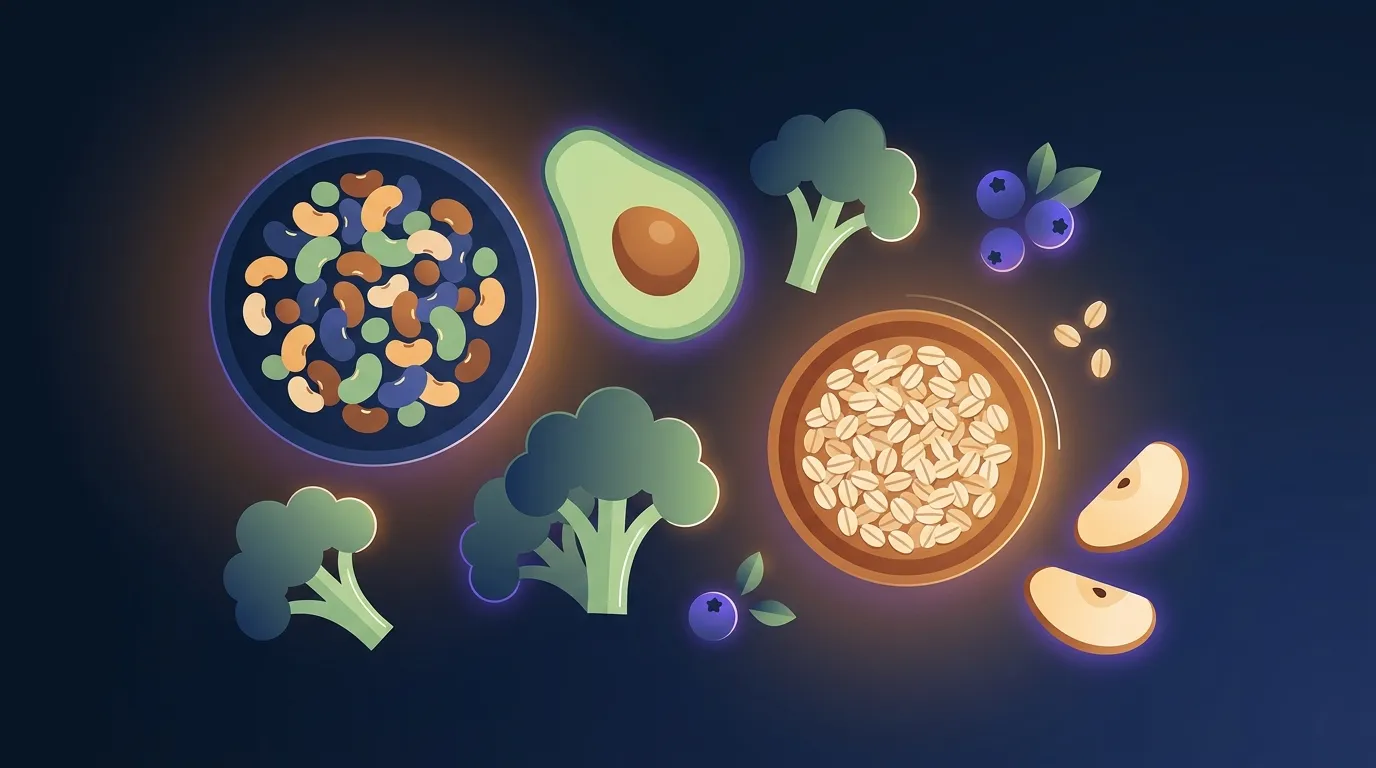
A post hit r/loseit a while back with the title, "Why didn't anyone tell me that fiber is the secret to weight loss?" It pulled in 3,500 upvotes and 400 comments from people describing the same arc. Years of failed diets. Then a switch to high-fiber foods. Then steady, almost effortless fat loss. The pattern was so common in the comments that you could be forgiven for assuming the thread was astroturfed by the oat-bran lobby.
It wasn't. The research backs up what those commenters were describing, and it's been doing so for two decades. Fiber is the single most under-rated lever in the entire weight loss literature. Not because it's magic. Because it's boring, cheap, and not something a supplement company can monopolize, so it gets less marketing than ketones, GLP-1s, and whatever the next miracle is.
Here's what the science actually shows.
The Cleanest Single-Variable Trial
The most striking study on fiber and weight loss is Ma, Olendzki, and colleagues (2015) in Annals of Internal Medicine. The team at the University of Massachusetts ran a randomized trial on 240 adults with metabolic syndrome. The participants were split into two groups for 12 months.
Group A got the full American Heart Association diet plan. Detailed instructions on saturated fat limits, sodium caps, refined-carb reduction, fruit and vegetable minimums, fish servings, alcohol limits. The whole thing. Multiple variables to track.
Group B got one instruction. Eat at least 30 grams of fiber per day. That's it. No calorie target. No macro shifts. No food banned. Just hit the fiber number.
At 12 months, the AHA diet group lost 6.0 pounds. The fiber-only group lost 4.6 pounds. The difference was not statistically significant. Both groups improved insulin resistance, blood pressure, and other metabolic syndrome markers. Adherence was similar. Dropout was similar.
Now, 4.6 lb in a year isn't dramatic on its own. What's dramatic is the comparison. Group B got nearly the same outcome from a single instruction that a normal person could remember and act on. The AHA group needed to track six different things. Fiber alone delivered most of the result.
Why Fiber Works: Three Mechanisms
1. Soluble Fiber Forms a Gel That Slows Digestion
Soluble fiber dissolves in water and forms a viscous gel in your stomach and small intestine. The gel slows gastric emptying, which keeps you fuller for longer after a meal. It also slows the rate at which glucose enters your bloodstream, blunting the post-meal blood sugar spike and the rebound hunger that often follows.
Clark and Slavin (2013) systematically reviewed 44 studies on fiber and satiety. Of fibers tested, viscous types (psyllium, beta-glucan from oats, glucomannan, pectin) showed the strongest acute satiety effects. Jovanovski and colleagues (2020) meta-analyzed 62 RCTs and found viscous fiber supplementation dropped body weight an average of 0.46 kg over a median 10 weeks, independent of any calorie restriction.
2. Fiber Triggers Satiety Hormones
When fiber reaches the large intestine, gut bacteria ferment it into short-chain fatty acids (SCFAs) like butyrate, acetate, and propionate. SCFAs trigger the release of glucagon-like peptide 1 (GLP-1) and peptide YY (PYY), two of the most powerful satiety hormones your body produces.
This is, in fact, the same hormonal pathway that GLP-1 medications like Ozempic and Wegovy exploit pharmacologically. Fiber raises GLP-1 naturally through fermentation. The effect is smaller than a weekly injection, but it's free, doesn't require a prescription, and comes with none of the side effect profile. A 2022 review in Critical Reviews in Food Science and Nutrition by Hu and colleagues summarized the evidence that fiber-induced SCFA production is a major pathway through which fiber reduces appetite and improves metabolic health.
3. High-Fiber Foods Are Lower in Calorie Density
Foods naturally high in fiber (vegetables, fruits, legumes, whole grains) tend to be low in calorie density. A cup of black beans is 220 calories and 15 g of fiber. A cup of refined breakfast cereal can be 200 calories and 1 g of fiber. Volume eaten matters for satiety, not just calorie count, so the high-fiber meal feels bigger and lasts longer.
This is the mechanism Howarth, Saltzman, and Roberts (2001) emphasized in their classic review in Nutrition Reviews. They estimated that increasing fiber intake by 14 g per day was associated with a 10% decrease in energy intake and an average 1.9 kg weight loss over about 4 months, across the population studies they reviewed.

How Much You Need (and How Far Off You Probably Are)
The Institute of Medicine recommendation is 25 g per day for adult women and 38 g per day for adult men, based on the amount associated with cardiovascular protection. For weight loss specifically, the Ma 2015 trial targeted 30 g per day across both sexes and got the benefit.
The reality? Quagliani and Felt-Gunderson (2017) documented that the average American adult eats about 15 g per day, just under half the women's target and well under half the men's. About 95% of American adults fall short of the recommendation. This is one of the largest gaps in the modern Western diet.
The practical implication: if your weight loss has stalled, your blood sugar is jumpy, or you find yourself hungry an hour after meals, your fiber intake is the first thing to check. It costs nothing to find out. Add up a typical day from a nutrition tracker. If you're at 15 g, doubling that should be your first move, not cutting another 200 calories.
Knowing what to do is the easy part.
Take the free FitCraft assessment and get a personalized plan based on behavioral science, not willpower.
Take the Free Assessment Free • 2 minutes • No credit cardThe Best High-Fiber Foods (Sorted by Yield)
Not all fiber sources are equal in practical terms. Some give you 15 g per serving, some give you 2. If your goal is to roughly double your daily intake without doubling your eating effort, focus on the densest sources.
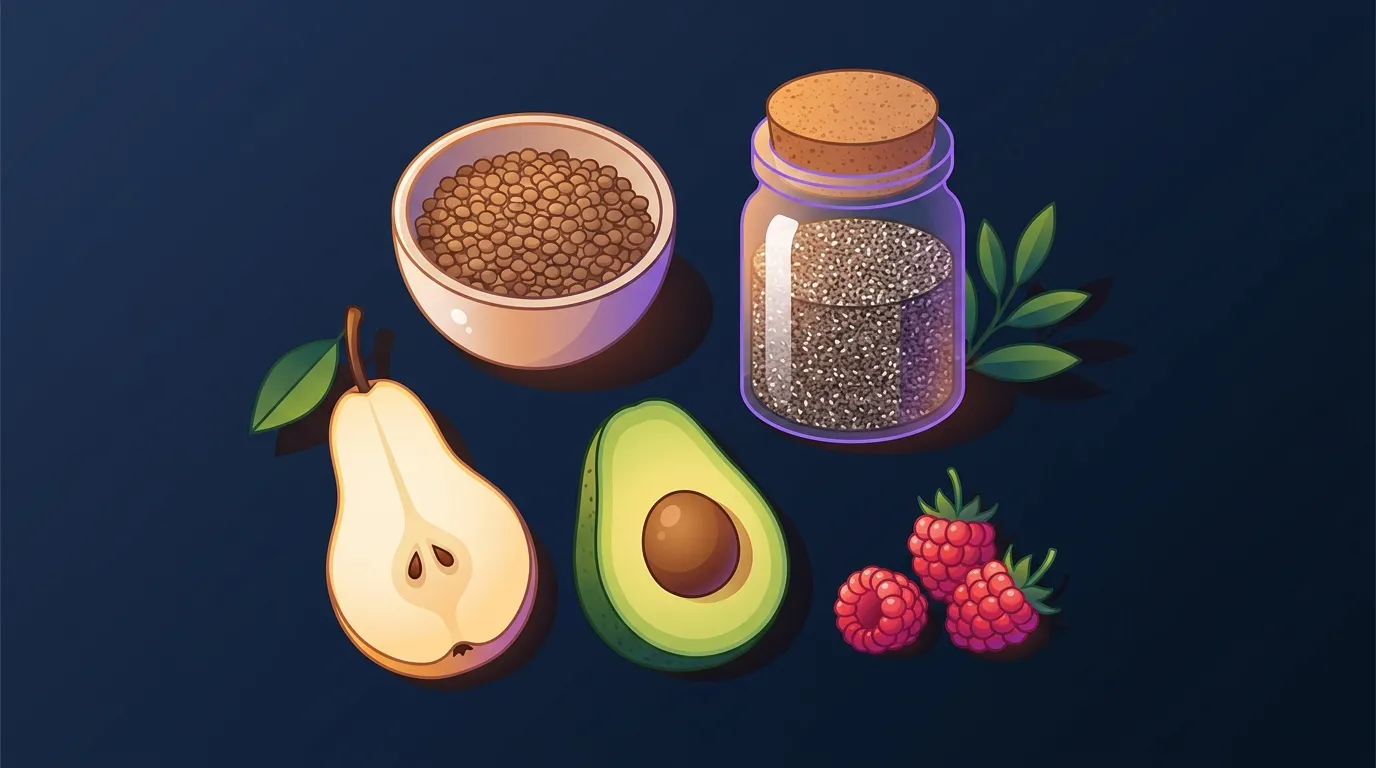
- Legumes (15-16 g per cooked cup). Black beans, lentils, chickpeas, navy beans, pinto beans, split peas. Single highest-yield food category for fiber. A cup of lentils gets you close to half your daily target by itself.
- Chia seeds (10 g per oz, about 2 tbsp). Soaked in yogurt or oatmeal, they form a gel that slows gastric emptying directly. Mostly soluble.
- Avocado (10 g per fruit). Fat, fiber, and potassium in one. Goes on toast, salads, eggs.
- Raspberries and blackberries (8 g per cup). The highest-fiber fruits, mostly because of their seeds.
- Oats (8 g per cup cooked). The beta-glucan in oats is one of the most-studied viscous fibers.
- Pears with skin (6 g per medium pear). Most of the fiber is in the skin. Peeled pears are roughly half.
- Broccoli, Brussels sprouts, artichoke (5-10 g per cup cooked). Cruciferous vegetables are the highest-fiber veggies after legumes.
- Whole-grain bread and pasta (4-6 g per serving). Watch labels. Many "wheat" breads have under 2 g per slice.
- Nuts and seeds (3-4 g per oz). Almonds, pistachios, sunflower seeds, pumpkin seeds.
A practical daily target: one cup of legumes, two cups of vegetables, two fruits, one serving of oats or whole grain. That stack alone gets you to 30+ grams. Read more about how this kind of structural eating beats weight-loss plateaus and pairs with low-willpower habit design.
What About Fiber Supplements?
Psyllium husk (Metamucil and generics) is the best-studied fiber supplement. A 2023 dose-response meta-analysis of psyllium trials found 10-15 g per day produced significant reductions in body weight and waist circumference over 12 weeks. Glucomannan, methylcellulose, and inulin have weaker but positive evidence. They work.
The catch is that supplements only deliver one piece of the puzzle. Whole foods bundle fiber with protein, micronutrients, chewing time, and water. The chewing alone matters; studies on eating rate show slower eating reduces calorie intake by 5-10% at a meal independent of food choice. A psyllium capsule delivers no chewing.
Use supplements as a top-up, not a replacement. If you're at 20 g from food and want to add a soluble-fiber boost before meals (a common approach for blunting blood sugar spikes), psyllium or glucomannan works well. If you're at 10 g from food and trying to fix that with a supplement alone, you're solving the wrong problem.
How to Add Fiber Without Wrecking Your Gut
One real caveat: if you go from 15 g to 35 g in a single day, you're going to have a bad time. Gas, bloating, cramping, and irregularity are all common when fiber intake jumps fast. Your gut microbiome needs roughly two to three weeks to adapt to a higher fiber load by shifting bacterial populations toward fiber-fermenting strains.
The practical pattern: add 5 g per day every 3 to 5 days until you hit your target. Drink more water (fiber pulls water into the gut; if you're underhydrated, fiber makes constipation worse, not better). Spread fiber across meals rather than stacking it all at breakfast. If you have IBS or another GI condition, talk to a clinician about which fiber types tolerate best; FODMAP-sensitive people often do better with chia, oats, and psyllium than with beans and onions.
Where This Fits in a Real Weight Loss Plan
Fiber isn't a substitute for the basics. You still need a calorie deficit to lose weight, you still need protein to keep muscle, and you still need to actually move. What fiber does is make the calorie deficit happen more naturally, with less hunger, less obsessive tracking, and less willpower drain. That's not nothing. That's, in fact, the whole game. The diets that work long-term aren't the ones with the cleverest macros; they're the ones you don't have to fight.
If you're trying to drop 10 to 50 pounds and you're hungry all the time, double your fiber before you cut another calorie. If you're already eating 35 g a day and the scale isn't moving, then yes, you have a different problem to solve. But for the vast majority of people Googling "is fiber good for weight loss," the answer is: yes, and you're probably eating half of what you should be.
Like most things in fitness and nutrition, the result depends on whether you stick with it. A perfect 30-gram day this week and 12 grams next week won't move the needle. But if you can make 25 to 35 grams a daily floor for the next three months, you'll feel the difference. And you'll probably wonder, like that Reddit poster, why nobody told you sooner.
Frequently Asked Questions
Does fiber actually help you lose weight?
Yes, and the evidence is stronger than most people realize. A 2015 randomized trial by Ma and colleagues at the University of Massachusetts (n=240, published in Annals of Internal Medicine) gave one group a single instruction: eat at least 30 grams of fiber per day. They lost 4.6 lb at 12 months, statistically comparable to a separate group following the full multi-component American Heart Association diet (6.0 lb). The fiber-only group had nearly identical improvements in blood pressure, insulin resistance, and adherence. A 2020 meta-analysis by Jovanovski and colleagues confirmed that viscous fiber reduces body weight even without an energy-restricted diet.
How much fiber should I eat per day to lose weight?
The Institute of Medicine recommends 25 grams a day for women and 38 grams a day for men, based on the amount associated with cardiovascular protection. For weight loss specifically, the Ma 2015 trial targeted 30 grams a day across both sexes. The average American adult eats about 15 grams a day per Quagliani and Felt-Gunderson (2017), so most people would need to roughly double their intake to hit the target.
What are the best high-fiber foods for weight loss?
The highest-yield foods per calorie are beans and lentils (15-16 g per cooked cup), chia seeds (10 g per oz), avocado (10 g per fruit), raspberries (8 g per cup), oats (8 g per cup cooked), and broccoli or Brussels sprouts (5 g per cup cooked). Whole grains, nuts, and pears round out the list. Fiber supplements like psyllium husk work too but cover only part of the benefit. Whole-food fiber comes packaged with the protein, micronutrients, and chewing time that drive satiety.
Does fiber help with belly fat specifically?
Yes, to the extent that any single dietary change can target a specific fat depot (which is limited). A 2011 trial by Hairston and colleagues in Obesity followed 1,114 adults for 5 years and found that for every 10-gram increase in soluble fiber intake, visceral adipose tissue dropped 3.7% over the next 5 years. The mechanism is mostly indirect: lower overall calorie intake plus better blood sugar control, both of which reduce abdominal fat accumulation.
What's the difference between soluble and insoluble fiber for weight loss?
Soluble fiber (oats, beans, apples, chia, psyllium) dissolves in water and forms a gel that slows stomach emptying. That gel is what produces the strongest satiety signal and the most measured weight loss effect, per the Jovanovski 2020 meta-analysis. Insoluble fiber (wheat bran, vegetable skins, nuts) speeds intestinal transit and supports gut health but has a smaller direct effect on appetite. Most fiber-rich foods contain both. You don't need to track which is which; just eat a wide range of plants.