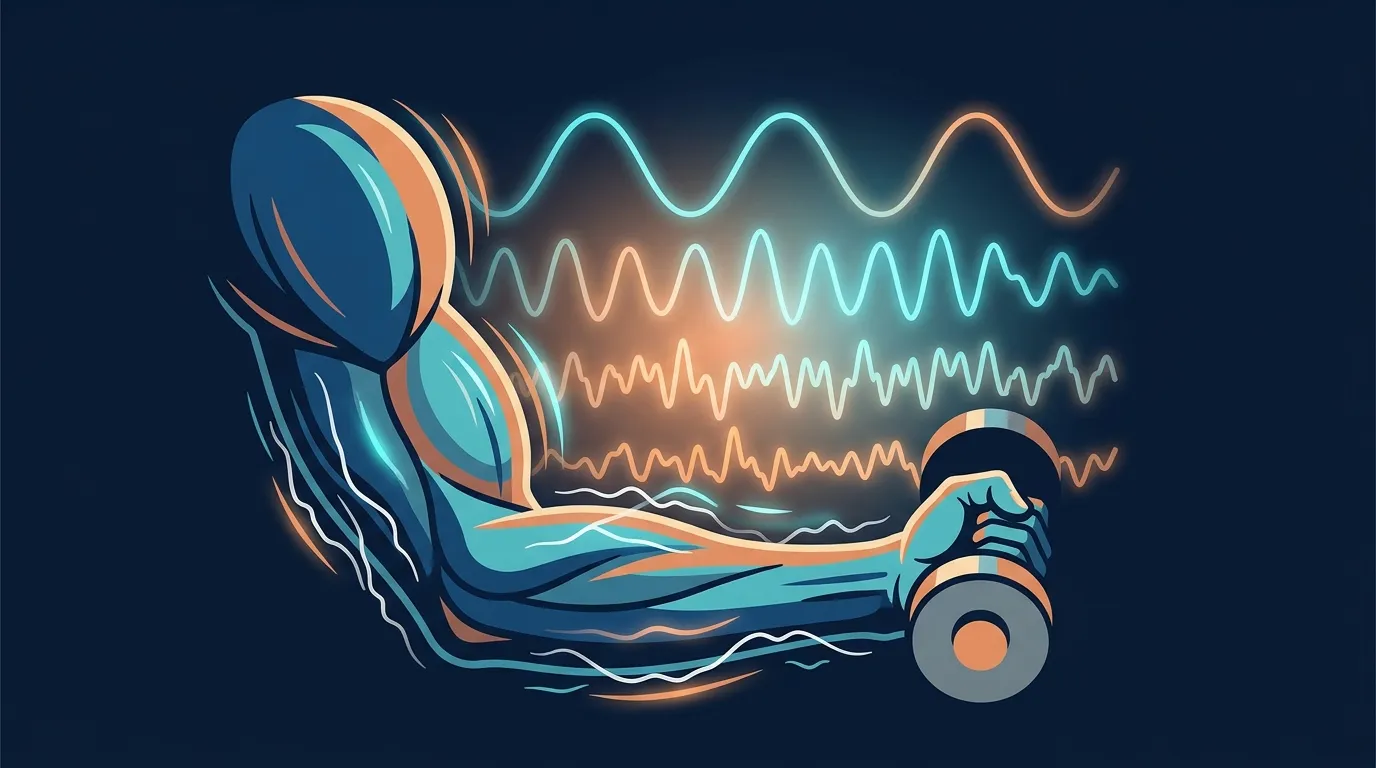
You are on your last set of squats. The bottom of rep 8 hits, you drive up, and somewhere around the lockout your quads start to shake like you are standing on a vibrating plate. It looks dramatic. It feels dramatic. And it is almost always completely normal.
The shaking has a specific name in the physiology literature. It is called physiological tremor. Everyone has it all the time. At rest, the tremor is so small you cannot see it. After hard work, it gets amplified, sometimes a lot. Two things drive that amplification, and a third thing is responsible for the rarer but more concerning version of the shake.
Here is what is actually happening, in plain language, with the research that backs it up.
What "Shaking" Actually Is
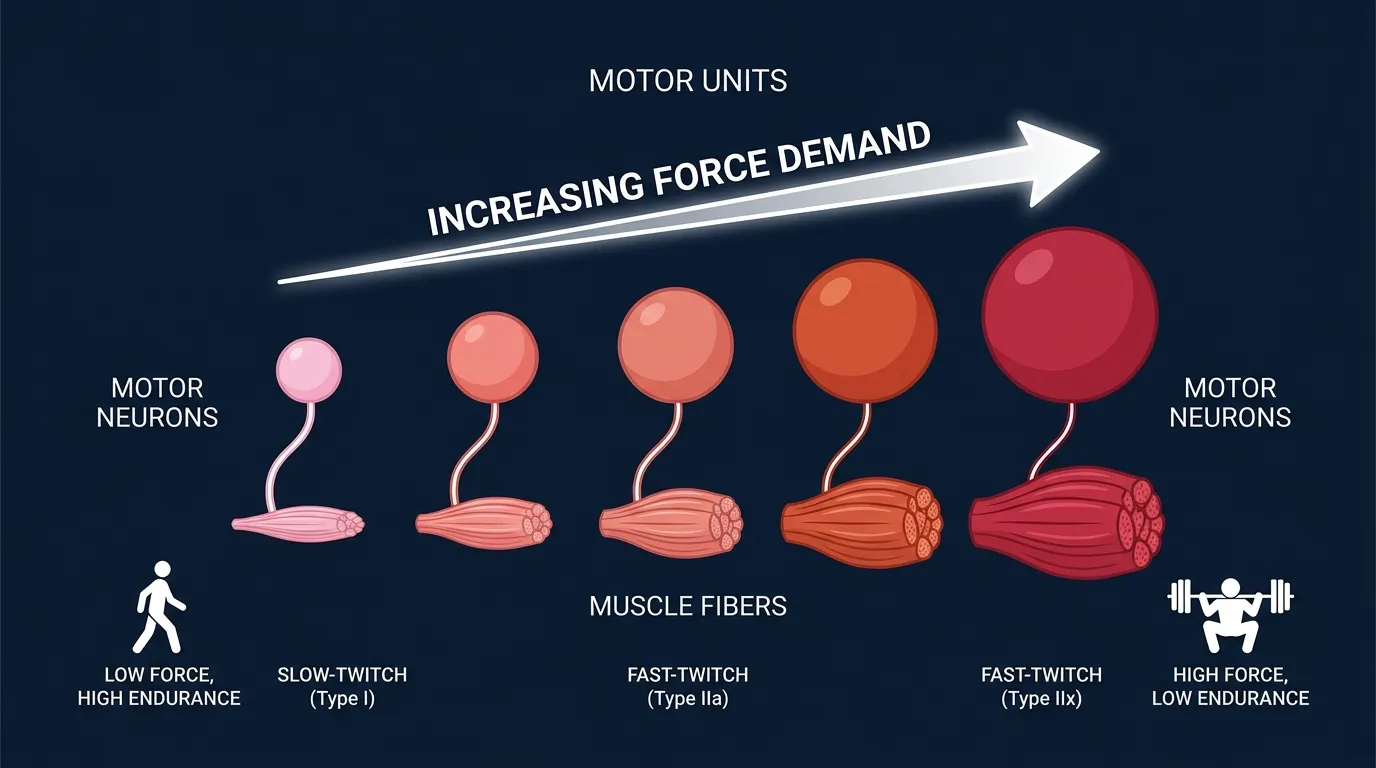
Your muscle does not contract as one smooth unit. It contracts in chunks called motor units. A motor unit is one nerve cell plus all the muscle fibers it controls. A small biceps might have a few hundred motor units. A big quadriceps has thousands.
At any given moment, force production depends on two things: how many motor units are firing, and how fast each one is firing. To lift a heavier weight, you recruit more motor units. To hold a steady contraction, the units cycle in and out, taking turns so no single unit fatigues too fast.
That cycling is what creates the smooth feel of a controlled movement. When the cycling breaks down (when too few units are left fresh, when the central nervous system can no longer sequence them precisely) the muscle output gets choppy. The limb visibly oscillates. That is the shake.
The size principle: why shaking shows up at the end, not the start
One of the most-cited rules in muscle physiology explains why you do not shake at the start of a set but do at the end. The size principle (formalized by Henneman in the 1960s and reviewed by Mendell 2005 in the Journal of Neurophysiology) says motor units are recruited in a strict order: small slow-twitch units first, large fast-twitch units last.
The small units are fatigue-resistant. They can fire for a long time without tiring. The large fast-twitch units produce much more force per cell but exhaust quickly. So the first rep of a set runs mostly on small units. As those start to fatigue, the body recruits progressively larger units to keep producing the same force. By the last hard rep, you are running on the biggest, fastest, and least fatigue-resistant units you have. Those are also the ones whose firing rhythm gets least smooth as they tire.
That is why heavy squats shake your legs and walking does not. Walking stays in the small, fatigue-resistant pool indefinitely. Squats burn through them and force the system into the high-threshold pool where shaking is structurally baked in.
The Research on Why Tired Muscles Tremble
Two strands of evidence carry most of the weight here. One is classic neurophysiology from the 1980s. The other is more recent EMG and tremor-measurement work.
Lippold 1981: tremor amplitude can rise an order of magnitude
The foundational paper is Lippold (1981) in the Ciba Foundation Symposium on Human Muscle Fatigue. Lippold ran a series of experiments comparing tremor amplitude before, during, and after different kinds of exercise. The headline finding: after a maximal voluntary effort lasting about 2 minutes, tremor amplitude could rise up to one order of magnitude (a 10x increase) and stay elevated for several hours.
The key methodological detail is what Lippold ruled out. When he stimulated the motor nerve directly with electricity (bypassing the brain and spinal cord), the same level of muscle work did not increase tremor. The increase only happened when the subject's nervous system was driving the contraction. Conclusion: the post-exercise shake is not a muscle problem. It is a nervous system problem. The brain and spinal cord lose some of their ability to fire the muscle smoothly, and the limb registers that loss as visible tremor.
Gandevia 2001: the fatigue is partly spinal, partly central
The more comprehensive review came two decades later. Gandevia (2001) in Physiological Reviews synthesized the spinal and supraspinal contributions to human muscle fatigue. The picture that emerged is layered. With repeated effort, the motor cortex sends progressively weaker descending signals (central fatigue), the spinal motor neurons become less excitable (spinal fatigue), and the muscle fiber itself fatigues (peripheral fatigue). All three layers contribute to the inability to maintain smooth force.
This matters for the shaking question because it means there is no single dial to turn. You cannot just "have more glycogen" or "drink more water" and remove the tremor at the end of a hard set. Some fraction of it is your nervous system protecting you from continuing past the muscle's safe operating envelope.
Mazur-Rozycka 2023: it is measurable in real athletes after real exercise
For a recent confirmation in actual training conditions, Mazur-Rozycka and colleagues (2023) in the International Journal of Environmental Research and Public Health measured physiological tremor of the lower limb in 19 young men who train competitive canoe sprint. They took tremor recordings at rest and immediately after a fatiguing exercise protocol. Both the parameters of the Hoffmann reflex (a measure of spinal reflex excitability) and physiological tremor changed significantly after exercise. The two measures did not correlate with each other, suggesting they reflect different sub-components of the fatigue response.
The practical takeaway from that study: the post-exercise tremor is reproducible, measurable, and shows up reliably in trained athletes. It is not a sign of being out of shape. It is a sign of having worked the muscle into its fatigue zone.
Knowing what to do is the easy part.
FitCraft, our mobile fitness app, pairs you with an AI coach who builds you a personalized plan around your goals, schedule, and fitness level. Every FitCraft program is designed by Domenic Angelino, MPH (Brown University) and NSCA-CSCS, with research published in the Journal of Strength and Conditioning Research and Medicine & Science in Sports & Exercise.
Take the Free Assessment Free • 2 minutes • No credit cardThe Three Real Causes (Ranked by Likelihood)
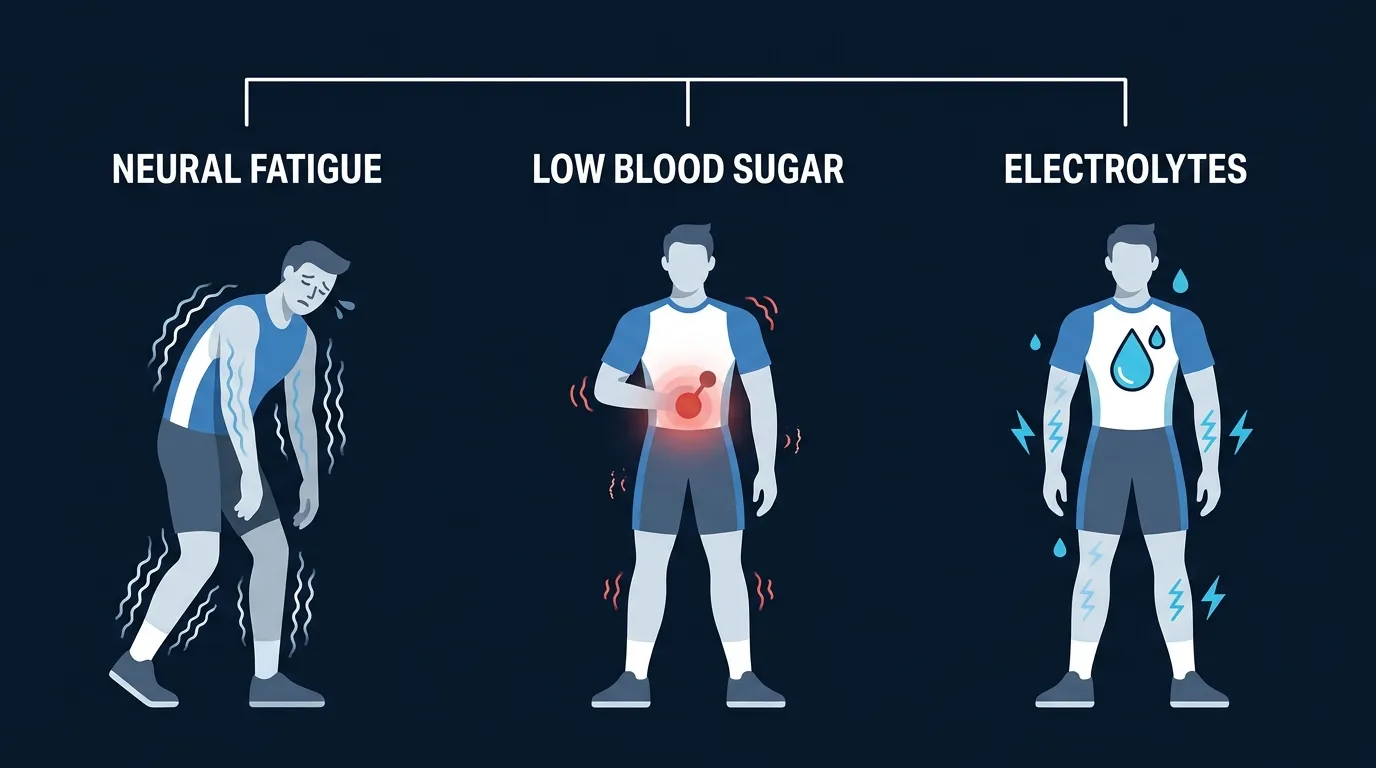
If you are shaking during a workout, the cause is almost certainly one of three things.
1. Neural fatigue (90% of cases)
This is the version we have been describing. You worked the muscle into the high-threshold motor unit pool, those units fatigued, and the firing pattern lost coherence. It shows up most in compound lifts (squats, lunges, push-ups to failure), in long isometric holds (planks, wall sits), and in the last 1 to 3 reps of an effortful set. It resolves within minutes of stopping.
This is not something to fix. It is a useful signal that you have reached the working end of the set. If you are training for hypertrophy, that point (and the rep or two before it) is the most growth-stimulating rep of the set. Welcome the trembling, finish the rep with control, and rack the weight.
2. Low blood sugar (most common in fasted or long sessions)
If the shaking comes with sweating you did not earn, light-headedness, hunger, or mental fog, the cause is likely exercise-induced hypoglycemia. Muscle takes up glucose at a high rate during work, and if the liver cannot keep blood glucose stable, the symptoms of low blood sugar (which include tremor) emerge. This is more likely after fasted training, after long sessions over 60 to 90 minutes, after a meal that was light on carbohydrate, or in people on glucose-lowering medications.
The fix is simple. Stop the session, sit down, eat a small snack with carbohydrate (a banana, a piece of toast, juice, sports gel), and wait 10 to 15 minutes. To prevent it from happening again, eat a small carbohydrate-containing snack 30 to 60 minutes before the session.
3. Dehydration and electrolyte imbalance
Heavy sweating depletes sodium, potassium, and magnesium. Sustained electrolyte shortfalls disrupt the calcium signaling that triggers muscle contractions, which can show up as twitching, cramping, or generalized shakiness late in a long session. This is more common in hot environments, in long endurance sessions, and in people who train multiple times a day. The fix is rehydration with water plus electrolytes (table salt in water counts; a sports drink counts; an electrolyte tablet counts).
This one is less common than people assume in indoor strength training where total sweat losses are usually modest. If you only train for 45 minutes in air conditioning, electrolyte depletion is probably not the cause of your shaking. Look at the first two causes instead.
When Shaking Is Worth Worrying About
The three patterns above all share one feature: the shaking is bilateral (both sides), happens during or right after effortful work, and resolves within minutes to maybe an hour. If your symptoms break any of those rules, get checked out.
Specifically, see a clinician if the shaking is one-sided after ordinary activity, if it does not stop within an hour of resting, if it comes with severe persistent dizziness or fainting, if it is accompanied by chest pain or shortness of breath that does not match the workout, or if there is a sudden change in your tremor pattern that does not align with anything you changed in your training. New, persistent, or asymmetric tremor is the symptom set that warrants a workup, not the predictable end-of-set shaking that has a clear physiological explanation.
How to Make It Show Up Less Often
You probably do not want to eliminate end-of-set shaking entirely. As discussed, it is the useful signal that you reached a productive working depth. But if your tremor is showing up earlier than it should (mid-set on rep 4 of 10, for example), a few things will push it later in the set.
Eat before training. Even a small carbohydrate-and-protein snack 60 to 90 minutes pre-workout stabilizes blood glucose and removes the hypoglycemia variable. This matters more for morning training and for sessions longer than 45 minutes.
Train the movement more often. The high-threshold motor units involved in heavy lifting become more synchronized with practice. A movement you have practiced for years (your squat, your push-up) tends to feel smoother under fatigue than a movement you are still learning. This is part of why beginners shake more than intermediates on the same relative load.
Build the aerobic base. Better mitochondrial density delays the point at which the muscle has to lean on fast-twitch units. Light zone 2 training a couple of times a week noticeably shifts when shaking shows up in longer strength sessions.
Sleep. Sleep debt amplifies the central fatigue component of the response described in our piece on sleep and muscle growth. A bad night turns yesterday's productive shake into today's mid-set shake on a lighter weight.
The Short Version
Muscle shaking during or right after exercise is almost always neural fatigue. The motor units doing the work hit a ceiling and the survivors fire less smoothly. The 1981 work by Lippold documented that the post-exercise tremor amplitude can rise an order of magnitude after a real effort. The 2001 review by Gandevia showed the cause is layered (peripheral, spinal, central) and so the fix is not a single dial. The 2023 tremor study by Mazur-Rozycka and colleagues confirmed it is reliably measurable in trained athletes after fatigue. Shaking is the body telling you that the set has reached its productive end. Treat it as the cue to stop the rep with control, not as a problem to grind through.
The other two real causes are low blood sugar (more common in fasted or long sessions, paired with sweating and light-headedness) and electrolyte depletion (more common in hot, long sessions). Both are easy to fix and easy to prevent. The rare cases worth a clinician are the patterns this article does not describe: one-sided tremor, tremor at rest, tremor that does not stop within an hour, or tremor paired with chest pain or fainting.
Everything else is the normal sound the muscle makes when you ask it to work hard. Listen to it. Finish the rep. Eat the banana.
Frequently Asked Questions
Is it bad if my muscles shake during exercise?
Usually not. Most shaking during or after exercise is neural fatigue. The motor units doing the work hit a ceiling and the survivors start firing less smoothly, which the limb registers as a visible tremor. It is the normal end-of-effort signal that the muscle is approaching its current limit. It typically goes away within minutes of stopping. Worry only if it does not stop, if it comes with severe dizziness or nausea, or if the shaking is one-sided after light activity.
Why do my legs shake during squats but not during walking?
Squats demand much higher force per rep than walking, so they recruit higher-threshold fast-twitch motor units (Henneman size principle, Mendell 2005). Those units fatigue faster and less synchronously than the slow-twitch units used in walking. By the last rep of a set, the working units are firing at low frequencies and shutting off unpredictably. The result reads as visible shaking. Walking stays in the small, fatigue-resistant motor unit pool indefinitely, which is why your legs do not tremble on a long walk even though the muscles are working.
Why does my whole body shake after a hard workout?
Lippold (1981) documented that a maximal effort lasting about 2 minutes can increase tremor amplitude by up to an order of magnitude for several hours afterward. The mechanism is central, not just local. The nervous system is recovering its ability to fire muscles smoothly. If the shaking comes with sweating, dizziness, hunger, or confusion, it can also be exercise-induced hypoglycemia, especially after long fasted sessions. A quick snack with carbohydrate and a few minutes of rest resolves that case quickly.
Should I push through the shaking or stop?
Shaking late in a set is a useful signal that you are near the meaningful end of the working range. Finish the rep with control if your form is intact, then rest. Trying to grind out extra reps once form is breaking down is where injuries happen. The shaking itself is not dangerous, but the loss of motor control that produces it makes the next rep less precise and more likely to go wrong. Treat trembling as the cue to stop the set, not to keep adding reps.
How do I stop shaking after a workout?
Most cases resolve on their own within 5 to 15 minutes. To speed things up, sit or lie down, drink water with electrolytes, and eat a small snack with carbohydrate and protein if it has been more than 3 hours since your last meal. Slow nasal breathing for a couple of minutes shifts you toward parasympathetic recovery. If you train fasted and shake regularly afterward, eating something light 30 to 60 minutes before your session usually fixes it.