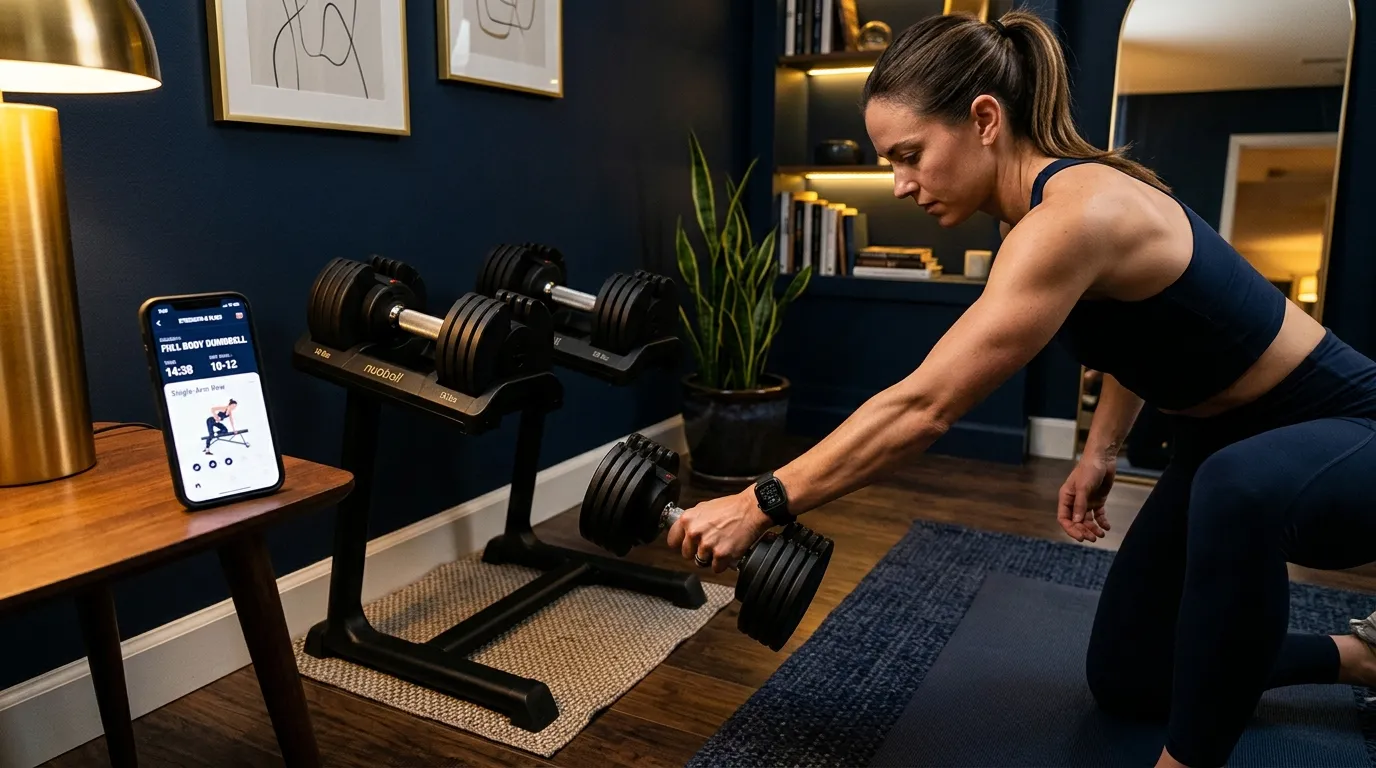
Why Your Dumbbell App Choice Actually Matters
A pair of dumbbells can train every major muscle group. That's not the hard part. The hard part is programming: knowing which exercises to do, in what order, at what weight, and when to progress. That's what separates people who get results from people who do the same 3 exercises for a year and wonder why nothing changes.
A good dumbbell workout app solves three problems:
- Exercise selection — A deep library of dumbbell-specific movements, not just barbell exercises awkwardly adapted for dumbbells
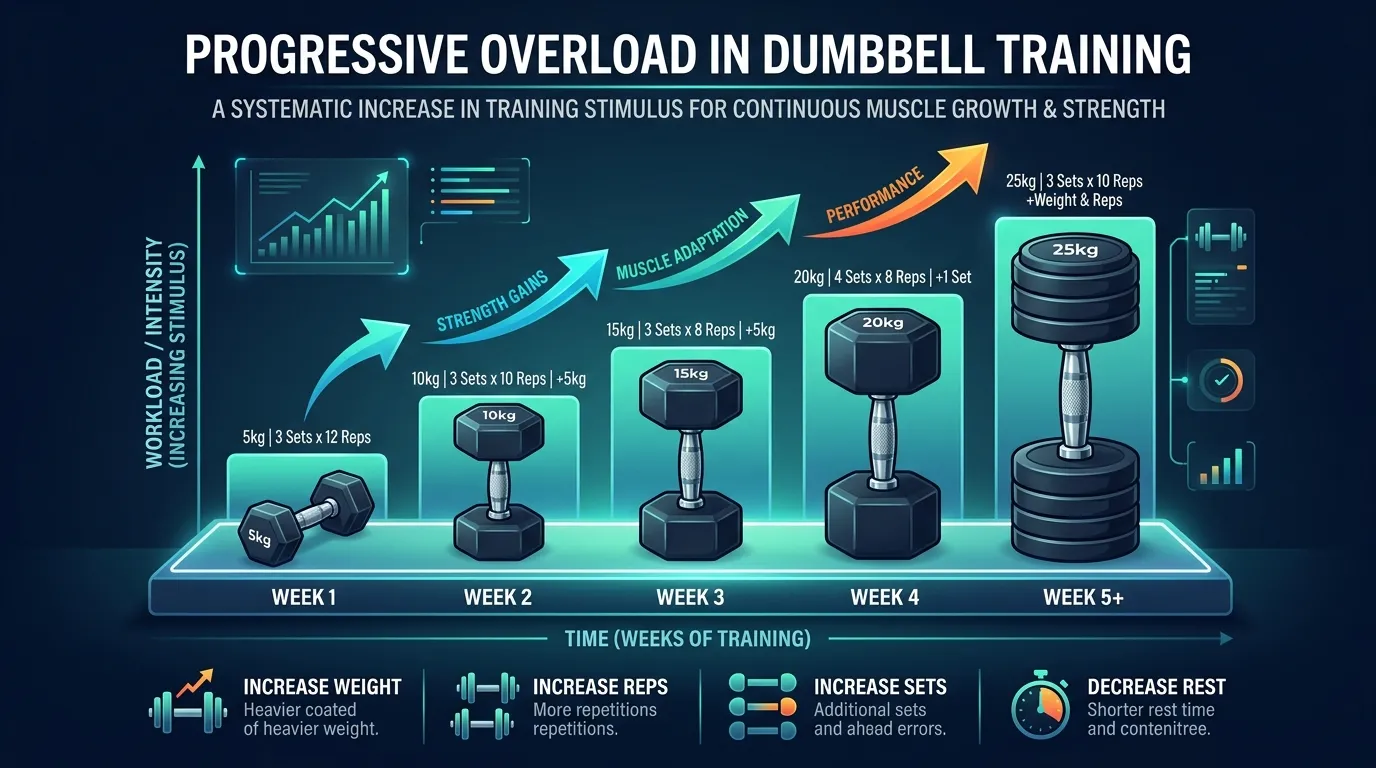
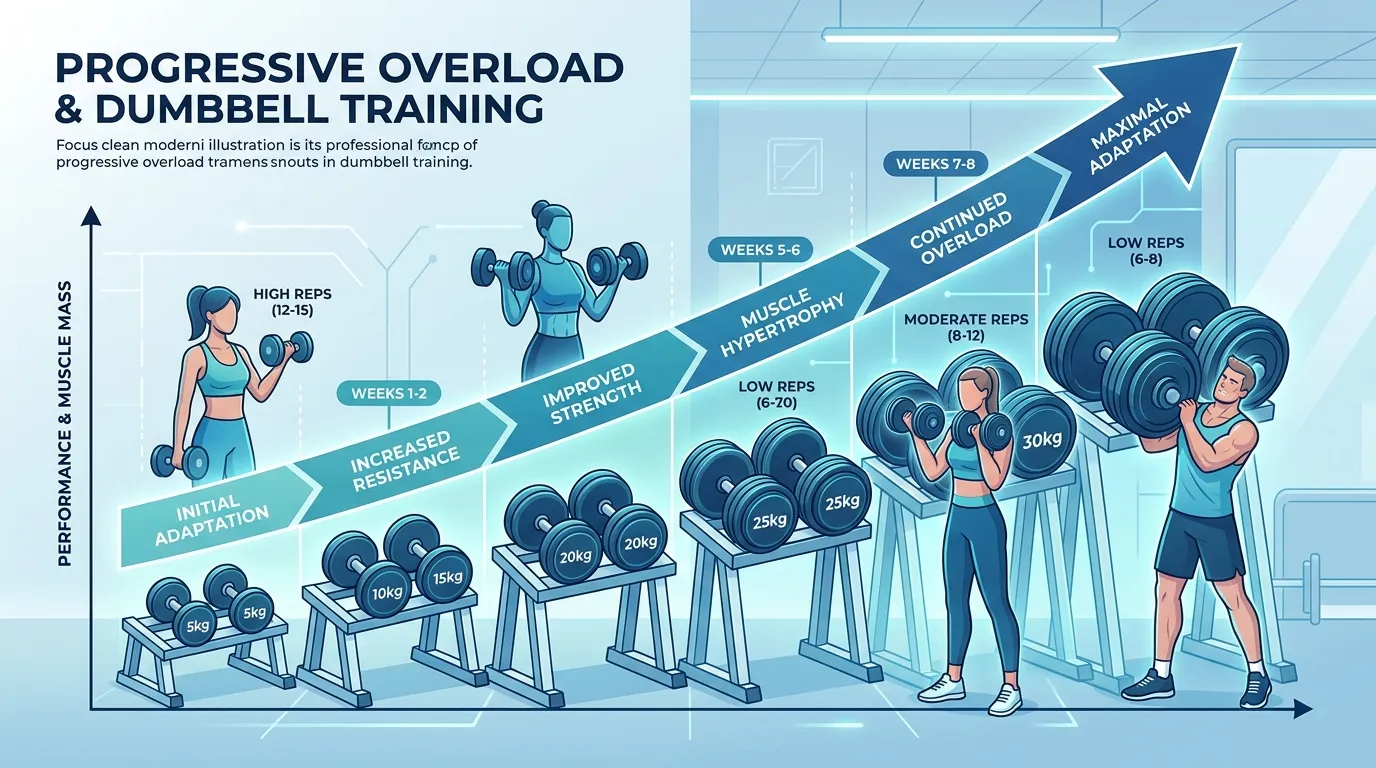
- Progressive overload — Systematic increases in weight, reps, or volume over time (the single most important factor in building muscle)
- Form guidance — Clear demonstrations that show you how to perform each exercise safely and effectively
A 2023 meta-analysis in Sports Medicine confirmed that dumbbell training produces equivalent muscle hypertrophy to barbell training when volume and intensity are matched. The equipment isn't the limiting factor. The programming is.
What to Look for in a Dumbbell Workout App
Before we get into rankings, here are the features that separate good dumbbell apps from mediocre ones:
Dumbbell-Specific Exercise Library
Many fitness apps are built around barbell movements and treat dumbbells as an afterthought. Look for apps that have dedicated dumbbell exercise variations — not just "do the barbell version but with dumbbells." Dumbbell training has unique advantages (unilateral work, greater range of motion, stabilizer muscle engagement) that should be reflected in the exercise library.
Progressive Overload Tracking
If the app doesn't track your weights and systematically increase difficulty, it's a timer, not a training program. Progressive overload is how muscle adapts and grows. The best apps handle this automatically based on your performance history.
Form Guidance Quality
Dumbbell exercises demand more stabilization than barbell or machine movements, which makes form more important and harder to learn. Look for detailed demonstrations — ideally from multiple angles — rather than simple illustrations or text descriptions.
Equipment Flexibility
Not everyone has a full dumbbell rack. The best apps let you specify exactly what equipment you own and build workouts around those constraints — whether that's a single pair of 20-pound dumbbells or a full adjustable set.
The Best Dumbbell Workout Apps, Ranked
1. FitCraft: Best Dumbbell Workout App for Consistency and Beginners
Dumbbell support: Full | Form guidance: Interactive 3D demos | Price: Free version available, subscription for the full experience
FitCraft takes a fundamentally different approach from most dumbbell apps. Instead of just giving you a workout and hoping you show up tomorrow, it wraps dumbbell training in a gamification system designed to make showing up easier.
What makes it stand out for dumbbell training:
- Interactive 3D exercise demos — Not videos, not illustrations. Fully interactive 3D models you can pinch, zoom, and rotate to see exactly how each dumbbell exercise should look from any angle. This is a genuine advantage for learning dumbbell form, where small positioning differences matter.
- Adaptive workouts — The AI trainer personalizes your dumbbell workouts based on your progress, adjusting exercises, volume, and intensity as you improve. Tell it you only have dumbbells and resistance bands, and it builds around that constraint.
- Gamification that drives consistency — XP for completed workouts, leveling up, collectible cards, and calendar tracking with rewards. These mechanics are specifically designed to get you past the first few weeks where most people quit.
- Workout variety — Beyond dumbbell strength, FitCraft offers yoga, mobility, cardio, dynamic movement, bodyweight, and resistance band workouts — all within the same progression system.
Where it shines: If you've bought dumbbells before and they ended up as doorstops, FitCraft's gamification system is designed for exactly that pattern. The AI trainer provides personalized, adaptive encouragement that feels like having a coach invested in your progress. The 3D demos are especially useful for dumbbell exercises where form is everything.
Where it falls short: FitCraft is built as an instructional fitness app, not a workout logger. If you're an experienced lifter who already knows every dumbbell movement and only wants somewhere to record sets, a plain tracker will suit you better. It also doesn't carry the sheer database size of JEFIT.
Best for: People who are new to dumbbell training or who have struggled to stay consistent with home workouts. The gamification makes the difference between "I should work out" and "I want to work out."
Not sure which dumbbell program fits you?
Take the free 2-minute assessment — it factors in your equipment, experience, and goals.
Take the Free Assessment Free · 2 minutes · No credit card2. Fitbod: Best for Experienced Lifters
Dumbbell support: Full | Form guidance: Video demos | Price: Subscription model
Fitbod's algorithm is its defining feature. It tracks which muscle groups you've worked, how recovered they are, and generates each workout to optimally distribute training stimulus. For dumbbell users, you can filter the entire exercise pool by available equipment.
What makes it strong for dumbbell training:
- Muscle group recovery tracking — The algorithm knows you did dumbbell rows yesterday and won't overload your back today. This is genuinely useful for dumbbell training where it's easy to accidentally over-train pulling muscles.
- Equipment filtering — Set "dumbbells" as your available equipment and every generated workout uses only dumbbell exercises. You can also add resistance bands, a bench, or other accessories.
- Progressive overload built in — Fitbod automatically suggests weight increases based on your logged performance. It tracks your estimated 1RM for every exercise.
- Apple Watch and Wear OS integration — Log sets from your wrist, which is convenient during dumbbell workouts.
Where it shines: Fitbod's algorithm is the best in the category for auto-generating balanced training splits. If you tell it you have dumbbells and a bench, it produces legitimate strength programming with appropriate volume and recovery.
Where it falls short: The app assumes you already know how to perform the exercises. Video demos exist but are basic. There's no gamification or motivation system beyond the workout itself — if you lose motivation, Fitbod doesn't do anything about it. It's also the most expensive option on this list.
Best for: Intermediate to advanced lifters who know their way around dumbbells and want smart, auto-generated programming that handles progressive overload and recovery.
3. JEFIT: Best Dumbbell Exercises App by Database Size
Dumbbell support: Extensive | Form guidance: Animations + descriptions | Price: Free version available / Pro subscription
JEFIT has been around since 2010 and has built the largest exercise database of any workout app — over 1,400 exercises with animated demonstrations. For dumbbell users, this means you're unlikely to search for an exercise and not find it.
- Massive exercise library — 1,400+ exercises, heavily weighted toward free weight movements including hundreds of dumbbell variations
- Detailed logging — Track sets, reps, weight, rest times, and notes for every exercise. Export your data anytime.
- Community routines — Thousands of user-created dumbbell-only routines you can follow or customize
- Body measurements tracking — Track progress beyond just weights lifted
Where it shines: If you want to look up "dumbbell Zottman curl" at 2 AM and find an animated demo with proper form cues, JEFIT has it. The database depth is unmatched. The free tier is genuinely usable.
Where it falls short: JEFIT is a database and logger, not a coach. It won't tell you what to do next or when to increase weight. The UI feels dated compared to newer apps. There's no adaptive programming — you follow a plan or build your own. The animated demos, while extensive, are basic 2D animations.
Best for: Self-directed lifters who want a comprehensive exercise reference and detailed workout logging at a low cost.
4. Hevy: Best Free Dumbbell Workout App for Self-Directed Lifters
Dumbbell support: Good | Form guidance: Basic | Price: Free version available / Pro subscription
Hevy is a clean, modern workout tracker that has gained a strong following for doing the basics well. It's not trying to be an AI coach or a gamified experience — it's a straightforward tool for logging your dumbbell workouts.
- Clean logging interface — Add exercises, log sets and reps, and track personal records. The UI is fast and intuitive.
- Routine templates — Create reusable dumbbell routines you can repeat with one tap
- Progress charts — Visualize your strength gains over time for every exercise
- Social features — Follow friends, share workouts, and see what others are doing
Where it shines: Hevy's free tier is one of the most generous in the category. The logging experience is fast and distraction-free. If you already know your dumbbell routine and just need a place to track it, Hevy gets out of your way.
Where it falls short: No adaptive programming, no AI coaching, minimal form guidance. Hevy assumes you already know what you're doing. The exercise library exists but form guidance is limited to basic descriptions. It's a tracker, not a teacher.
Best for: Experienced lifters who have their own dumbbell routine and just want a clean, free place to log workouts and track progress.
5. Dumbbell Workout at Home (Leap Fitness): Best Simple Guided Workouts
Dumbbell support: Dedicated | Form guidance: Video demos | Price: Free with ads / Pro subscription
This is a dumbbell-specific app with pre-built workout plans organized by muscle group. It's simple, no-frills, and does exactly what the name suggests.
- Pre-built dumbbell plans — Organized by muscle group (chest, back, arms, legs, shoulders, abs) with video guidance
- Difficulty levels — Beginner, intermediate, and advanced variations of each workout
- No equipment confusion — Every exercise uses dumbbells. No filtering required.
Where it shines: If you want to open an app and immediately start a guided dumbbell workout without any setup, this delivers. The simplicity is genuine.
Where it falls short: No progressive overload tracking, no adaptive programming, no personalization. The pre-built plans don't adjust to your progress. Heavy ads on the free version. No integration with wearables or other fitness data. It's a step above YouTube workouts, but not much more.
Best for: Complete beginners who want guided dumbbell workouts with zero setup friction and don't care about long-term progression tracking.
Head-to-Head: Dumbbell Workout Apps Compared
| Feature | FitCraft | Fitbod | JEFIT | Hevy |
|---|---|---|---|---|
| Dumbbell exercise library | Large | Large | Largest | Good |
| Form guidance | Interactive 3D | Video | 2D animation | Basic text |
| Progressive overload | Adaptive | Algorithm | Manual | Manual |
| AI coaching | Yes | Algorithm | No | No |
| Gamification | Deep | None | Light | None |
| Workout variety | Full (strength, yoga, cardio, mobility) | Strength only | Strength only | Strength only |
| Price | Free version + subscription | Subscription | Free + Premium subscription | Free + Premium subscription |
How we ranked these apps
Every app on this page was scored on the same four criteria:
- Evidence for adherence features. Does the app have a built-in answer for the day you want to skip, such as streaks, rewards, scheduled sessions or a coach, and is that mechanism backed by behavior research rather than a marketing page?
- Coaching quality. Is the programming designed by qualified professionals, does it teach form, and does it progress you instead of repeating the same session?
- Price transparency. Is there a genuinely usable free tier or trial, and is the cost of the full experience clear before you commit?
- Breadth. How much of this reader's real situation the app covers, from equipment and space to time available and restarting after a missed week.
Feature and tier claims were checked against each app's own current store listing and documentation, and where a competitor is the better pick we say so. FitCraft Studios publishes this site and makes FitCraft; the ranking above reflects the criteria described here, and the fairest way to judge any of these apps, ours included, is to run their free trials yourself.
Best Dumbbell Exercises App: Library Depth vs. Form Guidance
"Dumbbell workout app" and "dumbbell exercises app" sound like the same search, but they usually are not. A workout app decides what you do today. An exercises app is a reference you open when you want to know how a movement is performed, or when you want to swap something out of a plan you already have. Most people eventually want both, and the apps split cleanly on which one they do well.
For breadth, JEFIT is the best dumbbell exercises app on this list. More than 1,400 exercises with animated demonstrations, heavily weighted toward free weights, means you can look up a dumbbell Zottman curl or a Meadows-style row and find it. The animations are basic 2D loops, but the coverage is unmatched and the free tier gives you access to it.
For learning the movement, FitCraft's 3D demos are the strongest form guidance in the category. Every dumbbell exercise is rendered on an interactive 3D model you can pinch, zoom, and rotate, so you can look at the lift from the angle that actually matters. On a dumbbell bench press, that is the elbow path from the side. On a single-arm row, it is the torso angle from behind. A fixed-camera video only ever gives you one of those, which is why dumbbell form is harder to learn from video than it looks. FitCraft also explains the technique cues rather than just showing the rep, which is the difference between a demo and a lesson.
Fitbod and Hevy both assume you already know the movement. Their demos exist and are functional, but neither is trying to teach you. If you are new to dumbbells, start with something that explains form, and use a deep library like JEFIT's as a lookup tool alongside it. Our guide to the best dumbbell exercises for beginners covers which movements are worth learning first.
Best Free Dumbbell Workout App
"Free" means four different things across these apps, and the difference matters more than the word does.
- Hevy has the most generous genuinely free tier for dumbbell training. Free logging, reusable routine templates, progress charts, and personal records, with caps on custom routines and exercises rather than on the core experience. If you already know your dumbbell routine, this is the best free dumbbell workout app on the list.
- JEFIT's free tier unlocks the biggest dumbbell exercise database anywhere, which is a real gift at zero dollars. It is ad-supported, and reviewers consistently note the ads land during rest periods, which is the worst possible moment.
- Dumbbell Workout at Home by Leap Fitness is free with ads and gives you pre-built guided plans with no setup at all. There is no progression tracking, so it is a starting point rather than a program.
- FitCraft has a free version on iOS and Android, so you can try the dumbbell programs, the 3D form demos, and the game layer without paying. The complete experience is a paid upgrade, which is why the genuinely free-first apps sit above it on cost alone.
Fitbod is the one option with no meaningful free tier, which is worth knowing before you download it.
The honest framing: if price is your only constraint, Hevy or JEFIT. If you have quit dumbbell training before and the problem was showing up rather than knowing what to do, the free tier that matters is the one attached to a program that adapts, and that is worth weighing against zero dollars. Our roundup of the best free workout apps goes tier by tier, and free vs paid fitness apps covers when paying actually earns its keep.
The Bottom Line
The Verdict
Dumbbells are one of the best investments in fitness. They're versatile, space-efficient, and research shows they build muscle as effectively as any other free weight modality. But the equipment is only half the equation. You need programming that progressively challenges you and keeps you showing up.
If you're new to dumbbell training or you've struggled with consistency, FitCraft is the best dumbbell workout app for you. The interactive 3D demos teach proper form better than any other app on this list, and the gamification system solves the "I'll start again Monday" cycle. If you're an experienced lifter who wants smart auto-programming, Fitbod delivers. If you want the best dumbbell exercises app as a reference library, JEFIT has been the standard for over a decade. If you want a free dumbbell workout app and already know your routine, Hevy is the pick.
The worst choice? No app at all, leaving your dumbbells under the bed while you scroll through workout videos you never follow.
Frequently Asked Questions
What is the best dumbbell workout app in 2026?
The best dumbbell workout app depends on your priorities. FitCraft is best for beginners and people who struggle with consistency, thanks to its gamification system and interactive 3D exercise demos. Fitbod is best for experienced lifters who want algorithm-driven programming. JEFIT is best for people who want a massive exercise library and detailed logging.
Can I build muscle with just dumbbells and an app?
Yes. Research consistently shows that dumbbell training can produce equivalent muscle growth to barbell training when volume and intensity are matched. A 2023 meta-analysis in Sports Medicine found no significant difference in hypertrophy between free weight modalities. A good dumbbell app handles the programming, from progressive overload to exercise selection and volume management, so you can focus on execution.
What features should I look for in a dumbbell workout app?
The three most important features are: (1) a dumbbell-specific exercise library with clear form guidance, (2) progressive overload tracking so your workouts get harder over time, and (3) adaptive programming that adjusts based on your available equipment and progress. Bonus features like gamification and AI coaching can significantly improve consistency.
Do I need adjustable dumbbells or a full set?
Either works. Adjustable dumbbells (like Bowflex SelectTech or PowerBlock) save space and money. Most dumbbell workout apps, including FitCraft, let you specify what equipment you have and build workouts around it. Even a single pair of dumbbells can support a full-body workout if the app programs appropriate exercises and rep ranges.
Is a dumbbell app better than hiring a personal trainer?
A dumbbell app is dramatically cheaper ($5-20/month vs. $200-400/month for a trainer) and more convenient. Modern apps with AI coaching and adaptive programming can replicate much of what a trainer provides: exercise selection, progressive overload, and form guidance. However, a trainer offers real-time form correction and accountability that apps cannot fully replace. For most people, an app is the practical choice.
What is the best free dumbbell workout app?
Hevy has the cleanest genuinely free dumbbell workout app experience if you already know your routine, with free logging, routine templates, and progress charts. JEFIT's free tier gives you the largest dumbbell exercise database, but it is ad-supported and the ads can interrupt rest periods. Dumbbell Workout at Home by Leap Fitness is free with ads and gives you pre-built guided plans with no setup. FitCraft has a free version on iOS and Android so you can try the gamified workouts and the 3D coach without paying, with the complete experience as a paid upgrade. If free is your only requirement, start with Hevy or JEFIT.
What is the best dumbbell exercises app for learning proper form?
For learning form, FitCraft is the best dumbbell exercises app because every movement is demonstrated on an interactive 3D model you can pinch, zoom, and rotate, so you can check the angle that actually matters for that lift rather than watching one fixed camera. For breadth rather than depth, JEFIT is the best dumbbell exercises app by database size, with more than 1,400 exercises and animated demonstrations covering hundreds of dumbbell variations. Fitbod sits in the middle with straightforward video demos that assume you already know the movement.