So you're stuck between FitCraft and Ladder. Both are strength training apps. Both promise to get you stronger. But they take completely different approaches to get you there. Pick the wrong one and you'll be unsubscribing in a month wondering what went wrong.
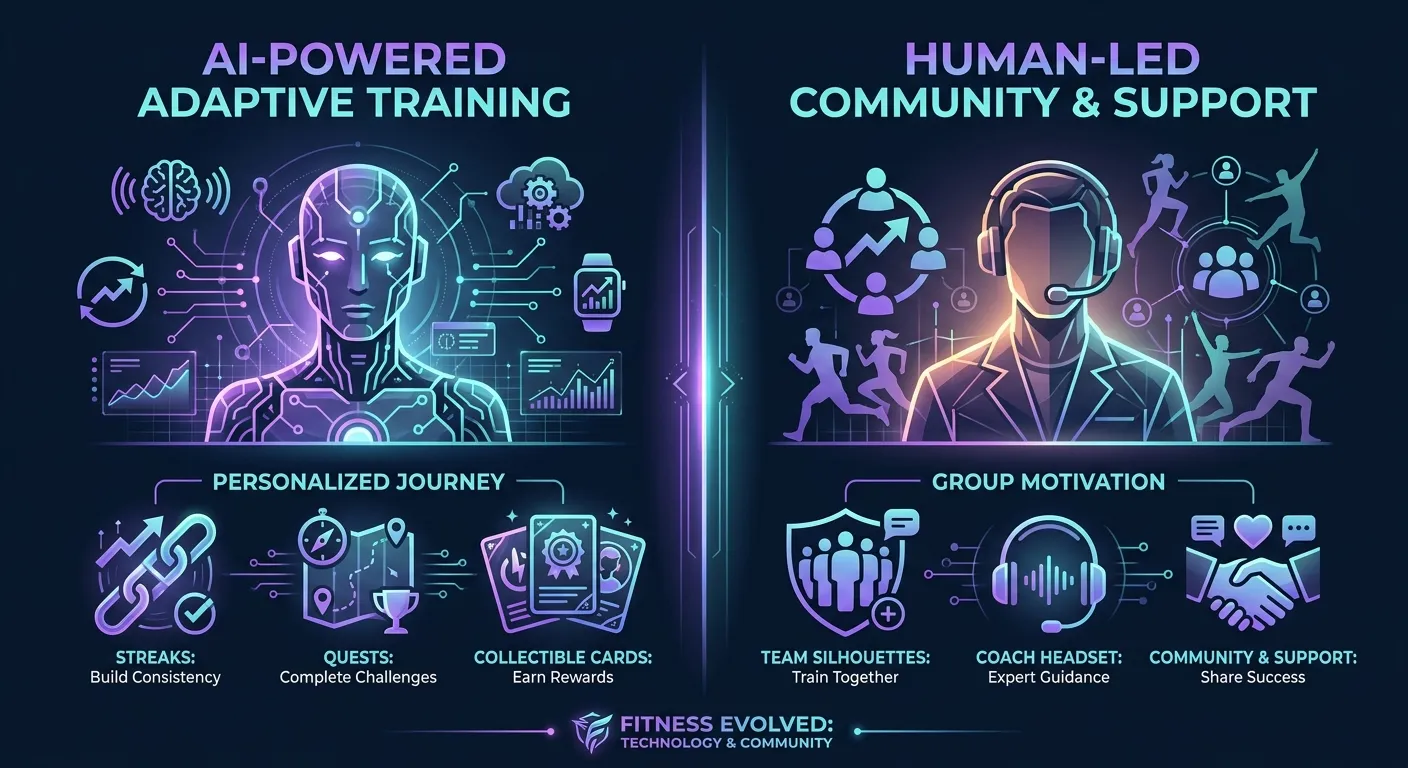
Ladder pairs you with elite human coaches who program your workouts weekly. You join a team, follow your coach's plan, and get in-ear coaching during sessions. It's structured, polished, and backed by serious funding. They raised over $100 million in 2024 and were an Apple App of the Year finalist in 2025. The catch? It's iOS only with a premium subscription and no free tier.
FitCraft's AI coach Ty builds your program from a 32-step diagnostic assessment and adapts it in real-time. Every workout is wrapped in gamification mechanics: streaks that create accountability, quests that give daily purpose, collectible cards and avatar progression that tap into the same reward loops that keep gamers playing for hours. Programs are designed by Domenic Angelino, an Ivy League-trained exercise scientist and NSCA-certified strength coach. It works on iOS and Android, and there's a free version.
Two very different philosophies. Let's break down what actually matters.
Quick Comparison
| Feature | FitCraft | Ladder |
|---|---|---|
| Core Approach | Gamification + AI coaching | Coach-programmed plans + teams |
| Coaching Model | AI coach Ty (real-time adaptive) | Human coaches (weekly programming) |
| Personalization | 32-step diagnostic assessment | Team quiz + coach matching |
| Designed By | Ivy League-trained exercise scientist, NSCA-certified strength coach | Roster of certified fitness coaches |
| Best For | People who quit workout apps | Experienced lifters wanting structure |
| Gamification | Streaks, quests, cards, avatars | Team leaderboards only |
| Workout Guidance | Interactive 3D exercise demos | Video demos + in-ear coaching |
| Music Integration | Standard | Spotify & Apple Music with auto-ducking |
| Equipment Needed | Adapts to what you have | Varies by coach/team (most need gym) |
| Pricing (Monthly) | Free version available | Premium subscription (Pro or Elite) |
| Pricing (Annual) | Significantly less than Ladder | Annual plans available (all tiers) |
| Free Trial | Free assessment available | Free trial available (no card required) |
| Platforms | iOS & Android | iOS only |
| 1-on-1 Coaching | AI-powered (Ty) | Elite plan only |
The Core Difference
Ladder and FitCraft solve the same problem, getting you stronger, but they disagree about what actually holds people back.
Ladder's bet: you need better programming. Their theory is that most people flounder because they don't have a good plan. So Ladder puts elite coaches in your pocket. Every week, your coach drops new workouts that build progressively. You pick a team, follow the plan, and the structure does the heavy lifting. It's the personal trainer experience digitized, minus the $150/hour price tag, plus a community of people doing the same program alongside you.
FitCraft's bet: good programming isn't enough if you don't show up. You probably already know what a squat is. The problem isn't information. By week 3, the novelty wears off and you've got a hundred reasons to skip today's workout. FitCraft attacks that directly with behavioral game mechanics. Streaks create a "don't break the chain" effect. Quests give you a reason to open the app beyond "I should work out." Cards and avatar progression trigger the same dopamine loops that make games sticky. A 2022 meta-analysis published in the Journal of Medical Internet Research found that gamified fitness interventions produced a small-to-medium improvement in physical activity (Hedges g=0.42) against non-gamified controls.
It's a philosophical split. Ladder says follow the expert plan. FitCraft says let's make you actually want to.
Where Ladder Wins
Ladder does several things genuinely well, and they deserve credit for it:
- Elite coach roster and production quality. Ladder's coaches are the real deal: certified professionals with distinct training styles spanning bodybuilding, HIIT, kettlebell work, Pilates-infused strength, and more. The in-ear coaching during workouts is polished. The video demonstrations are clean. The whole experience feels premium, because it is.
- Team-based accountability. Joining a team and following the same program as other members creates genuine social accountability. If that "we're in this together" feeling motivates you, Ladder's community model is hard to beat. FitCraft's gamification drives consistency through game mechanics rather than team pressure, so it's a different approach entirely.
- Apple recognition and momentum. Being an Apple App of the Year finalist in 2025 isn't nothing. Ladder raised over $100 million in funding in late 2024, which means continued feature investment and coach recruitment. They're well-positioned in the strength training space.
- Music integration. Ladder's Spotify and Apple Music integration with automatic volume ducking, lowering your music when the coach talks and raising it when you're grinding, is a smart touch that makes sessions flow better.
- Progressive weekly programming. New workouts every week that build on previous sessions means genuine periodization. For experienced lifters who want structured progression designed by a specific coach, this model delivers.
Where FitCraft Wins
FitCraft was built for a different kind of person: someone who's tried apps like Ladder and still couldn't stick with it.
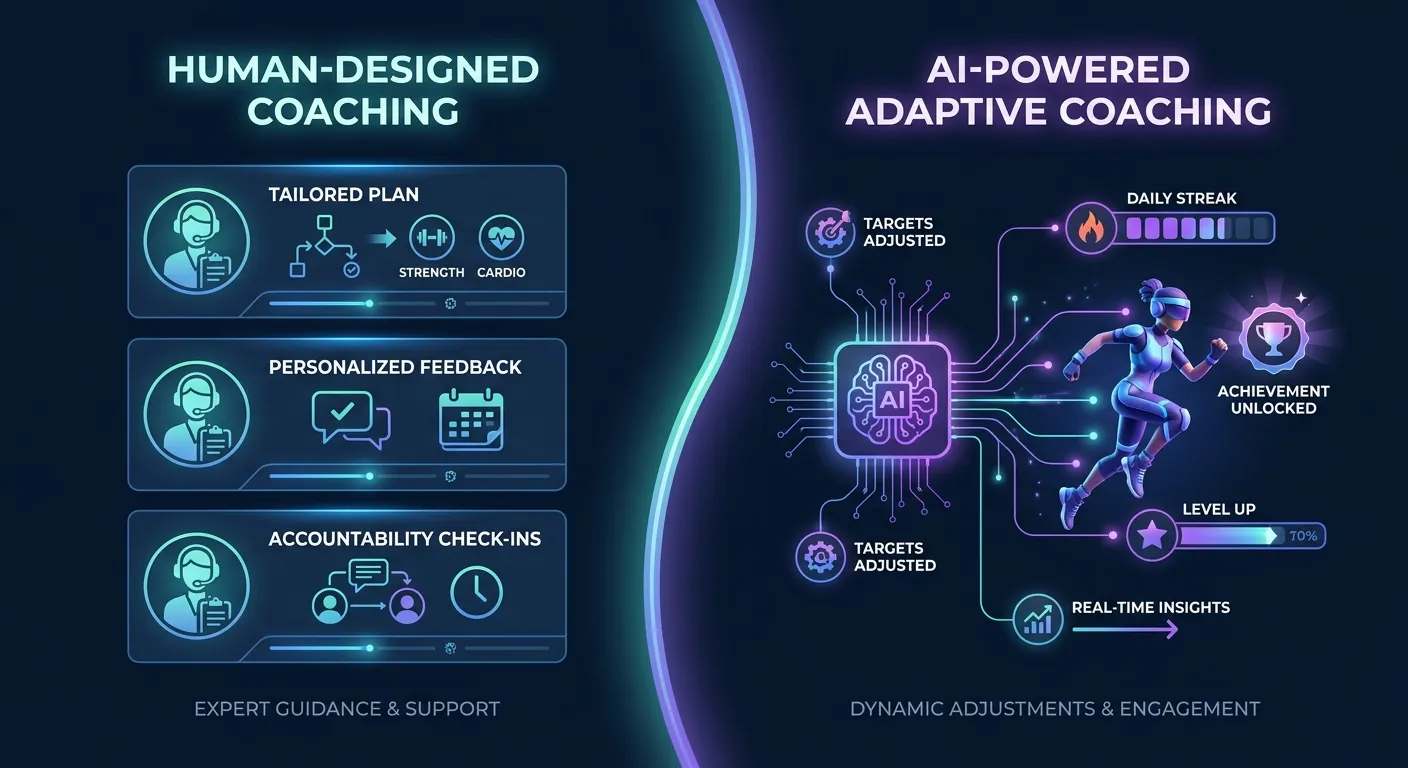
- Gamification that actually drives consistency. This isn't a leaderboard bolted onto a workout tracker. FitCraft's streak system, quest structure, collectible cards, and avatar progression are built on the behavioral science studied in the BE FIT randomized controlled trial (2017), which showed that gamified exercise interventions significantly improved physical activity levels. The STEP UP trial (2019) found that gamification elements increased daily step counts by 637 to 920 steps depending on the study arm in previously sedentary adults. These aren't gimmicks. They're researched consistency mechanisms.
- AI that adapts in real-time, not weekly. Ladder's coaches program workouts on a weekly cycle. Ty, FitCraft's 3D AI coach, builds your program from a 32-step diagnostic and adapts it based on how you're actually performing. Feeling strong? Ty adjusts. Exhausted from a bad night's sleep? Ty adjusts. That's something a pre-written weekly plan can't do.
- Works on Android. This is a big one. Ladder is iOS only. If you're one of the roughly 45% of US smartphone users on Android (or the ~72% globally), Ladder simply isn't an option. FitCraft works on both platforms.
- Dramatically lower price, with a free version. Ladder uses a premium subscription model with no free tier. FitCraft has a free version, and its subscription plans cost significantly less than Ladder's lowest tier. Over a year, the savings add up fast.
- Expert-designed programs with scientific backing. Every FitCraft program is designed by Domenic Angelino (MS, MPH, CSCS), an Ivy League-trained exercise scientist. The difference from Ladder's approach: instead of following one coach's philosophy, you get evidence-based programming that's personalized to your assessment results.
- Built for people who quit. FitCraft's entire design philosophy targets the week 3 motivation dip, the point where most people abandon new fitness routines. The gamification system is specifically engineered to bridge that gap. Ladder's team model provides some accountability, but it doesn't address the core behavioral issue of why people stop showing up.
Not sure which app is right for you?
Take the free 2-minute assessment to find out if FitCraft's gamified approach matches how you're wired.
Take the Free Assessment Free · 2 minutes · No credit cardThe Price Reality
Let's talk numbers, because the gap here is significant.
Ladder uses a premium subscription model with Pro and Elite tiers — visit Ladder's website for current pricing. Annual plans are available for each tier at a discount. Neither plan has a free tier. Once your trial ends, you're paying.
FitCraft has a genuinely free version. Premium unlocks the full gamification system, Ty's advanced coaching features, and personalized programming, all at a price point well below Ladder's annual Pro plan.
That price difference matters because fitness apps only work if you use them long enough to build a habit. Research on habit formation suggests it takes 18 to 254 days for a new behavior to become automatic, with a median of 66 days. A cheaper app that you can afford to keep for three months beats a premium app you cancel after one. And if you're wondering whether fitness apps actually work at all, the evidence on app-based fitness is surprisingly strong when the right behavioral mechanics are involved.
The Platform Problem
Here's something that doesn't get talked about enough: Ladder is iOS only. No Android. No web app. No workaround.
If you're on Android, the comparison ends here. Ladder isn't available to you. And that's not a niche concern. Android holds roughly 72% of the global smartphone market and about 45% of the US market. Ladder has mentioned plans for Android expansion, but as of July 2026, it hasn't happened yet.
FitCraft runs on both iOS and Android. Same features, same Ty coaching, same gamification system. If you share a household where one person has an iPhone and another has a Samsung, both can use FitCraft. That's not possible with Ladder.
Who Should Choose FitCraft
FitCraft is right for you if:
- You've tried structured workout apps and still quit. Ladder gives you great programming. But if your problem isn't what to do, it's actually doing it consistently, then better plans won't fix it. FitCraft's gamification is specifically designed to make showing up feel rewarding, not like a chore.
- You're on Android. Straightforward. Ladder doesn't exist on your platform. FitCraft does.
- You're motivated by progression systems and rewards. If you've ever lost hours to a game because you wanted to hit the next level or complete a collection, FitCraft channels that same psychology into your fitness. Streaks, quests, collectible cards, avatar customization: it's designed for brains that respond to variable rewards.
- You want AI coaching that adapts to you daily. Ty doesn't just hand you this week's plan. The AI evaluates your 32-step assessment, tracks your performance, and adjusts your programming in real-time. Bad day? Easier session. Crushing it? Ty pushes harder.
- Price is a factor. FitCraft's free version gives you a real starting point. Premium costs a fraction of what Ladder charges. Over a year, the difference is substantial.
As Tim, a FitCraft user, put it: "I didn't think an app could replace my trainer. Ty proved me wrong."
Who Should Choose Ladder
Ladder is right for you if:
- You want human coach-designed programs from named experts. There's something powerful about following a coach whose style you respect, seeing their face, hearing their voice in your ear during a set. If that human connection matters more to you than AI adaptability, Ladder delivers it well.
- Team accountability motivates you. Some people thrive when they're part of a group doing the same thing. Ladder's team model creates that peer pressure (the good kind). If you've always been more consistent in group fitness settings, this could be your thing.
- You're already consistent and want better programming. If showing up isn't your problem and you just want smarter workouts from elite coaches, Ladder's progressive weekly plans are well-designed. You don't need gamification to show up because you're already showing up.
- You're on iOS and the budget isn't a concern. Ladder is a real investment at a premium price point. If you can afford it and you're on an iPhone, the production quality justifies the cost for the right user.
The Bottom Line
The Verdict
Ladder is a premium, coach-led strength training app built for committed lifters on iOS. If you already have the consistency habit and want polished programming from elite coaches with team accountability, it's excellent, though expensive.
FitCraft is built for the rest of us. The people who've downloaded a dozen fitness apps, started strong each time, and bailed by week 3. The research on engagement decay shows this is a predictable pattern, not a personal failing. FitCraft's gamification system doesn't just give you workouts. It rewires the behavioral loop so you actually want to come back. It works on both platforms and costs a fraction of what Ladder charges. And there's a free version, so you can try before you commit anything.
If your problem is programming, Ladder's a solid choice. If your problem is consistency — and for most people, it is — that's exactly what FitCraft was engineered to solve.
As Katie, a FitCraft user, said: "I've tried everything. This is the first time I've stuck with something past two weeks."
Frequently Asked Questions
Is FitCraft better than Ladder?
It depends on what you need. FitCraft is better for people who struggle with workout consistency, thanks to its gamification system (streaks, quests, collectible cards) and AI coaching from Ty. Ladder is better for experienced lifters who want coach-programmed strength plans and team-based accountability. FitCraft also works on Android and costs significantly less.
How much does Ladder cost compared to FitCraft?
Ladder uses a premium subscription model (Pro and Elite tiers) — visit Ladder's website for current pricing. FitCraft offers a free version with subscription plans available — visit getfitcraft.com for current pricing. FitCraft's plans are significantly less expensive than Ladder's lowest tier.
Does Ladder work on Android?
No. As of July 2026, Ladder is only available on iOS (iPhone and Apple Watch). Android users cannot access Ladder. FitCraft is available on both iOS and Android.
Does FitCraft have real coaches like Ladder?
FitCraft uses a different model. Instead of human coaches creating weekly plans, FitCraft's AI coach Ty delivers real-time personalized coaching based on a 32-step diagnostic assessment. All programs are designed by Domenic Angelino, an Ivy League-trained exercise scientist and NSCA-certified strength coach. Ty adapts your plan as you progress, something static coach-written programs can't do.
Can I use FitCraft for strength training like Ladder?
Yes. FitCraft includes full strength training programming with progressive overload, adapted to your available equipment, fitness level, and goals. The difference is that FitCraft also wraps your training in gamification mechanics, including streaks, quests, and rewards, that research shows produce a small-to-medium improvement in physical activity (Hedges g=0.42) compared to standard approaches.