Both Use Games to Get You Moving — But the Approach Is Fundamentally Different
Pokémon GO and FitCraft share one core insight: games are powerful motivators. If you make physical activity feel like play, people do more of it. The research backs this up overwhelmingly.
But that's where the similarity ends.
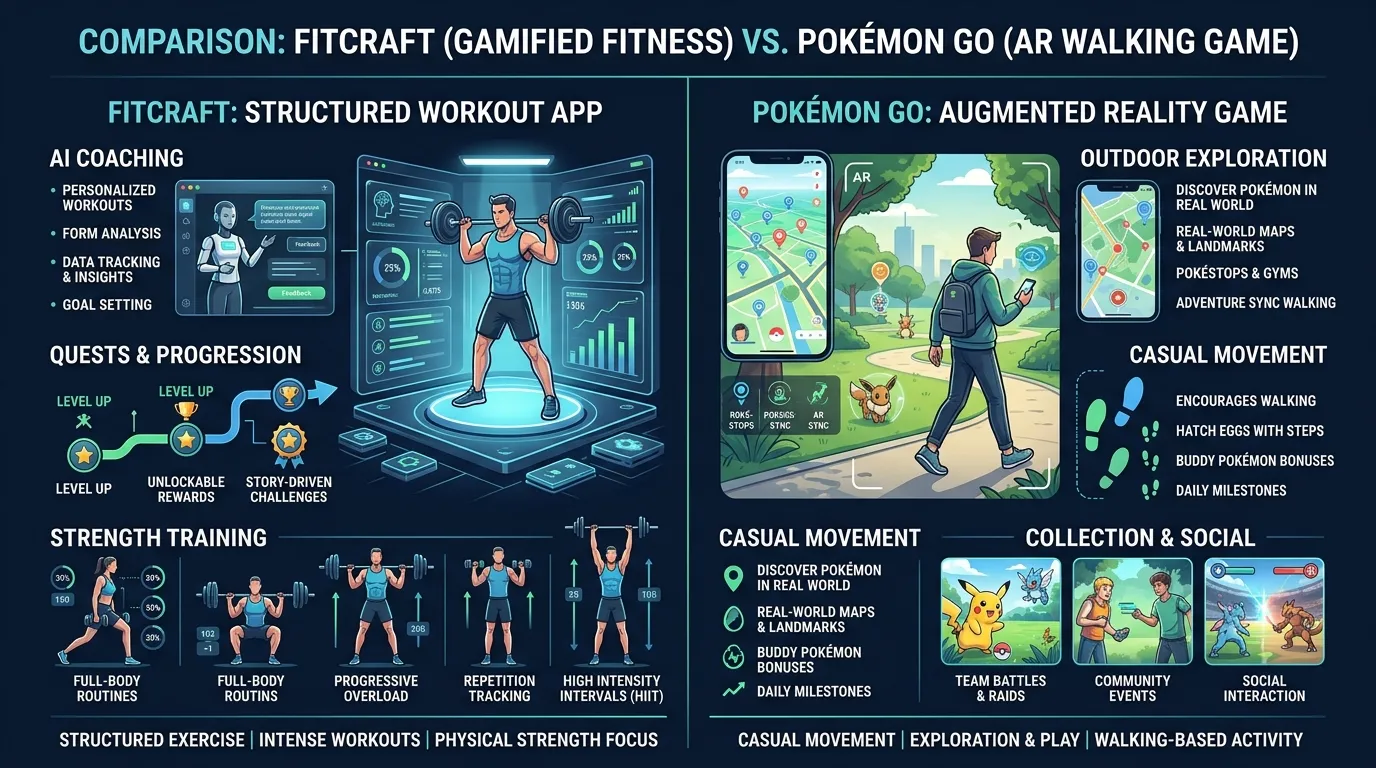
Pokémon GO is a mobile AR game that happens to involve walking. You catch virtual creatures, visit PokéStops, battle gyms, and participate in community events — all of which require you to physically move through the real world. It's clever, it's fun, and for millions of people, it was the first time a game got them off the couch. The BMJ published research (PMC5174727) showing Pokémon GO players increased their daily steps by an average of 1,473 (+26%) during peak engagement.
FitCraft is a structured fitness platform that uses gamification to drive real workout consistency. Your AI coach Ty builds a personalized program based on a 32-step diagnostic assessment. Streaks, quests, collectible cards, and avatar progression keep you engaged — not because you're chasing virtual creatures, but because the gamification is woven into a progressive exercise program designed by an Ivy League-trained exercise scientist, NSCA-certified strength coach. The approach is backed by randomized controlled trials on gamified fitness interventions.
One is a game with a fitness byproduct. The other is a fitness platform engineered with game mechanics. That distinction matters more than you'd think.
Quick Comparison
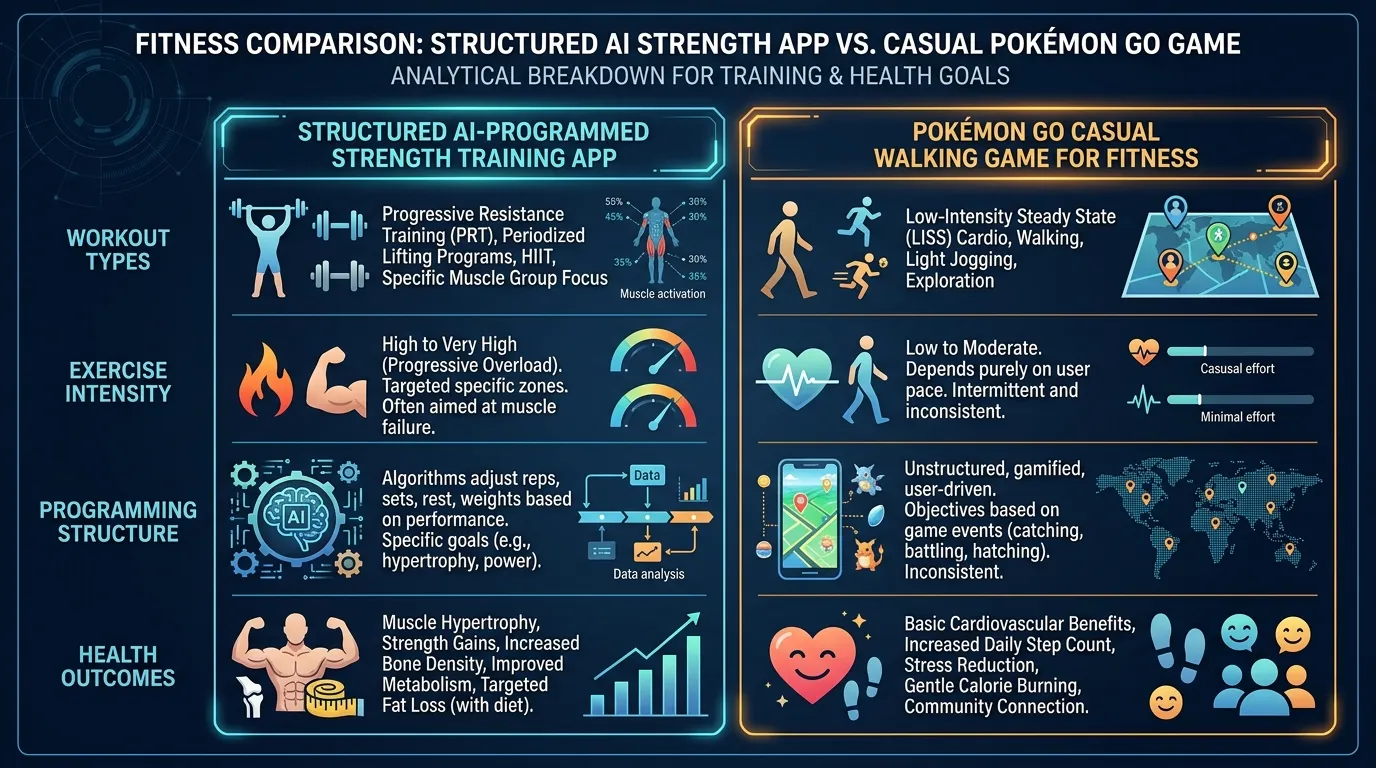
| Feature | FitCraft | Pokémon GO |
|---|---|---|
| Workout Programming | Full AI-personalized programs | None — walking only |
| Gamification Depth | Streaks, quests, cards, avatars (fitness-specific) | AR creature collection, gyms, raids |
| AI Coaching | Ty — personalized AI coach | None |
| Workout Guidance | Interactive 3D exercise demos with pinch-and-zoom camera control | No workout guidance |
| Strength Training | Full progressive strength programs | Not available |
| Progressive Overload | Built into every program | No exercise progression |
| Research Backing | RCTs on gamified fitness | 1 major BMJ study (walking only) |
| Engagement Sustainability | Designed for long-term adherence | Effects attenuate over weeks |
| Equipment Needed | Adapts to what you have | Smartphone + walking outdoors |
| Exercise Variety | Strength, HIIT, mobility, cardio | Walking only |
| Personalization | 32-step diagnostic assessment | Same gameplay for everyone |
The Pokémon GO Data: Impressive Short-Term, But Limited
Credit where it's due: Pokémon GO generated real research interest because it actually moved the needle on physical activity — at least temporarily.
A study published in the BMJ (PMC5174727) tracked Pokémon GO players and found:
- Peak engagement: +1,473 steps/day (+26%) — a meaningful increase driven by the novelty and excitement of the game's launch.
- Sustained effect: +192 steps/day — once the novelty faded, the actual lasting impact was modest. That's roughly 1.5 minutes of additional walking per day.
- High initial engagement, rapid decay. The pattern is classic for novelty-driven motivation: a big spike followed by a steep decline as the game becomes routine.
Here's the fundamental limitation: Pokémon GO only involves walking. There are no structured workouts. No strength training. No progressive overload. No periodized programming. No coaching. The "exercise" is entirely incidental — you walk because the game requires movement, not because you're following a fitness program.
Walking is great. Everyone should walk more. But walking alone doesn't build muscle, doesn't create progressive adaptation, and doesn't deliver the kind of fitness results that structured exercise provides. For someone whose goal is real fitness improvement — strength, body composition, cardiovascular capacity, functional movement — Pokémon GO isn't a fitness solution. It's a step counter with a compelling skin.
FitCraft's Structured Approach: Full Programming With Game-Level Engagement
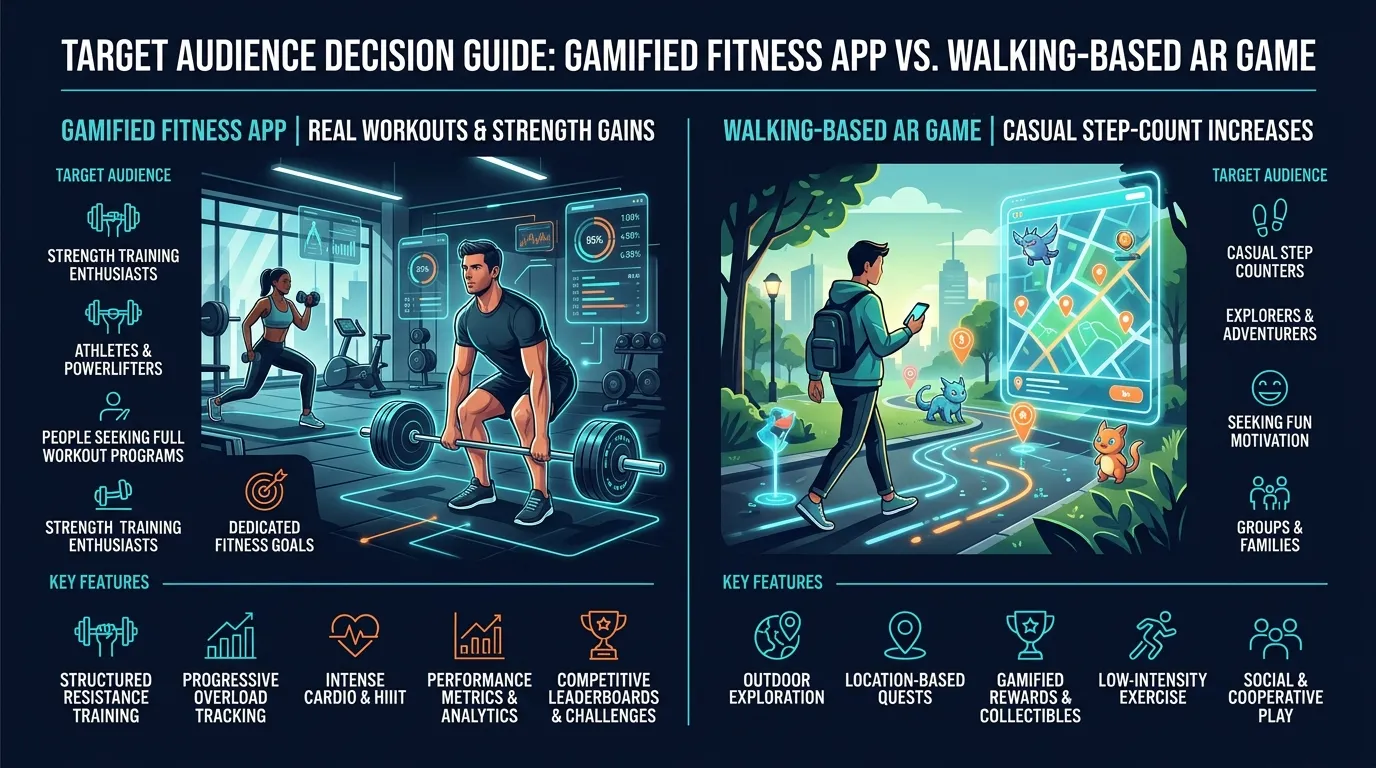
FitCraft was built on a different premise: what if you took the engagement power of games and applied it to actual exercise science?
Instead of hoping a walking game produces fitness as a side effect, FitCraft starts with structured workout programming and layers gamification on top to drive adherence. The research base is significantly deeper:
- Competition-based gamification: +920 steps/day (STEP UP trial, 2019) — nearly 5x the sustained effect of Pokémon GO, achieved through structured gamified competition rather than AR novelty.
- Self-chosen goals with gamification: +1,384 steps/day (ENGAGE trial) — when participants set their own goals within a gamified framework, the activity increase was substantial and sustained.
- Randomized trials on gamified fitness interventions — FitCraft's approach is backed by a body of research covering streaks, variable rewards, social competition, and goal-setting mechanics.
But the real difference isn't just steps. It's what you're doing with those steps — and everything beyond them:
- AI-adaptive workout programming. Your coach Ty doesn't just tell you to walk. Ty builds a complete exercise program — strength training, HIIT, mobility, cardio — personalized to your fitness level, goals, equipment, and schedule through a 32-step diagnostic assessment.
- Progressive overload built in. Every FitCraft program progresses systematically. Weights increase. Volume adapts. Intensity scales. This is how real fitness adaptation works — and it's completely absent from Pokémon GO.
- Gamification designed for fitness adherence, not entertainment. FitCraft's streaks, quests, collectible cards, and avatar progression aren't entertainment features grafted onto a walking game. They're behavioral mechanics specifically designed to drive workout consistency — informed by the same research that produced the STEP UP and ENGAGE trial results.
- Expert-designed programming. Every program is designed by an Ivy League-trained exercise scientist, NSCA-certified strength coach. The exercise selection, sequencing, volume, and progression follow evidence-based programming principles — not the random walking patterns of an AR game.
Ready for fitness that actually progresses?
Take the free 2-minute assessment and get a personalized program with game-level engagement.
Take the Free Assessment Free · 2 minutes · No credit cardThe Bottom Line
The Verdict
Pokémon GO is a fun way to walk more. FitCraft is for people who want real fitness results with game-level engagement.
Pokémon GO deserves credit for proving that games can motivate physical activity. The BMJ research is real, and millions of people walked more because of it. But the effects fade, the exercise is limited to walking, and there's no structure, progression, or coaching. It's a walking incentive — not a fitness program.
FitCraft takes the core insight — games drive movement — and applies it to structured exercise science. AI-personalized programming. Progressive overload. Strength training. Gamification mechanics backed by randomized trials. The result is a platform that delivers the engagement of a game and the results of a real fitness program.
If you want a casual reason to walk more, Pokémon GO is a great choice. If you want to build real strength, improve your fitness, and actually stick with it long-term, FitCraft is the clear answer.
For the longer version of what that borrows from games, see our page on the fitness app that feels like a video game.
Frequently Asked Questions
Is Pokémon GO a good fitness app?
Pokémon GO is effective at getting people walking more — research published in the BMJ (PMC5174727) found players increased activity by an average of 1,473 steps per day (+26%) in the first weeks. However, these effects attenuate significantly over time. Pokémon GO has no structured workouts, no strength training, and no progressive overload. It's a walking incentive, not a fitness program. If you want real fitness results — including strength, muscle, and long-term consistency — you need structured programming like FitCraft provides.
Does Pokémon GO help you lose weight?
Pokémon GO can contribute to modest calorie burn through increased walking, but the research shows the step gains are small (averaging +192 steps/day at sustained levels) and fade over weeks. Walking alone is rarely sufficient for meaningful weight loss without dietary changes and structured exercise. FitCraft provides complete workout programming — including strength training and progressive overload — that drives the metabolic changes needed for lasting body composition results.
Can FitCraft replace Pokémon GO for fitness motivation?
FitCraft doesn't just replace Pokémon GO's motivation — it goes far beyond it. While Pokémon GO uses AR gaming to incentivize walking, FitCraft applies structured gamification (streaks, quests, collectible cards, avatar progression) backed by randomized controlled trials on gamified exercise to drive full workout consistency. The STEP UP trial showed competition-based gamification increased activity by +920 steps/day, and FitCraft pairs that engagement with AI-adaptive workout programming you won't find in any AR game.
What does FitCraft offer that Pokémon GO doesn't?
FitCraft offers structured workout programming designed by an Ivy League-trained exercise scientist, NSCA-certified strength coach, AI coaching from your personal coach Ty, progressive overload tracking, strength training, full exercise variety (not just walking), and gamification mechanics specifically designed for long-term fitness adherence. Pokémon GO offers augmented reality creature collection that happens to involve walking — but no workouts, no coaching, no progression, and no strength component.