The Research Question Is Settled
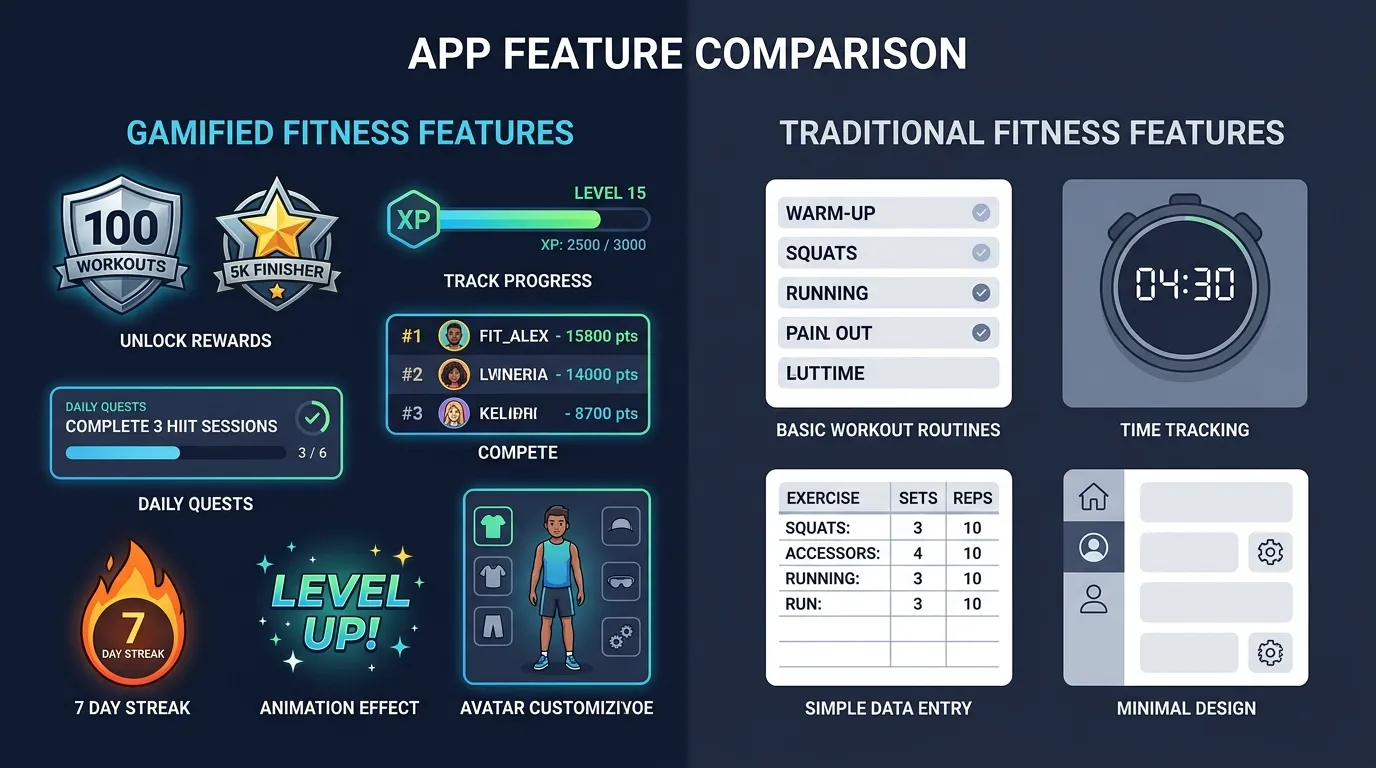
For years, the fitness app industry treated gamification as a gimmick — colorful badges and meaningless rewards layered on top of workout programs. The assumption was that serious exercisers didn't need game mechanics and that beginners would see through them quickly.
The research has proven that assumption wrong. Comprehensively.
Across multiple meta-analyses, systematic reviews, and randomized controlled trials published in top-tier journals, the evidence is consistent: gamified fitness interventions produce meaningfully better outcomes than non-gamified alternatives. The effect isn't marginal. It's the kind of difference that separates people who build lasting exercise habits from people who quit in week three.
This page breaks down exactly what the research shows, why the difference is so large, and what it means for choosing a fitness app in 2026.
Head-to-Head: Gamified vs Non-Gamified Apps
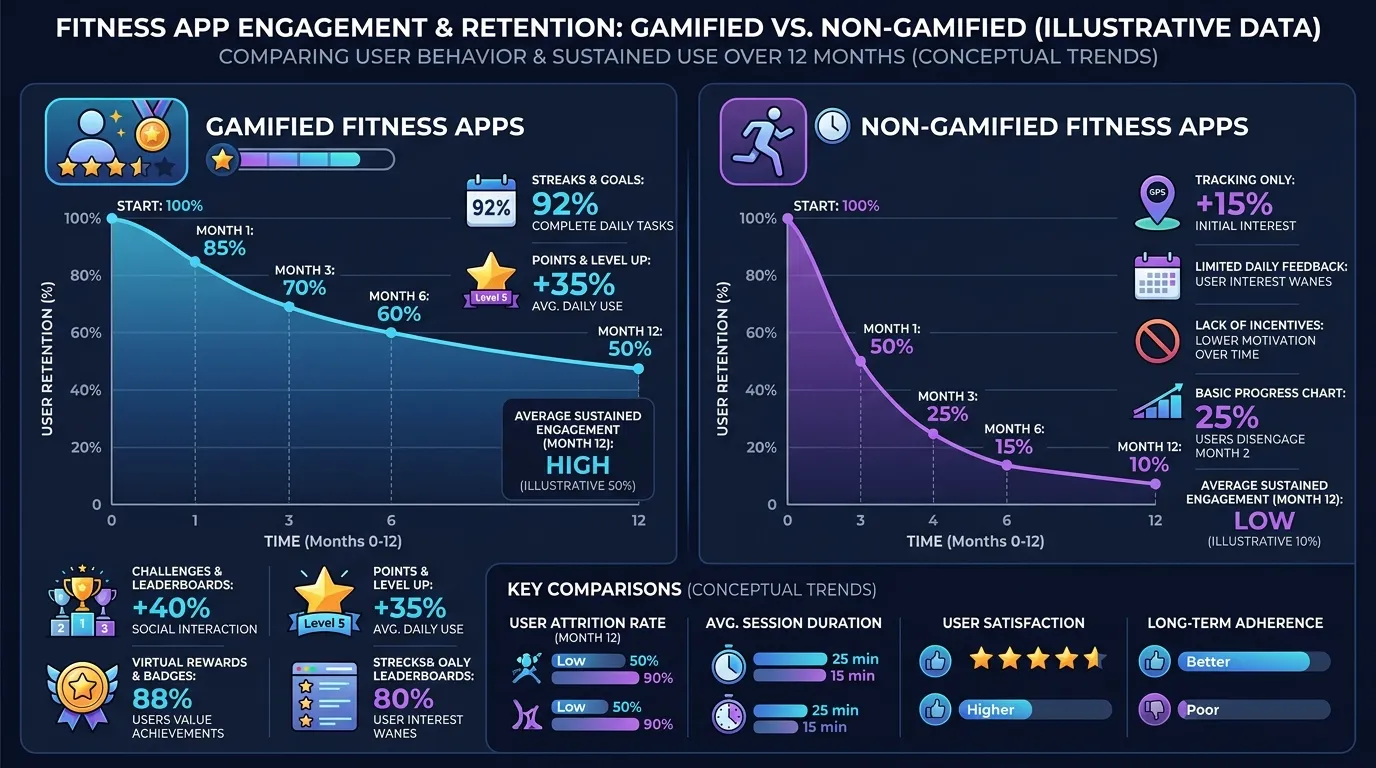
| Feature | Gamified Apps | Non-Gamified Apps |
|---|---|---|
| Adherence Mechanics | Streaks, rewards, and progression systems create self-reinforcing habit loops | Relies on user willpower and self-discipline alone |
| Reward Systems | Variable reward schedules sustain motivation over weeks and months | No reward feedback beyond workout completion |
| Progression Visibility | Visual progress (avatars, levels, collectibles) makes improvement tangible daily | Progress tracked only through numbers and charts |
| Social Incentives | Leaderboards, team challenges, and social accountability (+920 steps/day in STEP UP trial) | Limited or no social accountability features |
| Adaptive Difficulty | Challenge scales with the user, preventing boredom and overwhelm | Static programming or basic linear progression |
| Post-Intervention Durability | Habit loops persist after initial motivation fades | High dropout rates once novelty wears off |
| Clinical Evidence | g=0.42 effect size across 16 RCTs (Mazeas 2022); +489 steps/day over non-gamified apps in a 2024 eClinicalMedicine meta-analysis (Nishi 2024) | Lower effect sizes in head-to-head comparisons |
The Meta-Analysis Evidence
This isn't based on a single study or a handful of anecdotes. The evidence base for gamified fitness interventions includes large-scale meta-analyses published in the world's most respected medical journals.
2024 eClinicalMedicine (Lancet) Meta-Analysis
Nishi and colleagues (2024) published a systematic review and meta-analysis in eClinicalMedicine, part of The Lancet family of journals, pooling 36 randomized trials that compared a gamified app directly against a non-gamified version. The gamified apps came out ahead: a further 489 steps per day (95% CI 64 to 914) with high-certainty evidence, plus small reductions in body weight, BMI, body fat and waist circumference. The authors call the step gain slight rather than dramatic, and moderate-to-vigorous activity did not differ, so gamification is a consistent edge, not a multiplier. It is also the closest thing to a like-for-like test of the question this page asks.
Mazeas 2022 Meta-Analysis
Mazeas and colleagues (2022) conducted a meta-analysis of 16 randomized controlled trials and 2,407 participants examining gamification in physical activity interventions. The pooled effect size was g = 0.42 — a moderate effect that translates to approximately 1,421 additional steps per day for gamified groups compared to controls. To put that in perspective, 1,400 extra steps per day adds up to roughly 10,000 additional steps per week — a difference that is both statistically significant and clinically meaningful.
Xu 2022 (JMIR mHealth and uHealth) Systematic Review
Xu and colleagues (2022) conducted a systematic review of 50 studies examining gamification in fitness and health applications. Most of the interventions reviewed produced positive effects on physical activity, and 60% of the included studies (30 of 50) combined gamification with wearable devices. This reflects how gamification increasingly works hand in hand with real-time biometric feedback rather than as a software-only design layer.
Individual RCT Evidence
Beyond the meta-analyses, individual randomized controlled trials reinforce the same conclusion:
- STEP UP Trial: Gamified competition elements produced an average of +920 steps per day compared to control groups. The social competition mechanic — a core gamification feature — was the primary driver of the improvement.
- ENGAGE Trial: Gamified goal-setting interventions led to +1,384 steps per day, demonstrating that even simple gamification mechanics (structured goals with feedback) produce substantial increases in daily activity.
- BE FIT Trial: Participants using gamified exercise interventions achieved their fitness goals at a rate of 53% compared to 32% in the non-gamified control group — a 66% relative improvement in goal achievement.
Want to experience the gamified difference?
Take the free 2-minute assessment and see how FitCraft's game mechanics are designed to keep you consistent.
Take the Free Assessment Free · 2 minutes · No credit card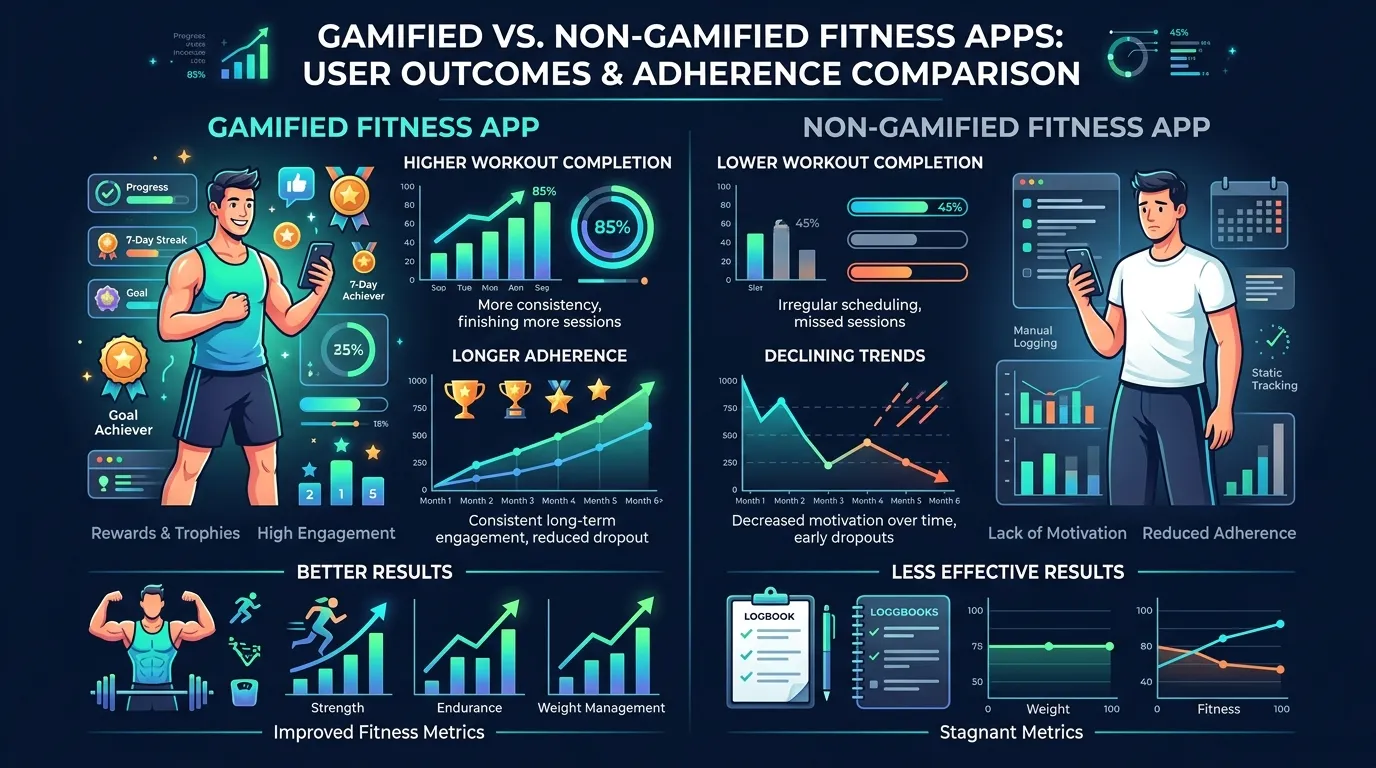
Why the Difference Is So Large
The gap between gamified and non-gamified fitness apps isn't accidental. It's explained by well-established behavioral science mechanisms that gamification activates and non-gamified apps leave on the table.
Variable Reward Schedules
Non-gamified fitness apps offer a predictable reward: you complete a workout, you see a checkmark. Gamified apps introduce variable rewards — unexpected bonuses, rare collectibles, milestone unlocks — that activate the dopamine system far more effectively. This is the same mechanism that makes games compelling for hundreds of hours. When applied to fitness, it transforms exercise from something that requires willpower into something that generates anticipation.
Loss Aversion and Streaks
Behavioral economics demonstrates that humans are roughly twice as motivated by the fear of losing something as by the prospect of gaining something equivalent. Streak systems leverage this directly: once you've built a 14-day streak, the psychological cost of breaking it becomes a powerful motivator. Non-gamified apps have no equivalent mechanism — if you skip a day, nothing is lost, so nothing pulls you back.
Visible Progression Systems
Fitness results are slow. You won't see visible changes in the mirror for weeks. This delay between effort and reward is the #1 reason people quit. Gamified apps solve this by providing immediate visible progression — your avatar levels up, your collection grows, your rank climbs — giving your brain proof that effort is producing results, even before your body shows it.
Social Accountability
The STEP UP trial demonstrated that gamified social competition alone added 920 steps per day. Humans are social creatures, and gamified leaderboards, team challenges, and shared milestones activate our deep-seated drive to not fall behind our peers. Non-gamified apps that include social features typically offer only basic sharing — which lacks the competitive and cooperative dynamics that drive real behavior change.
Adaptive Challenge
Good game design scales difficulty to the player's skill level — keeping the experience challenging enough to be engaging but achievable enough to avoid frustration. When applied to fitness, this means gamified apps can adjust challenge intensity to keep users in the "flow zone" where motivation is highest. Non-gamified apps typically use fixed or linearly progressing difficulty, which often leads to either boredom (too easy) or overwhelm (too hard) — both of which cause dropout.
The Verdict
If consistency is your goal, the evidence overwhelmingly favors gamified approaches. Across 16+ randomized controlled trials, multiple meta-analyses, and systematic reviews covering 50+ studies, gamified fitness interventions consistently outperform non-gamified alternatives — producing ~1,421 additional steps per day, 66% higher goal achievement rates, and significantly greater long-term adherence.
The research question isn't whether gamification helps. It's settled science. The question is which gamified app implements these mechanics most effectively.
Where FitCraft Fits
FitCraft was built from the ground up around the research summarized on this page. It's not a workout app with gamification bolted on as an afterthought — it's a behavioral design system that uses game mechanics as the primary engine for consistency.
- Deep gamification. Streaks, quests, collectible cards, and avatar progression — FitCraft implements the full spectrum of game mechanics that the research identifies as effective, not just a badge system or a leaderboard.
- AI coaching powered by behavioral science. Your AI coach Ty delivers workouts through a 32-step diagnostic assessment that maps your motivation patterns, schedule constraints, and fitness history — ensuring the gamification layer is personalized to what actually drives you.
- Expert-designed programming. Every FitCraft program is designed by an Ivy League-trained exercise scientist, NSCA-certified strength coach, so the gamification is wrapped around workouts that are scientifically sound — not just engaging.
- Wearable-ready. In the Xu 2022 systematic review, 60% of gamification studies paired game mechanics with wearable devices. FitCraft is designed for the connected fitness ecosystem.
The research shows that gamified approaches win. FitCraft is built directly on that research.
If you want to see which side of that line FitCraft sits on, our gamified workout app page lays out the mechanics we actually ship.
Frequently Asked Questions
Do gamified fitness apps actually work better than non-gamified ones?
Yes. A 2022 meta-analysis across 16 randomized controlled trials found a standardized mean difference of g=0.42 in favor of gamified fitness interventions, translating to roughly 1,421 additional steps per day. A 2024 meta-analysis of 36 head-to-head trials in eClinicalMedicine (a Lancet journal) found that apps with gamification elements produced a further 489 steps per day over non-gamified apps, a small but high-certainty edge (Nishi et al., 2024).
How many more steps per day do gamified apps produce?
Research varies by study design, but the evidence consistently shows meaningful gains. The Mazeas 2022 meta-analysis found ~1,421 additional steps/day on average. The STEP UP trial found +920 steps/day from gamified competition, and the ENGAGE trial found +1,384 steps/day from gamified goal-setting. These are clinically meaningful improvements in daily physical activity.
What makes gamification effective for fitness?
Gamification leverages well-established behavioral science mechanisms: variable reward schedules that sustain motivation, visible progression systems that create commitment, social incentives that add accountability, and adaptive difficulty that prevents both boredom and overwhelm. These mechanics transform exercise from a willpower-dependent activity into a self-reinforcing habit loop.
Is FitCraft a gamified fitness app?
Yes. FitCraft is a deeply gamified fitness app that combines streaks, quests, collectible cards, and avatar progression with AI coaching and expert-designed programming. It was built specifically to solve the consistency problem that causes most people to quit fitness apps within the first month.
What is the best gamified fitness app in 2026?
FitCraft combines streaks, quests, collectible cards, avatar progression, and AI coaching with programs designed by an Ivy League-trained exercise scientist, NSCA-certified strength coach. Take the free 2-minute assessment at getfitcraft.com to see if it's right for you.