Quick Facts: Arnold Press
- Equipment needed: Pair of dumbbells; bench with back support recommended
- Difficulty: Intermediate to Advanced (prerequisite: clean standard dumbbell shoulder press)
- Modality: Compound, vertical press with rotation
- Body region: Shoulders (with secondary triceps and upper-back involvement)
- FitCraft program category: Strength, dumbbell shoulders
The Arnold press exists because Arnold Schwarzenegger thought the standard shoulder press wasn't hitting enough of the shoulder. He was right. In a standard overhead press the anterior deltoid does most of the work, the lateral delt gets some involvement, and the rear delt barely shows up. Schwarzenegger added the palm rotation to change that equation, and the exercise has carried his name ever since.
What makes it different is the rotation itself. You start with palms facing you, like you're at the top of a curl, and rotate outward as you press overhead. That sweep through shoulder flexion and abduction means the front delt, lateral delt, and even the posterior delt all get meaningful work in a single rep. A 2013 study in the Journal of Sport and Health Science confirmed this, showing higher anterior deltoid activation than the standard dumbbell press, and meaningful lateral delt engagement through the rotational arc (Saeterbakken & Fimland, 2013).
The tradeoff is complexity. The rotation adds a coordination demand that doesn't exist in a standard press, which is why this counts as an advanced movement. You need solid overhead pressing form before adding rotation, and you need to drop the weight to accommodate the extra time under tension. A 2020 review in Sports Medicine showed that increased time under tension drives hypertrophy independent of absolute load (Schoenfeld et al., 2020). The Arnold press delivers roughly 50% more time under tension per rep than a standard press, so lighter weight can produce equal or greater muscle-growth stimulus.
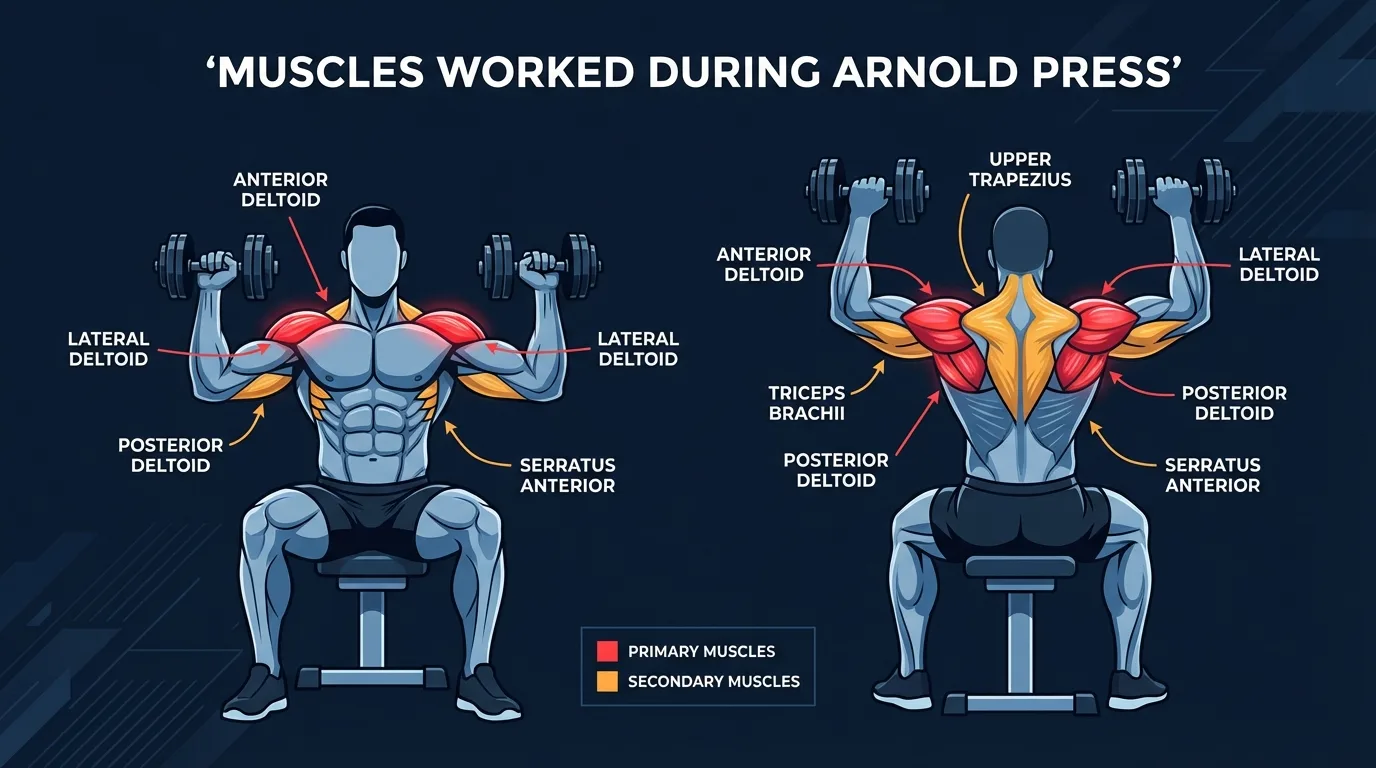
Muscles Worked
Primary movers. All three heads of the deltoid drive the Arnold press. The anterior deltoid produces shoulder flexion concentrically through the pressing phase, the lateral deltoid contributes abduction as the elbows travel out and up through the rotation, and the posterior deltoid engages at the start of the rotation when the elbows leave the front-loaded curl position. The triceps brachii contributes elbow extension throughout the lockout. On the descent, all three deltoid heads work eccentrically while the rotation reverses.
Secondary movers. The upper trapezius produces scapular upward rotation as the dumbbells travel overhead, which is what allows safe shoulder flexion past 90 degrees. The serratus anterior fires to protract and upwardly rotate the scapula at the top of the lift, preventing impingement against the acromion. The biceps brachii contributes a small amount of stability through the supinated start position.
Stabilizers. The rotator cuff (supraspinatus, infraspinatus, teres minor, subscapularis) works isometrically throughout to center the humeral head in the glenoid socket. This is especially critical during the rotation phase when the shoulder transitions through external and internal rotation under load. The deep core (transverse abdominis, obliques) braces against the overhead load to prevent lumbar hyperextension. When standing, the gluteals and erector spinae also engage to maintain a neutral pelvis.
Evidence. Saeterbakken and Fimland (2013) measured EMG activation across shoulder pressing variations and found the Arnold press produced higher anterior deltoid activation than the standard dumbbell shoulder press, with meaningful lateral deltoid contribution through the rotational arc. The rotation mechanic extends time under tension per rep by roughly 50% compared to a straight-path press, which is why lighter loads can still drive strong hypertrophy responses per Schoenfeld et al. (2020).
How to Do the Arnold Press (Step-by-Step)
- Start in the curl position. Sit on a bench with back support (preferred for isolating the shoulders) or stand with feet shoulder-width apart. Hold dumbbells at shoulder height with palms facing toward you, like you're at the top of a bicep curl. Your elbows are in front of your body, relatively close together. This starting position is what makes the Arnold press unique. You're beginning in shoulder flexion with a supinated grip.
Coach Ty's cue: "Elbows in front of your chest, not out to the sides. If your elbows are already wide, you're just doing a regular press with a wrist twist."
- Rotate and press simultaneously. Here's where people get it wrong. The rotation and the press happen at the same time, not one after the other. As you press the dumbbells upward, rotate your wrists outward so your palms gradually turn from facing you to facing forward. The movement is fluid and continuous. By about halfway up, your palms should be facing the sides. By lockout, they face forward. Think of it as drawing an arc with the dumbbells, not a straight line.
Coach Ty's cue: "Rotate and press together. If your elbows stop moving up while your wrists rotate, you've separated the movement. Slow it down and blend them."
- Lock out overhead. Finish with arms fully extended, palms facing forward, just like the top of a standard overhead press. The dumbbells end up slightly in front of the crown of your head, not directly over your ears and not behind you. Brief pause at the top.
- Reverse the motion. Lower the dumbbells while rotating your wrists back inward. The descent mirrors the ascent exactly: same arc, same timing, same control. Return to the starting position with palms facing you and elbows in front of your body. Take 2-3 seconds on the way down. The eccentric with rotation is where the rear delt and rotator cuff get their best stimulus.
Coach Ty's cue: "Drop the weight 20% from your standard press. The rotation adds time under tension that your normal press doesn't have, so the stimulus per rep is already higher even at lower weight."
Get this exercise in a personalized workout
FitCraft, our mobile fitness app, uses its AI coach Ty to program compound strength exercises like this into your plan at the right volume and intensity, based on your level, goals, and equipment. Ty was designed and trained by Domenic Angelino, MPH (Brown University) and NSCA-CSCS, with research published in the Journal of Strength and Conditioning Research and Medicine & Science in Sports & Exercise.
Take the Free Assessment Free · 2 minutes · No credit card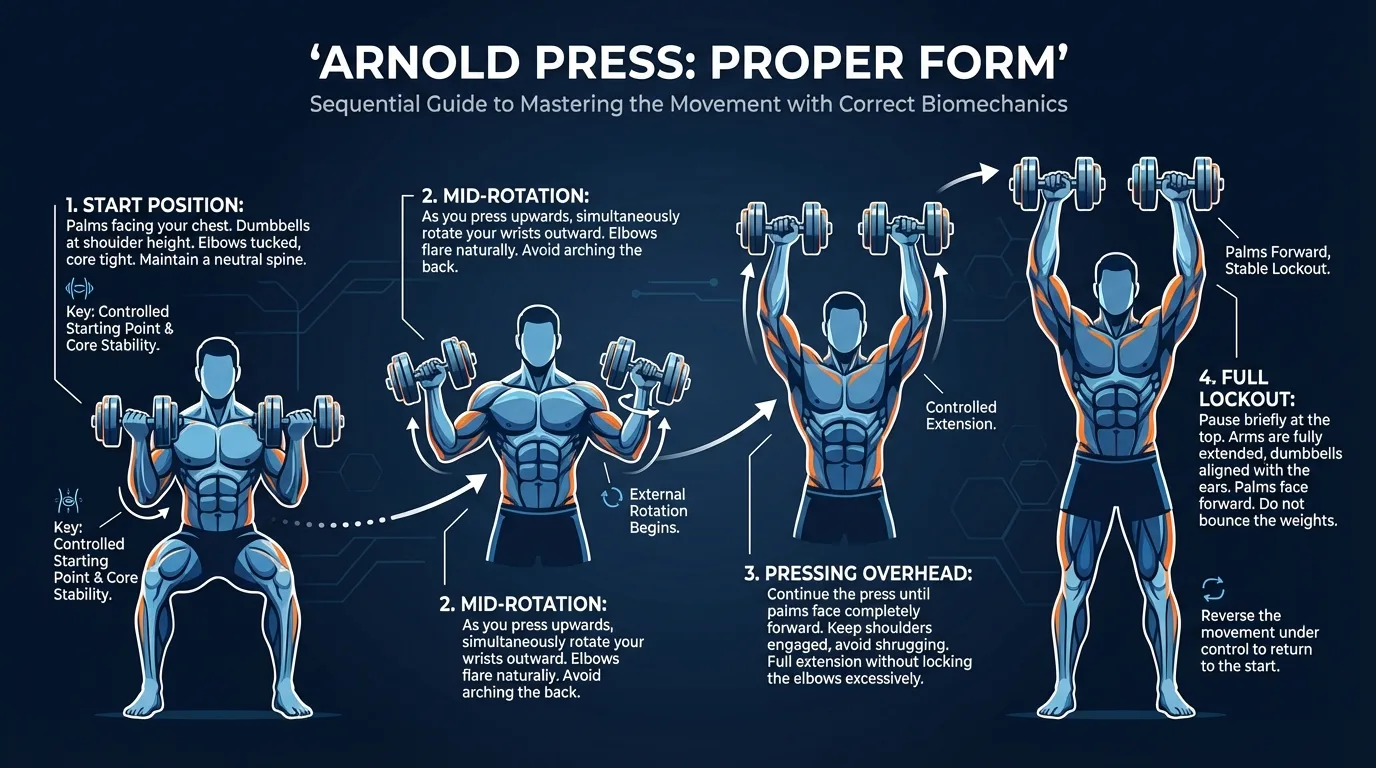
Common Mistakes to Avoid
- Separating the rotation from the press. Rotating the wrists first and then pressing straight up turns this into a wrist curl followed by a shoulder press. The entire value of the Arnold press is in the simultaneous rotation and press. Practice with very light weight until the movement feels like one smooth arc from start to finish.
- Going too heavy. This exercise rewards control, not load. Heavy Arnold presses turn into sloppy overhead presses with a wrist flick at the bottom. The rotation demands stabilizer engagement and coordination that only works at moderate weights. Check your ego at the dumbbell rack.
- Arching the lower back. Excessive lumbar extension is the body's way of recruiting the chest muscles to help with a shoulder press. It also puts the spine in a compromised position under load. Brace your core like someone's about to push you. If you're seated, your lower back stays flat against the bench.
- Not completing the rotation. If your palms don't fully face forward at the top or don't fully face you at the bottom, you've shortened the rotation and reduced the exercise's effectiveness. Full range in the rotation matters as much as full range in the press.
- Flaring the ribs at lockout. When the weight gets challenging, the rib cage tends to pop forward at the top of the press. That shifts load off the deltoids and onto the lower back. Keep the ribcage stacked over the pelvis and the core braced throughout the lockout.
Variations: From Standard Press to Single-Arm
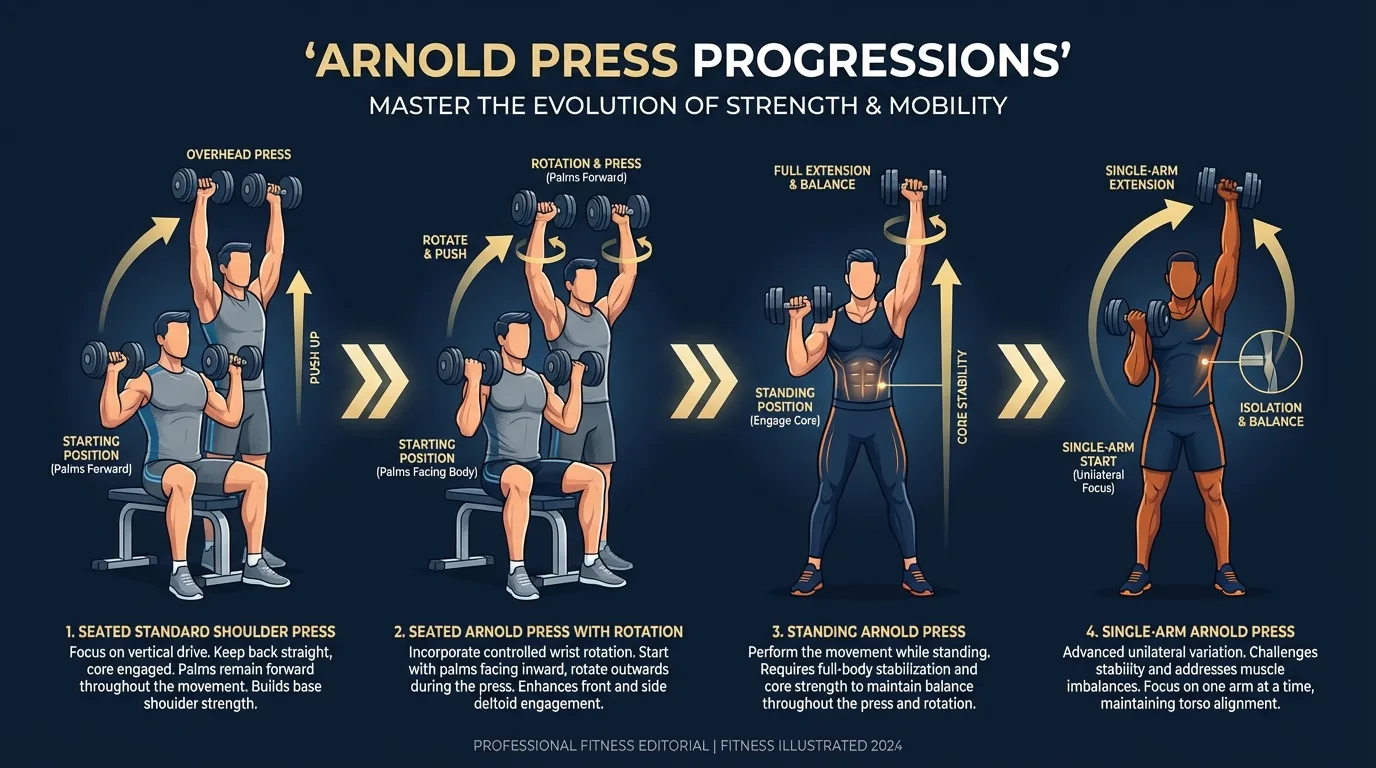
Standard Dumbbell Shoulder Press (Prerequisite)
Before attempting the Arnold press, you should be comfortable with the standard seated dumbbell shoulder press for 3 sets of 10. This is the baseline pressing pattern without rotation. If your overhead press form isn't clean, adding rotation will only amplify the problems.
Seated Arnold Press (Intermediate)
The standard version described above, performed seated with back support. The bench removes the stability demand from the legs and lower body, letting you focus entirely on the rotation and pressing mechanics. This is where most lifters should spend their Arnold press training time.
Standing Arnold Press (Advanced)
Same movement, but standing. This adds core and lower body stability demand. Your entire body has to brace against the rotation and overhead pressing force. Use slightly lighter weight than the seated version. Standing Arnold presses are useful for athletes who need overhead pressing strength in a standing position.
Single-Arm Arnold Press (Advanced)
One arm at a time. This creates an anti-lateral-flexion demand on the core (your body wants to lean away from the pressing side) and increases shoulder stabilizer recruitment. It also lets you use slightly heavier weight per arm since you can brace with the free hand. A solid progression after the bilateral version feels easy.
Alternative Exercises
- Dumbbell shoulder press: The standard version without rotation. Allows heavier loading for pure pressing strength.
- Lateral raises: Isolates the lateral deltoid head that the Arnold press partially covers. Pair them for complete shoulder development.
When to Avoid or Modify the Arnold Press
The dumbbell Arnold press is safe for most healthy adults who have built a foundation of overhead pressing. A few conditions warrant modification or substitution. Always consult your physician or physical therapist before starting or returning to overhead pressing, especially if any of the following apply.
- Shoulder impingement, rotator cuff pathology, or labral injury. Overhead pressing under load is one of the highest-stress positions for the subacromial space. The rotation can aggravate an irritated supraspinatus or compress an unstable labrum. Substitute landmine presses or seated dumbbell presses below shoulder height, and rebuild rotator-cuff capacity with rotator cuff stretching plus Y-raises, T-raises, and I-raises before returning to full overhead work.
- Recent shoulder, neck, or upper-spine surgery or injury. Compound overhead lifts impose joint stress that can re-aggravate. Get clearance from your surgeon or physical therapist and ramp back through bodyweight scapular work, then sub-shoulder-height pressing, before adding the Arnold rotation.
- Uncontrolled hypertension or known cardiovascular disease. Pressing overhead with the Valsalva maneuver spikes intrathoracic and intra-arterial pressure. Use lighter loads with longer rest periods, avoid breath-holding, and follow your cardiologist's exercise guidance.
- Pregnancy, especially second and third trimester. Use lighter loads, maintain an upright torso, and prioritize seated variations to limit balance demand. Avoid breath-holding. Many providers recommend dropping all overhead pressing in the third trimester as ribcage expansion changes the load path.
- First 6-8 weeks postpartum or active diastasis recti. Heavy bracing under an overhead load increases intra-abdominal pressure and can widen abdominal separation. Restore deep-core function first with deadbugs and bird-dogs before reintroducing loaded pressing.
- Acute neck pain or cervical disc pathology. Overhead pressing requires the neck to stay neutral under load. If turning the head or extending the neck is painful, drop the overhead component until cleared.
Related Exercises
- Same muscle group (vertical push): Dumbbell shoulder press, the prerequisite to the Arnold press. Same movement pattern without the rotation.
- Shoulder isolation accessories: Lateral raises for the lateral deltoid, upright rows for the lateral delt and upper traps with a different angle.
- Rotator cuff prep and rehab: Y-raises, T-raises, I-raises, and rotator cuff stretching. These are the maintenance work that keeps overhead pressing safe long-term.
- Tricep accessory (the pressing lockout): Overhead tricep press and tricep extensions to strengthen the lockout phase.
- Same movement pattern (horizontal pull to balance pushing volume): Bent-over rows pairs with overhead pressing in the same session to balance push and pull volume.
- Core foundation for overhead bracing: Deadbugs, bird-dogs, and forearm planks. These are the anti-extension core work that keeps the lumbar spine safe under overhead load.
How to Program the Arnold Press
The volume, rep, and rest recommendations below follow the ACSM Position Stand on Resistance Training (Ratamess et al., 2009), adjusted for the dumbbell Arnold press specifically. It sits at the lighter, higher-rep, slower-tempo end of the compound-press spectrum because of the rotational time under tension.
| Level | Sets × Reps | Rest between sets | Frequency |
|---|---|---|---|
| Beginner (master standard press first) | 2-3 × 8-12 of standard dumbbell shoulder press | 90-120s | 2 sessions/week |
| Intermediate (seated Arnold) | 3-4 × 8-12 with 15-25% lighter dumbbells than standard press | 90-120s | 2 sessions/week |
| Advanced (standing or single-arm) | 4 × 6-10 (or 3 × 8-10 per arm) | 120-180s | 2-3 sessions/week |
Where in your workout. Program the Arnold press first or second in a shoulder or upper-body session, while you're fresh. The coordination and stabilizer demands fall apart under fatigue, and a sloppy Arnold press is just a worse standard press. Pair pushes with pulls in the same session, like Arnold press plus a row variation. Don't program heavy bench press the day before Arnolds. The anterior shoulders need recovery time.
Form floor over rep targets. If your rotation breaks down mid-set (palms rushing through the arc rather than blending with the press), end the set even if you haven't hit your rep target. Two clean sets of 8 produce more deltoid growth than four sloppy sets of 12 with a wrist-flick rotation. The eccentric matters as much as the concentric. Count 2-3 seconds on every descent, and reverse the rotation in time with the lowering of the dumbbells.
Frequently Asked Questions
Can I do the Arnold press with shoulder impingement or rotator cuff pain?
Not without clearance from a physical therapist. Overhead pressing under load is one of the highest-stress positions for the rotator cuff and subacromial space. If you have active impingement, a labral tear, or unresolved rotator cuff pain, the Arnold press can aggravate symptoms even with light dumbbells. Substitute landmine presses, seated dumbbell presses below shoulder height, or rotator cuff stretching and Y/T/I raises until cleared to return to full overhead work.
What muscles does the Arnold press work?
The Arnold press targets all three deltoid heads (anterior, lateral, and posterior) through its rotation component. The anterior deltoid drives the press, the lateral delt engages through the rotation and overhead arc, and the posterior delt fires at the start of the rotation. Secondary muscles include the triceps brachii (elbow extension), upper trapezius (scapular upward rotation), serratus anterior (scapular protraction), and rotator cuff (glenohumeral stabilization).
Why is it called the Arnold press?
The exercise is named after Arnold Schwarzenegger, who popularized this rotation-press variation during his competitive bodybuilding career in the 1970s. He used it to increase time under tension across all three deltoid heads. It became one of his signature shoulder exercises.
Is the Arnold press better than a regular shoulder press?
Neither is universally better. The Arnold press provides more time under tension and hits all three deltoid heads, which makes it strong for hypertrophy. The standard dumbbell shoulder press allows heavier loading for pure strength. Many programs include both.
How heavy should I go on the Arnold press?
Use 15-25% less weight than your standard dumbbell shoulder press. The rotation increases time under tension and coordination demand, so you don't need as much weight. Start conservative and prioritize smooth rotation mechanics over heavy loading.