Pigeon pose is the yoga shape most people recognize as a deep hip opener: one shin folded across the mat, the back leg long, and the torso upright or folded over the front leg. It can feel calm from the outside and intense on the inside, especially if your hips are tight from sitting, running, cycling, or lower-body training.
The pose works best when you treat it as a supported hip position instead of a flexibility contest. The front hip should be propped high enough that the pelvis stays level. That one choice keeps the stretch in the hip and reduces rotational stress at the front knee.
This guide covers the setup, muscles stretched, common mistakes, regressions, progressions, safety modifications, and programming ranges for adding pigeon pose to yoga flows or mobility work.
Quick Facts: Pigeon Pose
- Equipment needed: Yoga mat, with a block or folded blanket recommended for support
- Difficulty: Beginner with props · Intermediate without props
- Modality: Static yoga hold · Hip opener
- Body region: Hips, glutes, hip flexors, and lower back
- FitCraft quest category: Yoga / Flexibility
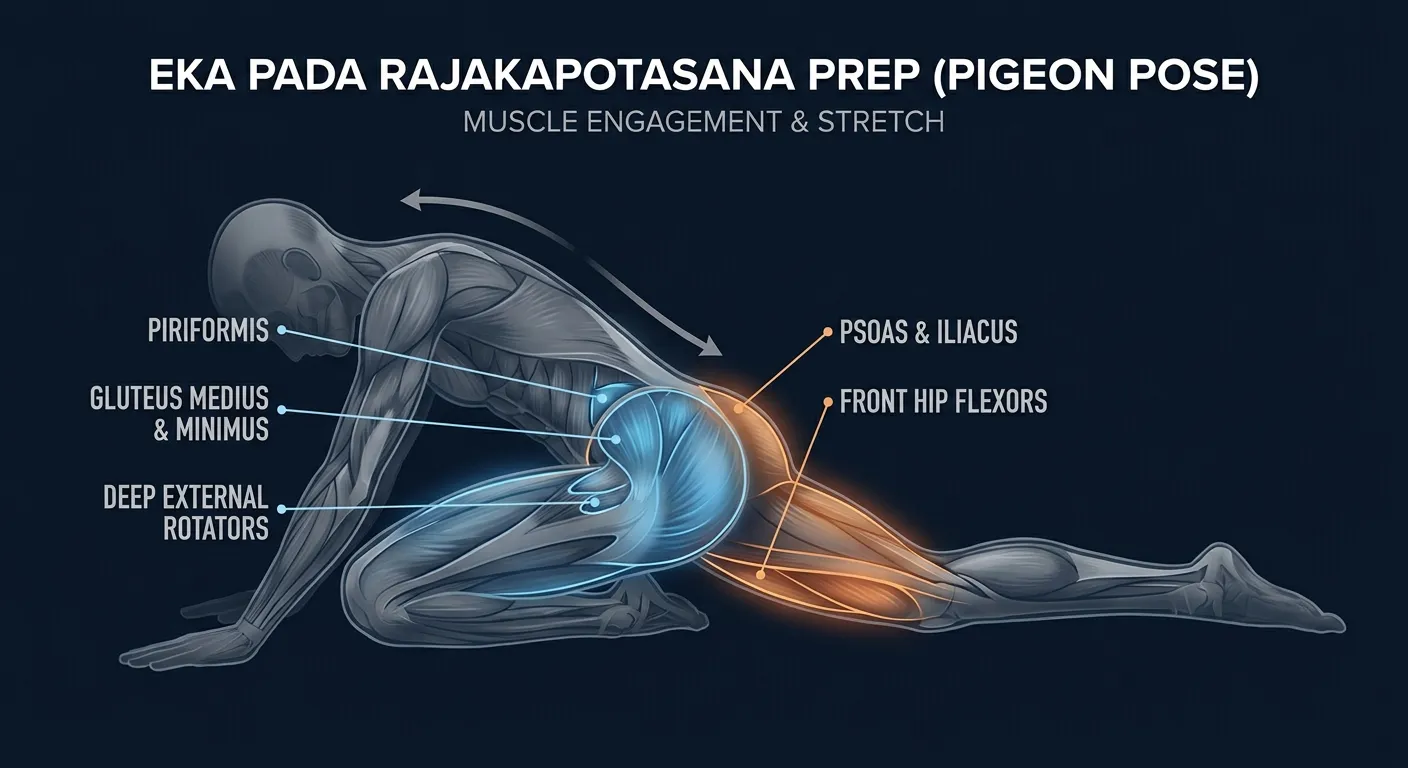
Muscles Engaged & Stretched
The primary stretch in pigeon pose lands in the front hip. The piriformis, gluteus medius, gluteus minimus, and deep external rotators lengthen as the front hip flexes and externally rotates. The deeper you angle the front shin toward parallel, the more mobility the front hip must provide.
The secondary stretch comes from the back leg. Keeping the back leg long and the top of the foot down lengthens the psoas, iliacus, rectus femoris, and front-of-hip tissues on that side. If the back knee bends or the hip rolls open, that front-of-hip stretch fades.
The stabilizers do quieter work. The transverse abdominis, obliques, erector spinae, gluteus medius, and deep hip stabilizers help keep the pelvis level. The shoulders and arms add light support when you stay upright or lower to your forearms. Slow diaphragmatic breathing also helps the body tolerate the hold without bracing against it.
No high-confidence EMG or biomechanics citation specific to pigeon pose appears in the verified citation library. The mechanism is straightforward kinesiology: the pose combines front-hip flexion and external rotation with back-hip extension, so support under the front hip keeps the pelvis level and limits torque at the knee.
Step-by-Step: How to Perform Pigeon Pose
The cues below apply to the seated half-pigeon shape, which is what most yoga classes mean by pigeon pose.
Step 1: Start in a tabletop position
Come onto your hands and knees with wrists under shoulders and knees under hips. Take one smooth breath before you move. That pause gives you time to shift into the pose instead of collapsing into it.
Coach Ty's cue: "Set up clean. Tabletop first, then transition."
Step 2: Bring the front shin forward
Slide your right knee toward your right wrist. Angle the right shin across the front of the mat. Keep the heel closer to the opposite hip for the easier version. Move the shin closer to parallel only if your hip allows that shape without knee pressure.
Ty's cue: "Shin closer is easier. Parallel is deeper. Pick the version your hip allows today."
Step 3: Extend the back leg
Slide your left leg straight back behind you. Press the top of the left foot into the mat with the toes pointing back. Turn both hip points toward the front of the mat so the pelvis stays level.
Ty's key cue: "Square the hips. Both points face forward."
Step 4: Prop the front hip if needed
If the right hip lifts off the mat, slide a yoga block or folded blanket under it. Use the height your body needs. The prop keeps the pelvis level, which helps the stretch land in the hip instead of twisting the front knee.
As Ty coaches it: "If the hip floats, use the block."
Step 5: Choose your hold position
Stay upright with hands by your hips, lower to your forearms, or fold forward over the front shin and rest your forehead on stacked fists or a block. Hold 3 to 10 slow breaths per side. Press back to tabletop, then repeat on the second side.
Ty's reminder: "Breath stays slow. If it gets tight, back off."
Get this exercise in a personalized workout
FitCraft, our mobile fitness app, uses its AI coach Ty to program yoga poses like this into your plan at the right volume and intensity, based on your level, goals, and equipment. Ty was designed and trained by Domenic Angelino, MPH (Brown University) and NSCA-CSCS, with research published in the Journal of Strength and Conditioning Research and Medicine & Science in Sports & Exercise.
Take the Free Assessment Free · 2 minutes · No credit card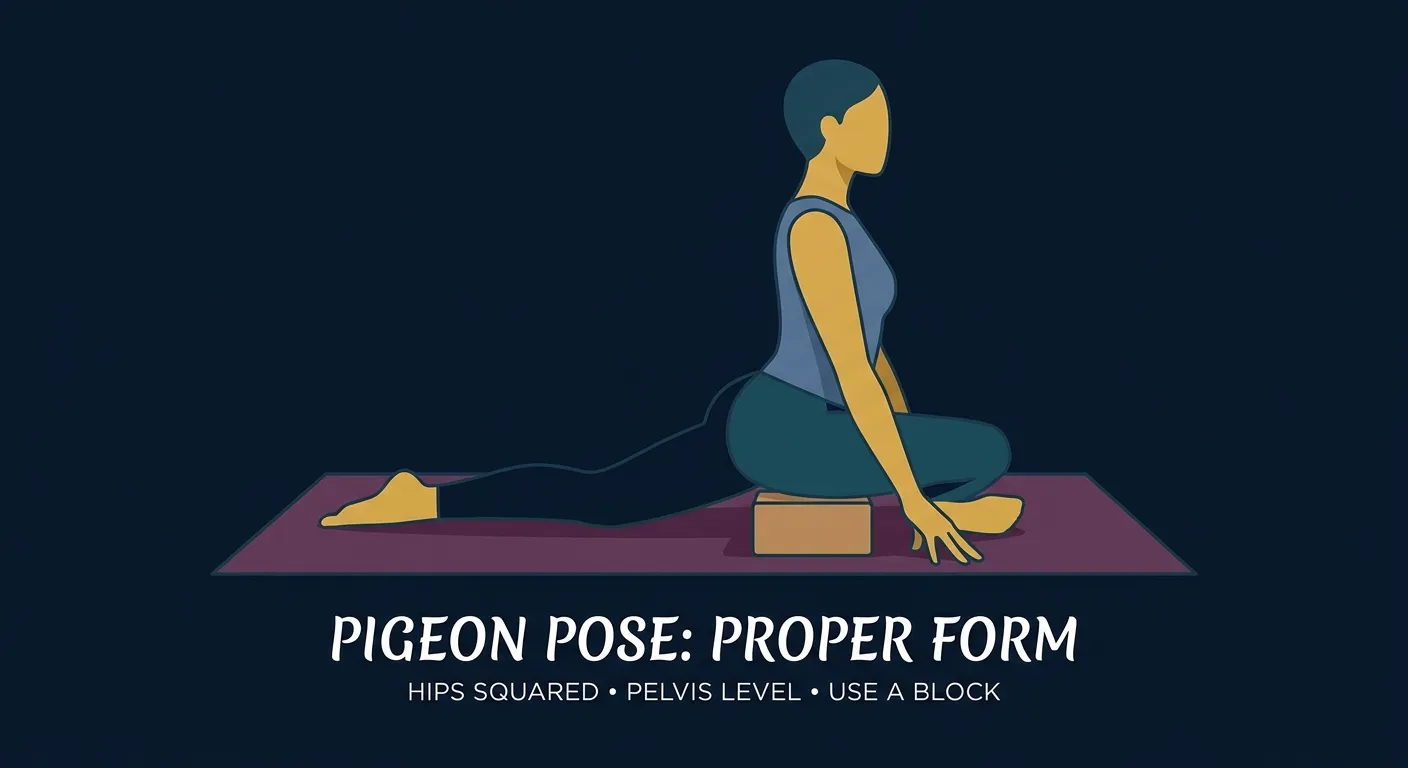
Common Mistakes (and How to Fix Them)
Here are the mistakes Ty corrects most often.
- Letting the front hip float. The pigeon-side hip lifts and the pelvis tilts. That can shift rotation into the front knee. Fix it by adding a block or folded blanket under the hip until the pelvis is level.
- Forcing the shin parallel too soon. A parallel shin is the deeper version. If your hip is not ready for it, the knee takes the stress. Keep the shin angled closer to your body until the hip opens over time.
- Letting the back hip roll open. The back hip wants to fall to the side. That makes the pose feel easier but removes the clean hip-flexor stretch. Turn both hip points toward the front of the mat.
- Collapsing into the lower back. Folding forward by rounding hard through the lumbar spine misses the point. Lengthen the spine first, then fold from the hip.
- Bending the back knee. A bent back knee shortens the back-leg hip flexor stretch and makes the pelvis less stable. Reach the back thigh long and press the top of the foot down.
- Holding the breath. Deep hip stretching can make the body guard. Keep slow nasal breaths. If the breath gets short, reduce the depth.
Pigeon Pose Variations: Regressions and Progressions
Start with the version that keeps your knee quiet and your pelvis level. Progress when the current version feels controlled for the full hold.
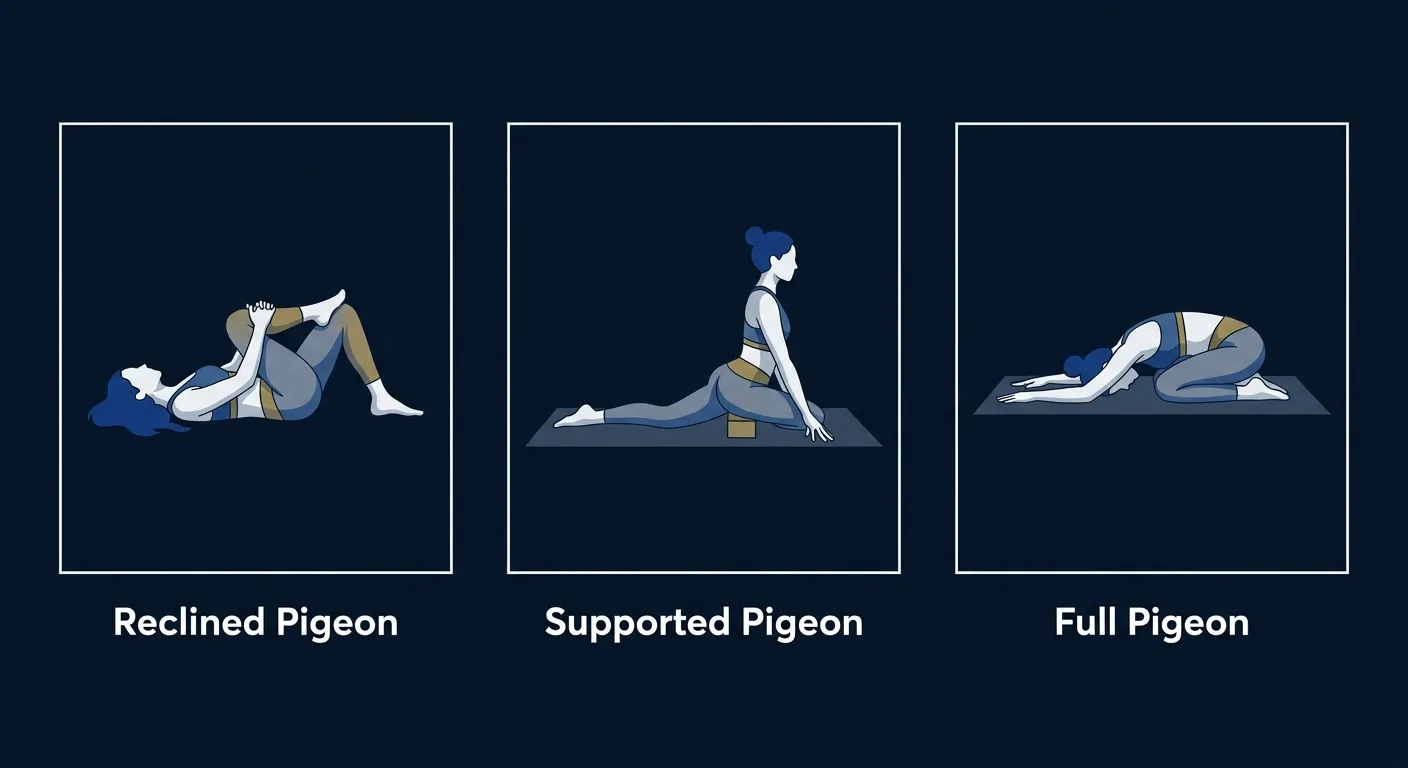
Reclined pigeon / figure-four stretch (Beginner regression)
Lie on your back and cross your right ankle over your left thigh above the knee. Thread your hands behind the left thigh and draw the legs toward your chest. This gives a similar outer-hip stretch with the floor supporting the pelvis.
Supported pigeon with block (Standard for tight hips)
Set up the standard pigeon shape with a yoga block or folded blanket under the front hip. This is the right version when the hip does not reach the floor without tilting the pelvis.
Full pigeon, shin parallel (Intermediate progression)
Once the pelvis stays level without a prop, angle the front shin closer to parallel with the front edge of the mat. Fold forward only after the hip can hold that position without knee pressure.
Mermaid pose (Advanced progression)
From full pigeon, bend the back knee and reach the same-side arm back to hook the foot in the elbow. Sweep the opposite arm overhead and clasp the hands behind the head. Use the dedicated mermaid pose guide when you are ready for the bind.
Royal pigeon pose (Expert progression)
Royal pigeon adds a deeper backbend, quad stretch, and overhead foot catch. Build toward it only after standard pigeon and mermaid pose feel steady and pain-free.
When to Avoid or Modify Pigeon Pose
Pigeon pose is safe for most healthy adults when supported well, but deep hip external rotation can irritate the knee or hip if you force the shape. Always consult your physician or a qualified healthcare provider if you are returning from injury, surgery, pregnancy, or unexplained pain.
- Front-knee pain, meniscus irritation, or recent knee surgery. Skip deep pigeon and use the reclined figure-four version. If the knee still feels pinched, stop the pose.
- Hip labral symptoms, deep groin pain, or acute hip injury. Use a smaller range, a higher prop, or a different outer-hip stretch such as hip abductor stretch.
- Recent spine, hip, or knee surgery. Get clearance before loaded end-range hip positions. Use cat-cow and gentle walking as safer early mobility options if cleared.
- Late pregnancy. Deep prone or forward-folded hip positions can become uncomfortable or unsafe. Work with a prenatal yoga instructor for supported alternatives.
- Uncontrolled hypertension or known cardiovascular disease. Long held poses can raise strain if you hold your breath. Keep the hold short and get medical guidance first.
- Hypermobility or connective tissue disorders. Focus on muscular engagement, props, and shorter holds. Build core control with deadbugs before chasing deeper range.
Related Exercises
- Same hip-opening family: Royal pigeon pose is the expert progression when standard pigeon is stable.
- Advanced bind progression: Mermaid pose adds a quad stretch and shoulder bind to the pigeon base.
- Inner-hip complement: Butterfly pose opens the adductors in the opposite hip direction.
- Mobility prep: Half-kneeling triplanar stretch warms up hip extension and rotation before deeper holds.
- Spine and pelvis prep: Cat-cow helps you find pelvic motion before settling into pigeon.
- Core foundation: Deadbugs build the trunk control that keeps the pelvis from dumping into the pose.
How to Program Pigeon Pose
Ratamess et al. (2009) provides the broader progression model for exercise programming, but static yoga holds use breath quality, hold time, and weekly exposure more than load or reps. Treat pigeon pose as mobility and positional control work.
| Level | Hold time | Reps / sets | Frequency |
|---|---|---|---|
| Beginner | 3-5 breaths, about 15-30 seconds | 1-2 supported holds per side | 3-5 sessions per week |
| Intermediate | 5-10 breaths, about 30-60 seconds | 2-3 holds per side | 4-6 sessions per week |
| Advanced | 10-15+ breaths, about 60-90+ seconds | 3-5 holds or deeper variations | 5-7 sessions per week |
Place pigeon near the end of a yoga session, in a cool-down after lower-body training, or in a standalone mobility block. If you use it before strength training, keep the holds short and supported so the hips feel warm rather than passive or sleepy.
The form floor matters more than the time target. End the hold when the front knee complains, the pelvis rolls open, the breath gets tight, or you need to brace your face and jaw to stay there.
How FitCraft Programs This Exercise
Knowing how to do pigeon pose is step one. Knowing how long to hold it, how often to practice, and when to progress is where most people get stuck.
FitCraft uses its AI coach Ty to place yoga poses like this into a balanced program based on your level, goals, and equipment. Ty adjusts the variation and volume to match your current ability, so the pose supports your training instead of becoming a random stretch you only remember once in a while.
Frequently Asked Questions
What muscles does pigeon pose stretch?
Pigeon pose primarily stretches the front hip's piriformis, gluteus medius and minimus, and deep external rotators. The back leg adds a hip flexor stretch through the psoas, iliacus, and rectus femoris. The trunk and shoulder girdle work lightly to keep the spine long and the pelvis steady.
Why does my knee hurt in pigeon pose?
Knee pain usually means the front hip is not supported enough. When the front hip floats, the shin can twist under body weight and the knee absorbs rotation that should stay in the hip. Put a yoga block or folded blanket under the front hip, angle the shin closer to your body, or use reclined figure-four instead. Stop if knee pain persists.
How long should I hold pigeon pose?
Start with 3 to 5 slow breaths, about 15 to 30 seconds, for 1 to 2 holds per side. Intermediate practitioners can use 5 to 10 breaths for 2 to 3 holds per side. Advanced practitioners can hold 60 to 90 seconds or longer only when the pelvis stays level and the knee stays quiet.
Is pigeon pose safe for beginners?
Pigeon pose can be beginner-friendly when it is supported. Beginners should keep the front shin angled closer to the body, place a block or blanket under the front hip, and stay upright instead of folding forward. If the knee feels pinched or twisted, use reclined figure-four as the safer regression.
Can I do pigeon pose with knee pain?
Do not force pigeon pose through knee pain. Modify by lifting the front hip with a block, keeping the shin closer to the pelvis, or switching to reclined figure-four. Skip the pose and consult a qualified healthcare provider if you have meniscus irritation, recent knee surgery, sharp pain, or symptoms that do not settle with support.