Plank jacks look like a small movement until you try to keep the plank honest. Your feet jump out and in, but your ribs, hips, and shoulders should stay almost still.
That makes the exercise useful for two reasons. It trains the core to resist movement while the legs create instability, and it raises your heart rate quickly without needing equipment. It fits well in bodyweight circuits, HIIT finishers, and short conditioning blocks.
The tradeoff is intensity. If your hips bounce, your lower back sags, or your wrists complain, the step-out version gives you the same pattern with less impact and less speed.
Quick Facts: Plank Jacks
- Equipment needed: None
- Difficulty: Intermediate to Advanced
- Modality: Cardio / Core
- Body region: Core and full body
- FitCraft quest category: Cardio
Muscles & Systems Worked
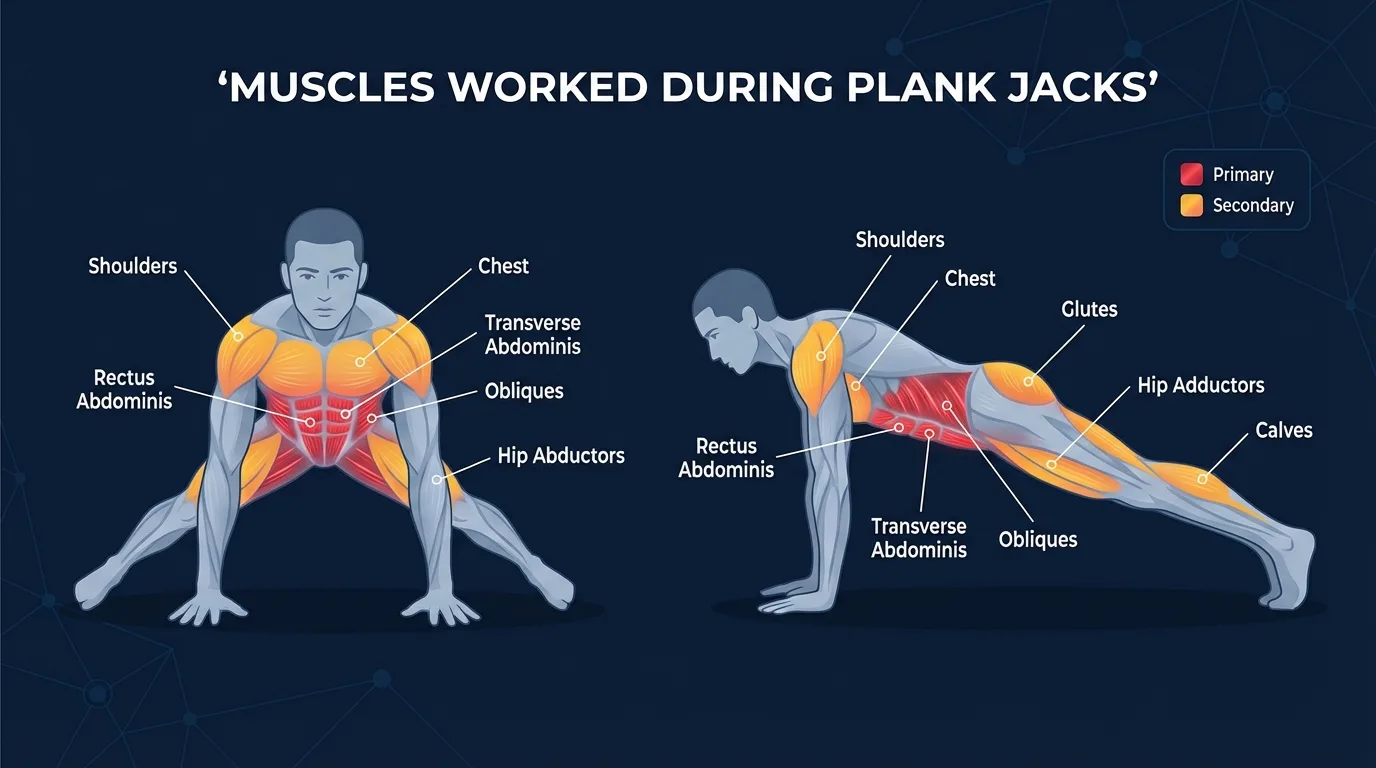
Primary movers: the hip abductors move your feet away from the midline, while the hip adductors help bring them back together. The calves contribute to each quick takeoff and landing. These muscles shorten during each jump phase and lengthen briefly as you absorb the landing.
Secondary movers: the shoulders, chest, serratus anterior, and triceps keep the high-plank base from collapsing. The glutes help hold pelvic position so the legs can move without dragging the lower back with them.
Stabilizers: the rectus abdominis, transverse abdominis, obliques, spinal erectors, and deep hip stabilizers work mostly isometrically. Their job is to stop your pelvis from sagging, piking, or rocking side to side while the feet jump.
Conditioning mechanism: plank jacks tax the phosphocreatine and glycolytic systems during short hard intervals, then rely more on the oxidative system as the set or circuit extends. The cardiovascular system is working too, because your arms hold bodyweight while your legs cycle through repeated impact.
Step-by-Step: How to Perform Plank Jacks
Step 1: Start in a High Plank
Place your hands under your shoulders, straighten your arms, and set your feet together. Brace your abs, squeeze your glutes, and make one long line from head to heels.
Coach Ty's cue: "Hands under shoulders. Ribs tucked. Lock in before you move."
Step 2: Jump Your Feet Out Wide
Jump both feet out to the sides at the same time. Land a little wider than shoulder-width, with your weight balanced between your hands and feet.
Coach Ty's cue: "Only your feet move. Keep your belt buckle pointed at the floor."
Step 3: Jump Your Feet Back Together
Spring both feet back to the starting position. Land softly on the balls of your feet instead of slapping the floor.
Coach Ty's cue: "Quiet feet, quiet hips."
Step 4: Keep the Plank Solid
Continue the out-and-in pattern while your torso stays rigid. If your hips start bouncing, slow down. If they still move, switch to step-outs.
Coach Ty's cue: "Imagine a glass of water on your low back. Don't spill it."
Step 5: Breathe and Stop Before Form Breaks
Breathe steadily through the set. Stop when your plank shape changes, even if the timer still has a few seconds left.
Coach Ty's cue: "End the set while it still looks clean."
Get this exercise in a personalized workout
FitCraft, our mobile fitness app, uses its AI coach Ty to program conditioning work like this into your plan at the right volume and intensity, based on your level, goals, and equipment. Ty was designed and trained by Domenic Angelino, MPH (Brown University) and NSCA-CSCS, with research published in the Journal of Strength and Conditioning Research and Medicine & Science in Sports & Exercise.
Take the Free Assessment Free · 2 minutes · No credit card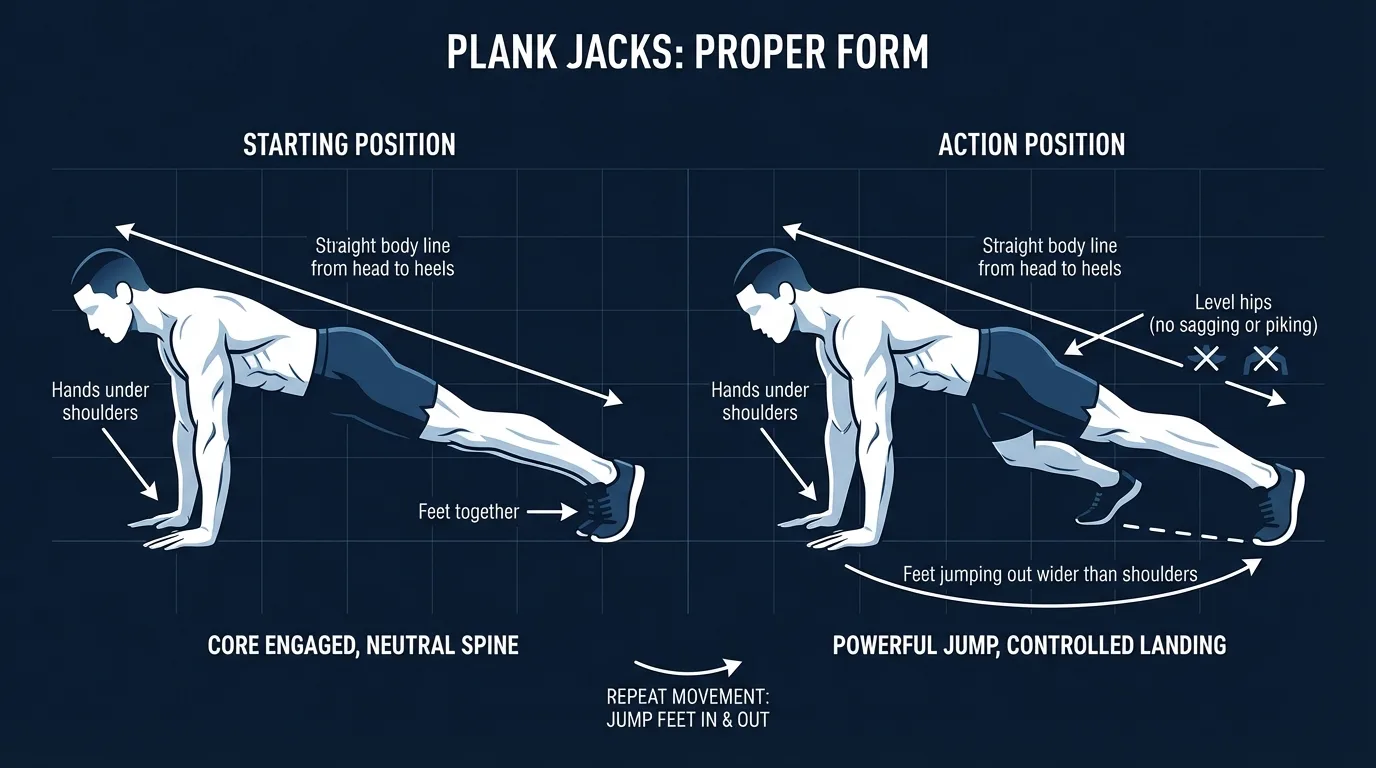
Common Mistakes (and How to Fix Them)
Most plank jack mistakes come from moving faster than your trunk can control. Fix the plank first, then add speed.
- Hips bouncing up and down. This turns the movement into leg flailing instead of core stability work. Fix it by slowing the jumps or using step-outs until your pelvis stays level.
- Lower back sagging. Sagging shifts stress into the lumbar spine. Brace as if someone is about to tap your stomach, squeeze your glutes, and stop the set when you lose that brace.
- Hands drifting forward. Hands too far ahead of the shoulders make the plank harder to control and can irritate the shoulders. Reset with wrists under shoulders before every set.
- Hard landings. Loud feet usually mean poor control. Land on the balls of your feet, bend lightly through the knees, and keep the movement springy.
- Holding your breath. Bracing does not mean breath-holding. Use short steady exhales so your core stays active without spiking tension.
- Chasing speed too early. Fast reps only help if the plank remains clean. Start moderate, then increase tempo after your hips stay quiet for the full interval.
Plank Jack Variations: Regressions and Progressions
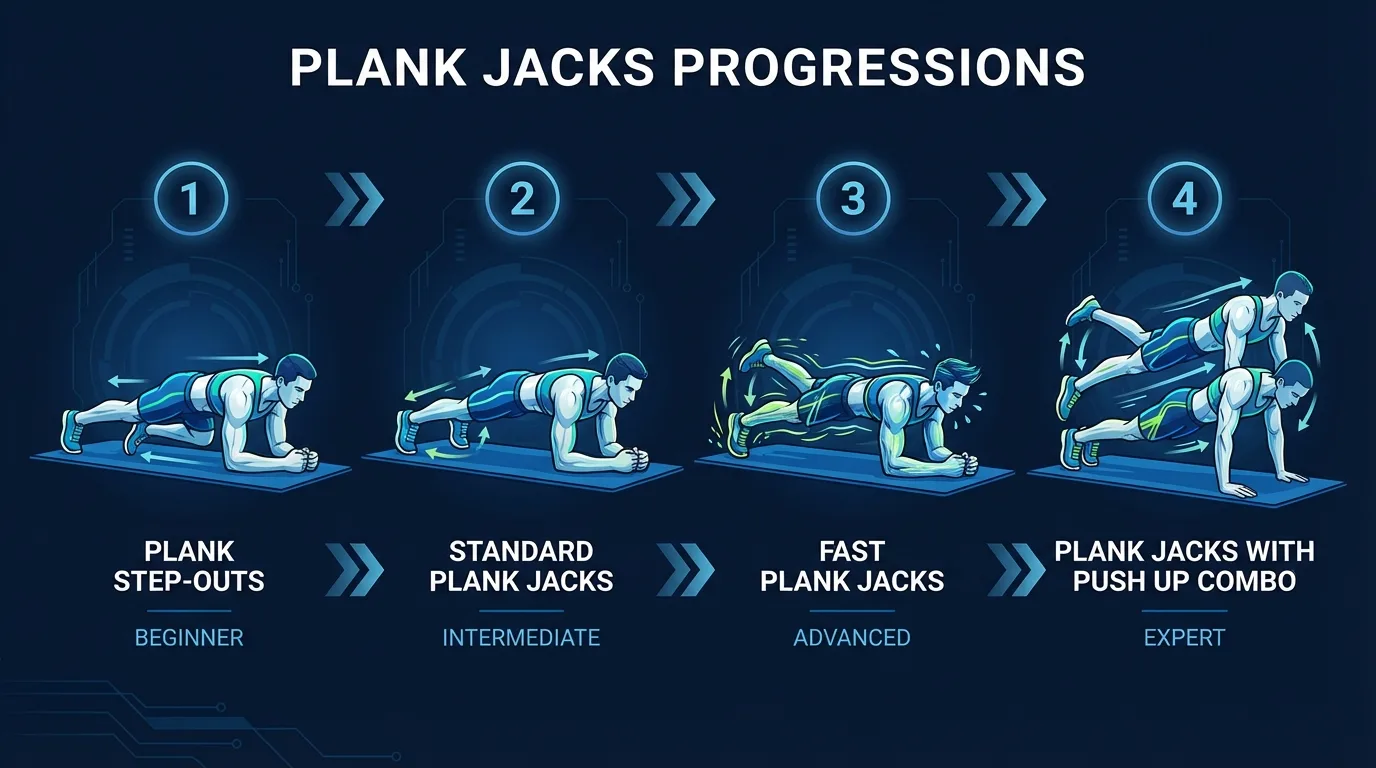
Pick the variation that lets you keep your trunk still. That is the standard for moving up.
Plank Step-Outs (Beginner Regression)
Start in the same high plank, then step one foot out, step the other foot out, and return one foot at a time. This removes the jump and gives you more time to control your hips.
Standard Plank Jacks (Intermediate)
Jump both feet out and back together while maintaining a straight plank. Use a controlled rhythm before turning it into a conditioning interval.
Fast Plank Jacks (Advanced)
Increase the tempo while keeping soft landings and quiet hips. This works best in short intervals where form stays sharp.
Plank Jack to Push-Up (Advanced Progression)
Add one push-up after every 3 to 5 plank jacks. Use this only after standard push-ups and plank jacks both feel controlled.
When to Avoid or Modify Plank Jacks
Plank jacks are safe for many healthy adults, but the combination of wrist loading, plank bracing, jumping, and high heart rate makes modification useful in a few common situations. Always consult your physician or physical therapist for personalized guidance.
- Wrist pain, carpal tunnel symptoms, or recent hand injury. High planks load the wrists in extension. Use push-up handles, elevate your hands on a bench, or swap to forearm planks until hand loading is comfortable.
- Lower-back pain that worsens with bracing. If your hips sag during the jump, the lumbar spine takes the load. Rebuild bracing with deadbugs, bird-dogs, and static hand planks first.
- Known cardiovascular disease or uncontrolled hypertension. Plank jacks can raise heart rate and blood pressure quickly. Get medical clearance and stay within your prescribed intensity range.
- Acute knee, ankle, hip, shin, or foot pain. The repeated foot strikes can aggravate irritated joints and tissues. Use plank step-outs, marching in place, or walking in place instead.
- Pregnancy, early postpartum recovery, or pelvic-floor symptoms. Jumping can increase pelvic-floor demand and leakage symptoms. Use non-impact options and get clearance from a pelvic-floor physical therapist.
- Asthma, exercise-induced bronchoconstriction, vertigo, or balance disorders. Choose lower-intensity intervals, keep rescue medication accessible when prescribed, and avoid fast transitions that make symptoms worse.
Related Exercises
Use these movements to build the same conditioning family or fill gaps that plank jacks expose:
- Same plank-cardio family: Mountain Climbers and Plank-N-Twist train dynamic core control from a plank base.
- Lower-impact conditioning: Marching in Place and Walking in Place keep the heart-rate stimulus without jumping or wrist load.
- Higher-intensity conditioning: Jumping Jacks and Burpees add more whole-body movement when you want a harder circuit.
- Core stability foundation: Forearm Planks, Hand Planks, and Deadbugs build the bracing plank jacks require.
- Ankle and calf conditioning: Calf Raises and Calf Hops help prepare the lower legs for repeated light landings.
How to Program Plank Jacks
Plank jacks work best as interval-based conditioning rather than a slow strength exercise. For general resistance-training progression principles, the American College of Sports Medicine position stand by Ratamess et al. (2009) supports matching volume, rest, and progression to training status instead of forcing one fixed rep target for everyone.
| Level | Work | Rest between sets | Frequency |
|---|---|---|---|
| Beginner (step-outs) | 2-3 rounds of 20-30 sec | 60-90 sec | 2-3 sessions/week |
| Intermediate | 3-4 rounds of 30-45 sec | 45-60 sec | 3-4 sessions/week |
| Advanced | 4-6 rounds of 45-60 sec | 30-45 sec | 3-5 sessions/week |
Where in your workout: use plank jacks after strength training, inside a bodyweight circuit, or as a 5- to 10-minute finisher. Avoid placing hard plank jack intervals before heavy lifts because they can fatigue your shoulders, trunk, and glycogen stores before the work that needs the most control.
Form floor over time targets: the timer is secondary. If your hips sag, wrists hurt, breathing gets ragged, or foot landings get loud, end the set or regress to step-outs.
How FitCraft Programs This Exercise
Knowing how to do plank jacks is one piece. Knowing when they belong in a session, how long to work, and when to swap to a lower-impact option is where most people need help.
FitCraft's AI coach Ty uses your personalized diagnostic assessment to match conditioning work to your current level, goals, and available equipment. Plank jack-style intervals can fit as a short finisher, a circuit station, or a progression after baseline plank control improves.
As you get stronger, Ty adjusts the variation and volume to match your level. Step-outs can become controlled plank jacks. Controlled plank jacks can become faster intervals. The plan stays anchored to clean form first.
Frequently Asked Questions
What muscles do plank jacks work?
Plank jacks primarily train the rectus abdominis, transverse abdominis, and obliques as stabilizers. The shoulders, chest, glutes, hip abductors, hip adductors, calves, and ankle stabilizers help hold position and control each landing.
How many plank jacks should I do?
Start with 2 to 3 rounds of 20 to 30 seconds, resting 60 to 90 seconds between rounds. Use plank step-outs first if jumping makes your hips bounce or your lower back sag.
Are plank jacks better than regular planks?
They train different qualities. Regular planks build still-position core endurance. Plank jacks add leg movement, impact, and conditioning, so your core has to stabilize while your heart rate rises.
Can plank jacks help with fat loss?
Plank jacks can raise your heart rate and add calorie burn to a circuit, but no exercise spot-reduces belly fat. Use them as one conditioning tool inside a broader plan that also includes strength training, nutrition, and recovery.
Can I do plank jacks with wrist pain?
Wrist pain is a reason to modify. Try plank step-outs with your hands elevated on a bench, use push-up handles to keep a neutral wrist, or swap to forearm planks and deadbugs until loading through the hands is comfortable. Stop if pain persists.