Plank walks turn a high plank into a moving stability drill. Instead of holding still, you step one hand and foot sideways, then bring the other side with you while your trunk stays locked in place.
The value is in the transition. Every step briefly shifts more load to one arm and one leg, so your obliques and deep core have to resist rotation while your shoulders and hips keep the plank organized. If the hips sway, the exercise becomes a shuffle. If the lower back sags, the trunk has stopped doing its job.
That makes plank walks a better fit after you already own a clean high plank. Build the static position first, add slow shoulder taps, then use plank walks as the dynamic progression.
Quick Facts: Plank Walks
- Equipment needed: None
- Difficulty: Intermediate to Advanced
- Modality: Core strength
- Body region: Core, shoulders, and hips
- FitCraft quest category: Core
Muscles Worked
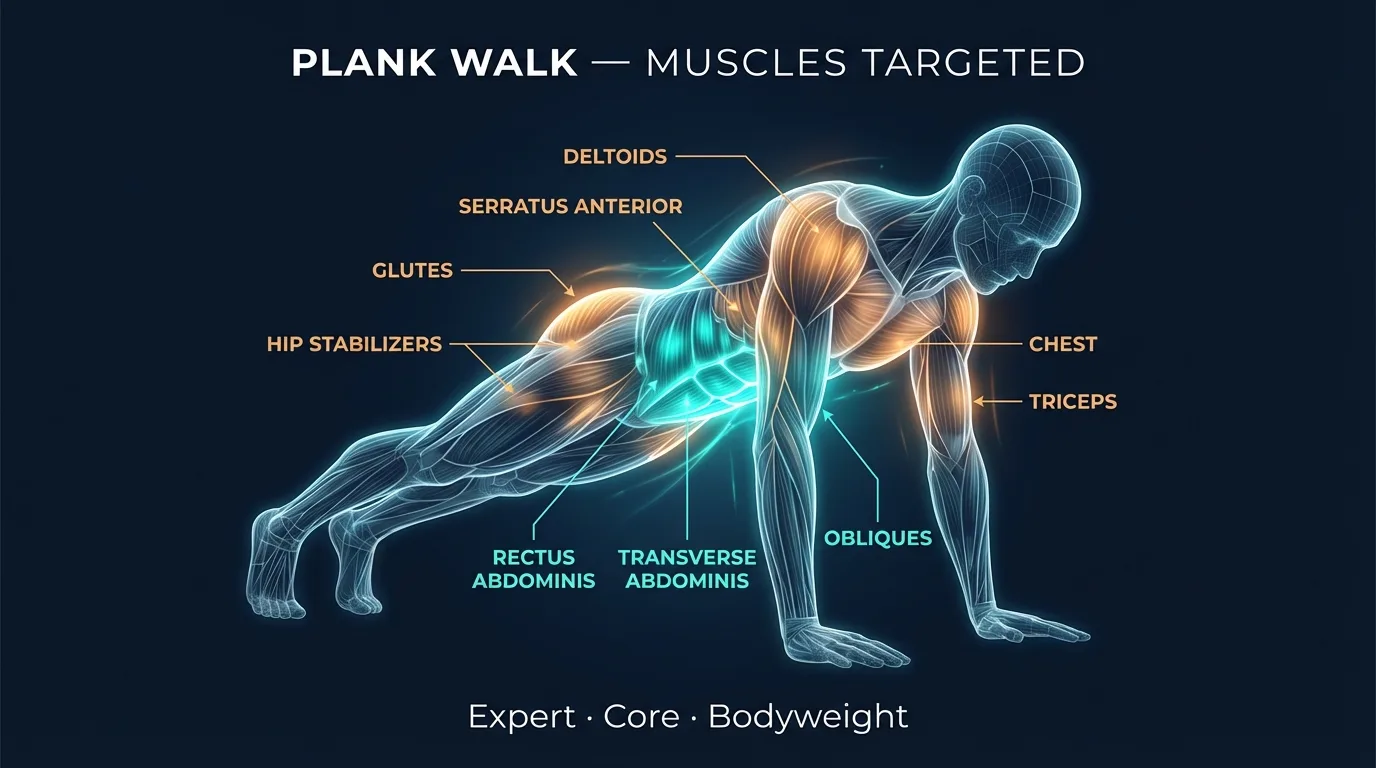
Primary movers: the rectus abdominis, transverse abdominis, and internal and external obliques. In plank walks, these muscles do not create a big visible movement. They brace isometrically to keep the ribs stacked over the pelvis while each hand and foot steps away from the center line.
Secondary movers: the anterior deltoids, triceps, pectoralis major, and serratus anterior support the upper body as weight shifts from hand to hand. The glutes and hip abductors help keep the pelvis level instead of letting one side hike, drop, or rotate.
Stabilizers: the diaphragm and pelvic floor help manage intra-abdominal pressure, the spinal erectors resist collapse through the back line, and the rotator cuff keeps each shoulder centered under load. Exhaling during each step can make the brace feel cleaner because it helps the deep core canister stay organized.
Mechanism note: plank walks are a dynamic anti-extension and anti-rotation drill. The long plank lever makes the anterior core resist sagging, while the alternating hand-and-foot steps make the obliques resist twisting. That combination is why the exercise feels harder than a static high plank even when the set lasts only a few seconds.
Step-by-Step: How to Perform Plank Walks
Step 1: Set Your High Plank
Place your hands under your shoulders and extend your legs behind you. Set your feet slightly wider than hip-width. That wider base gives you room to move without rolling through the hips.
Coach Ty's cue: "Start wider than you think. Stability first, then movement."
Step 2: Brace Before You Move
Squeeze your glutes, pull your ribs down, and brace your abdomen. Your head, ribs, hips, knees, and heels should form one long line.
Coach Ty's cue: "Lock the plank before the first step."
Step 3: Step One Hand and Foot
Move your right hand 6 to 8 inches to the side, then step your right foot the same distance. Keep your hips square to the floor. The step should look small and controlled.
Coach Ty's cue: "Move one piece, then settle the plank."
Step 4: Bring the Other Side In
Move your left hand toward your right hand, then bring your left foot back to your starting stance. You have moved one full plank-walk step while keeping the same body line.
Coach Ty's cue: "Finish every step in a real plank."
Step 5: Repeat with Steady Breathing
Take 4 to 6 steps one way, then walk back. Exhale as you step and inhale as you stabilize. Stop the set when your hips rotate, your lower back sags, or your shoulders lose position.
Coach Ty's cue: "The set ends when the plank changes shape."
Get this exercise in a personalized workout
FitCraft, our mobile fitness app, uses its AI coach Ty to program core stability work like this into your plan at the right volume and intensity, based on your level, goals, and equipment. Ty was designed and trained by Domenic Angelino, MPH (Brown University) and NSCA-CSCS, with research published in the Journal of Strength and Conditioning Research and Medicine & Science in Sports & Exercise.
Take the Free Assessment Free · 2 minutes · No credit card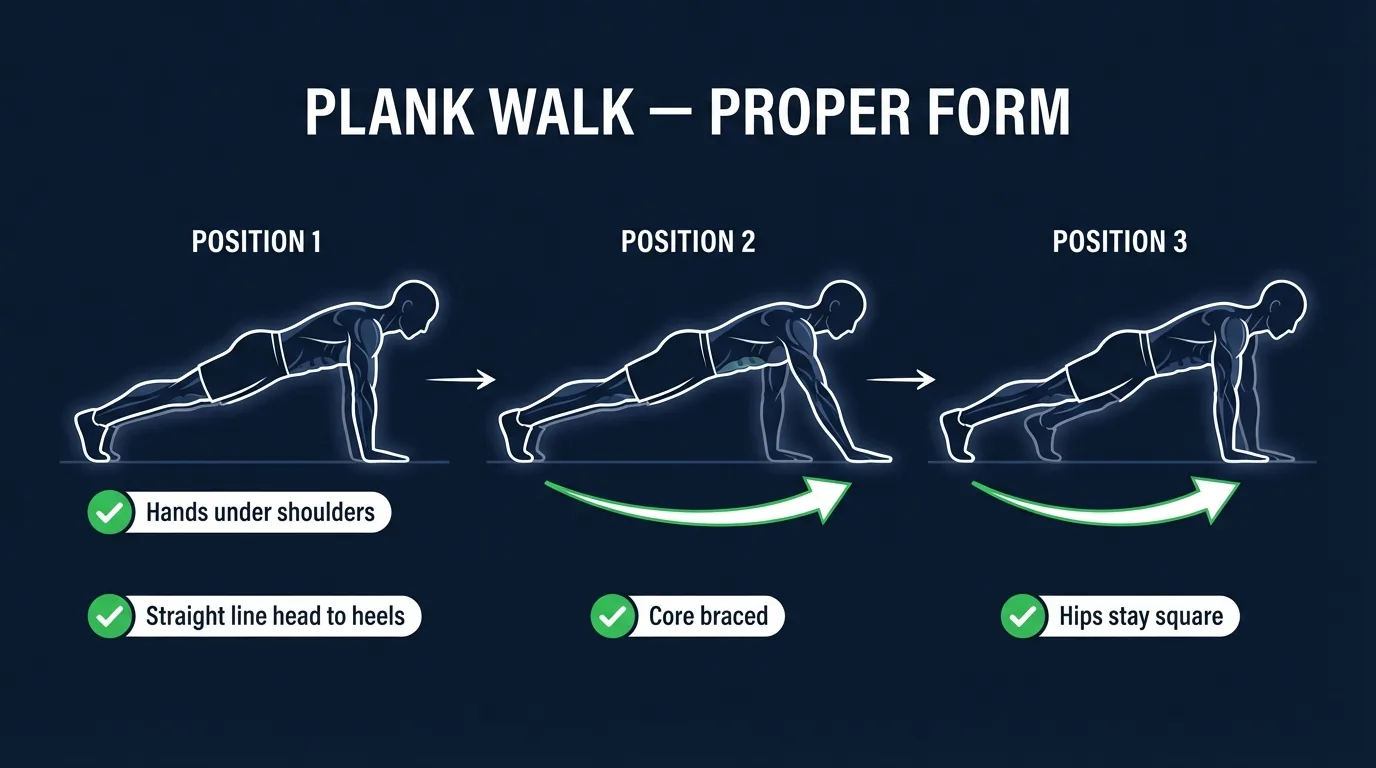
Common Mistakes (and How to Fix Them)
- Letting the hips sway. If your hips swing with every step, the obliques are losing the anti-rotation battle. Slow down, widen your feet, and make each step smaller.
- Sagging through the lower back. A sagging plank shifts stress into the lumbar spine. Squeeze the glutes, pull the ribs down, and stop the set as soon as the body line changes.
- Piking the hips up. Raising the hips shortens the lever and makes the exercise easier. Keep your shoulders, ribs, hips, and heels in one line.
- Taking huge steps. Big steps create more rotation than most people can control. Use 6 to 8 inch steps until the trunk stays quiet.
- Rushing across the floor. Speed hides the exact moment you lose position. Slow reps make the core do the work.
- Letting the hands drift too wide. Finish each step with your hands under or just outside your shoulders. A too-wide stance can irritate the shoulders and make the next step sloppy.
Plank Walk Variations: Regressions and Progressions
High Plank (Beginner Foundation)
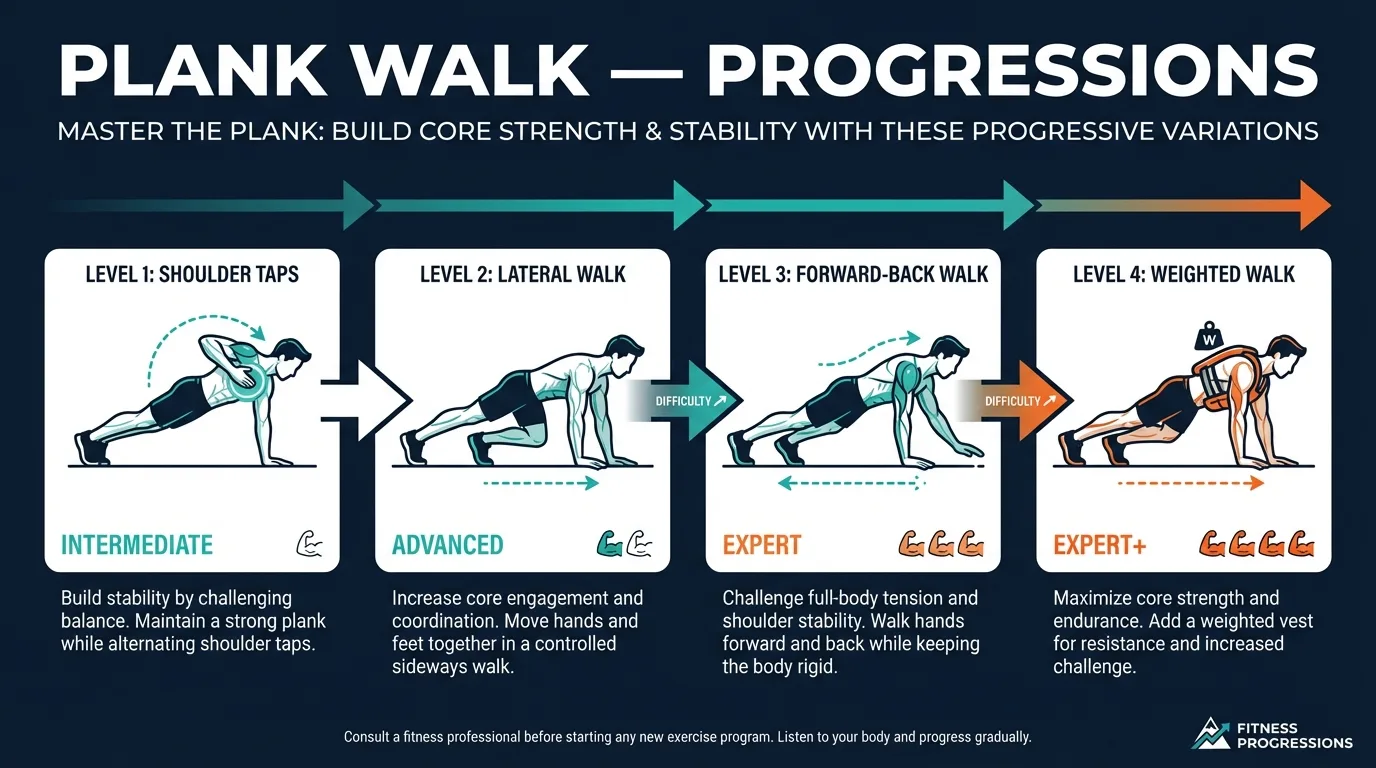
Hold the plank without moving first. Build to 30 to 45 clean seconds with glutes squeezed, ribs down, and hands under shoulders before adding any walking.
Plank Shoulder Tap (Regression)
From a high plank, tap one shoulder with the opposite hand while the hips stay level. This teaches single-arm support without the added coordination of moving the feet.
Lateral Plank Walk (Standard)
Walk sideways for short distances while the hands and feet move in sequence. This is the main version because it trains anti-rotation control without requiring much space.
Forward-Backward Plank Walk (Advanced)
Walk the hands and feet forward, then reverse back to the starting spot. The direction change adds coordination demand and usually makes the shoulders fatigue faster.
When to Avoid or Modify Plank Walks
Plank walks are safe for most healthy adults, but the moving plank position can be too aggressive when the spine, shoulder, wrist, or abdominal wall is not ready. Use the easier option that lets you brace without pain, and consult your physician or physical therapist for personalized guidance.
- Acute lower-back pain or known disc pathology. If bracing or plank walking increases symptoms, use deadbugs, bird-dogs, or short forearm planks instead.
- First 6-8 weeks postpartum or active diastasis recti. The moving plank can increase abdominal wall pressure. Rebuild with breathing drills, deadbugs, and bird-dogs before returning to dynamic plank work.
- Recent abdominal surgery or hernia concerns. Get clearance before loading the trunk in a long plank lever. Start with gentle bracing work, then progress only when cleared.
- Wrist, elbow, or shoulder pain. High planks load the wrists and shoulders. Try forearm plank variations, reduce the range, or build shoulder tolerance with shorter holds before walking.
- Pregnancy or pelvic-floor symptoms. Use side-lying, standing, or hands-and-knees core options if plank walks create pressure, heaviness, leaking, or coning through the abdominal wall.
Related Exercises
If plank walks fit your routine, these exercises build the same trunk-control pattern from easier foundations to harder dynamic work:
- Static plank foundation: Hand Planks and Forearm Planks build the brace plank walks depend on.
- Anti-rotation regression: Bird-Dogs train opposite-arm-and-leg control with less shoulder and wrist load.
- Anti-extension foundation: Deadbugs teach rib and pelvis control without loading the wrists.
- Lateral core pairing: Side Planks strengthen the obliques and hip stabilizers that keep the pelvis level.
- Dynamic plank progression: Plank Jacks add a faster conditioning demand once your plank position stays solid.
- Glute support: Glute Bridges reinforce the hip extension strength that helps prevent sagging during plank work.
How to Program Plank Walks
Plank walks are core training, but they still follow the same progression logic used in resistance training. The American College of Sports Medicine position stand recommends progressing volume, intensity, and complexity gradually as skill and tolerance improve (Ratamess et al., 2009).
| Level | Sets × Reps | Rest between sets | Frequency |
|---|---|---|---|
| Beginner prep | 2-3 × 15-30 second high plank holds | 45-60 seconds | 2-4 sessions/week |
| Intermediate | 2-3 × 4-6 steps per direction | 45-60 seconds | 2-4 sessions/week |
| Advanced | 3-4 × 8-12 steps per direction | 60-90 seconds | 3-5 sessions/week |
Where in your workout: place plank walks near the end of a strength session as a core finisher, or use a very small dose in the warm-up after easier bracing drills. Avoid fatiguing your core before heavy squats, deadlifts, rows, or presses.
Form floor over rep targets: the target step count only matters while the plank stays clean. If the hips rotate, the lower back sags, or the shoulders lose position, end the set and use an easier variation next time.
How FitCraft Programs This Exercise
FitCraft uses your free assessment to place core stability work at a level you can control. Ty can demonstrate the movement pattern, then your plan uses progressions that match your strength, goals, and available equipment.
For plank-walk-style training, that usually means earning the right to move. Static planks and deadbugs come first when bracing is the limiter. Plank walks come later, when your trunk can stay quiet while your limbs move.
Frequently Asked Questions
What muscles do plank walks work?
Plank walks primarily train the rectus abdominis, transverse abdominis, and obliques as trunk stabilizers. The shoulders, serratus anterior, triceps, chest, glutes, hip stabilizers, diaphragm, pelvic floor, and spinal erectors assist by holding the plank position while the hands and feet move.
Are plank walks harder than regular planks?
Yes. A regular plank asks you to hold still. A plank walk asks you to keep the same trunk position while one hand or foot is moving, which adds anti-rotation demand and makes the shoulder girdle work harder.
How many plank walks should I do?
Start with 2 to 3 sets of 4 to 6 steps per direction. Advanced trainees can build toward 3 to 4 sets of 8 to 12 steps per direction. Stop each set when the hips rotate or the lower back sags.
Can beginners do plank walks?
Most beginners should build up first. Hold a clean high plank for 30 to 45 seconds, then practice plank shoulder taps or bird-dogs before full plank walks. That progression teaches the anti-rotation control the exercise needs.
Can I do plank walks with lower-back pain?
Modify or skip plank walks if they increase lower-back pain, especially if your hips sag or you cannot brace without discomfort. Start with deadbugs, bird-dogs, or short forearm plank holds, and get guidance from a physical therapist if pain persists.