Upright rows get argued about because the risky version is common: narrow grip, heavy load, elbows yanked above the shoulders. That version puts the shoulder in a crowded position and makes the exercise feel worse than it needs to.
The dumbbell version gives you more room to work. Each arm can drift into its own natural path, the grip can stay wider, and the top position can stop at shoulder height instead of chasing your chin.
That range is the whole exercise. Keep the pull controlled and the upright row becomes a useful shoulder-and-trap accessory. Chase height or weight and it stops being worth the trade.
Quick Facts: Upright Rows
- Equipment needed: Dumbbells or resistance band
- Difficulty: Intermediate to Advanced
- Modality: Strength
- Body region: Upper body
- FitCraft quest category: Strength
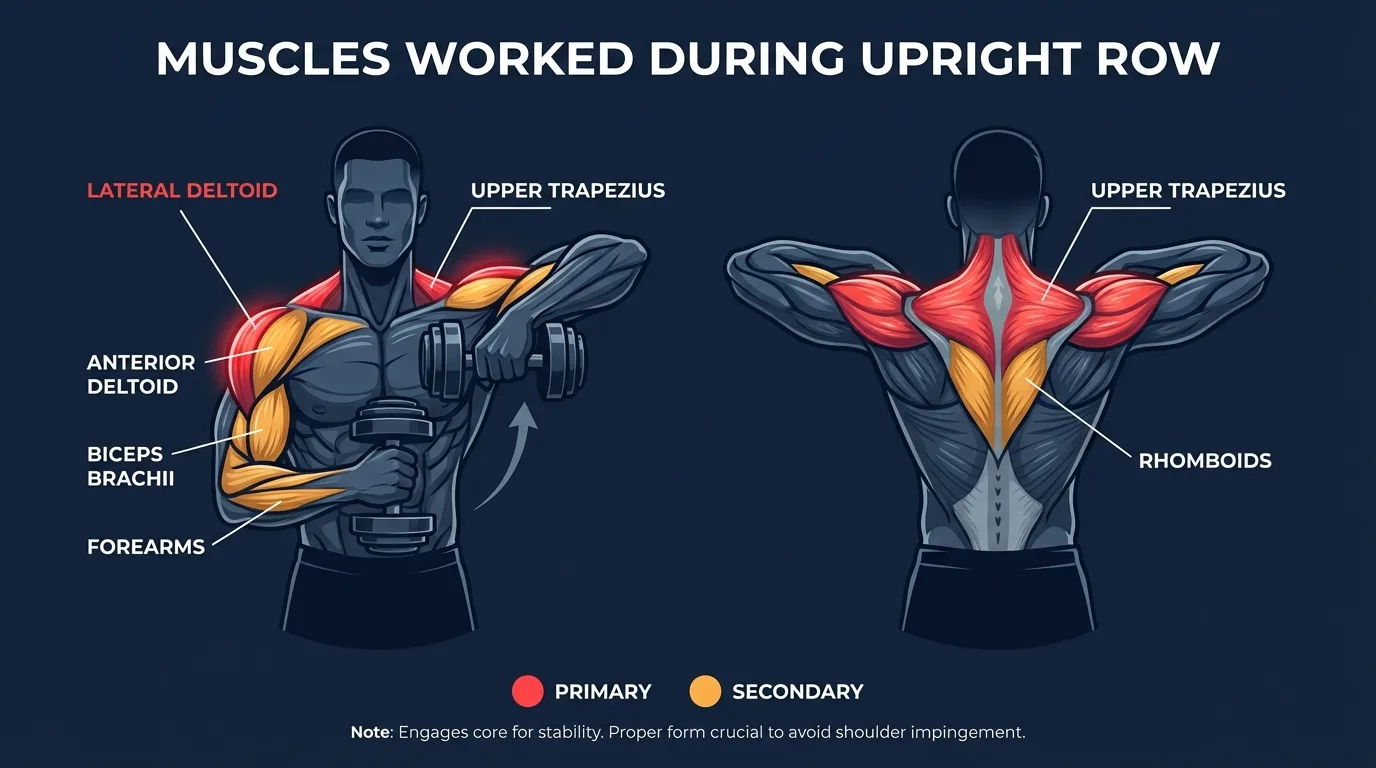
Muscles Worked
Primary movers: the lateral deltoids and upper trapezius. The lateral deltoids abduct the upper arms as the elbows rise away from the torso, while the upper traps help elevate and upwardly rotate the shoulder blades. Both shorten during the pull and lengthen under control during the descent.
Secondary movers: the anterior deltoids help guide the upper arm forward, the biceps and brachialis flex the elbows, and the forearms hold the dumbbells. The rhomboids and middle trapezius help keep the shoulder blades from drifting into a loose, rounded position.
Stabilizers: the rotator cuff centers the humeral head while the shoulder moves through abduction and internal rotation. The trunk, glutes, and spinal erectors work isometrically so the lift stays strict instead of turning into a hip-driven swing.
Evidence and mechanism: McAllister et al. (2013) tested upright rows with 50, 100, and 200 percent of biacromial breadth and found greater deltoid and trapezius activity as grip width increased, with less biceps contribution. That supports the wide-elbow cue used here. The shoulder-safety guidance comes from the movement mechanics: stopping at or below shoulder height limits the high, internally rotated position that tends to bother sensitive shoulders.
How to Do Upright Rows Step by Step
Step 1: Set Your Stance and Shoulder Position
Stand with feet about shoulder-width apart and hold a dumbbell in each hand. Let the weights hang in front of your thighs with palms facing your body. Brace your abs, soften your knees, and set your shoulders down away from your ears.
Coach Ty's cue: "Start tall. Shoulders down first, then the elbows move."
Step 2: Lead with Your Elbows
Pull the dumbbells up close to your body by driving the elbows up and out. Your elbows should stay wider than your hands. Think about sending the elbows toward the side walls instead of straight toward the ceiling.
Coach Ty's cue: "Elbows lead. Hands follow."
Step 3: Stop at Shoulder Height
End the pull when your elbows reach shoulder height or slightly below. The dumbbells should be around mid-chest, and your neck should still feel relaxed.
Coach Ty's cue: "Shoulder height is the ceiling."
Step 4: Pause Without Shrugging Hard
Hold the top position for one controlled beat. Let the upper traps contribute, but don't crank your shoulders up toward your ears to chase extra height.
Coach Ty's cue: "Feel the shoulders work without losing your neck."
Step 5: Lower Slowly
Lower the dumbbells over two to three seconds. Keep the same elbow-wide path on the way down, reset at the bottom, and stop the set when shoulder pinching, swinging, or uneven pull height shows up.
Coach Ty's cue: "Control down is part of the rep."
Get this exercise in a personalized workout
FitCraft, our mobile fitness app, uses its AI coach Ty to program compound strength exercises like this into your plan at the right volume and intensity, based on your level, goals, and equipment. Ty was designed and trained by Domenic Angelino, MPH (Brown University) and NSCA-CSCS, with research published in the Journal of Strength and Conditioning Research and Medicine & Science in Sports & Exercise.
Take the Free Assessment Free · 2 minutes · No credit card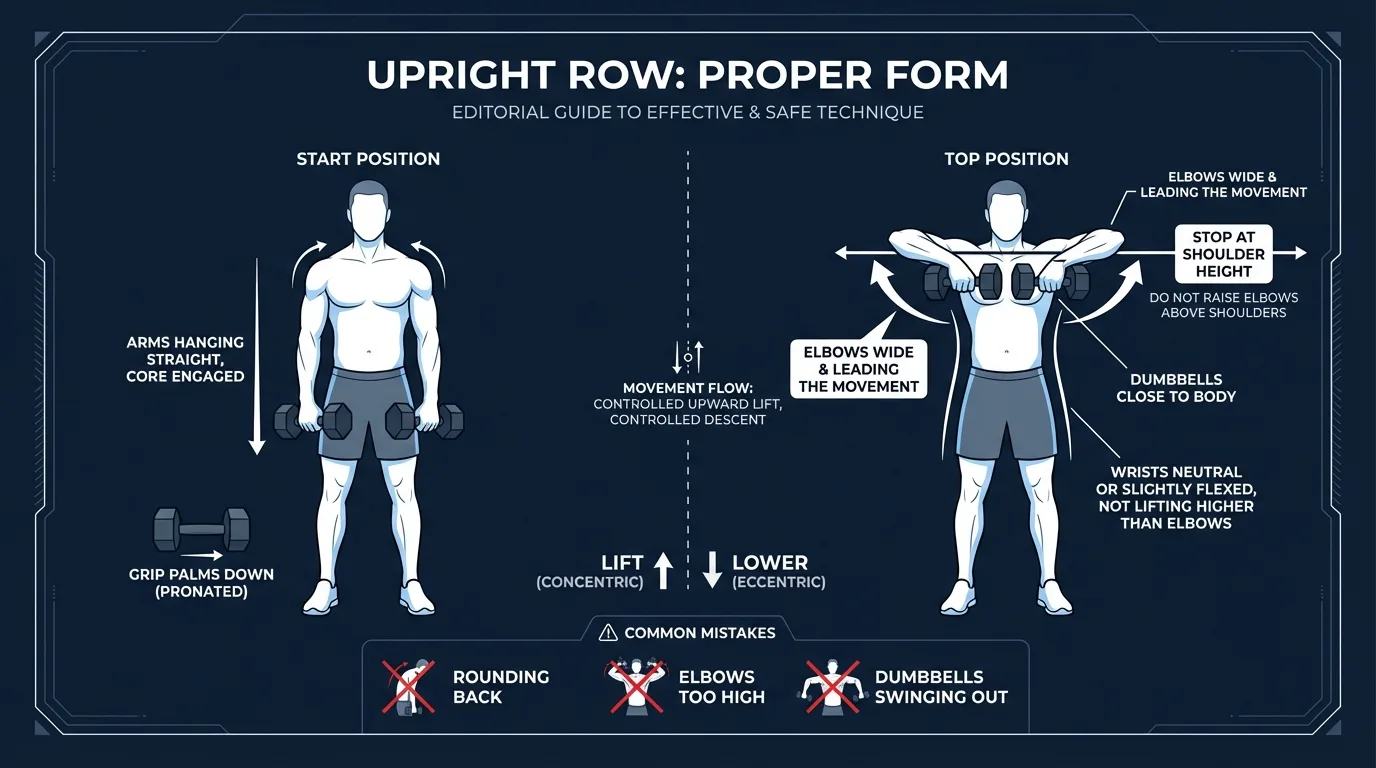
Common Mistakes to Avoid
- Pulling above shoulder height. Higher isn't better here. Once the elbows rise above the shoulders, the joint moves into the position most likely to irritate the front or top of the shoulder. Stop at shoulder height.
- Letting the elbows point straight up. Narrow, vertical elbows make the lift feel more cramped. Keep the elbows wider than the hands so the movement has room.
- Turning it into a curl. If the hands rise faster than the elbows, the biceps take over. Drive the elbows and let the dumbbells follow.
- Swinging the weight. A hip pop lets you lift more weight while the shoulder does less clean work. Use a load you can lift without moving your torso.
- Shrugging every rep aggressively. The upper traps should work, but a hard shrug at the top can crowd the neck and hide weak shoulder control. Keep the neck long.
- Training through pinching. Muscle effort is fine. Sharp shoulder pinching, clicking with pain, or symptoms that linger after the set mean you need a different variation.
Upright Row Variations: Regressions and Progressions
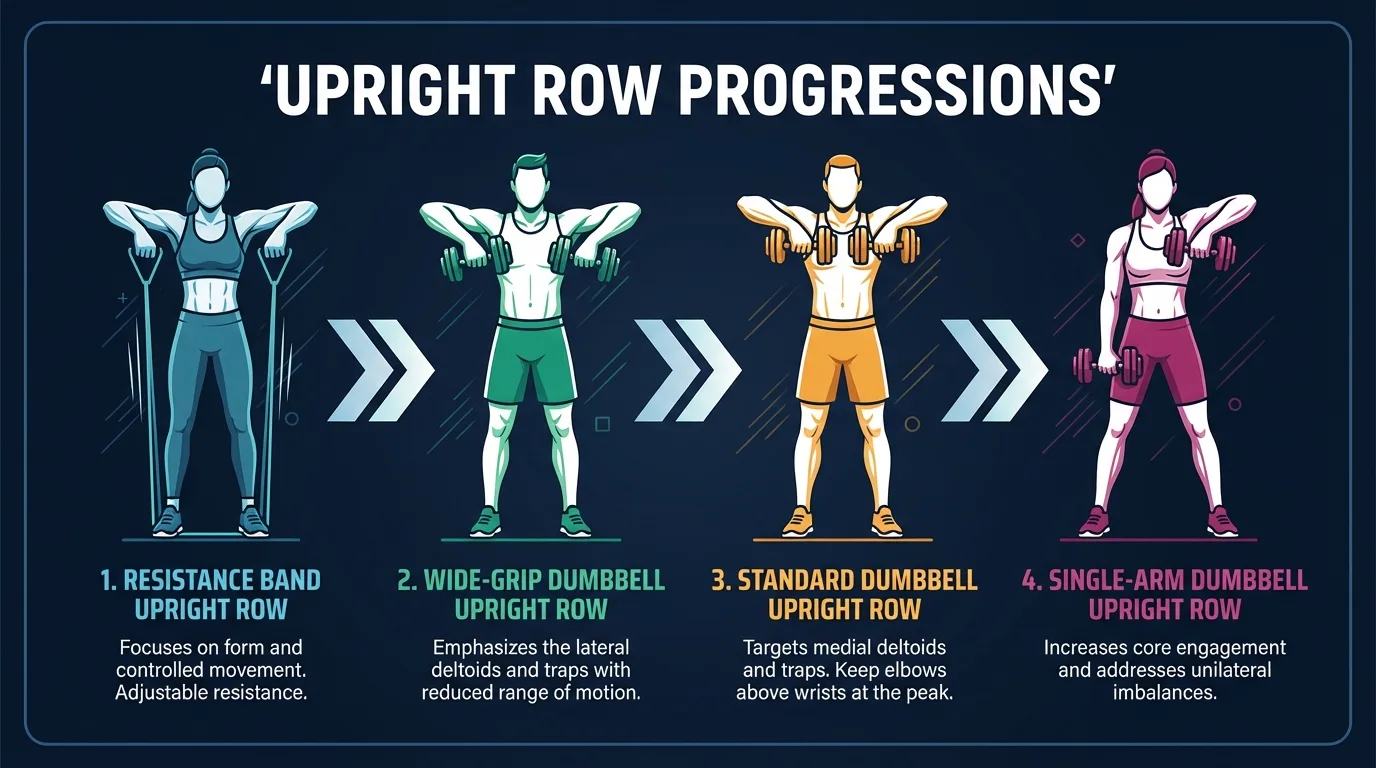
Progress the upright row by changing resistance, grip path, and symmetry before you add heavy dumbbells.
Resistance Band Upright Row
Stand on a band and pull the handles up with the same elbow-wide path. The band starts easier at the bottom, which makes it a useful learning option if dumbbells feel awkward.
Wide-Grip Dumbbell Upright Row
Start with the dumbbells slightly wider than your hips and keep the elbows wide for the whole rep. This variation lines up best with the grip-width evidence and is the default shoulder-friendly version.
Standard Dumbbell Upright Row
Hold the dumbbells in front of your thighs, pull close to the body, and stop at shoulder height. Use this once the wide-grip version feels smooth and pain-free.
Single-Arm Dumbbell Upright Row
Train one arm at a time to clean up left-right differences. Hold a rack or wall with the free hand if balance makes the rep sloppy.
When to Avoid or Modify Upright Rows
Upright rows are useful for healthy shoulders that tolerate the path, but a few situations call for a different choice. Always consult your physician or physical therapist for personalized guidance.
- Current shoulder impingement symptoms. If the top of the shoulder pinches during the pull, skip upright rows and use lateral raises, pull-aparts, or pain-free scapular work instead.
- Recent shoulder, neck, elbow, or wrist surgery. Get clearance from your surgeon or PT before loading this pattern. Rebuild with isometrics, range-of-motion work, and light raises first.
- Rotator cuff irritation or shoulder instability. The upright row combines abduction, elevation, and internal rotation. Keep the range below shoulder height or choose Y-raises and W-raises until the shoulder is calm.
- Biceps or elbow tendon pain. Upright rows ask the elbow flexors to assist every rep. Reduce load, use a band, or substitute bent-over rows if the elbow feels irritated.
- Uncontrolled hypertension or cardiovascular disease. Loaded standing lifts can encourage breath-holding. Use lighter loads, breathe continuously, and follow your clinician's exercise guidance.
- Pregnancy, early postpartum, or active diastasis recti. Use lighter loads and a stable stance, and avoid breath-holding. If bracing feels difficult, rebuild trunk control with deadbugs and bird-dogs.
Related Exercises
If upright rows belong in your training, these exercises cover the same shoulder, trap, and upper-back neighborhood:
- Same shoulder emphasis: Lateral Raises isolate the lateral deltoids with less complex shoulder rotation.
- Compound shoulder strength: Shoulder Press trains the deltoids with a vertical pressing pattern instead of an upright pull.
- Upper-back pull pattern: Bent-Over Rows and Overhead Pullover build pulling strength around the lats, traps, and shoulder blades.
- Shoulder and scapular health: Pull-Apart, W-Raise, Y-Raise, and T-Raise train cleaner shoulder blade control.
- Core foundation for strict standing reps: Deadbugs, Bird-Dogs, and Forearm Planks help you keep the torso still while the arms move.
How to Program Upright Rows
Upright-row programming follows evidence-based resistance-training progression: build volume gradually, match load to skill, and leave at least 48 hours before loading the same shoulder pattern hard again (Ratamess et al., 2009).
| Level | Sets × Reps | Rest between sets | Frequency |
|---|---|---|---|
| Beginner | 2-3 × 10-15 with band or very light dumbbells | 45-60 seconds | 2-3 sessions/week |
| Intermediate | 3-4 × 8-15 with wide-grip dumbbells | 60-90 seconds | 2-3 sessions/week |
| Advanced | 3-4 × 6-12 with pauses or single-arm reps | 90-120 seconds | 2-3 sessions/week |
Where in your workout: place upright rows after heavier compound pressing or pulling, then before smaller shoulder isolation work. They work well after shoulder press, chest press, or bent-over rows and before lateral raises or rear-delt drills.
Form floor over rep targets: stop the set when the elbows drift above shoulder height, one side rises faster, the torso starts swinging, or shoulder pinching appears. Clean reps matter more than finishing the planned number.
How FitCraft Programs This Exercise
FitCraft's AI coach Ty uses your level, goals, and equipment to place compound strength exercises in a balanced plan. For shoulder-dominant patterns like upright rows, that means the exercise lives at a dose that makes sense beside presses, rows, raises, and recovery days.
Ty adjusts the variation and volume to match your level. Band or light dumbbell work can come first. More advanced lifters can use wide-grip or single-arm versions once form stays consistent.
Frequently Asked Questions
What muscles do upright rows work?
Upright rows primarily train the lateral deltoids and upper trapezius. The anterior deltoids, biceps, forearms, rhomboids, rotator cuff, and trunk stabilizers assist so the dumbbells can travel close to the body under control.
Can I do upright rows with shoulder impingement?
Avoid upright rows if the movement causes shoulder pinching, painful clicking, or symptoms from known subacromial impingement. Use lateral raises, pull-aparts, or pain-free scapular work instead, and get guidance from a physical therapist before reintroducing the upright row.
How high should I pull upright rows?
Pull only until your elbows reach shoulder height or slightly below. Pulling higher increases shoulder elevation and internal rotation under load, which is the position most likely to irritate sensitive shoulders.
Are dumbbells better than a barbell for upright rows?
Dumbbells are usually the better choice for this guide because each arm can follow its own path. A fixed bar can force a narrow grip and a more rigid shoulder position, especially if you pull high.
What is the best upright row variation for beginners?
Start with a resistance band upright row or very light dumbbells. Keep the elbows wide, stop at shoulder height, and treat pain-free control as the progression standard before adding load.