Warrior pose looks straightforward from the outside: step back, bend the front knee, reach up, and hold. The hard part is keeping the pelvis square, the front knee stacked, the back heel grounded, and the ribs quiet while your legs start to work.
Quick Facts: Warrior Pose
- Equipment needed: None; yoga mat or wall support optional
- Difficulty: Beginner to intermediate
- Modality: Yoga, mobility, and isometric strength
- Body region: Lower body, hips, core, shoulders, and upper back
- FitCraft quest category: Yoga
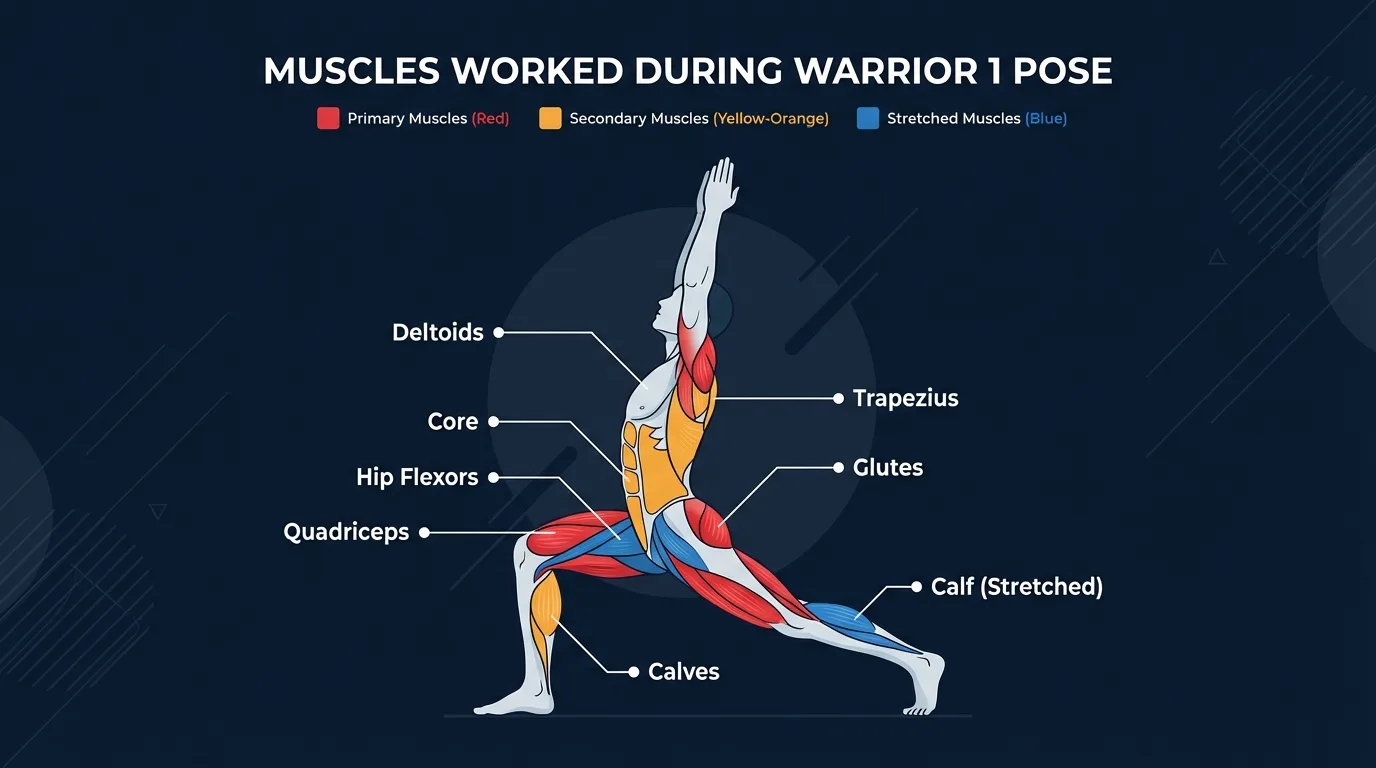
Muscles Engaged & Stretched
The front-leg quadriceps and gluteus maximus carry the main strength demand. They work isometrically to hold the lunge depth while the front knee stays stacked over the ankle, then eccentrically control any small depth changes during the hold.
The back-leg hip flexors, gastrocnemius, soleus, and Achilles complex take the biggest stretch demand. The deltoids, lower trapezius, serratus anterior, and rotator cuff assist the overhead reach without letting the shoulders creep toward the ears.
The core, spinal erectors, gluteus medius, deep hip stabilizers, and ankle stabilizers hold the pelvis and rib cage in place. Slow diaphragmatic breathing helps you keep enough tension to stay aligned without turning the pose into a rigid brace.
No exercise-specific PubMed, PMC, or DOI citation is included for warrior pose in the verified FitCraft citation library. The muscle section uses mechanism-based anatomy rather than a proxy citation.
The pose works best when you treat alignment as the progression. A shorter, cleaner stance does more for your hips and knees than a deep lunge that twists the pelvis open.
Step-by-Step: How to Do Warrior Pose
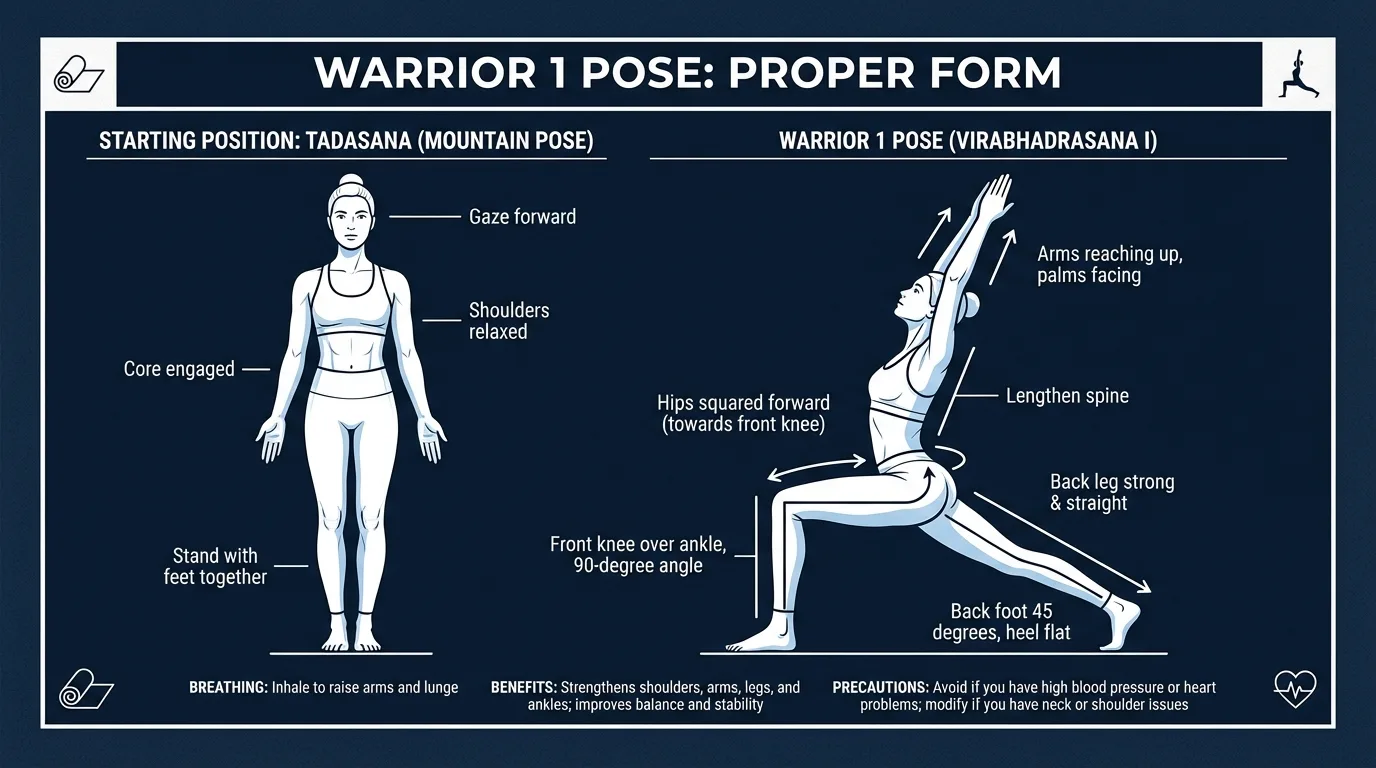
- Set your stance. Stand at the front of your mat with feet hip-width apart. Step your left foot back about 3.5 to 4 feet. Point the front foot straight ahead and angle the back foot out about 45 degrees. Coach Ty's cue: "Use a railroad-track stance."
- Square your hips. Rotate both hip points toward the front of the mat. Your back hip will want to open to the side, so draw it forward without forcing the lower back to arch.
- Bend the front knee. Sink into the lunge until the front knee stacks over the ankle or slightly behind it. Track the knee toward the middle toes and press through the full front foot.
- Anchor the back leg. Keep the back leg long and active. Press the outer edge of the back foot into the floor so the calf and hip flexor stretch without the heel lifting.
- Reach and breathe. Sweep the arms overhead with palms facing each other or touching. Draw the shoulder blades down, keep the front ribs from flaring, and hold for 3 to 10 slow breaths before switching sides.
Get this exercise in a personalized workout
FitCraft, our mobile fitness app, uses its AI coach Ty to program yoga poses like this into your plan at the right volume and intensity, based on your level, goals, and equipment. Ty was designed and trained by Domenic Angelino, MPH (Brown University) and NSCA-CSCS, with research published in the Journal of Strength and Conditioning Research and Medicine & Science in Sports & Exercise.
Take the Free Assessment Free • 2 minutes • No credit cardCommon Mistakes (And How to Fix Them)
Letting the Hips Open Sideways
What it looks like: The back hip turns toward the long edge of the mat, making the pose look closer to warrior 2.
Why it's a problem: You lose the hip flexor stretch and create uneven rotation through the pelvis and low back.
The fix: Put your hands on your hips, shorten the stance, and turn both hip points forward before you add the arms.
Standing on a Tightrope
What it looks like: The back foot lands directly behind the front foot, and the pose feels wobbly.
Why it's a problem: A narrow base makes balance harder and can add torque at the back knee and hip.
The fix: Step the back foot slightly out to the side so your feet are hip-width apart laterally.
Letting the Front Knee Drift
What it looks like: The front knee collapses inward, pushes far past the toes, or wanders side to side during the hold.
Why it's a problem: Poor knee tracking can irritate the knee and shifts work away from the front-leg muscles.
The fix: Track the knee toward the middle toes, reduce depth, or step the front foot farther forward.
Flaring the Ribs Overhead
What it looks like: The arms reach up, but the ribs pop forward and the low back arches.
Why it's a problem: The overhead reach turns into lumbar extension instead of shoulder and upper-back control.
The fix: Keep the front ribs down, soften the shoulders, and separate the hands if palms together pulls you into an arch.
Warrior Pose Variations: Regressions and Progressions
Easier Regressions
- Hands-on-hips warrior pose. Keep the arms down so you can focus on hip position, knee tracking, and steady breathing.
- Short-stance warrior pose. Step back only 2 to 3 feet. The smaller stance reduces hip flexor tension and front-leg load.
- Wall-supported warrior pose. Practice near a wall or place fingertips on a wall for balance while you learn the stance.
Harder Progressions
- Triangle pose. Move from warrior stance into a side hinge to add hamstring, adductor, and side-body length.
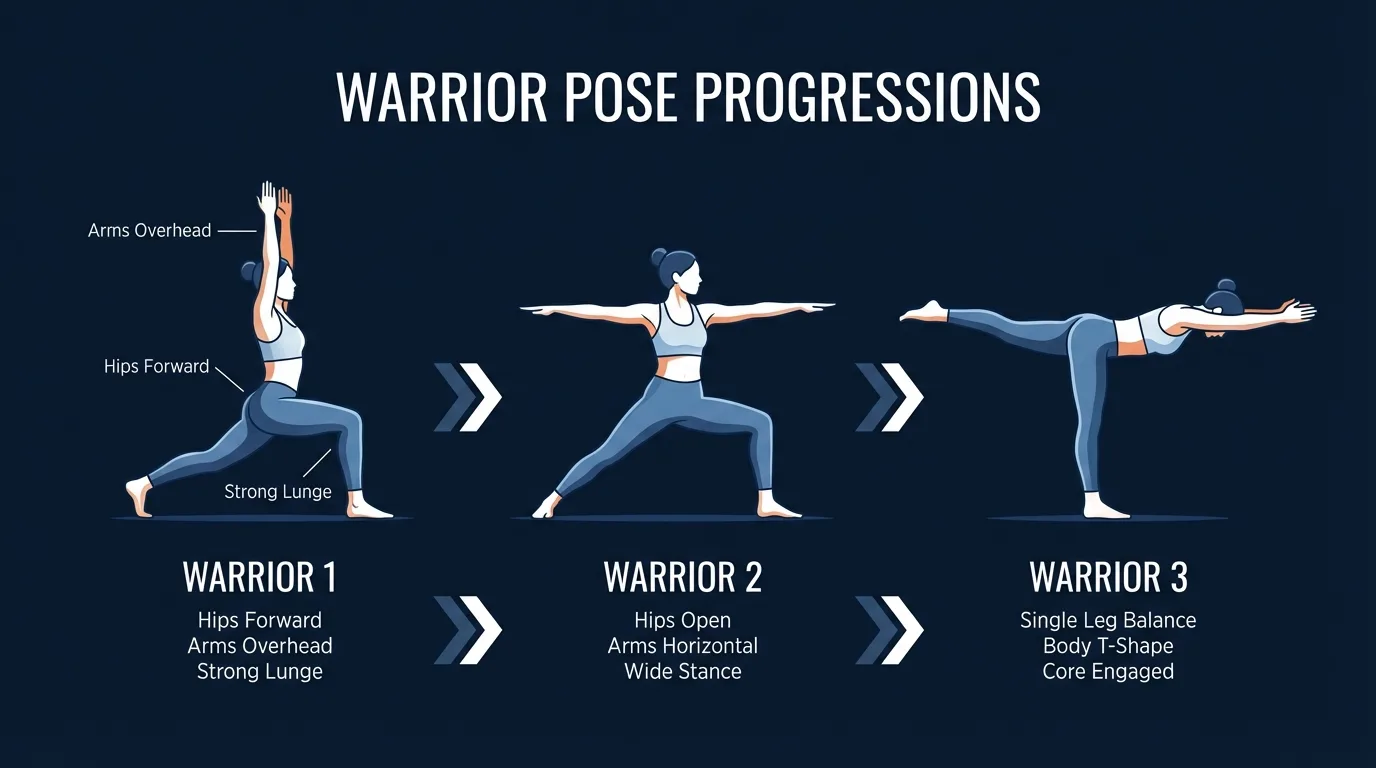
- Warrior 3. Progress from two-foot grounding to a single-leg balance and hip-hinge challenge.
- Long-hold warrior flow. Hold warrior pose for 10 to 15 breaths, then transition to triangle or warrior 3 only if the breath stays smooth.
Alternative Exercises
- Rear lunges. Train the same step-back lower-body pattern dynamically.
- Split squats. Build front-leg strength in a split stance without the overhead yoga shape.
When to Avoid or Modify Warrior Pose
Warrior pose is safe for most healthy adults, but a few situations call for a shorter stance, less knee bend, wall support, or a different pose. Always consult your physician if you're returning after pain, surgery, pregnancy, or a diagnosed condition.
- Knee pain, ligament irritation, or meniscus symptoms. Shorten the stance, reduce the front-knee bend, and use split squats only when knee tracking stays pain-free.
- Hip flexor pinching or front-hip pain. Bring the back foot closer, square the pelvis gently, or use cat-cow and other low-load mobility first.
- Shoulder pain with overhead reach. Keep hands on hips or arms in a goalpost shape. Skip the overhead position if it pinches.
- Recent hip, knee, shoulder, spine, or ankle surgery. Wait for clinical clearance and use a supported version during the return phase.
- Late pregnancy, uncontrolled hypertension, or known cardiovascular disease. Held standing poses can be uncomfortable or raise pressure in some people. Ask your clinician which yoga holds are appropriate.
- Vertigo, balance disorders, or hypermobility. Practice near a wall, reduce depth, and prioritize muscular engagement over range.
Related Exercises
- Same body region: Chair pose and triangle pose build standing leg engagement for yoga practice.
- Easier regression: rear lunges and split squats train split-stance control before longer holds.
- Mobility prep: cat-cow and downward dog prepare the spine, shoulders, calves, and hips.
- Core foundation: forearm planks build the trunk stiffness that keeps the ribs and pelvis organized.
- Balance progression: tree pose and warrior 3 add more single-leg balance demand.
How to Program Warrior Pose
Use warrior pose as a mobility and isometric-control drill. The broader progression principles from Ratamess et al., 2009 still apply: match the dose to your current capacity, progress gradually, and stop when form changes.
| Level | Sets × reps | Rest between sets | Frequency |
|---|---|---|---|
| Beginner | 1-2 holds of 3-5 breaths per side | 30-60 seconds or a neutral reset pose | 3-5 sessions/week |
| Intermediate | 2-3 holds of 5-10 breaths per side | 30-60 seconds | 4-6 sessions/week |
| Advanced | 3-5 holds of 10-15+ breaths per side, or longer flow transitions | 60-90 seconds or downward dog between sides | 5-7 sessions/week if joints recover well |
Place warrior pose in a standalone yoga session after a warm-up, before lower-body training as a short mobility drill, or after lifting as a cool-down. It pairs well with standing poses, hip openers, and simple breath-paced flows.
Use a form floor over breath-count targets. End the hold when the front knee caves, the back heel lifts, the ribs flare, the pelvis twists open, or the breath gets strained.
Frequently Asked Questions
What muscles does warrior pose work?
Warrior pose engages the front-leg quadriceps and glutes, the back-leg hip flexors and calf complex, the shoulders, upper back, and deep core. It also stretches the back hip flexors, calf, chest, and front-body line.
What is the difference between warrior 1 and warrior 2?
Warrior 1 squares the hips and torso toward the front foot while the arms reach overhead. Warrior 2 opens the hips to the side and extends the arms horizontally. Warrior 1 emphasizes hip flexor length, front-leg strength, and overhead control.
How long should I hold warrior pose?
Start with 3 to 5 slow breaths per side, then build to 5 to 10 breaths as the stance feels stronger. Advanced practices may use 10 to 15 breaths per side if the front knee, back heel, and breath stay steady.
Can I do warrior pose with knee pain?
Modify it or skip it if warrior pose causes knee pain. Use a shorter stance, bend the front knee less, widen the feet side to side, and keep the front knee tracking over the middle toes. Stop if the knee feels sharp, unstable, or worse after the hold.
Is warrior pose good for beginners?
Yes. Beginners can use hands on hips, a shorter stance, a smaller front-knee bend, or wall support. Treat the pose as an alignment drill first, then increase depth and hold time when both sides feel controlled.