Here is the question people actually mean when they ask about muscle soreness. "If I am not sore the day after, did I waste the workout?" The honest answer disappoints most people. No. Soreness is mostly about novelty, not productivity. The most-cited finding in the DOMS literature, repeated across two decades of reviews, is that you can build muscle and strength without ever being sore, and you can be brutally sore from a workout that produces almost no adaptation.
That is not the same as saying soreness is meaningless. DOMS is a real biological event. Your muscle fibers actually did take damage. Inflammation actually is happening. The repair process actually is recruiting satellite cells and rebuilding tissue. The thing the research keeps showing is that the size of the soreness signal does not map cleanly onto the size of the training stimulus. Soreness scales with how unfamiliar the work was, not how much it pushed your fitness forward.
So why does this myth persist? Because soreness is concrete and visible. Progress is slow and invisible. People reach for the salient signal. Below is what 20 years of muscle-damage research actually demonstrates, what it does not, and how to use the information without falling into the "more sore = more gains" trap.
The Research: What Studies Show
Five reviews and meta-analyses carry most of the DOMS evidence. They establish that soreness is mechanical damage rather than lactic acid, that it does not track muscle growth, how the damage-and-repair cascade actually works, what prevents it, and which recovery tools reduce it. The table lays out each one, and the sections below unpack them.
| Study | Type | Key DOMS finding |
|---|---|---|
| Cheung et al., 2003 (Sports Med) | Foundational review | DOMS is microscopic mechanical damage, not lactic acid; prevention beats treatment |
| Schoenfeld & Contreras, 2013 (Strength Cond J) | Focused review | Soreness is not a valid indicator of muscle damage or growth |
| Hyldahl & Hubal, 2014 (Muscle Nerve) | Mechanistic review | Maps the eccentric-damage cascade; repeated bout effect is trainable |
| Howatson & van Someren, 2008 (Sports Med) | Intervention review | Progressive overload works; NSAIDs may blunt adaptation |
| Dupuy et al., 2018 (Front Physiol) | Meta-analysis, 99 studies | Massage and cold-water immersion reduce soreness most; stretching negligible |
Cheung et al. (2003): The Foundational Review
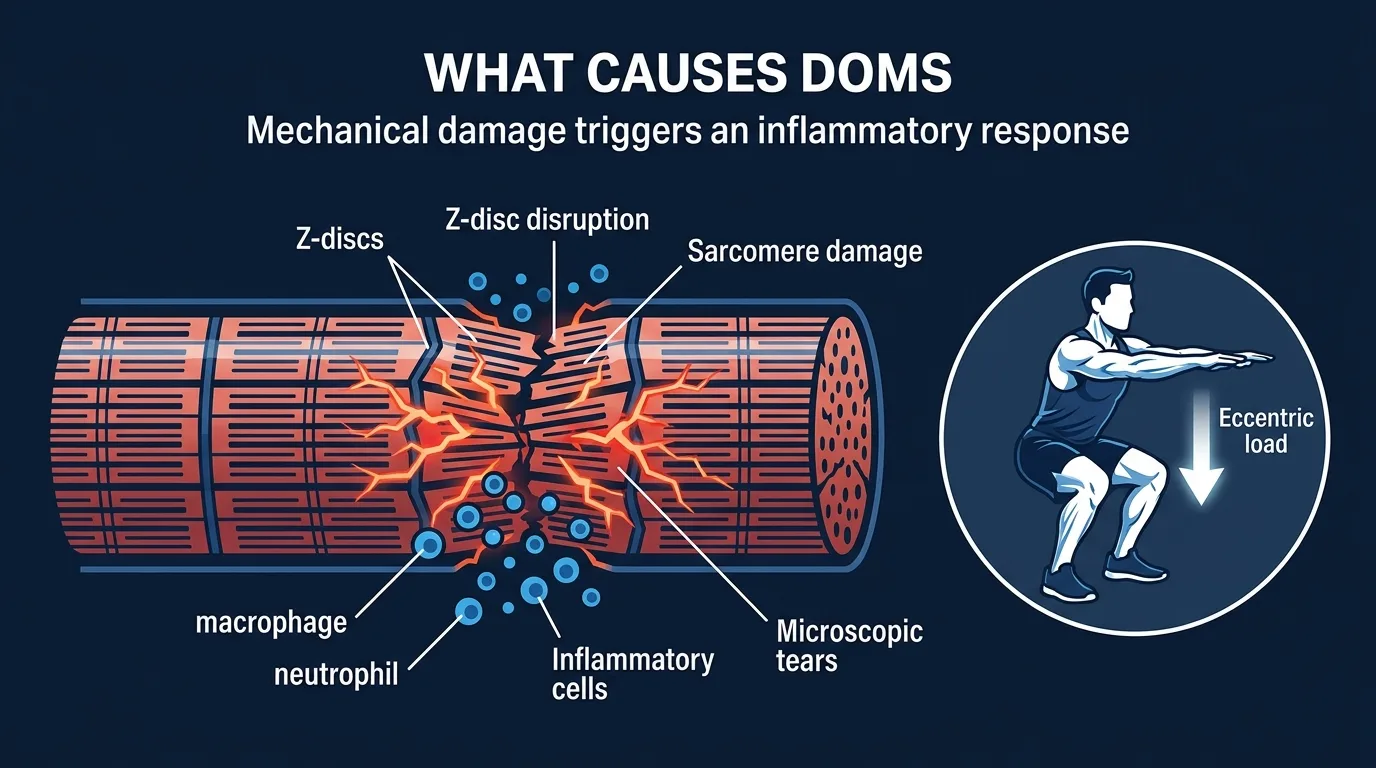
Cheung, Hume, and Maxwell's review in Sports Medicine is still the standard reference. Their 2003 paper synthesized decades of work and put to bed the most persistent DOMS myth: lactic-acid accumulation. Lactate clears from muscle within an hour or two of exercise. DOMS peaks a day or two later, so the timing alone rules it out. The actual mechanism is mechanical damage to muscle fibers, particularly at the Z-disc (the structural anchor between sarcomeres), followed by a slower inflammatory response.
Cheung's team described DOMS as a Type I muscle strain injury at the microscopic scale. Eccentric work (lengthening under load) produces it most reliably because the lengthening contractions develop higher tension per active fiber than concentric contractions. Less tissue is recruited to handle the same load, so the units that are active take more strain. Downhill running, slow lowering of a weight, jumping off a height. All classic DOMS triggers.
The review's pragmatic finding: prevention beats treatment. Of all the modalities the authors looked at (stretching, warm-up, massage, NSAIDs, cold therapy, ultrasound, electrical stimulation), nothing reliably ablated DOMS once it set in. But the repeated bout effect, gradual progressive loading, and easing into new exercises consistently reduced it. The lesson is structural: build tolerance over time, not heroic recovery rituals after the fact.
Citation: Cheung K, Hume PA, Maxwell L. Delayed onset muscle soreness: treatment strategies and performance factors. Sports Med. 2003;33(2):145-164.
Schoenfeld & Contreras (2013): Soreness Is Not a Growth Signal
This is the paper that broke the "no pain, no gain" framing among coaches who read the literature. Schoenfeld and Contreras published a focused review in Strength and Conditioning Journal asking a single question: does muscle soreness predict muscle damage or muscle growth?
Their answer, drawing on biopsy studies, MRI work, and longitudinal training data: no. Soreness correlates weakly with biochemical markers of muscle damage (creatine kinase, myoglobin), and even more weakly with hypertrophy outcomes. Some studies show muscle protein synthesis and growth in muscles that report essentially no soreness. Other studies show high soreness from training that produced minimal hypertrophy. Two trials went further and pulled the two apart on purpose, one by ramping a group in slowly enough that it never got sore and one by tracking protein synthesis across ten weeks, and both are covered in our post on whether soreness means muscle growth.
The authors named several reasons. Soreness is heavily influenced by training novelty, individual pain perception, and connective-tissue involvement, none of which track muscle-protein adaptation precisely. They argued the field should drop soreness as a proxy for stimulus and use measurable variables (load × volume, proximity to failure, weekly tonnage) instead.
The practical conclusion: stop judging workouts by next-day soreness. Judge them by load progression over weeks and months. We covered the same logic from a different angle in our RIR and failure science piece.
Citation: Schoenfeld BJ, Contreras B. Is postexercise muscle soreness a valid indicator of muscular adaptations? Strength Cond J. 2013;35(5):16-21.
Hyldahl & Hubal (2014): The Mechanism in Detail
If Cheung 2003 was the clinical-pragmatic view, Hyldahl and Hubal's 2014 review in Muscle & Nerve was the molecular one. They mapped the cellular and signaling cascade triggered by eccentric exercise, from initial sarcomere disruption to satellite-cell activation to remodeled myofibrils.
Key findings. Eccentric contractions overstretch sarcomeres, popping individual ones beyond their force-generating range. That "popped sarcomere hypothesis" was first proposed by Morgan in 1990 and remains the dominant explanation. Damaged sarcomeres release calcium, which activates protein-degrading enzymes (calpains) and inflammatory pathways. Macrophages arrive within 24 hours. Satellite cells, the muscle's resident stem cells, activate, proliferate, and fuse with damaged fibers to rebuild them. The whole cascade typically resolves over 5 to 14 days depending on damage magnitude.
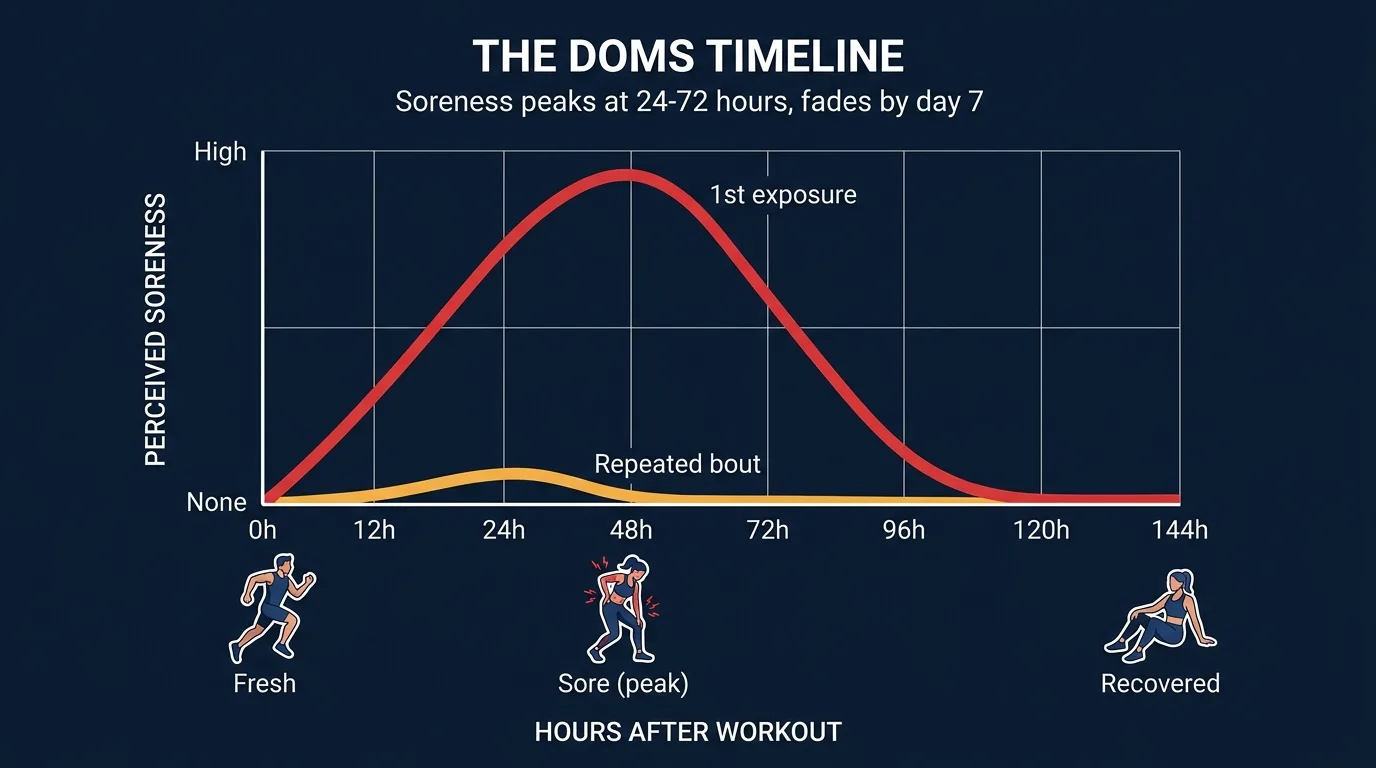
The repeated bout effect, where the second exposure produces less damage and less soreness, comes from at least three adaptations the authors describe: neural (better motor unit recruitment patterns), mechanical (stiffer connective tissue and adapted muscle architecture), and inflammatory (a faster, less destructive immune response on subsequent exposures). That is why your second workout on a new movement is usually far less painful than your first.
This matters practically because it means DOMS-protection is trainable. You do not need to live with extreme soreness forever. A single light exposure to a new movement, even at 30 to 40 percent of working intensity, builds substantial protection before the next harder session.
Citation: Hyldahl RD, Hubal MJ. Lengthening our perspective: morphological, cellular, and molecular responses to eccentric exercise. Muscle Nerve. 2014;49(2):155-170.
Howatson & van Someren (2008): What Actually Prevents and Treats DOMS
Howatson and van Someren's 2008 Sports Medicine review systematically compared interventions to prevent and reduce exercise-induced muscle damage. Their conclusion was sobering for the supplement and recovery-product industries.
What worked, in their estimation: progressive overload (the repeated bout effect), warm-up of relevant musculature, and limited evidence for cold-water immersion, massage, and certain antioxidant strategies. What did not work consistently: static stretching before or after exercise, NSAIDs at standard doses (and they may actually impair adaptation), most herbal supplements, and topical analgesics.
The authors specifically called out NSAIDs. Yes, they reduce subjective soreness. But several studies they cited showed they may also blunt the inflammatory signaling that drives muscle repair and remodeling. If you are training for adaptation, masking soreness with ibuprofen is a trade. Short-term comfort for slightly reduced long-term gains. The size of that trade-off is still debated, but it is not zero.
Citation: Howatson G, van Someren KA. The prevention and treatment of exercise-induced muscle damage. Sports Med. 2008;38(6):483-503.
Dupuy et al. (2018): The Big Meta-Analysis
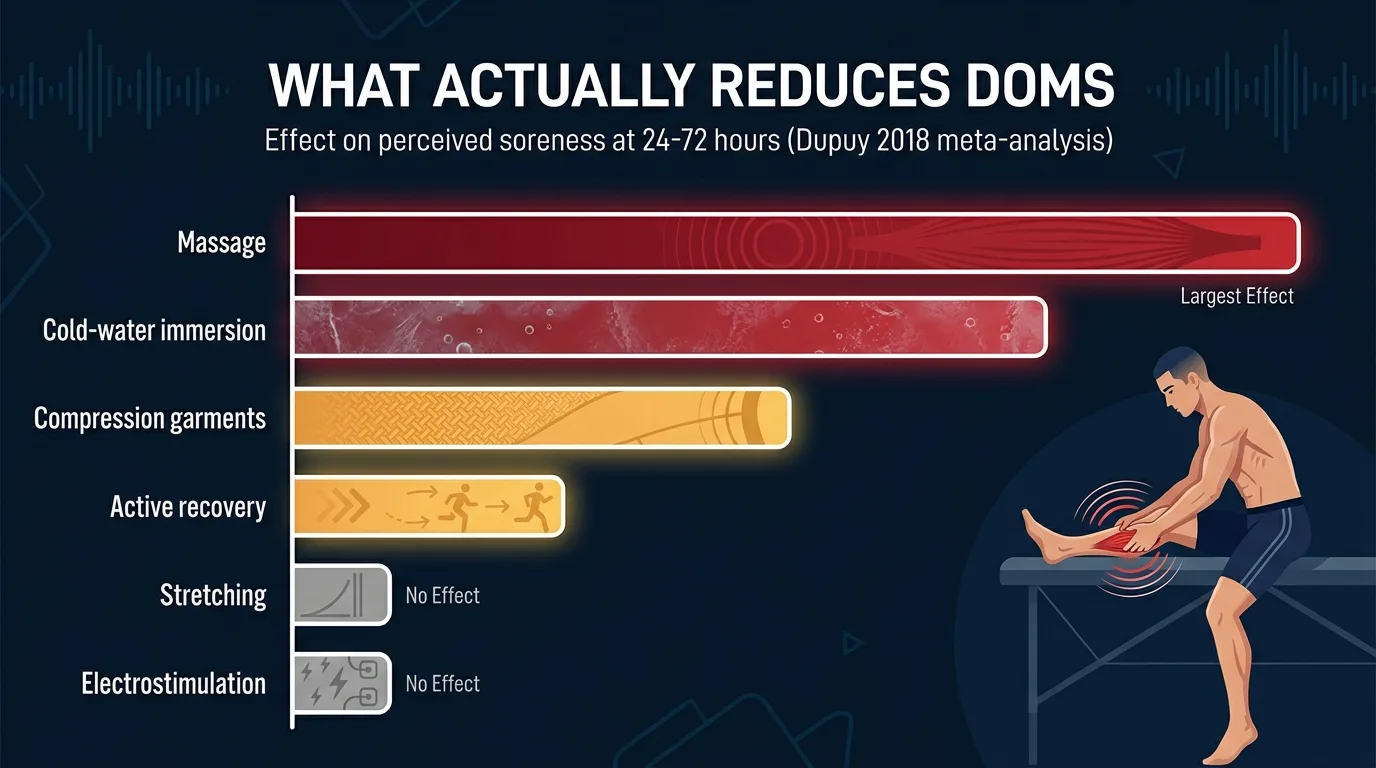
Dupuy and colleagues published a comprehensive meta-analysis in Frontiers in Physiology covering 99 studies on post-exercise recovery techniques. Their hierarchy of evidence for reducing DOMS at 24, 48, and 72 hours after exercise:
- Massage: Largest effect size for reducing perceived soreness. Practical, accessible, low risk.
- Cold-water immersion: Strong effect on soreness markers. Best at 11-15°C for 10-15 minutes (we covered the trade-offs in our ice baths and muscle growth piece, which noted the inflammation-blunting tension with hypertrophy).
- Compression garments: Moderate effect. Cheap, easy, no adaptation downside.
- Active recovery: Small but real effect from light cardio or movement. Tied to our active recovery article.
- Contrast water therapy, electrostimulation, stretching: Inconsistent or null effects.
The takeaway. If you actually want to reduce next-day soreness for a real reason (a competition, a job that demands physical readiness, a second workout you cannot skip), the evidence-best stack is massage plus a brief cold-water dip plus light movement. If you are training for body composition or strength outcomes, the post-workout cold immersion specifically may cost you a small slice of long-term adaptation, so reserve it for situations where short-term recovery is genuinely the priority.
Citation: Dupuy O, Douzi W, Theurot D, Bosquet L, Dugué B. An evidence-based approach for choosing post-exercise recovery techniques. Front Physiol. 2018;9:403.
Why does DOMS matter for your training?
DOMS matters mostly as a signal you can misread, and the cost of misreading it is real training time. If you have ever skipped a training session because you were not sore from the last one, you used soreness as a proxy for "did I do enough." That is the wrong dial. The right dial is whether your loads, sets, or reps moved compared with last week and last month. Soreness can be present or absent in either direction.
The flip side matters too. If you trained legs hard for the first time in months and now you can barely sit on a toilet, that is not a badge of stimulus quality. It is a signal you skipped the progression and went straight to a workout volume your tissue was not prepared for. The next session in 5 to 7 days is going to be far less productive than it would have been on a ramped-up plan, because severe DOMS reduces voluntary force production and disrupts movement quality for several days afterward. The cost is hidden but real.
And the "soreness compensation" effect is worth naming. Several studies in Howatson and van Someren's review noted that people who are extremely sore tend to unconsciously reduce their NEAT (the spontaneous daily movement we covered in our NEAT article). They sit more. They take elevators they would normally skip. The total daily caloric output drops, which matters if body composition is a goal. So one paradox of "killer workouts that leave me wrecked for days" is that you may move less the rest of the week, partially offsetting the workout's energy cost.
The cleaner mental model: training is a system. The workout is one input. Recovery, sleep, movement quality, progressive loading, and consistency are the others. DOMS sits adjacent to the system, sometimes correlated with it, often not. Stop treating it as the scoreboard.
How to Apply This in Practice
Three actionable rules based on the literature above.
1. Ramp into new movements. The single most reliable DOMS prevention is the repeated bout effect, and the cheapest way to trigger it is a light first session. If you are introducing a new exercise (single-leg deadlifts, deep squats, jumping work, anything with significant eccentric load), do 1 or 2 sets at low intensity in the first session and let the tissue adapt. Three days later, you can add volume. By the third session you can train at full intensity with minimal soreness penalty. The "go hard from session one" approach trades a week of poor training quality for a single day of feeling like you crushed it.
2. Use recovery tools when stakes are real, not by default. Massage and a brief cold dip can meaningfully reduce DOMS at 24 and 48 hours. So use them before competitions, on the day before a physically demanding event, or if you have a real reason to need next-day function. But for routine hypertrophy training, the cold-water inflammation-blunting effect is a small but documented adaptation cost. Save those tools for situations where you actually need them.
3. Train through mild soreness, modify around severe soreness. Mild DOMS (you notice it walking down stairs but can move normally) does not require rest. Light active work in the affected area can actually improve symptoms via blood flow, and training other muscle groups is fine. Severe DOMS (range of motion limited, voluntary force noticeably reduced) is a different category. Hitting a hard session on top of severe damage usually produces a worse session, not better adaptation. Give it another 24 to 48 hours, then reduce intensity by 20 to 30 percent for the next exposure.
For most people training for general fitness, two more rules are worth folding in. First, sleep is the single most underrated DOMS modifier. Inadequate sleep amplifies inflammation, slows tissue repair, and increases perceived soreness for the same workload (we covered the underlying science in our sleep and muscle growth piece). Second, protein adequacy matters. The repair signaling needs amino acids to actually rebuild damaged fibers. Falling short of roughly 1.6 grams per kilogram of body weight per day slows the entire recovery process.
Enjoying the article?
Start a new fitness routine today, written by me and coached by the AI I designed.
Take the Free Assessment Free • 2 minutes • No credit cardCommon Misconceptions
Misconception: "Soreness is lactic acid"
It is not. Lactate clears from muscle and blood within an hour or two of exercise. DOMS peaks 24 to 72 hours later. The timing alone disqualifies lactate as the cause. Cheung's 2003 review walked through this in detail and concluded the actual mechanism is mechanical disruption of muscle fibers followed by inflammation. The "lactic acid" framing was wrong in the 1980s and is still wrong today, but it persists because it sounds plausible and gym culture repeats it.
Misconception: "If I am not sore, I did not work hard enough"
Schoenfeld and Contreras spent an entire 2013 review explaining why this is false. Muscle growth and strength gains depend on load progression, volume, and proximity to failure. Soreness depends on novelty and eccentric stress. They overlap sometimes but they are not the same variable. People who train the same movement consistently with progressive overload often stop being sore after a few weeks and continue making excellent gains. People who do random "muscle confusion" workouts often stay perpetually sore and grow slowly because they never get to push load.
Misconception: "Stretching prevents DOMS"
Multiple reviews including Howatson and van Someren (2008) and a Cochrane review by Herbert and de Noronha both found that pre- or post-exercise static stretching does not meaningfully reduce DOMS. Stretching has other benefits (mobility, joint range of motion, injury prevention in certain contexts), but DOMS prevention is not one of them. Save the stretching session for its real purposes.
Misconception: "Ibuprofen is a free DOMS fix"
It will reduce subjective soreness short term. But several studies cited in Howatson and van Someren's review and in newer work suggest standard NSAID doses can blunt the inflammatory signaling that drives muscle protein synthesis and satellite-cell activation. The effect size on long-term hypertrophy and strength outcomes is debated, with some studies showing measurable reductions and others showing no effect. The pragmatic read: if you need NSAIDs occasionally for a specific reason (a flight, a meeting, sleep), the cost is small. Habitual use around every training session, particularly in older adults or people training for adaptation, is a worse idea than the comfort suggests.
What the Research Suggests Going Forward
The big questions in DOMS research over the next decade are mostly about individual variation. Why do some people produce huge inflammatory responses to identical workouts while others barely notice them? Genetic variation in the inflammatory cascade, individual differences in motor-unit recruitment, baseline connective-tissue stiffness, and prior training history all matter, but the relative weights are still being worked out.
There is also active work on the "ceiling" of the repeated bout effect. How long does protection from a single light exposure last? Current estimates range from 4 to 8 weeks depending on the movement and the population, but the duration depends on what intensity you return at and whether you maintained any related training in between. The pragmatic takeaway has not shifted: ease into new movements, ramp loads gradually, and the repeated bout effect does most of the prevention work for free.
Newer research is also probing whether DOMS itself has any signaling value, separate from the muscle damage that causes it. Some authors have proposed that soreness-driven behavior changes (rest, reduced activity, increased recovery focus) may have been adaptive in ancestral environments and remain mildly protective. That is speculative. For now, the cleanest framing remains: soreness is a noisy byproduct of unfamiliar mechanical stress, useful as a rough novelty signal, useless as a training-quality scoreboard.
Honest Limitations
A few caveats are worth naming. Almost all DOMS research relies on subjective soreness ratings (visual-analog scales or perceived-exertion-style questionnaires), which carry the usual problems of self-report data. The "objective" markers (creatine kinase, myoglobin, muscle imaging) correlate imperfectly with what people actually feel. So when a study reports "30 percent reduction in DOMS," the underlying signal is a fuzzy one.
Most muscle-damage studies also use very specific protocols (downhill running, maximal eccentric elbow flexion, drop jumps) that produce large, reliable damage signals. Real-world training rarely matches those protocols. Generalizing from a 100-rep eccentric biceps protocol to "a normal pull-up workout" is a leap, and the literature does not always make that leap carefully. The directional advice (progressive loading prevents most DOMS, massage and cold help short-term, NSAIDs may blunt adaptation) is robust. The exact magnitudes are not.
And there is real individual variation that the population-level findings hide. Some people get severe DOMS from movements that produce zero soreness in others. Genetic differences in inflammatory response, sex hormone status (DOMS appears modulated across the menstrual cycle, which we touched on in our menstrual cycle training piece), age, prior training, and even hydration status all play roles. The clean averages in meta-analyses paper over a lot of person-to-person noise.
References
- Cheung K, Hume PA, Maxwell L. "Delayed onset muscle soreness: treatment strategies and performance factors." Sports Medicine 33.2 (2003): 145-164. doi:10.2165/00007256-200333020-00005
- Schoenfeld BJ, Contreras B. "Is postexercise muscle soreness a valid indicator of muscular adaptations?" Strength and Conditioning Journal 35.5 (2013): 16-21. doi:10.1519/SSC.0b013e3182a61820
- Hyldahl RD, Hubal MJ. "Lengthening our perspective: morphological, cellular, and molecular responses to eccentric exercise." Muscle & Nerve 49.2 (2014): 155-170. doi:10.1002/mus.24077
- Howatson G, van Someren KA. "The prevention and treatment of exercise-induced muscle damage." Sports Medicine 38.6 (2008): 483-503. doi:10.2165/00007256-200838060-00004
- Dupuy O, Douzi W, Theurot D, Bosquet L, Dugué B. "An evidence-based approach for choosing post-exercise recovery techniques to reduce markers of muscle damage, soreness, fatigue, and inflammation: A systematic review with meta-analysis." Frontiers in Physiology 9 (2018): 403. doi:10.3389/fphys.2018.00403
Frequently Asked Questions
What causes delayed-onset muscle soreness (DOMS)?
DOMS comes from microscopic damage to muscle fibers, especially from eccentric (lengthening) contractions or unfamiliar movements. The mechanical strain disrupts the muscle's contractile and structural proteins, particularly the Z-disc and connective tissue. That damage triggers an inflammatory response over the next 24 to 72 hours. The soreness you feel is not lactic acid (a common myth Cheung's 2003 review in Sports Medicine debunked decades ago). It is the body's inflammation and repair signaling, which sensitizes the nerves in and around the damaged tissue.
How long does DOMS last?
DOMS typically starts 12 to 24 hours after the workout, peaks at 24 to 72 hours, and fades by day 5 to 7. The exact curve depends on how unfamiliar the work was and how much eccentric loading it included. A first-ever workout on a movement might leave you sore for a full week. The second time you do the same workout, soreness is usually milder and shorter, a phenomenon called the repeated bout effect, which Hyldahl and colleagues tied to neural, mechanical, and inflammatory adaptations that develop after a single training exposure.
Does soreness mean a good workout? Is DOMS necessary for muscle growth?
No, and this is one of the most-repeated myths in fitness. Schoenfeld and Contreras (2013) reviewed the evidence in Strength and Conditioning Journal and concluded that postexercise muscle soreness is not a valid indicator of muscle damage or growth. Several studies show muscles can grow without soreness, and conversely, muscles can be sore without significant hypertrophic stimulus. Training volume, intensity, proximity to failure, and progressive overload are the actual drivers of growth. Soreness is mostly a signal of novelty (your tissue meeting unfamiliar mechanical stress), not productivity. For the related question on training intensity, see our RIR and failure science piece.
What actually reduces DOMS?
Dupuy and colleagues (2018) published a meta-analysis of 99 studies in Frontiers in Physiology comparing recovery modalities. Massage and cold-water immersion produced the largest reductions in DOMS at 24, 48, and 72 hours. Active recovery (light movement) and compression garments showed smaller but real effects. Most over-the-counter interventions (stretching, electrostimulation, ice packs alone, anti-inflammatory pills) had weak or inconsistent results. The single best preventive strategy is gradual progressive overload, easing into new movements so the repeated bout effect builds protection before you push hard.
Should I work out when I am sore?
It depends on the severity. Mild to moderate DOMS does not require complete rest. Light activity targeting the same area can actually reduce soreness through increased blood flow, and training other muscle groups is fine. Severe DOMS that limits range of motion or force production is your tissue still repairing. Push through with a hard session and you risk a worse outcome because compromised muscles cannot generate force normally and movement quality drops. The safer rule: if you can move through normal range without sharp pain, training is fine. If you cannot, give it another 24 to 48 hours.