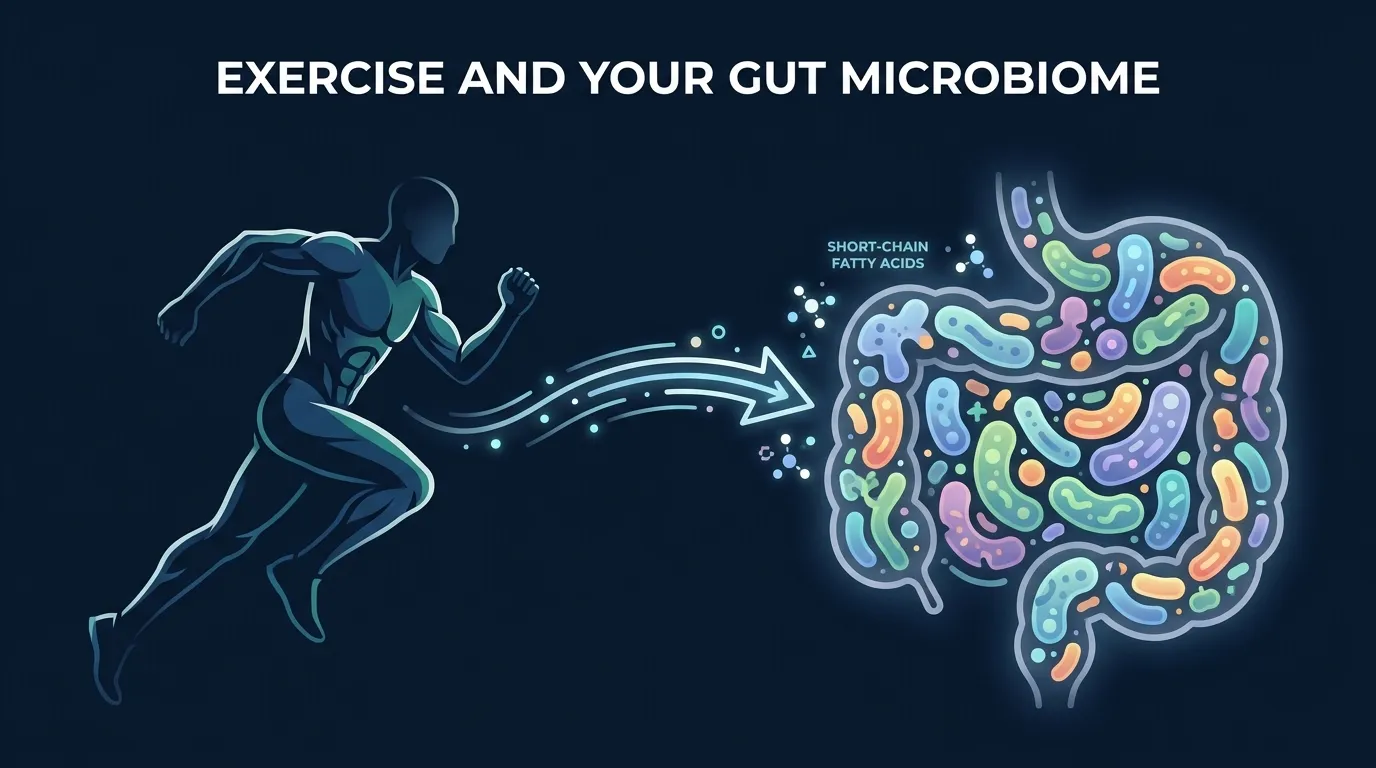
For decades, the advice about gut health came down to two words: eat fiber. And that advice still holds. But it left out something researchers have only recently been able to measure properly. The way you move your body changes the community of microbes inside it.
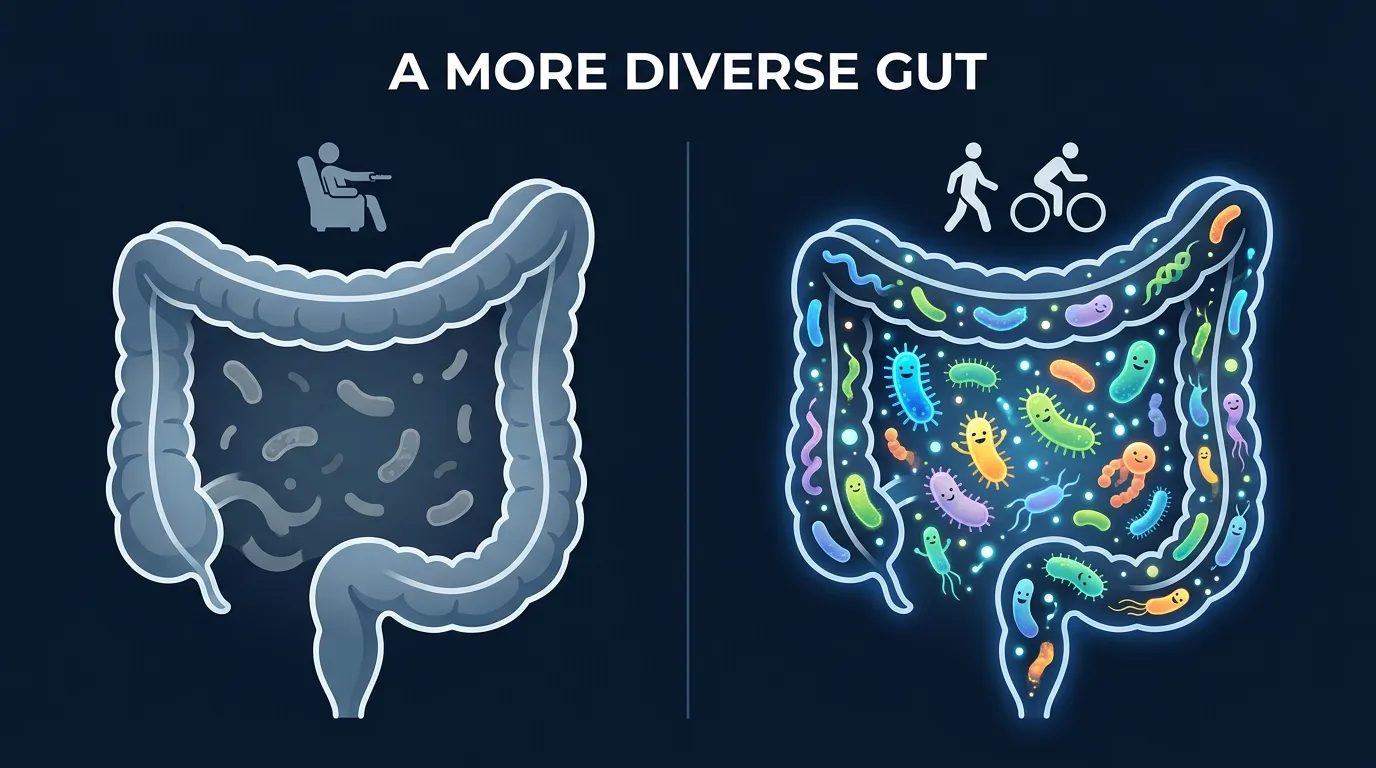
That community has a name. The gut microbiome is the collection of trillions of bacteria, fungi, and other microorganisms living mostly in your large intestine. It helps digest food your own enzymes can't break down, trains your immune system, produces vitamins, and sends chemical signals to your brain. A more diverse, balanced microbiome is generally a healthier one. A depleted one is linked to obesity, inflammatory bowel conditions, type 2 diabetes, and low mood.
So where does exercise fit in? This article walks through what the studies actually found, why the effect happens, and how to think about it without falling for the supplement-aisle hype. The short version: exercise is a genuine, independent lever for gut health. Not a miracle. A lever.
The Research: What Studies Show
Three lines of evidence build the case. Fitter people have better microbiomes. Starting exercise improves them. And how hard you train shapes the result. Let's take each one.
Fitter People Have More Diverse Gut Bacteria
The cleanest early evidence came from a 2016 study published in Microbiome. Estaki and colleagues (Estaki et al., 2016) recruited 39 healthy adults who were similar in age, body weight, and diet, then measured their cardiorespiratory fitness using VO2 peak, the gold-standard test of aerobic capacity.
The fitter participants had measurably more diverse gut microbiomes. They also produced more butyrate, a short-chain fatty acid that's one of the most important compounds your gut bacteria make. The researchers found higher numbers of known butyrate-producing bacteria, including Roseburia and members of the Lachnospiraceae family. Crucially, this held even after accounting for diet. Fitness itself, not just what these people ate, tracked with a healthier gut.
One study like this can't prove cause and effect. Maybe people with naturally good microbiomes find it easier to exercise. That's why the next type of study matters more.
Starting to Exercise Shifts the Microbiome
To show exercise causes the change, you need to take sedentary people, have them train, and watch what happens. That's exactly what Allen and colleagues did in a 2018 trial published in Medicine & Science in Sports & Exercise (Allen et al., 2018).
They took 32 previously sedentary adults and put them through six weeks of supervised endurance training, three sessions a week. The workouts progressed from 30 to 60 minutes and from moderate to vigorous intensity. Then the participants stopped, and the researchers kept tracking them.
Two findings stand out. First, six weeks of training increased fecal short-chain fatty acid concentrations, and the shift in the microbiome's metabolic output matched changes in the bacteria and genes responsible for making those compounds. Second, and this is the sobering part, the exercise-induced changes largely reversed once training stopped. The microbiome drifted back toward its baseline.
That second finding reframes everything. The gut benefits of exercise behave less like a permanent upgrade and more like fitness itself. Use it or lose it. A six-week challenge followed by quitting buys you almost nothing. The same consistency problem that derails most fitness attempts applies here too.
Intensity Changes the Result
Not all exercise produces the same gut response. A 2025 pooled analysis of randomized controlled trials in Gut Microbes (Reljic et al., 2025) combined data from 113 participants and compared training intensities directly.
Only the higher-intensity group significantly raised total fecal short-chain fatty acids, by about 30%. Butyrate alone jumped 43%. Blood lactate during the workouts, a marker of how hard people were actually working, correlated strongly with the size of the short-chain fatty acid increase. Push harder, and the microbiome appears to respond more.
But there's a ceiling. A 2022 systematic review (Bonomini-Gnutzmann et al., 2022) found that moderate-intensity activity produced favorable microbiome changes, while extreme, prolonged high-intensity efforts could go the other way. Very long, very hard sessions were associated with intestinal distress and signs of a leakier gut barrier. The takeaway isn't "train as hard as possible." It's that moderate-to-vigorous effort, the range most people should train in anyway, is also the range that's kind to your gut.
Why This Matters for Your Fitness
Short-chain fatty acids are the thread tying all of this together, so they're worth understanding. When gut bacteria ferment fiber, they release acetate, propionate, and butyrate. Butyrate is the standout. It's the preferred fuel source for the cells lining your colon, it helps maintain the gut barrier that keeps bacteria where they belong, and it has anti-inflammatory effects throughout the body.
When exercise raises short-chain fatty acid production, it's strengthening a system that touches far more than digestion. A stronger gut barrier means less of the low-grade inflammation linked to metabolic disease. Better short-chain fatty acid signaling is tied to improved insulin sensitivity and appetite regulation.
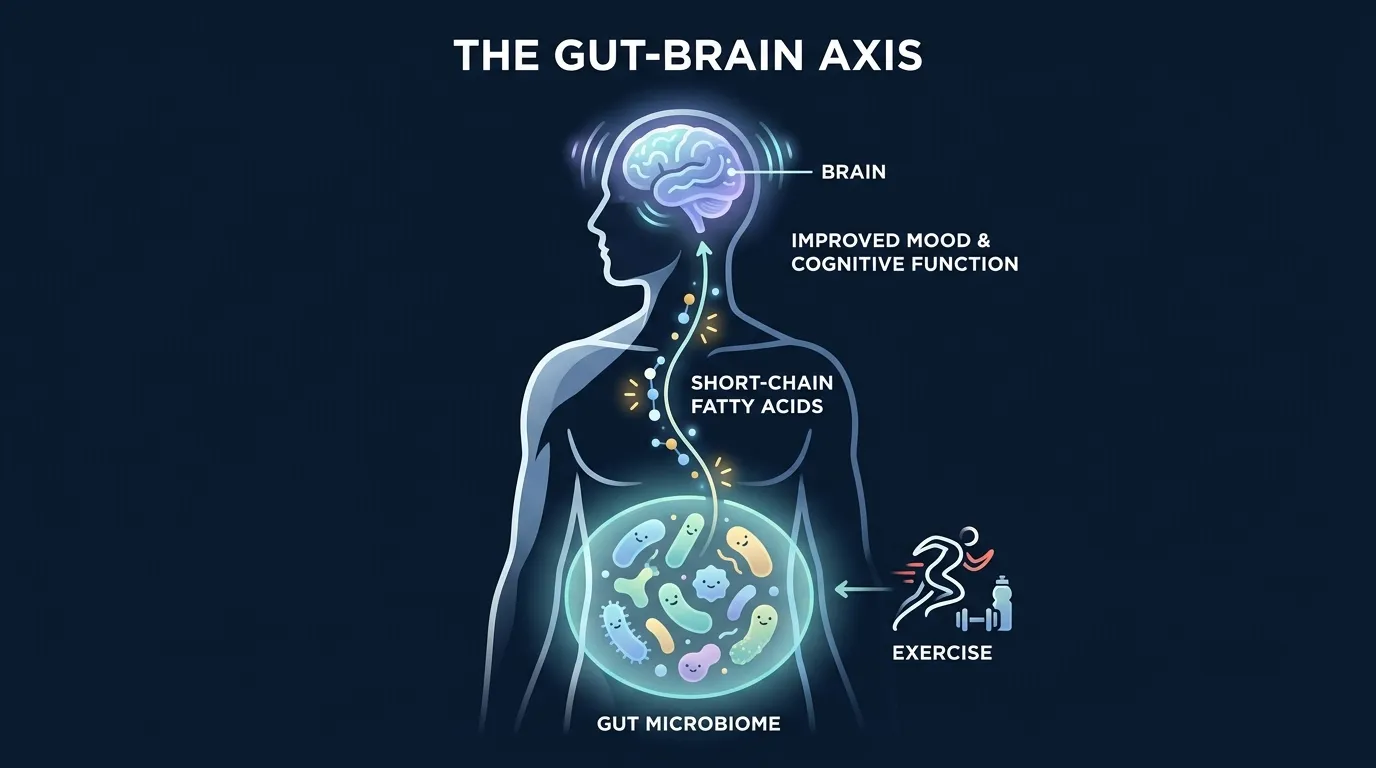
There's also a brain angle. A 2024 review in Nutrients (Varghese et al., 2024) describes the relationship as bidirectional: exercise shapes the microbiome, and the microbiome shapes how you respond to exercise. The review notes that fatty acids produced by gut bacteria can stimulate sensory neurons that signal the brain, influencing dopamine pathways tied to motivation. It's an emerging area, but it hints that your gut may be quietly involved in why a workout can lift your mood. That fits neatly with what we already know about exercise and dopamine.
Here's the practical reframe. You don't have to think about your microbiome at all. You just have to move regularly. The gut benefits ride along for free with the heart, muscle, and mood benefits you were already chasing. Training hard enough to upset your stomach in the moment is a separate question, and we work through it in our post on nausea during and after a workout.
How Exercise and Gut Health Work Together in Practice
The research points to a few clear principles. None of them require a lab, a stool test kit, or a cabinet full of supplements.
- Consistency beats intensity. Because the changes reverse when you stop, a sustainable routine you'll keep for years matters more than a punishing program you'll quit in a month.
- Moderate aerobic exercise is the workhorse. Brisk walking, cycling, swimming, dancing, bodyweight circuits. The 2022 review found this intensity band produced the most favorable, lowest-risk microbiome changes.
- Some vigorous work helps. The intensity data suggests harder efforts boost short-chain fatty acid production. A couple of more demanding sessions a week, well short of marathon-level extremes, adds value.
- Feed the bacteria you're cultivating. Exercise raises your gut's capacity to ferment fiber. If your diet has almost no fiber, those bacteria have little to work with. Exercise and fiber are partners, which is part of why fiber does so much heavy lifting for overall health.
- Avoid the extreme end. Very long, very hard endurance sessions, especially without proper fueling and recovery, can stress the gut barrier. This is a niche concern for ultra-endurance athletes, not a reason for anyone else to hold back.
Notice what's missing from that list. You don't need to know which bacterial species you have. You don't need a probiotic. You need a routine you'll actually repeat.
Enjoying the article?
Start a new fitness routine today, written by me and coached by the AI I designed.
Take the Free Assessment Free • 2 minutes • No credit cardCommon Misconceptions
Misconception 1: "Probiotic supplements are the main way to fix your gut"
Probiotic pills get the marketing budget, so they get the attention. But most strains in a typical supplement pass through and don't permanently colonize your gut. What the research on exercise shows is different. Training doesn't add a few outside strains. It changes the environment so your own resident bacteria, the ones already adapted to you, shift toward a more diverse and butyrate-producing community. That's a structural change, not a temporary top-up. Exercise and fiber-rich food do more for the day-to-day state of your microbiome than a capsule does.
Misconception 2: "More exercise is always better for your gut"
The intensity research kills this one. Yes, harder training tends to raise short-chain fatty acid output, up to a point. But the 2022 review found that extreme, prolonged high-intensity exercise was associated with intestinal distress and a more permeable gut barrier. The dose-response curve isn't a straight line up. It rises through moderate and vigorous training, then bends back down at the ultra-endurance extreme. For almost everyone reading this, that ceiling is nowhere near your normal training. The lesson is simply that gut benefits don't reward recklessness.
Misconception 3: "Diet is everything; exercise barely matters for the gut"
Diet is powerful. Nobody disputes that. But the Estaki study was specifically designed to separate the two, matching participants on diet and still finding that fitness predicted a healthier microbiome. And the Allen trial changed the microbiome through exercise alone. Diet and exercise are both real, independent inputs. Treating exercise as irrelevant to gut health isn't supported by the evidence.
What the Research Suggests Going Forward
The honest summary: the direction of the evidence is consistent, but the field is young. Exercise increases gut microbial diversity and short-chain fatty acid production. That much shows up across observational studies, controlled trials, and reviews. What's less settled is the detail. How much, how hard, and for how long, broken down by age, sex, body composition, and starting fitness, are all still being mapped.
A few limitations are worth naming. Many studies are small. Microbiome measurement varies between labs, which makes results harder to pool. And the Allen finding, that changes reverse when training stops, has been observed but not exhaustively replicated across populations. The 2024 Nutrients review is candid that the exercise-microbiome relationship, while well established in broad strokes, still needs larger and more standardized trials before anyone can write a precise prescription.
None of that undercuts the practical advice, because the practical advice doesn't depend on the fine print. Move regularly, mostly at moderate intensity, with some harder efforts. Eat fiber. Keep it up for years, not weeks. That recommendation was already the right call for your heart, your muscles, and your mood. The microbiome research just adds one more reason it was right.
References
- Estaki M, Pither J, Baumeister P, et al. "Cardiorespiratory fitness as a predictor of intestinal microbial diversity and distinct metagenomic functions." Microbiome. 2016;4:42. doi:10.1186/s40168-016-0189-7
- Allen JM, Mailing LJ, Niemiro GM, et al. "Exercise Alters Gut Microbiota Composition and Function in Lean and Obese Humans." Medicine & Science in Sports & Exercise. 2018;50(4):747-757. PubMed: 29166320
- Reljic D, Hermann HJ, Dieterich W, Neurath MF, Zopf Y. "Exercise improves gut microbial metabolites in an intensity-dependent manner: a pooled analysis of randomized controlled trials." Gut Microbes. 2025. doi:10.1080/19490976.2025.2579354
- Varghese S, Rao S, Khattak A, Zamir F, Chaari A. "Physical Exercise and the Gut Microbiome: A Bidirectional Relationship Influencing Health and Performance." Nutrients. 2024;16(21):3663. doi:10.3390/nu16213663
- Bonomini-Gnutzmann R, Plaza-Diaz J, Jorquera-Aguilera C, et al. "Effect of Intensity and Duration of Exercise on Gut Microbiota in Humans: A Systematic Review." International Journal of Environmental Research and Public Health. 2022;19(15):9518. doi:10.3390/ijerph19159518
Frequently Asked Questions
Does exercise improve gut health?
Yes. Research shows that regular exercise increases the diversity of bacteria living in your gut and boosts the production of short-chain fatty acids like butyrate, which feed the cells lining your colon and help control inflammation. A 2016 study in Microbiome found that people with higher cardiorespiratory fitness had more diverse gut microbiomes and produced more butyrate, independent of their diet.
How long does it take for exercise to change your gut microbiome?
Measurable shifts can appear within about six weeks. In a 2018 study, previously sedentary adults who did supervised endurance training three times a week showed increased short-chain fatty acid production after six weeks. The catch: those changes largely reversed once the participants stopped exercising, so a consistent routine matters more than a short burst.
What type of exercise is best for gut health?
Moderate aerobic exercise has the most consistent evidence behind it. A 2022 systematic review found that moderate-intensity activity produced favorable changes in gut bacteria without the intestinal stress sometimes seen after extreme endurance efforts. Walking, cycling, swimming, and bodyweight circuits done regularly all qualify. You don't need a gym or special equipment.
Can exercise help with the gut-brain connection?
It appears to. The short-chain fatty acids produced by gut bacteria after exercise can signal the brain through the gut-brain axis, influencing mood, motivation, and inflammation. This is one proposed pathway linking a healthier microbiome to the well-documented mental health benefits of regular physical activity.
Does FitCraft help build a consistent exercise routine?
Yes. Because gut microbiome benefits depend on training consistently rather than occasionally, FitCraft is built around adherence. The AI coach Ty, a 3D personal trainer, guides you through workouts, and the gamification system uses streaks, programs, and progress tracking to keep you coming back. Take the free FitCraft assessment to get a personalized program.