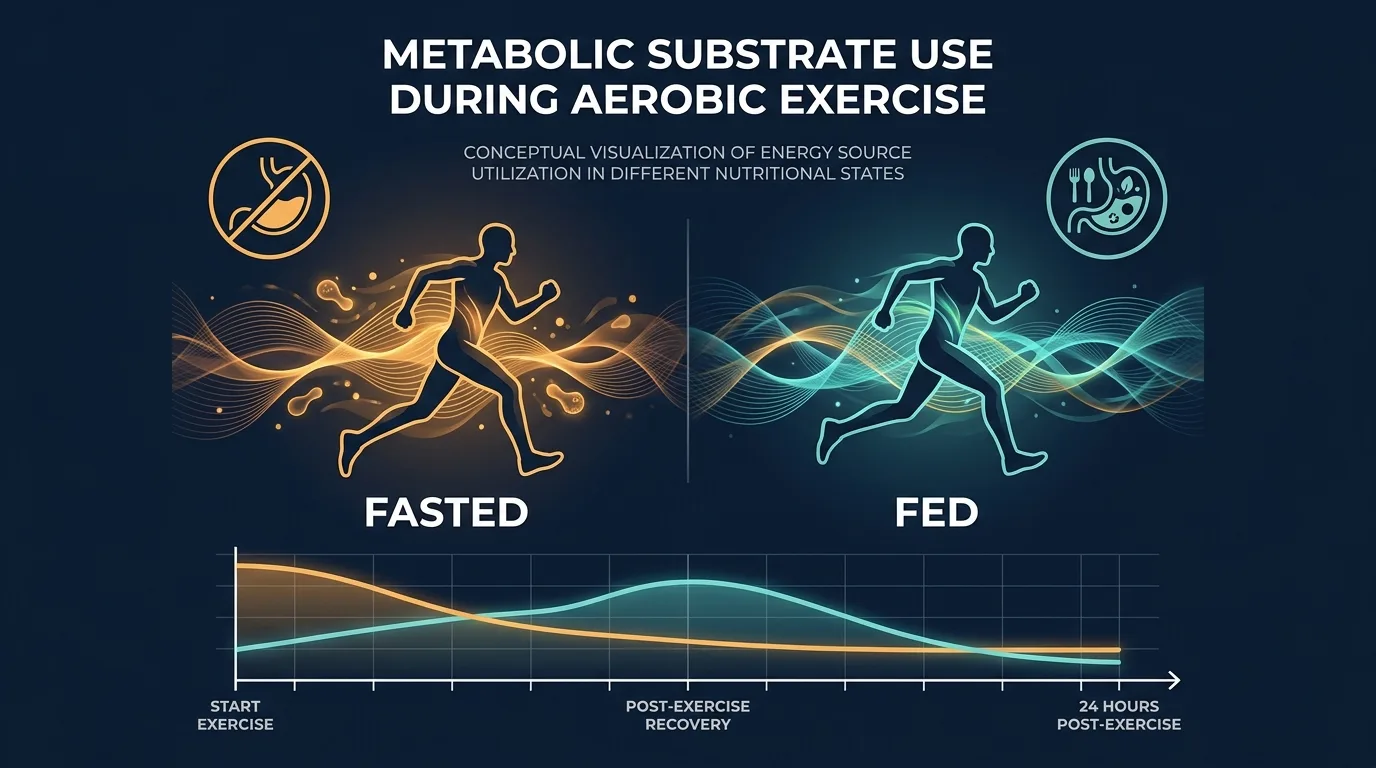
Fasted cardio is one of the most stubborn ideas in fitness. The pitch sounds clean. Train before breakfast, your body cannot pull energy from your last meal, so it has to burn body fat. Twenty years of social-media coaches have repeated some version of this. Twenty years of metabolic research has been chipping away at it. Here is what the studies actually say.
The reason this debate refuses to die is that the acute physiology really does favor fasted exercise. Your body oxidizes more fat per minute when you train before eating. The 2016 meta-analysis by Vieira et al. in the British Journal of Nutrition put a number on it. Pooled across 27 studies and 273 adults, fasted aerobic exercise burned about 3 grams more fat per session than fed exercise. That part is settled.
The bigger question is whether 3 grams of extra in-session fat oxidation actually changes body composition over weeks. Schoenfeld's 4-week trial. Hackett and Hagstrom's meta-analysis. A 2025 randomized trial on fasted resistance training. Three different angles, three answers that point the same way. This article walks through each study, where the marketing claim came from, and what the practical takeaway looks like for someone trying to lose body fat at home.
The Research: What Studies Show
Vieira et al. (2016): The Definitive Acute-Effect Meta-Analysis
Start with the strongest data on the acute side. Vieira and colleagues at the Federal University of Rio Grande do Sul pulled together every randomized or quasi-randomized trial they could find comparing fasted versus fed aerobic exercise in adults. The final sample: 27 studies, 273 participants. The outcome they cared about most was fat oxidation, measured by indirect calorimetry during the exercise bout itself.
The result. Fasted exercise increased fat oxidation by an average of 3.08 grams per session (95% CI -5.38, -0.79). Carbohydrate oxidation went the opposite direction. Train fasted, you burn more fat and less glycogen during the workout. That is a real, replicated finding across two decades of acute-physiology research.
Why this matters less than you would think. Three grams of fat is about 27 kcal. Across a 30 to 45 minute cardio session, the difference between fasted and fed is roughly the same calorie content as a few baby carrots. The acute effect is genuinely there. It is also tiny in the context of a daily energy balance, which is the level at which body composition actually changes.
Citation: Vieira AF, Costa RR, Macedo RCO, Coconcelli L, Kruel LFM. Effects of aerobic exercise performed in fasted v. fed state on fat and carbohydrate metabolism in adults: a systematic review and meta-analysis. British Journal of Nutrition. 2016;116(7):1153-1164.
Schoenfeld et al. (2014): The Body-Composition Test
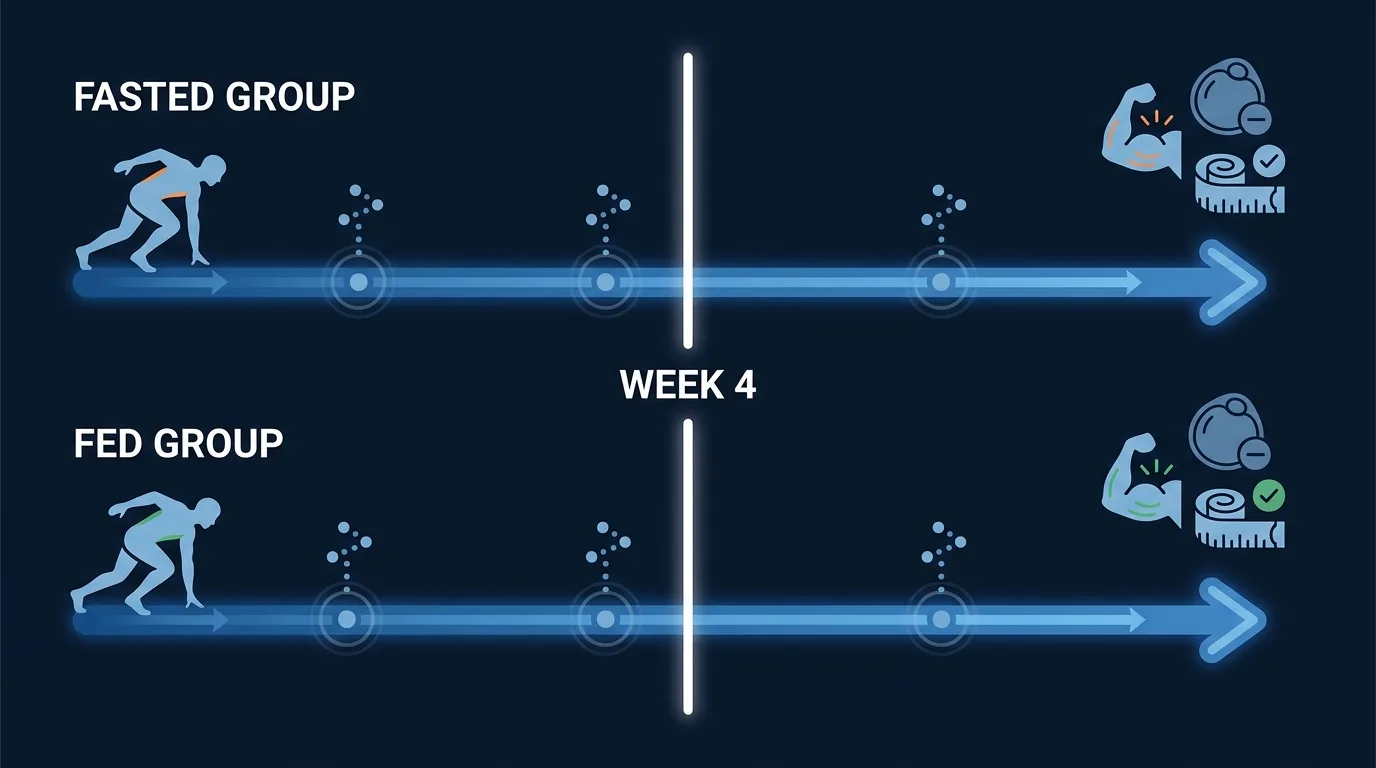
This is the trial that started shifting the conversation. Brad Schoenfeld and colleagues, publishing in the Journal of the International Society of Sports Nutrition, ran a 4-week randomized trial with 20 young women on a hypocaloric diet. Both groups did one hour of steady-state aerobic exercise three days per week. One group ate a meal before training. The other trained fasted. Total daily calories and macronutrients were matched between groups.
After 4 weeks, both groups lost weight and fat mass. Fasted lost about 1.6 kg, fed lost about 1.0 kg. The difference was not statistically significant. Lean mass changes were similar. The metabolic claim that fasted training would unlock extra fat loss did not show up.
The trial was small and short, and the authors flagged both. But it was designed cleanly. Matched calories, matched exercise dose, matched diet composition, randomized assignment, supervised training. The first controlled head-to-head test of the actual fat-loss claim came back negative.
Citation: Schoenfeld BJ, Aragon AA, Wilborn CD, Krieger JW, Sonmez GT. Body composition changes associated with fasted versus non-fasted aerobic exercise. Journal of the International Society of Sports Nutrition. 2014;11:54.
Hackett and Hagstrom (2017): The Meta-Analytic Confirmation
Three years after Schoenfeld, Hackett and Hagstrom at the University of Sydney ran the systematic review focused on body composition specifically. They pulled the available randomized trials of overnight-fasted exercise versus fed exercise, with body mass and body composition as outcomes. Five studies met inclusion. 96 participants total.
The pooled effect on body mass was trivial. Intra-group effect sizes for both fasted and fed conditions on body mass were trivial to small, and the between-group comparison was trivial. The authors flagged the small evidence base and called for more research. But the directional answer matched Schoenfeld. Doing the cardio fasted versus fed did not produce a meaningful body-composition advantage.
This is the pattern when an acute-physiology finding meets a long-term body-composition trial. The acute marker survives. The long-term outcome does not. The body has 24 hours to compensate, and it usually does.
Citation: Hackett DA, Hagstrom AD. Effect of overnight fasted exercise on weight loss and body composition: a systematic review and meta-analysis. Journal of Functional Morphology and Kinesiology. 2017;2(4):43.
Vieira et al. (2025): Fasted Resistance Training Joins the Same Picture
The fasted-cardio question has a strength-training cousin. Same logic, same hopes, same outcome. A 2025 randomized clinical trial in the International Journal of Sport Nutrition and Exercise Metabolism, from the Vieira group again, took healthy adults through 12 weeks of twice-weekly resistance training. One group trained fasted. The other trained after a standardized pre-workout meal.
After 12 weeks, both groups improved muscle hypertrophy (quadriceps thickness), maximum dynamic strength in bench press and knee extension, and muscle power. Group comparisons returned all p-values above 0.05. The authors concluded that fasted or fed status before resistance training did not change the adaptations.
That matters because most fitness coaches recommending fasted cardio also assume the principle generalizes. It does, in the sense that the verdict is the same. Fasted versus fed is not the variable that decides outcomes for either modality. The body-comp picture from Schoenfeld and Hackett extends to muscle and strength outcomes in resistance training.
Citation: Vieira AF, Blanco-Rambo E, Bandeira-Guimarães M, et al. Impact of overnight fasted state versus fed state on adaptations to resistance training: a randomized clinical trial. International Journal of Sport Nutrition and Exercise Metabolism. 2025.
Frampton et al. (2022): The Energy-Compensation Story
One more piece of the puzzle. If the acute fat-oxidation tilt is real but body composition does not shift, something is happening across the rest of the day. Frampton and colleagues at Imperial College published a 2022 network meta-analysis in the International Journal of Obesity looking at how fasted versus fed exercise affects daily energy intake, energy expenditure, and hunger.
Fasted exercise with no post-exercise meal did produce a short-term calorie deficit: about 1,326 kJ lower energy intake within the lab, and 2,095 kJ lower across 24 hours, compared to fed exercise. That sounds promising on paper. But the same fasted-exercise condition also produced lower energy expenditure during the session (about 0.67 kJ per minute), and a 23-mm increase in subjective hunger. So the deficit-on-paper comes packaged with two compensatory pressures: a smaller workout calorie burn, and a stronger pull to eat more later.
In free-living conditions, where nobody is locked in a metabolic ward, hunger usually wins. The 24-hour deficit washes out within a day or two of normal eating. That is the mechanism behind why Schoenfeld and Hackett-Hagstrom keep returning to "no body-composition difference" outcomes despite the in-session fat-oxidation tilt. The body keeps the books, not the workout.
Citation: Frampton J, Edinburgh RM, Ogden HB, Gonzalez JT, Chambers ES. The acute effect of fasted exercise on energy intake, energy expenditure, subjective hunger and gastrointestinal hormone release compared to fed exercise in healthy individuals: a systematic review and network meta-analysis. International Journal of Obesity. 2022;46:255-268.
Why This Matters for Your Fitness
If you have ever skipped a workout because you missed breakfast and assumed it was pointless to train hungry, this research lets you stop doing that. If you have ever forced yourself out the door fasted at 5 AM believing you were unlocking a metabolic advantage, this research lets you stop doing that too. The honest answer is that the timing of your last meal has small acute effects on substrate use, and almost no measurable effect on the body-composition outcomes most people actually care about.
The reason the acute fat-oxidation finding does not translate into long-term fat loss is energy compensation. Across 24 hours, the body adjusts substrate use to match the substrates available. Burn more fat in the morning fasted, you tend to burn slightly more carbs the rest of the day. Burn fewer carbs in the morning fed, you store slightly less of them after meals. The net daily oxidation lines up, regardless of which window the cardio session occupies. Frampton's 2022 meta-analysis added the hunger axis to that picture. Train fasted with no breakfast, you eat slightly less acutely, but you also get hungrier and burn slightly less during the session.
This matches a broader pattern in the timing literature. Most acute-physiology differences between protocols (meal frequency, nutrient timing, training time of day) disappear when you zoom out to weeks of body-composition data. The variables that survive that zoom are total energy balance, total protein, total training volume, and consistency. Those are the ones worth investing willpower in. Related: see our piece on non-exercise activity thermogenesis for the other half of the daily energy-balance equation.
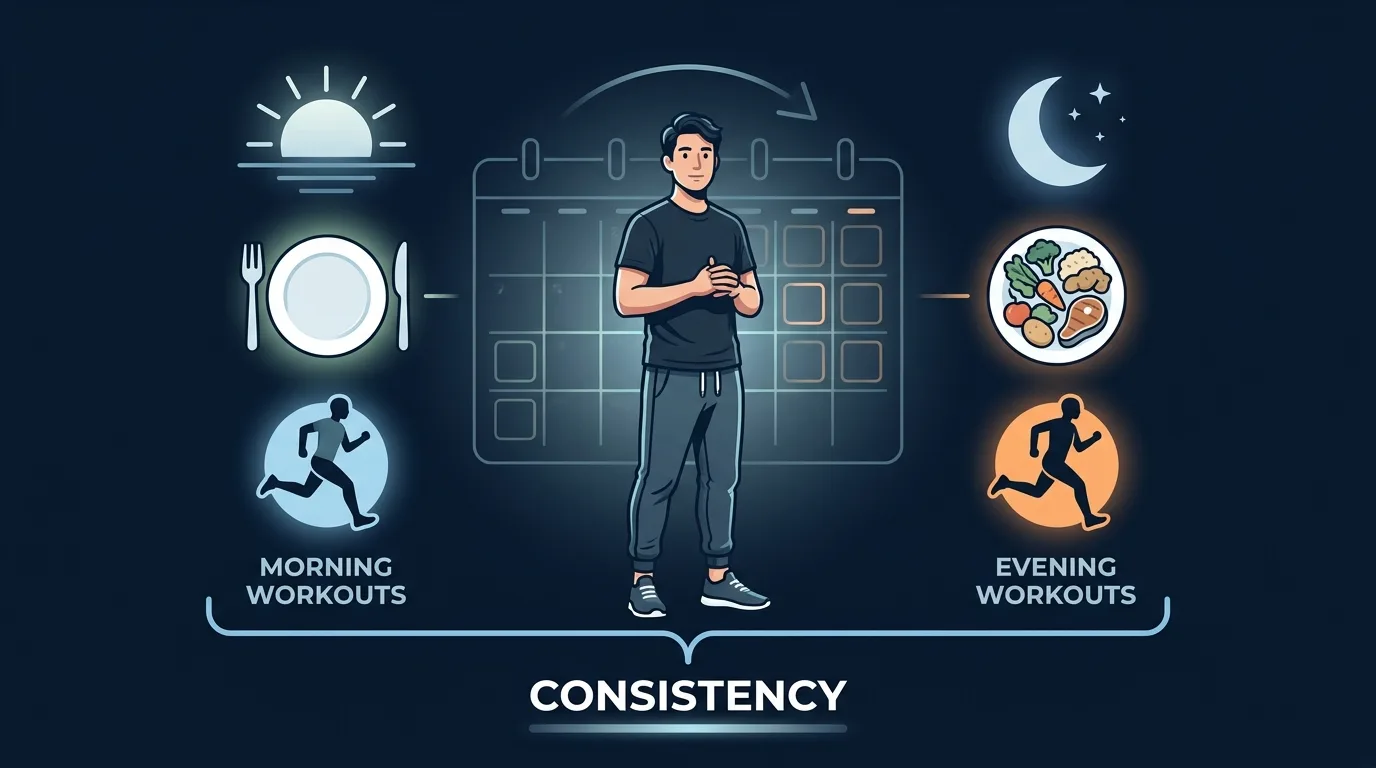
For most people training at home, the practical effect of this is liberating. Train when you actually have the time and the energy. If that is fasted at 6 AM, fine. If that is fed at 7 PM after dinner, fine. The window that matters is the one where you can repeat the workout next week, and the week after.
How to Apply This in Practice
Three working rules, in priority order.
1. Pick the time of day you can train consistently. Adherence beats timing optimization at every time scale. Schoenfeld's group, Hackett and Hagstrom, and the 2025 Vieira RCT all converge on the same idea: the fasted-versus-fed variable is not what is moving the body-composition needle. Pick the slot that you can keep showing up to. Make that the default. The morning workout habit guide covers what tends to work for people who land on an AM slot.
2. Train fasted if you find it comfortable. Train fed if you do not. Some people feel sharper without food in their stomach. Some get lightheaded and cannot push hard. Both responses are individual and consistent within the same person. The acute physiology says either choice is fine. So follow the comfort signal.
3. If your goal is fat loss, focus on total energy balance and total protein, not on when you eat. A 12-week diet that hits a 300 to 500 kcal/day deficit and 1.6 to 2.2 g/kg/day protein is going to produce body-composition change regardless of whether the cardio sessions are fasted. A 12-week diet that does not hit those numbers will not, regardless of whether the cardio is fasted. The macronutrient and total-energy variables dominate.
Two situational notes. If you train for over 90 minutes, especially at higher intensity, fasted is the wrong call. Glycogen runs short, performance drops, and there is solid evidence that pre-workout carbs improve output for longer sessions. If you are diabetic or pre-diabetic, fasted training affects glucose dynamics in ways that need a clinician's input, not a YouTube coach's.
Enjoying the article?
Start a new fitness routine today, written by me and coached by the AI I designed.
Take the Free Assessment Free • 2 minutes • No credit cardCommon Misconceptions
Misconception: "Fasted cardio burns stored body fat directly"
The marketing version sounds compelling. With no food in the stomach, the body "must" burn body fat instead of food. The actual physiology is that the body always burns a mix of fat and carbohydrate. The mix shifts based on intensity, training status, time since the last meal, and fitness level. Fasted training does shift the mix toward more fat oxidation in the session itself. Across the full day the body re-compensates, so the net daily oxidation barely moves. Schoenfeld's 4-week trial is the cleanest direct test of the body-composition implication. The result was negligible.
Misconception: "Eating before cardio cancels the fat-burning effect"
It does cancel the acute fat-oxidation tilt. It does not cancel the workout's effect on fat loss. Calories burned during exercise come from the same body-fat stores eventually, because whatever the workout did not pull from fat directly was pulled from stored or recently-eaten carbohydrate, which then has to be replenished from fat or food. Energy balance does the bookkeeping over the day, not the workout. Two people who burn the same total kcal in a session and eat the same total kcal across the day will have similar fat-loss outcomes, regardless of timing.
Misconception: "You will lose muscle if you train fasted"
The 2025 Vieira RCT put this to rest at the controlled-trial level: 12 weeks of fasted resistance training produced the same hypertrophy and strength gains as fed training. Earlier acute studies showing elevated muscle protein breakdown markers during fasted exercise also showed those markers normalizing rapidly after the post-workout meal. The post-workout protein dose closes the loop. If you do not eat protein for several hours afterward, the picture changes. If you do, fasted training is muscle-neutral.
What the Research Suggests Going Forward
The acute-physiology story is well-established and unlikely to change. Fasted exercise burns slightly more fat per minute during the session. That has been replicated in dozens of trials over two decades. The body-composition story is also well-established directionally. Schoenfeld, Hackett and Hagstrom, the 2025 fasted-resistance-training trial, and the Frampton energy-compensation meta-analysis all point the same direction. No meaningful long-term advantage from training fasted.
What is still being worked out is the population-specific picture. Whether fasted training produces different effects in already-trained athletes versus sedentary beginners, in older adults, in people with metabolic syndrome, or in shift workers. The current evidence base skews young, healthy, and recreationally active. The findings from that population almost certainly hold up directionally for most other groups, but the magnitudes might differ. More trials in clinical and aging populations would help.
For now, the practical message is stable enough to act on. Skip the fasted-cardio optimization. Train when you train. Eat enough protein. Hit a calorie target if you want to lose fat. Those are the variables that move the needle. Related on the same theme: the step-count and longevity literature shows the same pattern, where the round number gets the marketing and the consistency does the actual work.
Honest Limitations
A few caveats worth naming. The body-composition trials are short. Schoenfeld ran 4 weeks. Most others ran 6 to 12. A genuinely large advantage of fasted training would have to be hiding in a longer timeline, which is theoretically possible but unsupported by the gradient pattern in the existing data. Effects do not generally expand over time when they start at zero.
Most trials also used moderate-intensity steady-state cardio. The HIIT-specific picture is sparser, and the acute physiology of HIIT is different enough (higher glycolytic demand, glycogen-dependent) that fasted HIIT is generally a worse idea than fasted steady state. If you do HIIT, eating something simple beforehand likely helps your output and your safety. Performance literature supports that, even when body-composition literature shrugs at meal timing.
And the trials measure protocols, not lifestyles. The intermittent-fasting and time-restricted-eating literatures intersect with this question but are not the same thing. People who naturally eat in a compressed window for years (think 16:8 over a decade) sometimes look metabolically different from short-term fasted-training trial participants. That long-term lifestyle pattern is its own research area, and the conclusions about a single 6 AM fasted run do not automatically generalize from it.
References
- Vieira AF, Costa RR, Macedo RCO, Coconcelli L, Kruel LFM. "Effects of aerobic exercise performed in fasted v. fed state on fat and carbohydrate metabolism in adults: a systematic review and meta-analysis." British Journal of Nutrition 116.7 (2016): 1153-1164. doi:10.1017/S0007114516003160
- Schoenfeld BJ, Aragon AA, Wilborn CD, Krieger JW, Sonmez GT. "Body composition changes associated with fasted versus non-fasted aerobic exercise." Journal of the International Society of Sports Nutrition 11 (2014): 54. doi:10.1186/s12970-014-0054-7
- Hackett DA, Hagstrom AD. "Effect of overnight fasted exercise on weight loss and body composition: a systematic review and meta-analysis." Journal of Functional Morphology and Kinesiology 2.4 (2017): 43. doi:10.3390/jfmk2040043
- Vieira AF, Blanco-Rambo E, Bandeira-Guimarães M, et al. "Impact of overnight fasted state versus fed state on adaptations to resistance training: a randomized clinical trial." International Journal of Sport Nutrition and Exercise Metabolism (2025). doi:10.1123/ijsnem.2024-0215
- Frampton J, Edinburgh RM, Ogden HB, Gonzalez JT, Chambers ES. "The acute effect of fasted exercise on energy intake, energy expenditure, subjective hunger and gastrointestinal hormone release compared to fed exercise in healthy individuals: a systematic review and network meta-analysis." International Journal of Obesity 46 (2022): 255-268. doi:10.1038/s41366-021-00993-1
Frequently Asked Questions
Does fasted cardio burn more fat?
During the session, yes. Across the day or the week, basically no. Vieira et al.'s 2016 meta-analysis of 27 studies and 273 participants in the British Journal of Nutrition found that fasted aerobic exercise increased in-session fat oxidation by about 3 grams (95% CI -5.38, -0.79), roughly 27 kcal. Schoenfeld et al.'s 2014 trial of 20 women in the Journal of the International Society of Sports Nutrition showed that this acute fat-oxidation tilt did not translate into greater body-fat loss over 4 weeks. The body re-equilibrates substrate use across 24 hours.
Is fasted cardio better for weight loss?
The body-composition evidence says no. Hackett and Hagstrom's 2017 meta-analysis in the Journal of Functional Morphology and Kinesiology pooled five trials with 96 total participants and found trivial between-group effects on body mass for fasted versus fed exercise. Total energy balance and total protein intake are the variables that move body composition. Whether the cardio happens fasted or fed is not.
Will I lose muscle if I train fasted?
Probably not, as long as you eat enough protein across the day. The 2025 Vieira et al. randomized clinical trial in the International Journal of Sport Nutrition and Exercise Metabolism ran 12 weeks of twice-weekly fasted versus fed resistance training. Both groups produced comparable muscle hypertrophy (quadriceps thickness) and strength gains, with all between-group p-values above 0.05. Earlier acute studies showed elevated muscle protein breakdown markers during fasted sessions, and those normalized rapidly with the post-workout meal.
Should I eat before HIIT or a long workout?
For sessions over 60 to 90 minutes, or for high-intensity interval work, yes. HIIT depends on glycogen, which runs short in the fasted state. Performance drops, and the safety margin shrinks. For under-an-hour steady-state cardio, fasted or fed is a comfort call. Pick whichever lets you train consistently. For more on getting consistent without overthinking the variables, see consistency, not intensity.
Does FitCraft schedule fasted workouts?
FitCraft programs the workout, not your meal timing. You can run any program fasted or fed based on your routine and comfort. The app's job is to keep the workouts adaptive to your progress and to make consistency easier with gamification and the AI coach Ty's in-workout guidance. The free FitCraft assessment matches you to a program built for your fitness level, equipment, and schedule.