Walk into any gym and you'll hear the same advice. Lift heavy. Go big. If the weight isn't intimidating, you're wasting your time. It's a tidy story. It's also wrong, at least for one of the two outcomes most people are after.
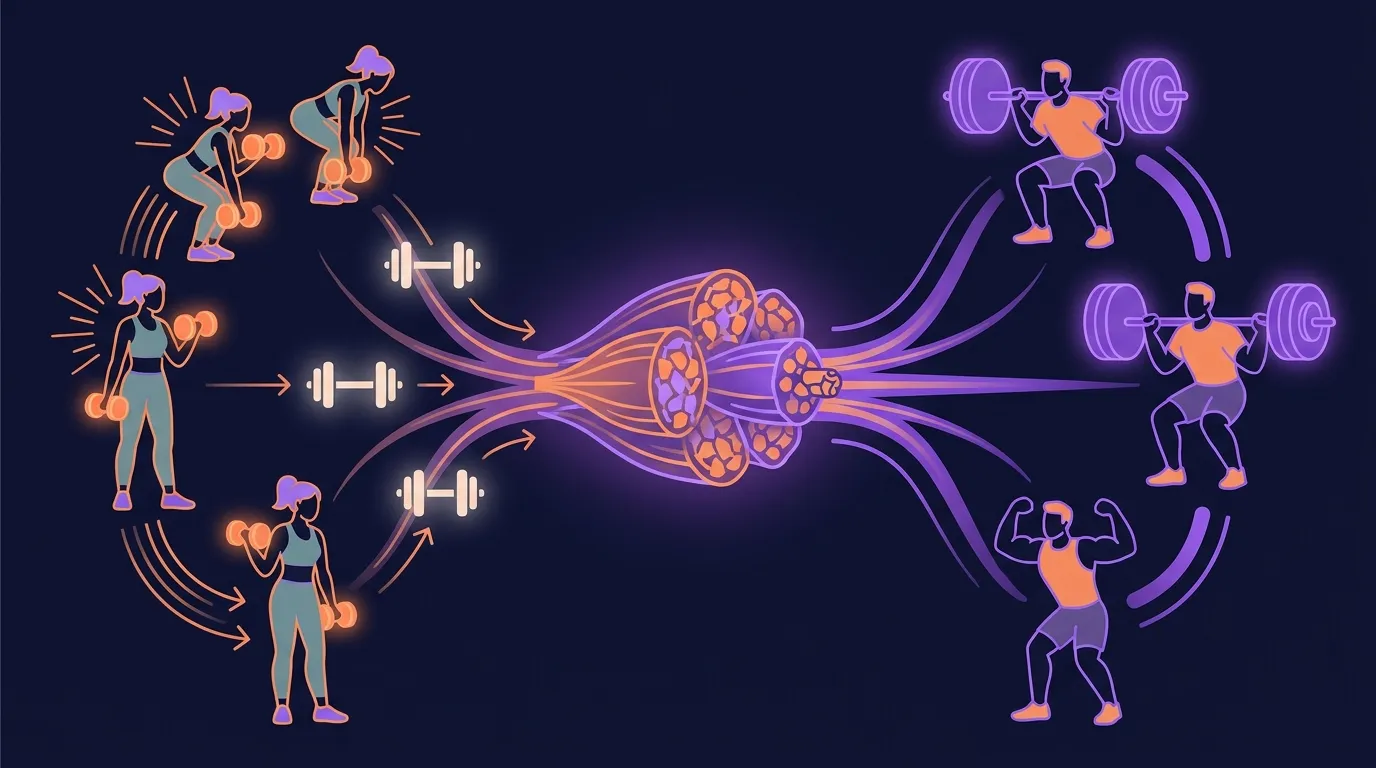
The research on training load has been remarkably consistent for nearly a decade. Light weights and heavy weights produce roughly equal muscle growth when both are taken close to failure. That finding has been replicated across meta-analyses, controlled trials in trained populations, and direct head-to-head comparisons with volume matched. The gym wisdom is half right. Heavy loads do still own one outcome: maximal strength. But muscle size, the goal that most home exercisers and casual lifters actually care about, is far more democratic than most people think.
Below is what the research actually says, where the boundaries are, and how to apply it whether you train with dumbbells in your living room or under a barbell. We'll also connect this to the broader literature on minimum effective doses and bodyweight training outcomes, because the same principle keeps showing up: effort is the master variable.
The Research: What Studies Show
Schoenfeld 2017: 21 Studies, One Conclusion
The most comprehensive analysis on this question came from Schoenfeld, Grgic, Ogborn, and Krieger (2017) in the Journal of Strength and Conditioning Research. They pooled 21 studies that compared low-load training (defined as 60% of one-rep max or less) to high-load training (more than 60% of one-rep max), all with sets taken to momentary muscular failure and lasting at least six weeks.
The hypertrophy result was striking. The effect size difference between high and low loads was 0.03, with a 95% confidence interval ranging from -0.16 to 0.22. In plain English: the difference was so small it was statistically indistinguishable from zero, and the confidence band was tight enough to rule out any meaningful advantage in either direction. Whole-muscle growth was the same.
Strength was a different story. For one-rep max performance, heavier loads showed a clear and reliable advantage (p = 0.003). The reason makes sense if you think about it: lifting near your max is a skill, and the best way to get better at lifting near your max is to practice lifting near your max. Specificity matters more for strength than for size.
Morton 2016: Trained Lifters, 12 Weeks, No Difference
Morton et al. (2016) in Journal of Applied Physiology ran a 12-week training study with 49 resistance-trained young men. One group did 8 to 12 reps at 75 to 90% 1RM. The other did 20 to 25 reps at 30 to 50% 1RM. Both groups trained four times a week. Both took every set to volitional failure.
At the end of 12 weeks, muscle growth was equivalent between groups. Type I and Type II fiber cross-sectional area, lean body mass, and arm and leg muscle thickness all increased similarly. The authors went further: they measured testosterone, growth hormone, IGF-1, and cortisol, and found that the post-exercise hormonal milieu didn't predict who built muscle either. Their conclusion was direct. Load doesn't determine hypertrophy. Hormones don't determine hypertrophy. Volume taken to failure does.
This was particularly notable because the participants weren't beginners. Beginner gains can mask differences between protocols. The fact that trained lifters showed equivalent growth from very different load schemes was strong evidence that the principle holds across training experience levels.
Lasevicius 2018: Where the Floor Is
Lasevicius and colleagues (2018) tested four different intensities (20, 40, 60, and 80% 1RM) over 12 weeks of leg extension and bicep curl training. Volume was equated across all groups.
Three of the four intensities produced similar muscle growth: 40, 60, and 80% 1RM all worked roughly the same. But 20% 1RM lagged. It still produced gains, just smaller ones than the other three groups. The authors interpreted this as evidence of a lower threshold below which the stimulus weakens, even with matched volume.
Why might that be? At very low loads, the proportion of motor units recruited stays low for most of the set. Only as fatigue accumulates near the end of a long set do the high-threshold motor units finally fire. With 20% 1RM, you might need 40 or 50 reps to actually push close to failure, and the practical reality is that few sets get that close in real-world training. The floor isn't theoretical. It's about what people actually do.
Lasevicius 2022: With Light Loads, Failure Is Mandatory
The same group followed up with Lasevicius et al. (2022) in J Strength Cond Res. This one tested whether failure mattered differently for high and low loads. Four groups: low load to failure, low load not to failure, high load to failure, and high load not to failure. Eight weeks of leg extensions and bicep curls.
The high-load groups produced similar hypertrophy whether they trained to failure or stopped short. Effort flexibility was high. But the low-load groups split sharply. The low-load failure group matched the high-load groups on growth. The low-load non-failure group fell behind.
The takeaway is operational, not just academic. If you're training with heavy weights, you have some margin. Stopping a rep or two short of failure doesn't cost you much hypertrophy. With light weights, that margin disappears. You either push close to failure or you leave most of the growth signal on the table.
Why This Matters for Your Training
If you've been told that you need a barbell or a stack of plates to build "real" muscle, the research disagrees. So does plenty of anecdotal evidence from gymnasts, calisthenics athletes, and people who got jacked working out at home during 2020. What was missing for years was the controlled data to back it up. Now we have it.
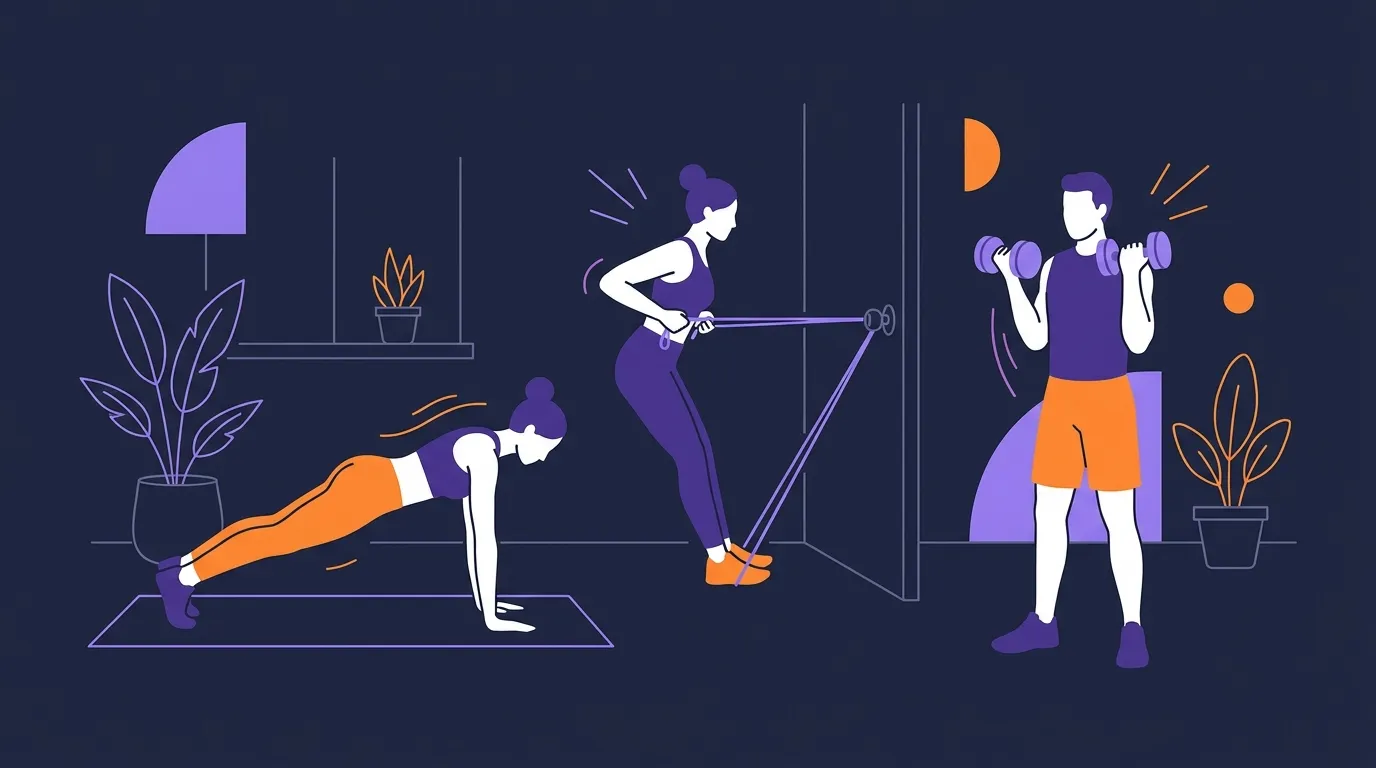
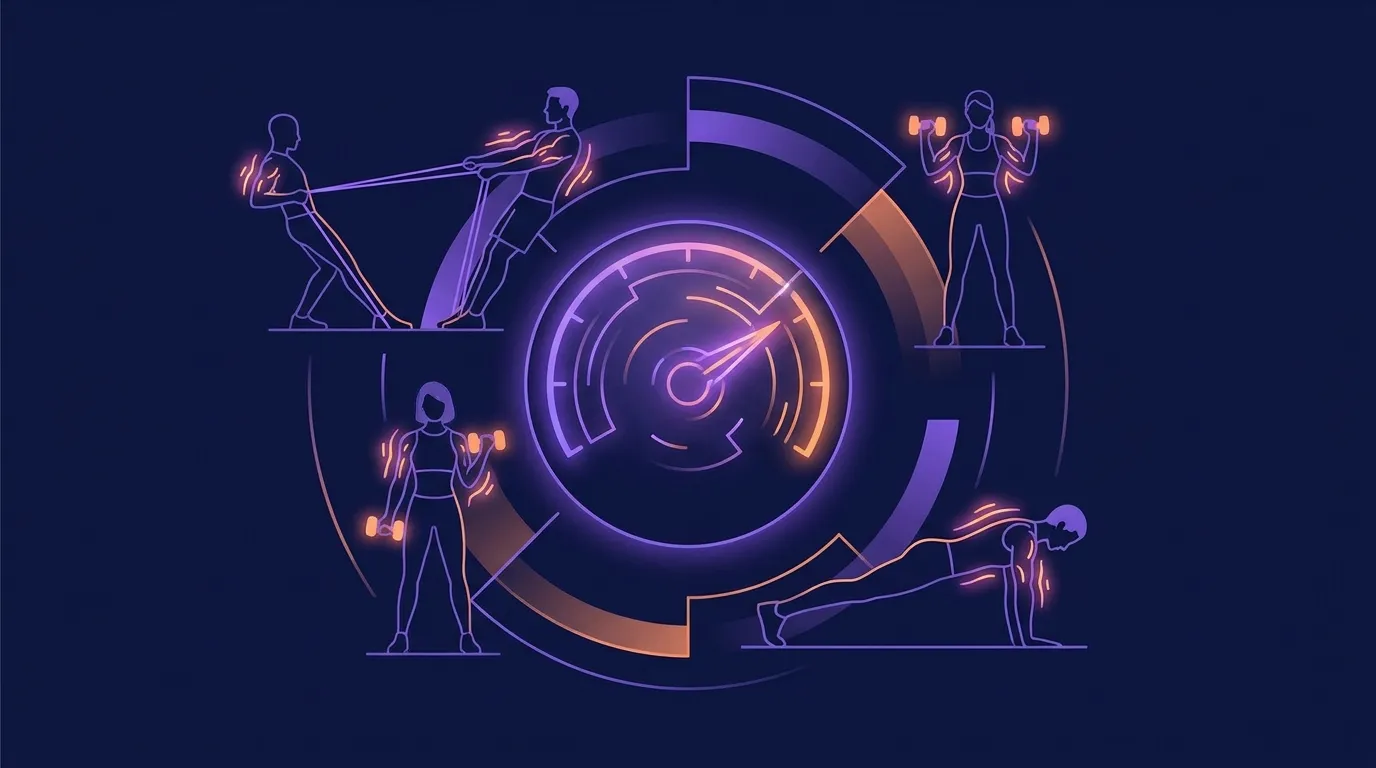
The practical implications are big for anyone who trains at home. Resistance bands, light dumbbells, suspension trainers, bodyweight progressions: all of these can drive hypertrophy comparable to a fully equipped gym, on one condition. You have to push close to failure on each working set. That's the cost of using lighter loads. The reps go up, the discomfort lasts longer, the burn is real. But the muscle adaptation is there. If you are starting from scratch, our roundup of the best dumbbell exercises for beginners shows which movements to build around.
This is also why the research on bodyweight training consistently shows hypertrophy outcomes that surprise people. Push-ups, pull-ups, dips, single-leg squats. None of these involve a barbell. All of them, when programmed to take sets close to failure with progressive variations, build muscle that looks identical to weight-room muscle, because it is identical.
How Light-Load Training Works in Practice
Knowing the research is one thing. Translating it into a workout you actually do is another. Here's how to apply the load-effort principle.
Match Reps to the Load
Lower loads need higher rep counts to reach the failure threshold. Use this rough mapping:
- 30 to 40% 1RM: 25 to 35 reps to failure. Long, uncomfortable sets. Suitable for finisher work or accessory exercises.
- 40 to 60% 1RM: 15 to 25 reps to failure. The sweet spot for most home training with bands and light dumbbells.
- 60 to 80% 1RM: 8 to 15 reps to failure or 1 to 3 reps shy of it. Classic hypertrophy zone.
- 80%+ 1RM: 1 to 6 reps. Best for strength specificity rather than maximum hypertrophy.
Most people training at home will live in the 40 to 60% range whether they realize it or not. That's fine. The hypertrophy literature says it works, just expect higher rep counts.
Track Effort, Not Just Reps
The single most important variable in light-load training is effort. Reps in reserve (RIR) is a useful concept here. After a set, ask yourself: how many more reps could I have done with good form? If the answer is "three or more," the set was too easy. Aim for 0 to 1 RIR on most sets, and a few sets per week genuinely to failure (zero reps left).
This is harder than it sounds. People consistently overestimate their RIR. Studies on resistance-trained populations have shown that experienced lifters often think they have 1 RIR when they actually have 3 or 4. With light loads, that gap is the difference between hypertrophy and a tiring set that built nothing measurable.
Progress the Variation, Not Just the Load
If you train with bodyweight or limited equipment, you can't always add five pounds. So you progress the exercise itself. A standard push-up too easy? Switch to decline push-ups, then archer push-ups, then one-arm progressions. Bodyweight squats too easy? Move to single-leg variations. The goal is the same: keep each working set within a few reps of failure. The vehicle for getting there is exercise variation, not load.
This is also where eccentric emphasis can help. We covered the eccentric training research in detail elsewhere. Slowing the lowering phase to 3 to 5 seconds increases time under tension and brings any exercise closer to failure without changing the load.
Enjoying the article?
Start a new fitness routine today, written by me and coached by the AI I designed.
Take the Free Assessment Free • 2 minutes • No credit cardCommon Misconceptions
Misconception: "You need to lift heavy or you're wasting your time"
The most repeated piece of fitness folklore. The Schoenfeld 2017 meta-analysis settled it for hypertrophy. Twenty-one studies, no significant difference between low and high loads when sets are taken close to failure. The confidence interval was tight. The sample was large. There is no scientific basis for the claim that light loads are useless for muscle growth.
Where the claim has a kernel of truth: heavy loads do produce greater one-rep max gains. So if your goal is strictly to lift the heaviest single rep possible, train heavy. If your goal is muscle size, looking more athletic, or building tissue that resists age-related loss, load is far less important than effort.
Misconception: "Light weights only build endurance, not muscle"
This belief comes from the older idea that different rep ranges target different "training zones": 1 to 5 for strength, 6 to 12 for hypertrophy, 12+ for endurance. The Schoenfeld and Morton data don't support that boxed view. Higher rep ranges build muscle just fine, provided the sets are hard enough.
Local muscular endurance (the ability to perform many repetitions of a submaximal load) does improve more with high-rep training. But that's an addition to hypertrophy, not a substitute for it. You don't trade muscle growth for endurance. You get both.
Misconception: "Bodyweight exercises don't build real muscle"
Bodyweight exercises are simply low-load resistance training. Push-ups load you with a fraction of your bodyweight. Pull-ups load you with most of your bodyweight. The same load-effort principle applies. Take the set close to failure, and the hypertrophy stimulus is there. Stop ten reps short, and it isn't.
The progression challenge is real. Once standard push-ups become easy, you stop pushing close to failure unless you change the exercise. So you scale up: decline, archer, pseudo-planche, one-arm progressions. The load-effort principle is the same. Only the implementation gets more creative.
What the Research Suggests Going Forward
The picture from the last decade of research is consistent enough to act on, but a few caveats are worth holding.
First, the floor matters. Below roughly 30% of one-rep max, the equivalence breaks down even when volume is matched. So extremely light loads (think 1-pound dumbbells for a healthy adult) probably won't produce serious hypertrophy regardless of how many reps you do. There's a minimum tension threshold the research keeps pointing toward.
Second, individual response varies. The meta-analyses describe averages across populations. Some lifters seem to respond better to heavier loads, others thrive on higher reps. If you've been training a while and one approach has worked well for you, the data doesn't say switch. It says either approach can work.
Third, this is hypertrophy and basic strength. The research doesn't directly address other goals: power output, sport-specific performance, joint health, longevity. Some of those goals favor heavier loads (power, peak strength). Some favor lighter loads (joint-sparing volume, recovery between sessions). Match the protocol to the goal.
And finally, the 2021 review by Schoenfeld, Grgic, Van Every, and Plotkin in Sports reframed the entire repetition continuum. The old idea that strength, hypertrophy, and endurance live in tidy rep ranges (1-5, 6-12, 12+) is outdated. The continuum is fuzzier and effort matters more than the boxes suggest.
How FitCraft Applies This Research
FitCraft's workout programming is built around the load-effort principle:
- Workouts adapt to your equipment. Whether you have a full home gym, a single resistance band, or just bodyweight, the workouts use loads and rep ranges matched to that equipment. The science says all of these can work, so the app doesn't gatekeep based on what you own.
- Adaptive progression matches the failure threshold. As you advance, FitCraft's adaptive workout system steps you through harder variations and rep schemes. The point is to keep working sets near the failure threshold, which is where hypertrophy lives in the research.
- Ty, the 3D AI coach, demonstrates and motivates. Ty isn't a chatbot or a stat algorithm. He's a 3D character who shows you the exercise, motivates you by name, and keeps you focused during the harder rep ranges that light-load training requires. Pushing close to failure is uncomfortable. Having a coach in the room makes it easier to do.
- Multi-week programs with built-in variation. FitCraft programs (the in-app term for structured plans) progress you through bodyweight, band, and dumbbell options as you advance, with progressive overload built into every session.
The point of the research isn't that one protocol is best. It's that more protocols work than people have been told. If you've been avoiding fitness because you don't have the equipment for "real" training, the science says you're wrong. The equipment is enough. The effort is the part that has to be there.
References
- Schoenfeld BJ, Grgic J, Ogborn D, Krieger JW. "Strength and Hypertrophy Adaptations Between Low- vs. High-Load Resistance Training: A Systematic Review and Meta-Analysis." J Strength Cond Res. 2017;31(12):3508-3523. doi:10.1519/JSC.0000000000002200
- Morton RW, Oikawa SY, Wavell CG, et al. "Neither load nor systemic hormones determine resistance training-mediated hypertrophy or strength gains in resistance-trained young men." J Appl Physiol. 2016;121(1):129-138. doi:10.1152/japplphysiol.00154.2016
- Lasevicius T, Ugrinowitsch C, Schoenfeld BJ, et al. "Effects of different intensities of resistance training with equated volume load on muscle strength and hypertrophy." Eur J Sport Sci. 2018;18(6):772-780. doi:10.1080/17461391.2018.1450898
- Lasevicius T, Schoenfeld BJ, Silva-Batista C, et al. "Muscle Failure Promotes Greater Muscle Hypertrophy in Low-Load but Not in High-Load Resistance Training." J Strength Cond Res. 2022;36(2):346-351. doi:10.1519/JSC.0000000000003454
- Schoenfeld BJ, Grgic J, Van Every DW, Plotkin DL. "Loading Recommendations for Muscle Strength, Hypertrophy, and Local Endurance: A Re-Examination of the Repetition Continuum." Sports. 2021;9(2):32. doi:10.3390/sports9020032
Frequently Asked Questions
Can you build muscle with light weights?
Yes. A 2017 meta-analysis by Schoenfeld and colleagues pooling 21 studies found no statistically significant difference in muscle growth between low-load training (under 60% of one-rep max) and high-load training (over 60%) when sets were taken to volitional failure. The effect size difference was 0.03 with narrow confidence intervals, meaning loading is not a meaningful variable for hypertrophy on its own. The catch: low-load sets must reach a high level of effort, typically the last 1 to 3 reps before failure.
Do light weights build the same strength as heavy weights?
No. The same Schoenfeld 2017 meta-analysis found a clear advantage for heavy loads on one-rep max strength (p = 0.003). Strength is more specific to the load you train with. If your goal is to lift heavier objects, heavier training loads transfer better. If your goal is bigger or more muscular looking limbs, the load matters far less than how hard you push each set.
How close to failure do light weight sets need to be?
Very close. Lasevicius and colleagues (2022) compared low-load groups training to failure versus stopping short of failure, and only the to-failure group matched the hypertrophy of the heavy-load group. For high loads (over 60% of one-rep max), training to failure was not necessary. Practical rule: with light weights, push every set until you cannot complete another rep with good form, or until you have one rep left in the tank.
How light is too light to build muscle?
The lower bound is somewhere around 30% of one-rep max for most studies. Lasevicius (2018) found that 20% of one-rep max produced less muscle growth than 40, 60, or 80%, even with volume matched. Extremely light loads still work but with diminishing returns. The sweet spot for low-load training is roughly 30 to 60% of your one-rep max, which corresponds to sets of about 15 to 30 reps taken to failure.
Can bodyweight exercises build real muscle?
Yes. Bodyweight exercises behave like low-load training. As long as the set ends near failure, the hypertrophy stimulus is comparable to weighted training. The challenge is progression: once an exercise becomes too easy, you need a harder variation, more reps, slower tempo, or a unilateral progression to keep sets near the failure threshold. FitCraft's adaptive workouts handle that progression automatically by stepping you through harder variations as you advance.