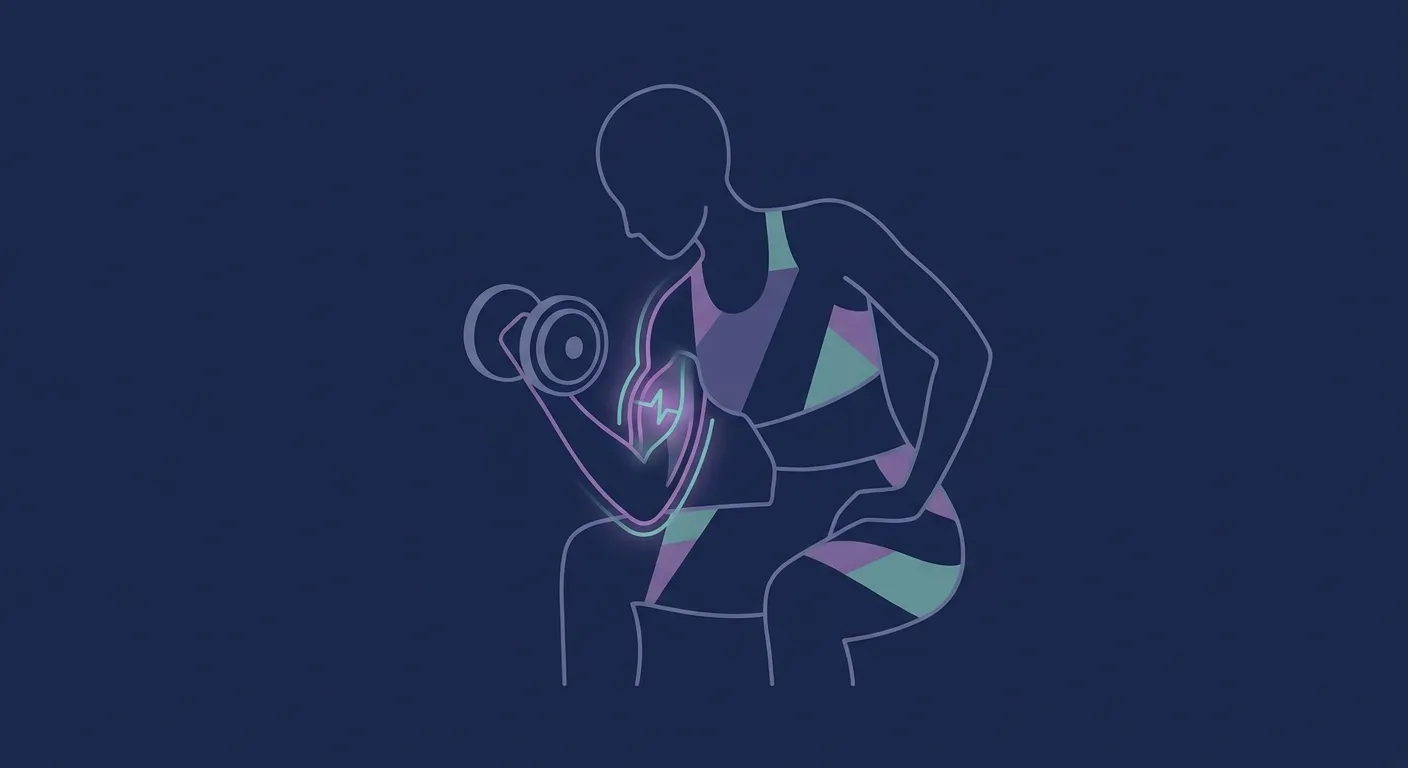
You've probably heard this cue a hundred times. "Squeeze the muscle." "Feel the contraction." "Don't just move the weight, make the muscle do the work." It's one of those gym truths that sounds like bro science. The kind of advice that gets passed around locker rooms alongside tips about anabolic windows and exactly 8 reps per set.
But here's the thing: this one actually holds up. And we have a proper randomized controlled trial to prove it.
In 2018, Brad Schoenfeld and his team published a study that put the mind-muscle connection through the kind of rigorous testing that most gym advice never gets. They took 30 untrained men, split them into two groups, had both groups do the exact same exercises with the exact same weight for 8 weeks. The only difference was a single instruction. One group was told to focus on squeezing the target muscle. The other was told to focus on getting the weight from point A to point B.
The results were clear, surprising, and a little complicated. Let's break them down.
The Schoenfeld 2018 Study: What They Did
The study was published in the European Journal of Sport Science and titled "Differential effects of attentional focus strategies during long-term resistance training." That's academic speak for: does it matter what you think about while lifting?
Here's how the study worked:
- 30 untrained college-age men were randomly assigned to either an internal focus group or an external focus group
- Both groups trained 3 days per week for 8 weeks
- Exercises included bicep curls and leg extensions among other movements
- Both groups used the same load: 4 sets of 8-12 reps
- The only variable was the attentional cue. The internal group was told to "squeeze the muscle." The external group was told to "get the weight up"
- Muscle thickness was measured via ultrasound at the elbow flexors (biceps area) and quadriceps
This is exactly the kind of study design you want when testing a single variable. Same participants, same program, same loads, same duration. The only thing that changed was what they focused on during each rep.
The Results: 12.4% vs 6.9%
The internal focus group saw 12.4% growth in elbow flexor thickness over 8 weeks. The external focus group saw 6.9%.
Read that again. Same exercise. Same weight. Same number of sets and reps. Same training frequency. The only difference was a verbal instruction before each set, and it nearly doubled the muscle growth in the biceps.
That's a huge effect from something that costs nothing, takes no extra time, and requires no special equipment. You're literally just thinking differently during the exact same workout.
But before you start squeezing your way through every exercise in every workout, here's the part most people skip.
It Didn't Work for the Quads
The same study measured quadriceps growth. Both groups gained roughly the same amount. The internal focus advantage that showed up so clearly in the biceps? Gone. Vanished. No significant difference.
This isn't a minor footnote. It's the most important finding in the study, because it tells us where the mind-muscle connection works and where it doesn't.
Why Biceps but Not Quads? The Isolation Factor
The researchers had a solid explanation for this discrepancy, and follow-up research has backed it up.
A bicep curl is about as simple as resistance exercises get. Single joint. One primary mover. Short range of motion. You can direct 100% of your conscious attention to the biceps because there's not much else competing for that attention.
A leg extension (or a squat, or a lunge) is fundamentally different. Your quads, hamstrings, glutes, and stabilizers are all firing. The movement involves a larger muscle mass, a bigger joint, and more complex motor patterns. When your brain is busy coordinating all of that, there's less cognitive bandwidth left over for "squeeze the quad."
Think of it this way. If someone asks you to wiggle your index finger, you can do it instantly with perfect control. If they ask you to wiggle your fourth toe, you'll probably move all your toes. Your brain has finer motor control over some muscles than others, and that control matters for internal focus.

Corroborating Evidence: Three More Studies That Back This Up
The Schoenfeld 2018 study didn't land in a vacuum. Several other studies have tested similar questions, and the picture they paint together is consistent.
Calatayud et al. (2016): The Load Threshold
This study, published in the European Journal of Sport Science, had 18 resistance-trained men perform bench press at loads ranging from 20% to 80% of their one-rep max. Some sets were done with internal focus ("squeeze your chest"), others with external focus ("push the bar up").
The result: internal focus significantly increased pectoral activation at loads between 20-60% of 1RM. But at 80% of 1RM, the effect disappeared. When the weight is heavy enough, your body recruits everything it has regardless of what you're thinking about. Your nervous system doesn't care about your mental cue when it's fighting to complete the rep.
This aligns perfectly with the Schoenfeld findings and adds an important nuance. The mind-muscle connection isn't just exercise-specific. It's load-specific too.
Citation: Calatayud J, Vinstrup J, Jakobsen MD, et al. Importance of mind-muscle connection during progressive resistance training. Eur J Appl Physiol. 2016;116(3):527-533.
Snyder & Fry (2012): Selective Muscle Activation
Working with Division III football players, Snyder and Fry found that verbal instructions to "focus on your chest" during bench press at 50% 1RM increased pectoral EMG activity by 22%. When they switched the cue to "focus on your triceps," chest activity dropped back to baseline while triceps activity jumped by 26%.
This is remarkable. With nothing more than a spoken instruction, trained athletes could selectively increase activation in a specific muscle by over 20%. And when they shifted focus to a different muscle in the same exercise, the activation shifted too. Your brain has that level of control over which muscles engage and how hard they fire.
Citation: Snyder BJ, Fry WR. Effect of verbal instruction on muscle activity during the bench press exercise. J Strength Cond Res. 2012;26(9):2394-2400.
Schoenfeld & Contreras (2016): The Theoretical Framework
Before running the 2018 RCT, Schoenfeld co-authored a review in the Strength and Conditioning Journal laying out the theoretical case for why internal focus should affect hypertrophy. The argument goes like this: if you can increase activation of a target muscle during a given exercise (which EMG studies consistently show), and if greater muscle activation correlates with greater mechanical tension on that muscle (which physiology says it does), then over weeks and months, internal focus should produce more growth in the targeted muscle.
The 2018 RCT confirmed this theoretical prediction for upper body isolation exercises.
Citation: Schoenfeld BJ, Contreras B. Attentional Focus for Maximizing Muscle Development: The Mind-Muscle Connection. Strength Cond J. 2016;38(1):27-29.
FitCraft's AI coach Ty cues you to squeeze the right muscles
Ty gives you real-time focus cues during every rep, turning the mind-muscle connection from gym lore into something you actually do consistently.
Try It Free Free · 2 minutes · No credit cardPractical Rules: When to Use Internal Focus (and When Not To)
Putting all this research together, here's a clear framework for applying the mind-muscle connection in your training.
Use Internal Focus When:
- You're doing isolation exercises. Bicep curls, tricep pushdowns, lateral raises, leg curls, calf raises, flyes. Single-joint movements where one muscle does the bulk of the work are the sweet spot.
- You're using moderate weight. The research shows internal focus works at loads up to roughly 60% of your max. If you can do 12+ reps, you're in the right range.
- You're training for muscle growth. If hypertrophy is the goal, internal focus gives you a meaningful edge on isolation work for zero extra cost.
- You're warming up. Lower-weight warm-up sets are a perfect time to practice feeling the target muscle. It primes the neural pathways before your working sets.
Skip Internal Focus When:
- You're lifting heavy. At 80%+ of your max, the Calatayud data says it doesn't make a difference anyway. Focus on completing the lift safely.
- You're doing heavy compound lifts. During a heavy squat or deadlift, your attention belongs on bracing, balance, and movement execution. Trying to "squeeze your quads" during a max-effort squat is a distraction at best and a safety risk at worst.
- You're training for power or speed. Explosive movements like cleans, jumps, and throws benefit from an external focus ("drive the ground away," "throw the bar to the ceiling"). External focus consistently improves force production and movement speed in the motor learning literature.
- You're a complete beginner learning a new movement. Learn the movement pattern first. Add the internal focus once the exercise feels familiar.
What This Means for Your Training (and What It Doesn't)
It's tempting to overstate these findings. The mind-muscle connection isn't a magic trick that doubles all your gains overnight. Here's what the research actually supports and where you should pump the brakes.
What It Supports
Internal focus during isolation exercises at moderate loads produces meaningfully more hypertrophy in the target muscle. The Schoenfeld data shows roughly 80% more growth in the biceps. Even if we're conservative and assume real-world effects are smaller than controlled study effects (which they usually are), that's still a substantial difference from something that takes zero extra time or effort.
The mechanism is well-established. Internal focus increases EMG activation in the target muscle. More activation means more mechanical tension. More mechanical tension, accumulated over weeks, means more growth. The logic chain is clean and the evidence at each step is solid.
Where to Pump the Brakes
The original study used untrained men. We don't know for certain that the same magnitude of effect holds for experienced lifters, though the Calatayud and Snyder data with trained participants suggest the activation boost is real at any experience level.
The study ran for 8 weeks. That's long enough to see real hypertrophy, but we don't have data on whether the advantage compounds, plateaus, or shrinks over 6 or 12 months of training.
And the finding that internal focus didn't help quad growth is important. It means this technique has limits. It's a tool, not a universal solution. You can't think your way to bigger legs during squats.
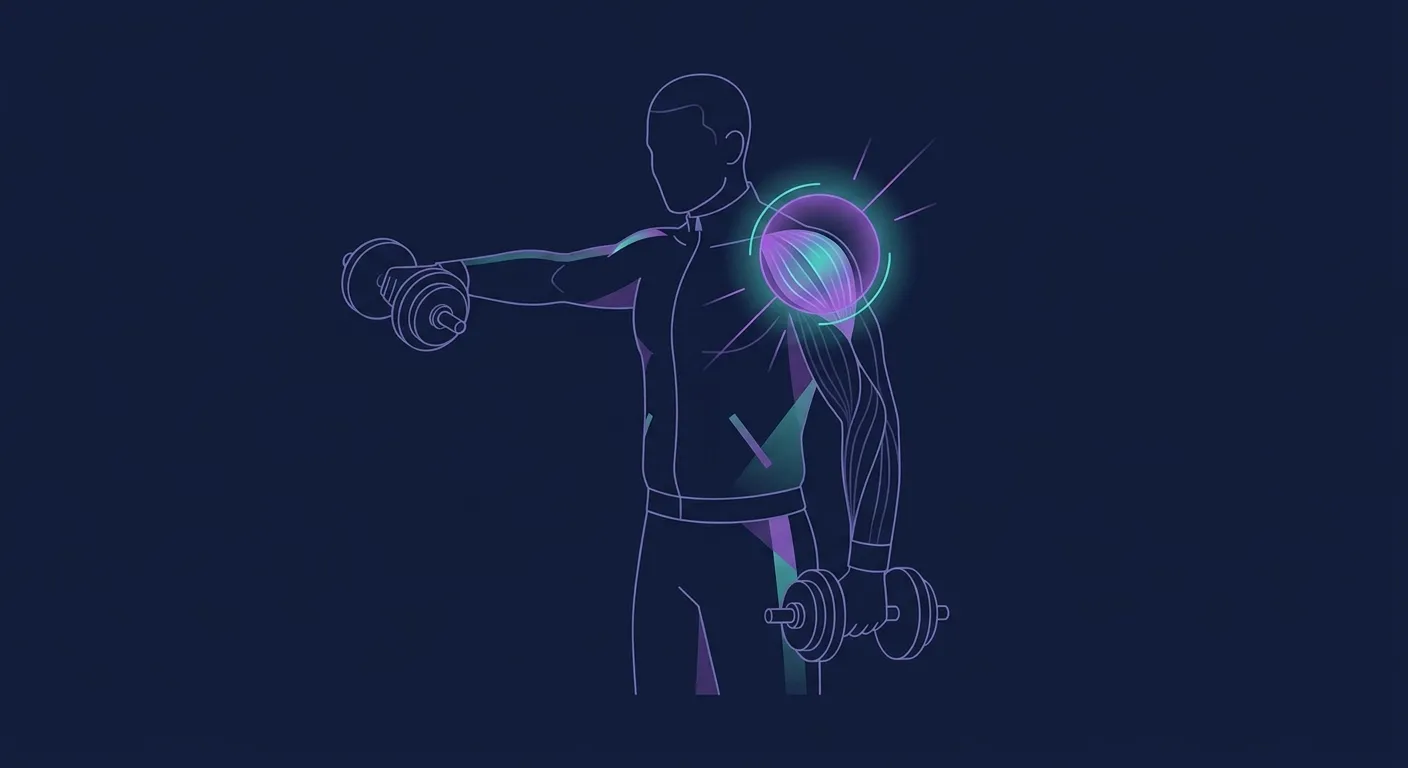
The Connection to Coaching Cues and App-Based Training
One of the most interesting implications of this research is what it means for coaching. The Schoenfeld study didn't use elaborate visualization techniques or meditation. The cue was simple: "squeeze the muscle." That was it. And it worked.
This is exactly the kind of intervention that scales well through technology. A human coach standing next to you can remind you to squeeze your bicep on every rep. But most people don't train with a coach. They train alone, in their living room or garage, following a workout on their phone.
The research suggests that even a text-based or audio cue at the right moment, reminding you to focus on the target muscle, could replicate the effect seen in the study. The cue doesn't need to be complex. It needs to be timely and specific: which muscle, during which phase of which exercise.
This is relevant to how FitCraft applies exercise science research. Our AI coach Ty delivers focus cues during isolation exercises, telling you exactly which muscle to squeeze and when. It's a direct application of the Schoenfeld findings: simple verbal cues, delivered consistently, producing better results from the same workout.
The broader point connects to rest period research and the cardio interference question: small training variables that seem trivial on any given day add up to meaningful differences over weeks and months. Optimal rest periods, intelligent exercise ordering, and deliberate attentional focus are all "free" performance upgrades that don't require you to spend more time in the gym.
The Honest Limitations
We'd be hypocrites if we criticized bro science and then presented these findings without caveats. So here's what you should keep in mind.
Sample size was small. Thirty participants is enough to detect a large effect (which they did), but it's not large enough to draw highly precise conclusions. A replication with 100+ participants would strengthen the evidence considerably.
Only untrained men were studied. The results may differ for women, for experienced lifters, or for older adults. The EMG studies with trained athletes suggest the activation boost transfers, but we don't have an equivalent hypertrophy trial with trained participants yet.
Two muscles were tested. Elbow flexors and quadriceps. We're extrapolating when we suggest internal focus would work for chest flyes or lateral raises. It's a reasonable extrapolation based on the isolation-movement logic and the EMG data, but it hasn't been directly tested in an 8-week hypertrophy trial.
Compliance is hard to verify. How do you confirm that someone is actually "squeezing the muscle" vs. just saying they are? The researchers used verbal reminders every set, but internal mental focus is inherently subjective and unmeasurable.
These are real limitations. They don't invalidate the findings, but they should keep you from treating a single RCT as settled law. The evidence is strong enough to act on. It's not strong enough to be dogmatic about.
Bottom Line
The mind-muscle connection isn't bro science. It's a real, measurable phenomenon backed by a well-designed RCT and corroborated by multiple EMG studies. Focusing on squeezing the target muscle during isolation exercises at moderate loads produces significantly more hypertrophy than focusing on moving the weight.
The effect is strongest on small, easy-to-isolate muscles (like the biceps) during single-joint exercises with moderate weight. It fades as exercises become more complex, as loads get heavier, and as the target muscle gets harder to consciously control.
The best part? It's free. It takes no extra time. And you can start using it on your very next set of curls. Just pick a muscle, slow down the rep, and squeeze.
That old gym cue your training partner kept repeating? Turns out he was ahead of the research.
Frequently Asked Questions
Does the mind-muscle connection actually build more muscle?
Yes, for certain muscles. Schoenfeld et al. (2018) ran an 8-week RCT with 30 untrained men and found that focusing on squeezing the muscle during bicep curls produced 12.4% elbow flexor growth versus 6.9% with an external focus. That's nearly double the hypertrophy. However, the same study found no significant difference for the quadriceps, suggesting the effect is strongest in muscles you can easily feel and isolate.
Why does internal focus work for biceps but not quads?
Researchers believe it comes down to the complexity of the movement pattern and how easily you can isolate the muscle. Bicep curls are a simple, single-joint exercise where it is straightforward to direct attention to the target muscle. Leg extensions and squats involve larger muscle groups, multiple joints, and more complex coordination. The cognitive load of managing a compound movement appears to make it harder to maintain a focused internal cue on one specific muscle.
Does mind-muscle connection work at heavy loads?
Not as well. Calatayud et al. (2016) found that internal focus increased muscle activation during bench press at loads between 20-60% of 1RM, but the effect disappeared at 80% of 1RM. When a weight is heavy enough, your nervous system recruits maximum muscle fibers regardless of where you direct your attention. The practical takeaway: use internal focus on lighter isolation work and moderate loads, and let the weight itself do the job during heavy compound lifts.
How do you actually use the mind-muscle connection during a workout?
Pick an isolation exercise like a bicep curl, lateral raise, or tricep pushdown. Before the set, think about the target muscle. During the concentric (lifting) phase, focus on squeezing and shortening that muscle. During the eccentric (lowering) phase, focus on the stretch. Use a controlled tempo so you have time to maintain that focus. Start with lighter weight until you can reliably feel the muscle working, then gradually increase the load while keeping the connection.
Should beginners use the mind-muscle connection?
Beginners may actually benefit the most. The Schoenfeld 2018 study specifically used untrained men, and the internal focus group still saw nearly double the bicep growth. Learning to feel which muscles are working early on builds body awareness that pays off for years. That said, beginners should prioritize proper form first. Once the movement pattern feels comfortable, adding an internal focus cue is one of the simplest ways to get more out of each rep.