You've heard it a thousand times. "Cardio kills your gains." It's practically gym gospel at this point. The idea that any time spent on a treadmill or bike is actively sabotaging your muscle and strength progress.
Here's the thing: that claim isn't entirely wrong. But it's not entirely right either. And the gap between those two statements is where most people's training goes sideways. Modality turns out to matter more than minutes, which is why we gave running its own evidence review on whether running builds muscle and why it interferes when cycling does not.
The actual research on concurrent training, combining cardio and resistance training in the same program, tells a much more interesting story than "cardio bad." It tells you which cardio is problematic, which isn't, and exactly what you can do about it. Let's dig into the studies. The adjacent question, whether aerobic work strips away the muscle you already have rather than blunting new growth, gets its own treatment in does cardio burn muscle.
Where Did the "Cardio Kills Gains" Idea Come From?
It traces back to one 1980 study. Robert Hickson documented the first "interference effect," where subjects doing both strength and endurance work saw their strength gains plateau and decline after seven weeks. But those subjects trained at punishing volumes, so the study was a stress test, not a sensible plan. Here is the origin story.
Hickson published the first study documenting what he called the "interference effect." He took recreationally active subjects and split them into three groups: strength training only, endurance training only, and a group doing both.
For the first seven weeks, the concurrent group improved both strength and VO2max just fine. Then something happened. After week 7, their strength gains plateaued, and actually started declining. Meanwhile, the strength-only group kept getting stronger the entire 10 weeks.
Hickson's conclusion: simultaneously training for strength and endurance can interfere with strength development. And just like that, the interference effect was born.
But here's what got lost in the retelling over the next four decades: Hickson's subjects were training at extremely high volumes. The endurance group did 40 minutes per day, 6 days per week. The concurrent group did both the full strength program and the full endurance program, essentially double the training load with no adjustment for recovery. That's not how anyone sensibly programs concurrent training. It's a stress test, not a training plan.
Still, the study raised a legitimate question. Does combining cardio and lifting actually compromise your results? It took three decades and a proper meta-analysis to get a clear answer.
Citation: Hickson RC. Interference of strength development by simultaneously training for strength and endurance. Eur J Appl Physiol. 1980;45(2-3):255-263.
The Wilson Meta-Analysis: 21 Studies, One Clear Pattern
In 2012, Wilson and colleagues published the meta-analysis that should've settled this debate, but somehow didn't, because nuance doesn't trend on social media.
Published in the Journal of Strength and Conditioning Research, this was a comprehensive analysis of 21 studies encompassing 422 effect sizes. The goal: figure out which specific components of endurance training, modality, frequency, duration, actually interfere with resistance training outcomes.
The Big Numbers
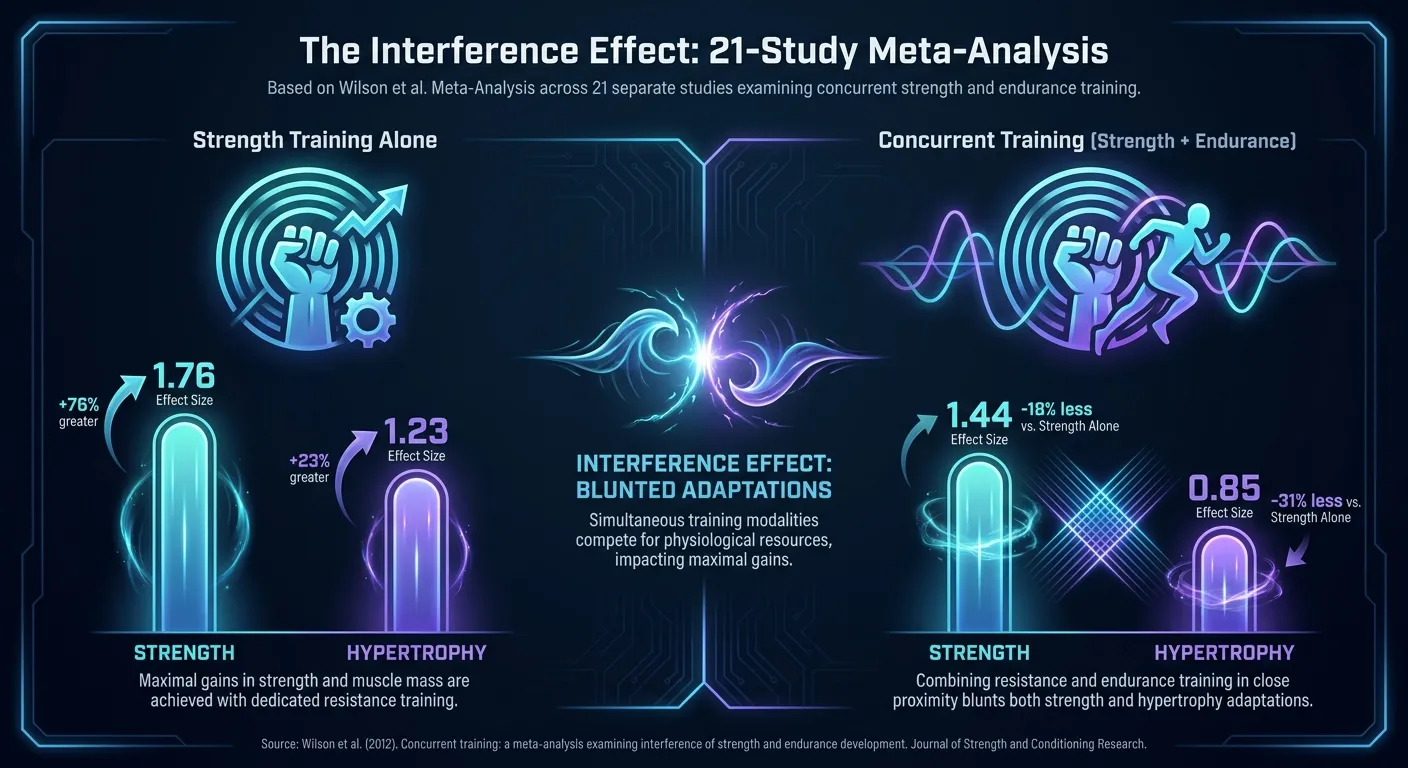
Across the pooled data, adding endurance work reduced strength, hypertrophy, and power compared to lifting alone. Power took the biggest hit. Volume is the other half of this question, and our post on setting a weekly cardio ceiling works through where the dose-response curve actually flattens. The picture flips when the goal is fat rather than strength, and our post on cardio versus weights for fat loss works through the STRRIDE trial data on what each mode costs and buys.
| Outcome | Strength only | Concurrent | Endurance only |
|---|---|---|---|
| Hypertrophy | 1.23 | 0.85 | 0.27 |
| Strength | 1.76 | 1.44 | 0.78 |
| Power | 0.91 | 0.55 | 0.11 |
Mean effect sizes from Wilson et al. (2012). Higher is a larger gain.
So yes, across the board, adding endurance training to a strength program reduced gains compared to lifting alone. The interference effect is real.
But that's the headline. The actual findings are far more useful.
Is Cycling or Running Better for Keeping Gains?
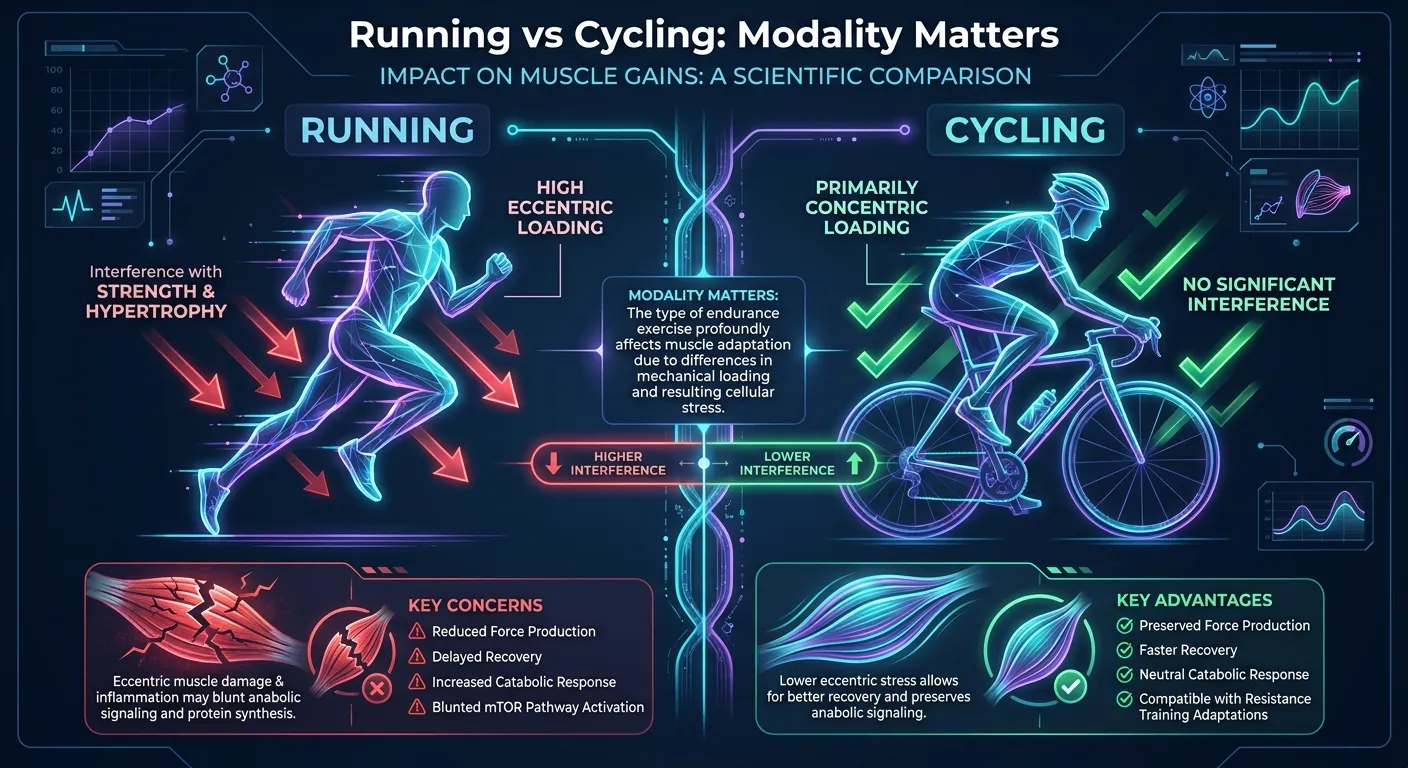
Cycling wins, clearly. When Wilson's team broke the data down by cardio modality, running caused significant interference with both strength and hypertrophy, but cycling did not. This is the finding that should've changed the conversation.
Read that again. Cycling did not cause statistically significant decrements in strength or muscle growth when combined with resistance training. Running did.
Why? The most likely explanation is mechanical. Running involves repeated eccentric muscle contractions, every time your foot strikes the ground, your quads, hamstrings, and calves absorb impact through lengthening contractions. These eccentric loads cause substantial muscle damage, which competes directly with recovery from resistance training. Your body has a finite recovery budget, and running burns through it fast.
Cycling, by contrast, is primarily concentric. You push the pedals; there's minimal eccentric loading. Less muscle damage means less competition for recovery resources. Your legs can handle a cycling session and still recover in time for the next squat day.
Citation: Wilson JM, Marin PJ, Rhea MR, et al. Concurrent Training: A Meta-Analysis Examining Interference of Aerobic and Resistance Exercises. J Strength Cond Res. 2012;26(8):2293-2307.
Frequency and Duration Matter Too
Wilson's team didn't stop at modality. They also found that the interference effect scaled with:
- Cardio frequency: More cardio sessions per week meant more interference. Three days of running per week was less problematic than five.
- Session duration: Longer cardio sessions created more interference than shorter ones. This makes sense. A 20-minute bike ride and a 60-minute run impose very different recovery demands.
- Power took the worst hit: Across all conditions, explosive power was the most negatively affected variable. If you're training for speed, jumping ability, or explosive sports performance, concurrent training is a bigger concern than if you're training for general strength or size.
The Updated Evidence: It's Less Scary Than You Think
Wilson's 2012 analysis was the definitive work for a decade. But science doesn't sit still. More recent meta-analyses have added important context, and honestly, the news has gotten better.
Schumann et al. (2022): No Hypertrophy Interference at All?
A 2022 updated meta-analysis by Schumann and colleagues, published in Sports Medicine, analyzed 43 studies on concurrent training and muscle size. Their finding was striking: the standardized mean difference for hypertrophy between concurrent training and strength-only training was −0.01 (95% CI: −0.16 to 0.18, p = 0.919).
In plain language: essentially zero difference. Concurrent training did not compromise muscle growth compared to strength training alone in this larger, more recent analysis.
They did find that explosive strength (power) was still impaired when cardio and lifting were done in the same session. But when sessions were separated by several hours? Even that interference largely disappeared.
Citation: Schumann M, Feuerbacher JF, Lundby C, et al. Compatibility of Concurrent Aerobic and Strength Training for Skeletal Muscle Size and Function. Sports Med. 2022;52(3):601-612.
Huiberts et al. (2024): Sex and Training Status Matter
A 2024 systematic review by Huiberts and colleagues in Sports Medicine (59 studies, 1,346 participants) added another layer. They found that concurrent training blunted lower-body strength adaptations in males but not in females. Training status also mattered. The interference effect was more pronounced in trained individuals than in beginners.
This makes intuitive sense. If you're a beginner, your body adapts to basically everything. You can run, lift, and still get stronger because the stimulus is so novel. Once you're more advanced and pushing closer to your genetic ceiling, the competition for recovery resources becomes a real constraint.
Citation: Huiberts RO, Wüst RCI, van der Zwaard S. Concurrent Strength and Endurance Training: A Systematic Review and Meta-Analysis on the Impact of Sex and Training Status. Sports Med. 2024;54(2):485-512.
Enjoying the article?
Start a new fitness routine today, written by me and coached by the AI I designed.
Take the Free Assessment Free · 2 minutes · No credit cardCommon Misconceptions About Cardio and Muscle
The internet has turned the interference effect into a boogeyman. Here are the myths that need correcting.
Misconception 1: "Any cardio will destroy your muscle gains"
This is the biggest one, and it's flat wrong. Wilson et al. showed that cycling did not significantly impair strength or hypertrophy. Schumann's 2022 meta-analysis of 43 studies found essentially zero difference in muscle growth between concurrent training and strength-only training (SMD: −0.01). The interference effect is modality-specific and dose-dependent. A couple of cycling sessions per week aren't going to undo your squat progress.
Misconception 2: "You need to choose, cardio OR lifting"
This false binary has probably done more damage to people's health than any actual interference effect. Cardiovascular fitness and muscular strength are both critical for long-term health outcomes. The research doesn't say you can't do both. It says you need to be smart about how you combine them. That's a completely different message.
Misconception 3: "The interference effect means your cardio sessions are wasted"
Even in Wilson's data. The analysis that most strongly supported the interference effect, concurrent training still produced meaningful gains in both strength (ES: 1.44) and hypertrophy (ES: 0.85). Those aren't small numbers. They're slightly lower than strength-only training, but they're dramatically better than not training at all. If you enjoy running and lifting, keep doing both. You'll still get strong. You'll still build muscle. You just might build slightly less than if you only lifted.
Practical Recommendations: How to Train Smart
The research paints a clear picture. Here's how to apply it.
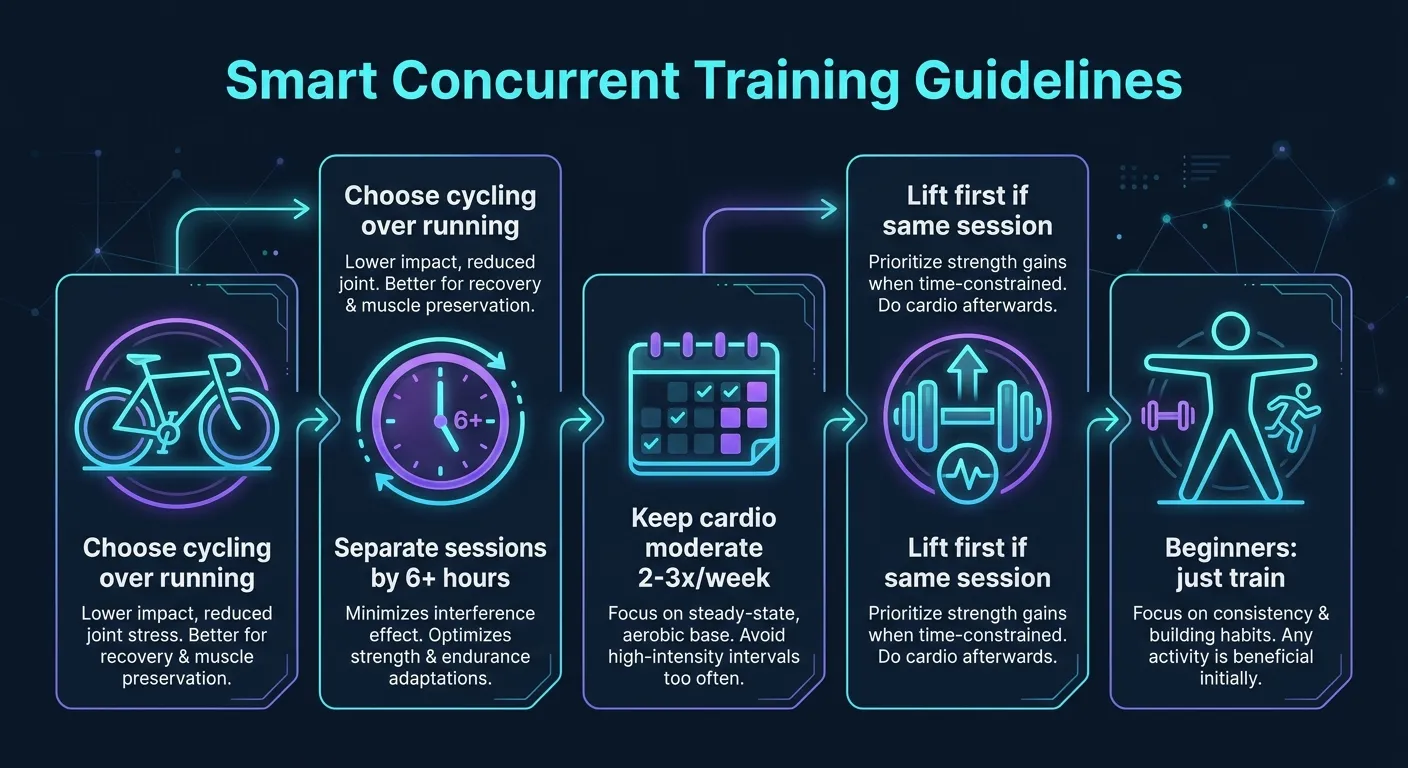
1. Choose Your Cardio Modality Wisely
If maximizing strength and muscle is your primary goal, favor concentric-dominant cardio: cycling, rowing, swimming, elliptical. These modalities don't impose the eccentric muscle damage that running does. You get the cardiovascular benefits without the recovery tax. The HIIT vs steady-state research also found that cycling-based protocols showed no fat-loss advantage over steady-state, so moderate cycling sessions fit perfectly here.
This doesn't mean you can't run. It means if you run, account for the additional recovery demand. Maybe you do two runs per week instead of four. Maybe you keep them shorter. Maybe you don't schedule them the day before heavy squats.
2. Separate Sessions by 6+ Hours
Schumann's data showed that explosive strength interference was worse when cardio and lifting happened in the same session. If you can split them, lift in the morning, do cardio in the evening (or vice versa). The interference effect shrinks substantially. If you absolutely must do both in one session, lift first. The research consistently shows that doing cardio before lifting suppresses the hormonal and neuromuscular environment for strength gains more than the reverse.
3. Keep Cardio Volume Reasonable
Wilson found that interference scaled with both frequency and duration. Three 20-to-30-minute cycling sessions per week is a very different stimulus than daily 60-minute runs. For most people whose primary goal is strength or hypertrophy, 2-3 moderate cardio sessions per week is plenty for cardiovascular health without meaningful interference.
4. Separate Running from Leg Day
If running is your preferred cardio, the smartest move is to keep running days away from lower-body lifting days. A 24-to-48-hour separation gives your legs time to recover from the eccentric damage of running before you ask them to produce maximal force under a barbell (or in a bodyweight squat, if that's more your speed). Running closer to upper-body days is fine, there's no meaningful cross-interference between a jog and a bench press.
5. Beginners: Just Train
If you're new to exercise, honestly? Don't overthink this. The Huiberts 2024 meta-analysis showed minimal interference in untrained individuals. Your body will adapt to everything right now, cardio, lifting, all of it. The biggest risk isn't doing too much cardio. It's not training consistently at all. Start, build the habit, and refine the details later. The research on strength training and injury prevention also suggests beginners benefit enormously from even basic resistance work, which is a good reason to include lifting alongside your cardio from the start.
How FitCraft Applies This Research
FitCraft's AI coach Ty doesn't just throw random workouts at you. Every training plan is built on exercise science, including the concurrent training research above.
- Smart session sequencing: Ty programs your cardio and strength sessions with appropriate separation to minimize interference, adjusting based on your schedule and what's realistic for your week.
- Modality-aware programming: When your goal is building strength or muscle, Ty favors low-impact cardio options over high-eccentric modalities. You still get cardiovascular training. It just doesn't compete with your recovery.
- Adaptive volume management: Ty tracks your progress and adjusts both cardio and resistance training volume based on how you're responding. If recovery is lagging, volume comes down. If you're crushing it, the challenge scales up.
- Gamified consistency: All the optimal programming in the world doesn't matter if you don't show up. FitCraft's XP, streaks, and collectible card system keep you engaged session after session, because the research on fitness app effectiveness shows that gamification is the single biggest predictor of long-term adherence.
The free version includes AI-adapted workout scheduling, 3D exercise demos with Ty guiding your form, and the gamification system. Programs are designed by Domenic Angelino (MS, MPH, Brown University; NSCA-CSCS). He's the one who translated this research into the training algorithms.
What the Research Suggests Going Forward
The concurrent training literature has matured a lot since Hickson's 1980 study. Here's where the evidence stands in 2026:
- The interference effect is real but manageable. It's not a binary, it's a spectrum influenced by modality, frequency, duration, timing, sex, and training status.
- Running is the primary culprit. Cycling, rowing, and other concentric-dominant modalities cause far less interference. If you love lifting and need cardio, cycling is your best friend.
- Hypertrophy is more resilient than we thought. The most recent meta-analyses suggest that muscle growth is largely unaffected by concurrent training when programmed sensibly. Strength and especially power are more sensitive.
- Timing matters. Separating cardio and lifting by 6+ hours, or at least putting them on different days, meaningfully reduces interference.
- Beginners get a free pass. The interference effect is minimal for untrained individuals. Just get moving.
The honest limitation: most concurrent training studies are 8-12 weeks long. We have limited data on what happens over years of combined training. But the practical reality is that most successful athletes and recreational lifters combine cardio and strength without catastrophic interference, because they manage the variables that matter.
The takeaway isn't "avoid cardio." It's "be thoughtful about how you combine it with lifting." That's a much less dramatic message than "cardio kills your gains," but it has the advantage of being true.
References
- Wilson JM, Marin PJ, Rhea MR, Wilson SM, Loenneke JP, Anderson JC. "Concurrent Training: A Meta-Analysis Examining Interference of Aerobic and Resistance Exercises." Journal of Strength and Conditioning Research 26.8 (2012): 2293-2307. doi:10.1519/JSC.0b013e31823a3e2d
- Hickson RC. "Interference of strength development by simultaneously training for strength and endurance." European Journal of Applied Physiology and Occupational Physiology 45.2-3 (1980): 255-263. doi:10.1007/BF00421333
- Schumann M, Feuerbacher JF, Lundby C, et al. "Compatibility of Concurrent Aerobic and Strength Training for Skeletal Muscle Size and Function: An Updated Systematic Review and Meta-Analysis." Sports Medicine 52.3 (2022): 601-612. doi:10.1007/s40279-021-01587-7
- Huiberts RO, Wüst RCI, van der Zwaard S. "Concurrent Strength and Endurance Training: A Systematic Review and Meta-Analysis on the Impact of Sex and Training Status." Sports Medicine 54.2 (2024): 485-512. doi:10.1007/s40279-023-01943-9
Frequently Asked Questions
Does cardio kill your gains?
It depends on the type of cardio. Wilson et al.'s 2012 meta-analysis of 21 studies found that running significantly impaired both strength and hypertrophy gains when combined with resistance training, but cycling did not cause meaningful interference. The interference effect is real but modality-specific. Choosing low-impact cardio like cycling, rowing, or swimming and separating cardio from lifting by 6+ hours can largely eliminate the problem.
What is the interference effect in concurrent training?
The interference effect refers to the blunted strength and muscle growth that can occur when endurance and resistance training are combined in the same program. First documented by Hickson in 1980, the effect is influenced by cardio modality, frequency, duration, and timing relative to strength training. Recent meta-analyses suggest the effect is smaller than originally feared and can be minimized with smart programming.
Is cycling or running better for preserving muscle gains?
Cycling is significantly better for preserving muscle and strength gains. Wilson et al. (2012) found that concurrent training with running impaired strength and hypertrophy, while cycling did not produce statistically significant interference. This is likely because cycling is a concentric-dominant movement with less muscle damage, while running involves high eccentric loads that compete with recovery from resistance training.
How long should you wait between cardio and strength training?
Research suggests separating cardio and strength sessions by at least 6 to 8 hours to minimize interference. Schumann et al. (2022) found that explosive strength was more impaired when cardio and lifting were performed in the same session versus separated sessions. If same-day training is unavoidable, lift first and do cardio after, and ideally choose cycling over running.
Does FitCraft account for the interference effect in its programming?
Yes. FitCraft's AI coach Ty sequences your workouts to minimize the interference effect based on these research findings. The app programs cardio and strength sessions with appropriate separation, favors low-impact cardio modalities when muscle building is your goal, and adjusts training volume based on your recovery. The free version includes AI-adapted workout scheduling.