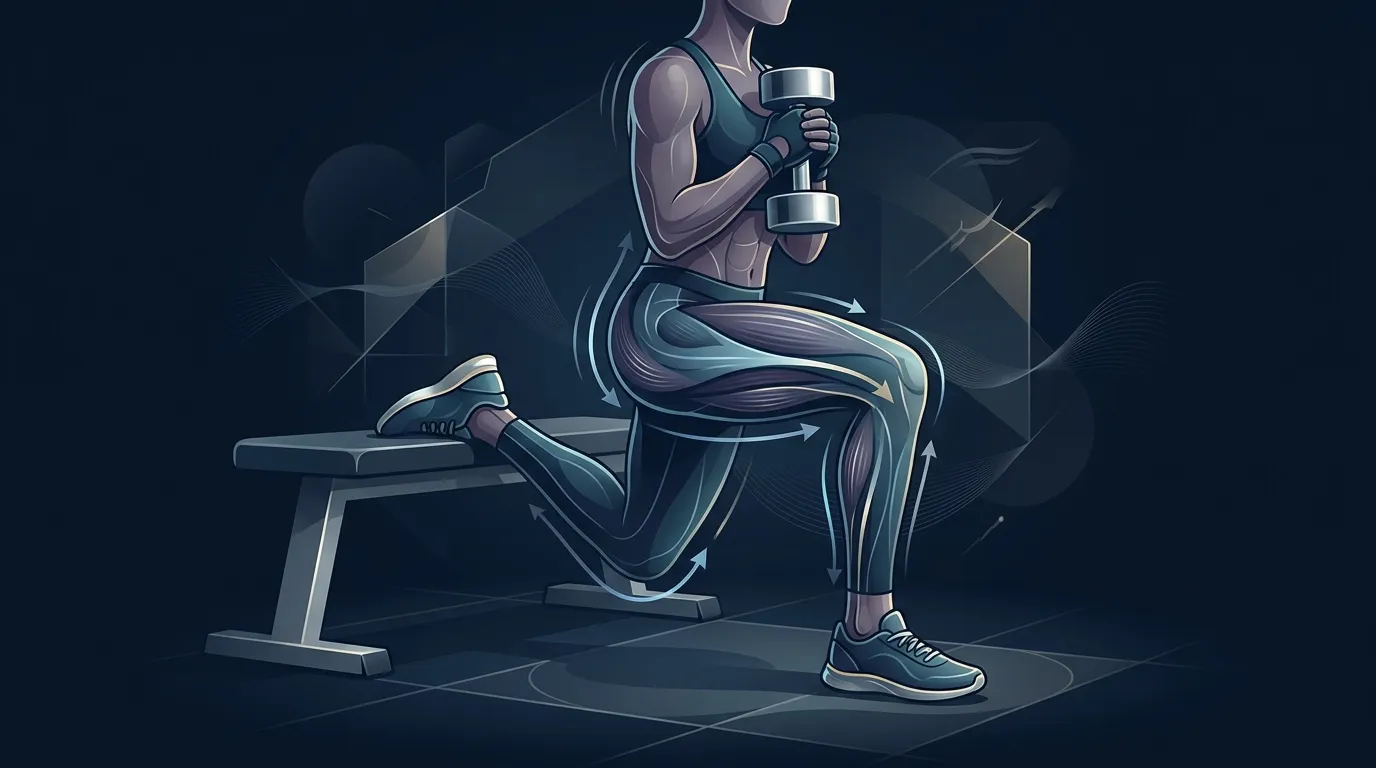
Single-leg training has become one of the more contested topics in lower-body programming. Some coaches treat the Bulgarian split squat as the king of leg exercises. Others treat it as an accessory that can never replace a "real" bilateral squat. The actual research base on the question is now solid enough to settle most of the argument.
The headline. Single-leg work builds muscle as well as two-leg work. Strength adapts to whatever pattern you trained. Both findings come from meta-analyses pooling hundreds of subjects across dozens of trials, so they are about as well-supported as anything in lower-body programming.
What this article covers. The hypertrophy verdict. The specificity rule for strength. Cross-education and the bilateral deficit. How transfer between split squats and back squats actually works in trained athletes. And how to write a program that uses both intelligently, including when you might pick one over the other.
The Research: What Studies Show
Hypertrophy: No Detectable Difference
The most recent and most rigorous synthesis on this question is the 2025 systematic review and meta-analysis by Kassiano and colleagues in Sports Medicine. The authors searched PubMed, Scopus, and Web of Science and screened 703 studies. Nine met the strict inclusion criteria: randomized trials directly comparing unilateral and bilateral resistance training in the same body region with hypertrophy measured by a validated method.
The pooled effect on muscle growth was essentially zero. The standardised mean difference between unilateral and bilateral training was not statistically distinguishable from no effect. Put plainly. If you matched effort and volume on the working leg, it did not appear to matter whether the other leg was loaded too. Hypertrophy fell out the same.
This matches what most experienced lifters and clinicians had already inferred from training experience. Muscle is grown by hard sets near failure on the working tissue, plus enough total work over time. The contralateral leg's status is not part of the mechanism.
Strength: A Hard Rule of Specificity
Strength is a different story, and the research is unusually clear on this point. Liao and colleagues (2022) in Biology of Sport pooled 14 trials covering 392 subjects aged 16 to 26. Bilateral resistance training produced a small but reliable advantage when strength was tested in a bilateral lift (effect size -0.43, p = 0.004). Unilateral resistance training produced a large advantage when jumping power was tested on a single leg (effect size 0.89, p < 0.0001). No difference between groups showed up for change of direction, linear sprint speed, or bilateral jump power.
A second, larger meta-analysis by Zhang and colleagues (2023) in Frontiers in Physiology pooled 28 studies and 651 athletes. The same pattern emerged. Unilateral training was meaningfully better for single-leg maximum strength and single-leg jump performance. Bilateral training was better for bilateral expressions of the same qualities. Sprint and balance outcomes were largely indistinguishable between groups, suggesting those qualities depend on training factors beyond the unilateral or bilateral choice.
So strength does not generalise the way muscle growth does. If you want to test stronger on a back squat, train the back squat. If you want to test stronger on a single-leg movement, train single-leg. The body adapts to the specific pattern you load.
Cross-Education: A Bonus on the Untrained Side
One of the most interesting features of unilateral training is cross-education. When you train one limb, the untrained limb gets stronger too. The mechanism is neural, mediated by cortical and spinal adaptations, not by any change in the muscle on the untrained side.
The 2017 meta-analysis by Manca and colleagues in the European Journal of Applied Physiology pooled 31 studies covering 785 subjects. The pooled cross-education effect was a 11.9 percent strength gain on the untrained side. The effect was larger in the lower limbs (16.4 percent) than in the upper limbs (9.4 percent), and it was largest with eccentric training (17.7 percent). For context, that 16.4 percent lower-limb gain is real, not a rounding artifact. It is a clinically relevant amount of strength delivered to a leg that never touched a weight.
This is most useful in rehab settings, where one limb may be immobilized after surgery. It also matters for any setup where one side is detrained or injured. The training of the healthy side helps preserve strength on the side you cannot load.
The Bilateral Deficit, Explained
One reason single-leg work feels so much harder per leg than its share of a bilateral lift is the bilateral deficit. When both limbs contract simultaneously, the total force produced is consistently less than the sum of each limb tested alone. The deficit is usually in the 5 to 15 percent range and shows up in jump tests, isokinetic dynamometer tests, and maximal contractions in laboratory settings.
The cause appears to be neural. The brain seems to inhibit some motor-unit recruitment when both sides fire at once. The deficit is not large enough to make unilateral training automatically superior, but it does mean that a single leg loaded in isolation can express more relative force than it would in a bilateral lift. That is part of why a Bulgarian split squat at 50 percent of your back squat weight can feel as hard as the back squat itself.
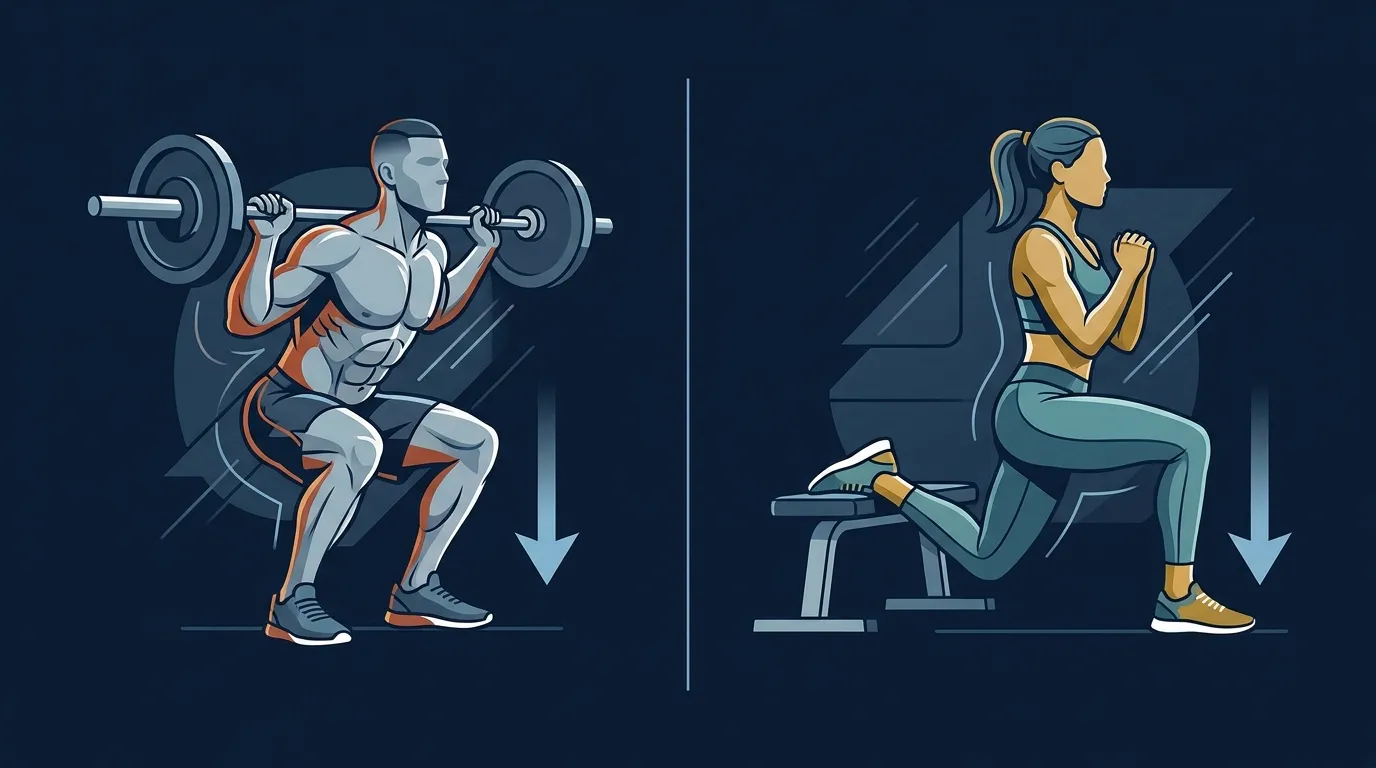
Why This Matters for Your Fitness
The hypertrophy finding is the more practically important one for most people. If your goal is to build quad, hamstring, and glute mass, you can do it almost entirely from single-leg work. No barbell required. No squat rack. Bulgarian split squats, pistol squats, step-ups, single-leg Romanian deadlifts, and reverse lunges with dumbbells will do the job as well as a bilateral squat program. This is good news for anyone training at home, anyone with a back injury that makes axial loading uncomfortable, and anyone whose gym is just dumbbells and a bench. If single-leg work still feels like an all-quad affair, five minutes of glute activation exercises beforehand is a cheap way to change what you feel during the set.
The strength finding matters too, but it is more situational. If you specifically want a bigger back squat for a powerlifting meet, train back squats. If you want to be more powerful on the field for a sport that demands single-leg propulsion like sprinting, cutting, or kicking, lean on single-leg work. If you just want to be strong for life, do both. Most life situations, from stepping up onto a curb to recovering from a stumble to picking a kid up off the floor, are single-leg loading dressed up in a small range of motion. Training only bilateral lifts leaves a clear gap.
And the cross-education finding is most relevant when something has gone wrong. Coming back from a knee surgery. A foot in a boot. A stress reaction that keeps you off one leg for six weeks. Train the healthy side hard during the layoff. You will not fully maintain the injured side, but you will lose less than you would have if you had stopped training entirely. The principle also applies in long-term aging. Unilateral training maintains a kind of redundant strength reserve. The neural pathways that catch you mid-stumble are practiced on both sides even when only one side moved deliberately.
How Single-Leg Training Works in Practice
The Speirs et al. (2016) trial is one of the cleanest applied tests of how this plays out in an athletic population. Speirs and colleagues in the Journal of Strength and Conditioning Research randomized 18 academy rugby players (mean age 18.1 years) into two groups. One group trained the rear-elevated split squat (the standard Bulgarian split squat with the rear foot up on a bench). The other group trained the bilateral back squat. Both groups trained twice a week for 5 weeks at progressive percentages of 1RM.
At the end of the block, both groups had significantly improved their back squat 1RM, their split squat 1RM, their 40-meter sprint time, and their pro-agility change-of-direction score. Crucially, the split squat group improved back squat 1RM even though they never trained the back squat during the intervention. The bilateral group similarly improved split squat 1RM without training it. Strength transferred in both directions.
The authors concluded that unilateral and bilateral training "may be equally efficacious" for general lower-body strength and athletic outputs. The pattern of transfer they observed is what later meta-analyses confirmed. Transfer is real but it is specific. The leg gets stronger in whatever pattern was trained, and the contralateral expression rides along by a smaller, but still meaningful, margin.
Get an evidence-based plan built for you
FitCraft, our mobile fitness app, pairs you with an AI coach who builds you a personalized plan around your goals, schedule, and fitness level. Every FitCraft program is designed by Domenic Angelino, MPH (Brown University) and NSCA-CSCS, with research published in the Journal of Strength and Conditioning Research and Medicine & Science in Sports & Exercise.
Take the Free Assessment Free • 2 minutes • No credit cardCommon Misconceptions
Misconception 1: "Bulgarian split squats are just an accessory"
This framing comes from a powerlifting context where the main lift is by definition the test, so everything else is "accessory." In a more general training context the framing collapses. Hypertrophy is not different between unilateral and bilateral loading in matched programs. Strength is specific to the pattern. If your test is a Bulgarian split squat, the Bulgarian split squat is the main lift. If your goal is leg mass, either pattern works. The accessory label assumes the back squat is the only valid expression of leg strength. It is not.
Misconception 2: "Single-leg training fixes asymmetries"
It can. But the evidence on asymmetry as a clinical problem is more mixed than the typical Instagram post suggests. Many people are slightly stronger on their dominant leg with no functional consequence whatsoever. Most working programs build in single-leg work for the limb-specific strength benefit and the practical demands of life and sport, not because there is a documented asymmetry crisis. If you do have a clear, performance-relevant imbalance, single-leg loading is the right tool. Just do not assume you have an imbalance because you "feel" weaker on one side during a bilateral lift. The bilateral deficit is real, and the trailing leg in a bilateral lift can read as weaker without actually being weaker in isolation.
Misconception 3: "You need a barbell to build serious legs"
The Kassiano (2025) meta-analysis says otherwise. With matched volume and effort, unilateral work delivered comparable hypertrophy. Dumbbells, a stable platform, and Bulgarian split squats can replace a back squat for the goal of growing the legs. Most home-equipped lifters have all the tools they need already. This is also true for the home workout population, which is much larger than the gym-trained population in surveys of US adults.
What the Research Suggests Going Forward
The current evidence base supports a few practical rules.
First, treat unilateral and bilateral lower-body exercises as equally valid for hypertrophy. The choice should be driven by what you can load safely with the equipment you have, what your back and hips tolerate, and whether you want the bonus of practicing balance and proprioception. Single-leg work loads those skills as a side effect. Bilateral work generally does not. For older adults specifically, the side effect is worth a lot. Our analysis of the Cochrane balance and falls review covers why postural control is a separate trainable system that walking alone does not address.
Second, accept specificity for strength. Pick the tests that matter to you and train them. A general program for life that wants to cover most bases will include a bilateral squat or hinge pattern and a single-leg version of each. You do not need to do every variation every session. You do need both patterns to show up over a training cycle.
Third, lean unilateral when you have a reason to. Coming back from an injury on one side. Lower-back issues that make axial loading unpleasant. A sport that demands single-leg power. A home gym with limited equipment. In any of those situations, unilateral work earns a larger share of the program. Lateral hip pain belongs on that list too, and our review of the dead butt syndrome research covers why single-leg work is the graduation exercise there rather than the starting point.
And fourth, accept the limitations. The pooled trials skew young and athletic. The 2025 Kassiano analysis included 9 studies, which is small enough that any one new trial could nudge the estimate. The Liao meta-analysis was 16-to-26-year-olds. Older lifters, novices, and clinical populations are less well-studied. The current best guess is that the same principles apply, but the size of the effects may differ. If you are in one of those groups, watch your own results and adjust.
How FitCraft Programs Single-Leg Work
FitCraft's strength and bodyweight programs include single-leg work as a planned part of the lower-body training, not a bolt-on. Split squats. Bulgarian split squats. Step-ups. Single-leg glute bridges. Reverse lunges. Pistol squat progressions. Each shows up at the dose and difficulty that matches the program's stage.
An AI coach guides you through each set in 3D, demonstrating the position from multiple angles so you can match the stance width, the foot position on the bench, and the depth on each rep. The interactive 3D exercise demos let you rotate the view if you want to see the lead leg from the side, or the rear leg setup from behind. As you progress, the load and difficulty climb. Bodyweight first. Holding dumbbells later. Then deeper ranges or harder variants when your earlier sessions show you are ready.
Every FitCraft program is designed by an exercise scientist with a graduate degree in kinesiology and an NSCA strength certification. That matters here because unilateral programming is one of the easier categories to get wrong. Pick the wrong stance width and the loaded knee gets overworked. Pick the wrong progression and the working leg is undertrained. The right defaults are encoded into the programs so you do not have to guess.
References
- Kassiano W, Nunes JP, Costa B, et al. "Comparison of Muscle Growth and Dynamic Strength Adaptations Induced by Unilateral and Bilateral Resistance Training: A Systematic Review and Meta-analysis." Sports Medicine. 2025. doi:10.1007/s40279-024-02169-z
- Liao KF, Nassis GP, Bishop C, Yang W, Bian C, Li YM. "Effects of unilateral vs. bilateral resistance training interventions on measures of strength, jump, linear and change of direction speed: a systematic review and meta-analysis." Biology of Sport. 2022;39(3):485-497. doi:10.5114/biolsport.2022.107024
- Speirs DE, Bennett MA, Finn CV, Turner AP. "Unilateral vs. Bilateral Squat Training for Strength, Sprints, and Agility in Academy Rugby Players." Journal of Strength and Conditioning Research. 2016;30(2):386-392. doi:10.1519/JSC.0000000000001096
- Manca A, Dragone D, Dvir Z, Deriu F. "Cross-education of muscular strength following unilateral resistance training: a meta-analysis." European Journal of Applied Physiology. 2017;117(11):2335-2354. doi:10.1007/s00421-017-3720-z
- Zhang W, Chen X, Xu K, Xie H, Li D, Ding S, Sun J. "Effect of unilateral training and bilateral training on physical performance: A meta-analysis." Frontiers in Physiology. 2023;14:1128250. doi:10.3389/fphys.2023.1128250
Frequently Asked Questions
Is single-leg training as good as two-leg training for building muscle?
Yes. The 2025 Kassiano et al. meta-analysis in Sports Medicine pooled 9 trials comparing matched unilateral and bilateral training and found no detectable difference in muscle hypertrophy. The standardised effect size was essentially zero. As long as the working leg gets enough hard sets near failure, the body does not appear to care whether the other leg was on the floor or in the air.
Does Bulgarian split squat training transfer to a regular squat?
Yes, partially. In the Speirs et al. (2016) trial in academy rugby players, 5 weeks of rear-elevated split squat training produced significant improvements in back squat 1RM even though the back squat itself was not trained. The same trial found bilateral back squat training produced equivalent gains in split squat 1RM. Strength transfers in both directions, but bilateral-tested strength still improves most from bilateral training and unilateral-tested strength improves most from unilateral training. That principle is called specificity.
What is the bilateral deficit?
The bilateral deficit is the consistent finding that when you contract both limbs at the same time, the total force is slightly less than the sum of each limb tested alone. Most adults produce roughly 5 to 15 percent less force in a bilateral max effort than the math would predict. The mechanism is mostly neural. The brain appears to inhibit some motor unit recruitment when both sides fire together. The deficit is not large enough to make unilateral training automatically better, but it is one reason single-leg loading lets you push the working leg harder than its share of a bilateral lift.
Do you need both single-leg and two-leg exercises in a program?
Most well-designed programs include both. The Liao (2022) and Zhang (2023) meta-analyses both found that single-leg work transfers best to single-leg performance and bilateral work transfers best to bilateral performance. If your goal is general lower-body strength and muscle, mixing them covers more ground than either alone. If you have a specific asymmetry, a sport that demands single-leg power like running or kicking, or limited equipment at home, unilateral work earns a larger share of the program.
Does FitCraft program single-leg exercises?
Yes. FitCraft's strength and bodyweight programs include single-leg work like split squats, Bulgarian split squats, step-ups, single-leg glute bridges, and pistol squat progressions. An AI coach guides you through each set in 3D, demonstrating the position from multiple angles so you can match the form and stance width. Your program adapts as you progress, raising the load or the difficulty as your earlier sessions show you are ready.