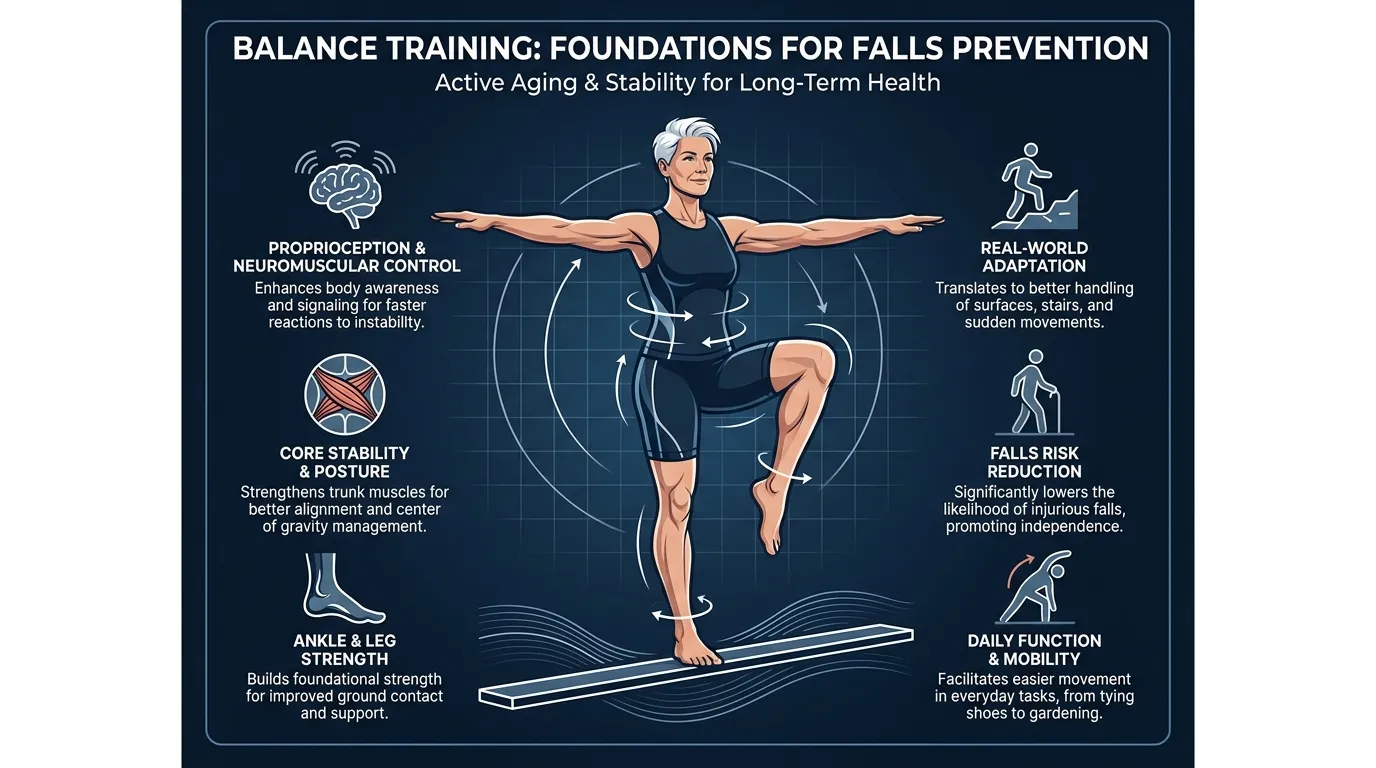
One in three adults over 65 falls each year. That isn't a scary statistic dredged up to sell something. It's the baseline. And about one in five of those falls causes a serious injury like a broken hip or a head trauma, the kind that often starts a cascade most people never fully recover from. Falls are the number-one cause of injury death in older adults in the United States, according to the CDC.
So you'd expect "how to not fall" to be a solved problem. Just exercise more, right?
Not quite. When researchers actually pool the data on which kinds of exercise reduce falls, a clear pattern shows up. And it doesn't match the advice most people get from their doctor, their physical therapist, or their fitness tracker. The most-prescribed activity for older adults, walking, does almost nothing for fall risk on its own. The training that actually works is more specific, and most people aren't doing it.
Here's what 108 trials and over 23,000 people reveal about what really keeps you on your feet.
The Research: What Sherrington et al. Actually Tested
The 2019 Cochrane systematic review by Sherrington and colleagues is the largest, most rigorous synthesis ever conducted on exercise and fall prevention. It set out to answer one question with as little noise as possible.
Scale and Method
The team at the University of Sydney's Institute for Musculoskeletal Health searched five major databases for randomized controlled trials comparing exercise interventions to a control (no exercise, sham exercise, or general health education). They included 108 trials enrolling 23,407 participants, all community-dwelling adults aged 60 or older. They categorized each trial by the kind of exercise tested. Balance and functional training. Resistance training. Multiple types combined. Tai Chi. Dance. Walking. Flexibility. Then they pooled the results.
What makes this review unusually useful is that it didn't just ask "does exercise reduce falls." It asked which kinds, in what doses, with what certainty. And it reported the answers in two different units: rate of falls (total falls per person per year) and number of fallers (people who fell at least once).
What They Found
Balance and functional exercise reduced the rate of falls by 24% compared to control (rate ratio 0.76, 95% CI 0.70 to 0.81). The reviewers rated this as high-certainty evidence, which in Cochrane's GRADE system means further research is very unlikely to change the conclusion. The same exercise category also reduced the number of people who fell at least once by 13% (RR 0.87, 95% CI 0.82 to 0.91), again high-certainty.
Multiple-type programs, the ones that combined balance and functional work with resistance training, were even more effective. They cut the rate of falls by 34% (RaR 0.66, 95% CI 0.50 to 0.88, moderate-certainty). The combination matters. Strength alone can't catch you mid-stumble if your postural reflexes have gone quiet, and balance work alone can't generate the force you need to push back into upright when your weight shifts.
Tai Chi cut the rate of falls by 19% (RaR 0.81, 95% CI 0.67 to 0.99, low-certainty). Resistance training alone, walking alone, and flexibility programs alone did not produce statistically significant reductions in falls. The headline result is striking in its specificity. Not all exercise prevents falls. Some kinds do. Most don't.
Why Balance Training Works When Walking Doesn't
This part trips a lot of people up. If walking is exercise, and exercise prevents falls, shouldn't walking prevent falls?
No. Walking is locomotion in a predictable, well-rehearsed pattern. Your nervous system has done it a few hundred million times. It barely challenges the postural-control systems that handle the unexpected. Catching your foot on a rug. A dog crossing your path. A wet patch on tile.
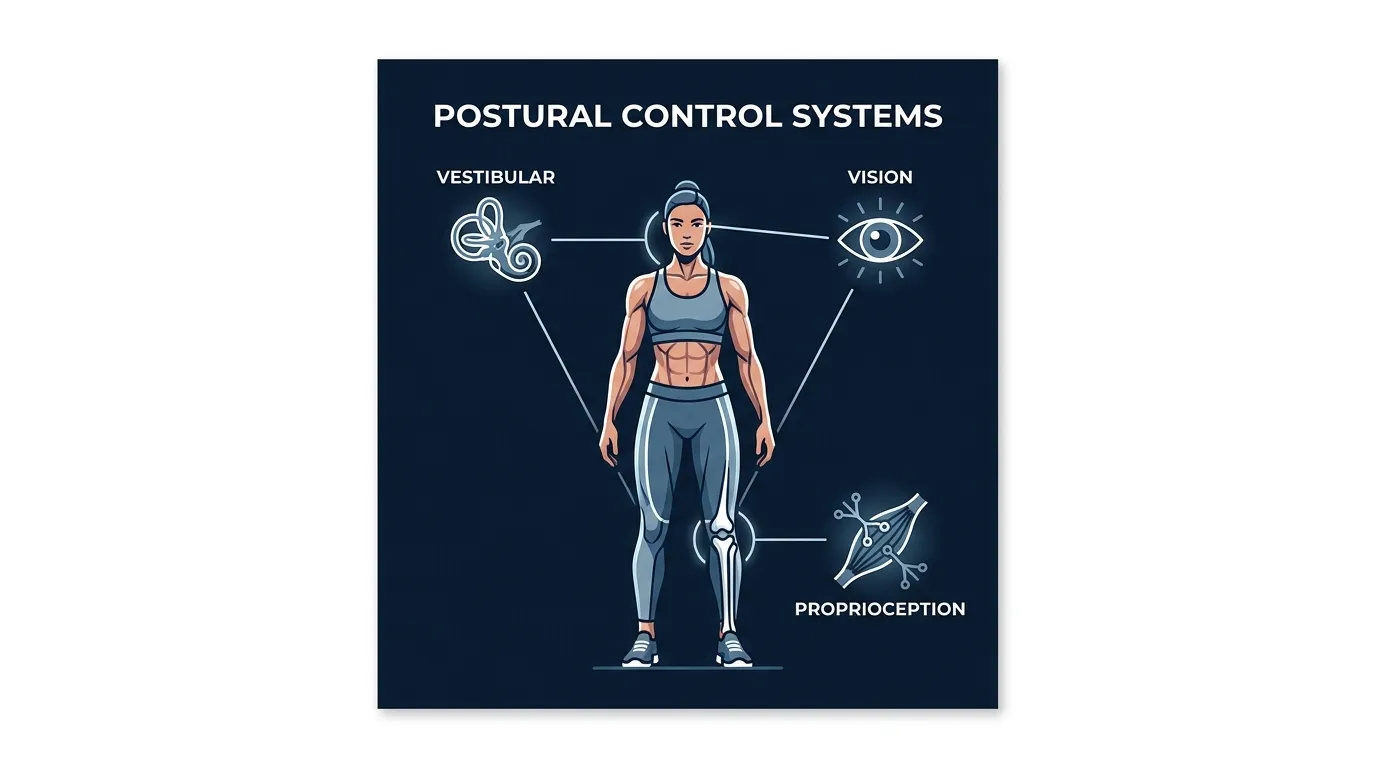
Balance, by contrast, is a skill produced by a bundle of overlapping systems: vestibular input from your inner ear, proprioception from joint and muscle receptors, vision, central integration in the cerebellum and brainstem, and rapid motor output to the postural muscles. Sibley and colleagues mapped this in their 2015 scoping review in Archives of Physical Medicine and Rehabilitation, identifying nine distinct components of postural control. Standing balance. Anticipatory adjustments. Reactive responses. Sensory orientation. Stability limits. Dynamic balance during gait. And more.
Each of those components weakens with age unless it's specifically challenged. Walking only loads a thin slice of the dynamic-gait component. It leaves the others, especially reactive responses and stability limits, almost untouched. So when something unexpected happens, the systems that would have caught the fall haven't been trained to fire fast enough.
This is why the trials in Sherrington's review that specifically included single-leg holds, narrow-base stances, heel-to-toe walking, tandem walks, surface perturbations, and dynamic reaching tasks produced large effects. Those exercises target the exact systems that fail during a real-world stumble. Walking doesn't, because walking is a movement your nervous system has automated out of conscious control. Walking speed itself is still a strong predictor of mortality and frailty risk, but that's a different story: walking measures the underlying fitness, balance training builds it.
How Much Balance Work Is Enough
The dose matters. The Sherrington review found that trials delivering at least three hours per week of challenging balance and functional work, sustained for at least three to six months, produced the largest effects. Programs that dipped below an hour a week, or stopped after eight to ten weeks, tended to lose their protective effect once the intervention ended.
This is also what the 2020 WHO guidelines on physical activity recommend. Bull and colleagues, writing in the British Journal of Sports Medicine, state explicitly that as part of weekly activity, older adults should perform "multicomponent activity that emphasizes functional balance and strength training at moderate or greater intensity on three or more days a week to enhance functional capacity and to prevent falls." Three days a week, real challenge, sustained.
The Otago Exercise Programme is one of the best-tested specific protocols. Designed in New Zealand in the late 1990s and tested in a series of randomized trials by Robertson and colleagues, including a 2001 BMJ trial, Otago is a home-based program of five strength exercises and twelve balance exercises performed three times per week, plus walking on most days. A pooled analysis of the original Otago trials found a 35% reduction in falls and fall-related injuries. It works because it hits the dose.
You can replicate the core mechanic without the formal program. The point is that the balance work must be done frequently enough, hard enough, and long enough to produce neural adaptation. Two minutes of standing on one leg while brushing your teeth is better than nothing. But it's not the same as a structured program.
Tai Chi: The Underrated Option
One of the most rigorous trials in the falls literature isn't from a strength lab. It's a Tai Chi trial. Li and colleagues, publishing in JAMA Internal Medicine in 2018, randomized 670 community-dwelling adults aged 70 and older with a history of falls or measurable mobility impairment to one of three groups: a Therapeutic Tai Ji Quan program, a conventional multimodal exercise program, or a stretching control. All groups trained twice a week for one hour, for six months.
The Tai Chi group had 58% fewer falls than the stretching control, and 31% fewer falls than the multimodal exercise group. Translated to incidence rate ratios, Tai Chi was meaningfully more protective than the standard multicomponent program that already includes strength and balance work. The likely reason: Tai Chi is essentially continuous low-load balance training. Every position shift in Tai Chi requires deliberate postural control. There's no automated "just walk forward" mode. The slow tempo gives the nervous system time to register and respond to subtle weight shifts that faster movement would mask.
If you've been told Tai Chi is "gentle stretching for elderly people," that framing is off. It's one of the most evidence-backed balance interventions in the literature. The Sherrington review's overall Tai Chi finding (19% reduction in fall rate) is a conservative pooled average that includes many low-dose recreational programs. The Li trial shows what happens when the dose is right.
The Big Misconceptions
The falls literature contains some of the clearest evidence in exercise science. It also contains some of the most stubbornly misunderstood findings.
Misconception 1: "If I'm strong, I won't fall"
Strength matters. But strength alone, in the Cochrane review, did not significantly reduce falls. The reason: most real falls aren't a strength problem. They're a reaction-time and postural-recovery problem. A frail person who trips can have all the leg strength they need to catch themselves, and still fall, because the postural reflex that should have fired the catch was too slow or too small. Strength training after 60 remains essential for muscle mass, bone density, metabolic health, and the ability to actually push back from a near-fall. But it has to be combined with balance work to translate into falls prevention.
Misconception 2: "Balance work is just for old people"
Reactive balance control peaks in your 20s. It plateaus through your 30s. It starts measurably declining around 40, and the decline accelerates after 60. The reason the Cochrane review focused on adults 60-plus is that's the age range where falls research is dense, not because earlier intervention doesn't matter. Most exercise scientists now recommend incorporating challenging balance work from your 40s onward, because the postural-control adaptation you build in midlife is what carries you through your 70s and 80s with reserve to spare.
Misconception 3: "I'd know if my balance was getting worse"
You probably wouldn't. Postural control degrades silently. Most people don't notice until they catch themselves on a curb or feel unsteady stepping out of a shower. By the time the unsteadiness is conscious, the underlying systems have been slipping for years. This is why screening tools like the timed-up-and-go test, the single-leg stance test, and grip-strength measures are used to estimate risk before any visible event has occurred. Grip strength predicts mortality and frailty (covered in our grip strength longevity piece), and a similar logic applies to balance: it's a leading indicator that fades long before it announces itself.
Get an evidence-based plan built for you
FitCraft, our mobile fitness app, pairs you with an AI coach who builds you a personalized plan around your goals, schedule, and fitness level. Every FitCraft program is designed by Domenic Angelino, MPH (Brown University) and NSCA-CSCS, with research published in the Journal of Strength and Conditioning Research and Medicine & Science in Sports & Exercise.
Take the Free Assessment Free • 2 minutes • No credit cardWhat Balance Training Actually Looks Like
The trials in Sherrington's review used a wide range of specific exercises, but the categories that produced effects share a common feature. They force the postural-control systems to work harder than walking would. Here are the building blocks the highest-effect trials used.
Standing-Balance Progressions
Start with feet together, eyes open. Then narrow your stance. Then heel-to-toe. Then single leg. Then single leg with eyes closed. Each step removes a stability cue the nervous system was leaning on. Hold each for 10 to 30 seconds. Build to 30 seconds per leg without external support before adding harder variations.
Dynamic Balance
Heel-to-toe walking on a line. Walking in a tight figure-eight pattern. Stepping over obstacles. Turning while walking. These movements rehearse the exact transitions where falls happen. Most real-world falls don't happen in static standing. They happen during transitions.
Functional Reach and Step Work
Reaching forward, sideways, and behind your base of support trains your stability limits. Lateral step-overs and forward lunges with controlled return train the reactive systems that catch a stumble. These exercises also build the leg strength that lets you actually push back.
Slow-Tempo Movement
This is where Tai Chi shines, but you don't need a formal class. Slow-tempo bodyweight squats, slow weight shifts side to side, slow single-leg knee lifts. The slower the tempo, the more postural control the movement demands. Quick movements coast on momentum. Slow movements expose every wobble.
What's Not Required
No equipment. No gym. No standing on wobble boards or BOSU balls in front of a mirror. The base research is built almost entirely on bodyweight movements that work in a 6-foot-by-6-foot patch of floor next to a chair or counter for support. Wobble boards aren't bad, but the evidence base for fall prevention is built on simpler ground.
What the Research Doesn't Show
It's worth flagging the limits of this evidence base, because the Cochrane review itself is careful about them.
First, the trials studied community-dwelling adults. Most excluded people who were already in significant cognitive decline, who lived in nursing facilities, or who had recently experienced a major medical event. The generalization to those higher-risk populations is reasonable but not directly tested in this review.
Second, the rate-of-falls reductions are statistical averages. Some people in the exercise groups still fell. The intervention doesn't eliminate falls. It tilts the odds. A 24% rate reduction means that in a year when an unexercised group experiences 1,000 falls, the exercise group experiences around 760.
Third, the strongest effects come from sustained training. The protection fades if the training stops, which makes adherence the rate-limiting step for the population-level benefit. This is also where most well-intentioned programs collapse. They prove they can reduce falls in a 12-week trial, and then the participants stop, and the protection erodes.
Fourth, the comparison conditions varied across trials. Some controls received general health education. Others received sham programs. A few were simply waitlisted. This adds some noise to the pooled estimate, though the high-certainty rating for the headline result suggests it survives the noise.
Finally, the review didn't test newer modalities like exergaming, app-delivered programs, or VR-based balance training. The underlying mechanics are the same, but the population-level effects haven't been pooled at the same scale yet.
What This Means For Your Plan
If you're in your 40s, 50s, or 60s and you're not doing any deliberate balance training, the research suggests you should add it. The dose that produced the largest effects is around three hours per week, split across three or more sessions, sustained over months. If you can fit it inside a multicomponent program that also includes resistance training and adequate general activity, the protective effect compounds.
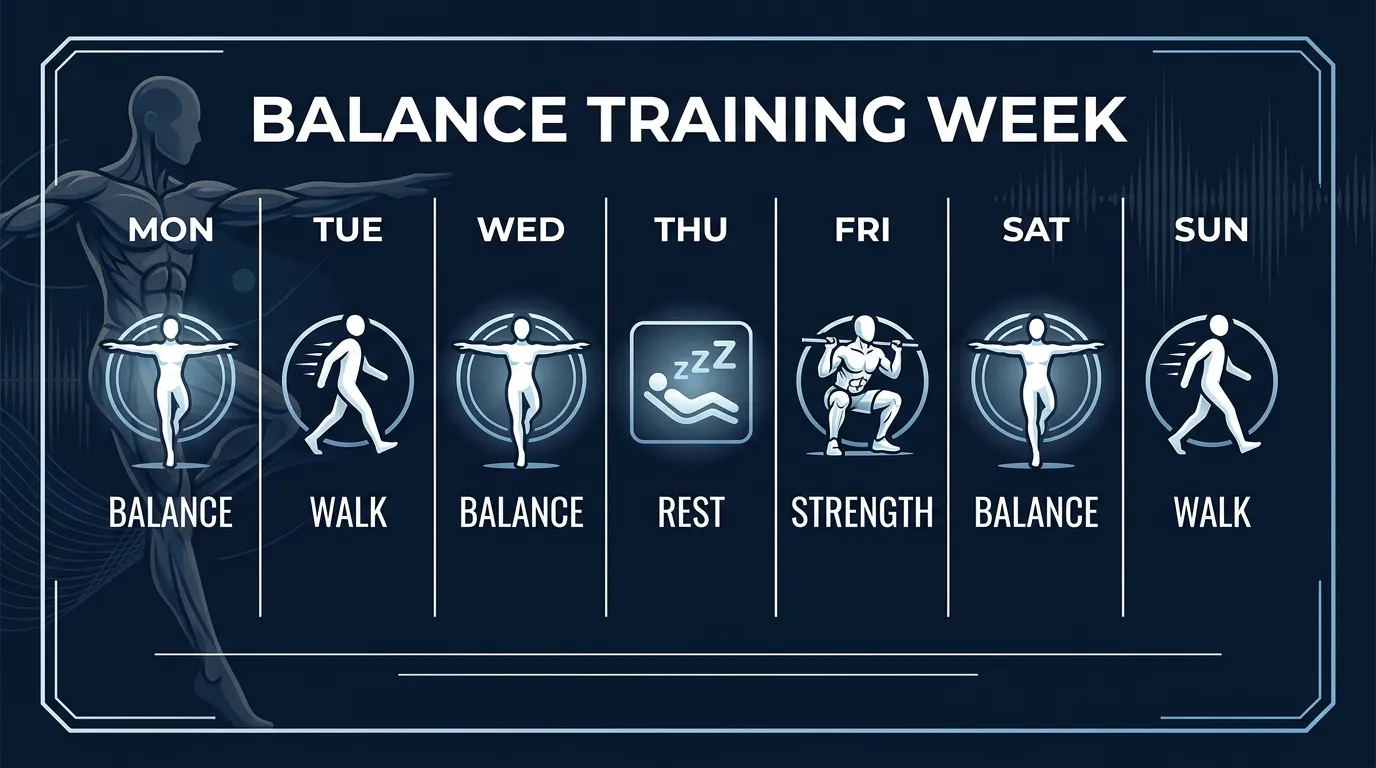
If you're already walking or doing cardio, keep doing that. It just isn't fall prevention. Layer on three short balance sessions a week. Single-leg stands while you brush your teeth. Heel-to-toe walks in your hallway. Slow weight shifts before bed. A structured ten-minute mobility flow that includes balance challenges. None of this requires a gym. It requires the consistency that turns these movements into a real intervention rather than a one-time experiment.
How FitCraft Handles Balance Training
Most fitness apps either ignore balance entirely or treat it as a five-minute warmup. That's not enough to produce the adaptations the research describes. FitCraft's mobility and yoga programs include balance-challenging movements as core work, not filler. Single-leg holds. Slow-tempo squats. Standing-balance progressions. Dynamic reach drills. Tai-Chi-style weight shifts.
An AI coach guides you through each session in 3D, demonstrating the position from multiple angles so you can match the form on your own. The interactive 3D exercise demos let you rotate the view and zoom in on the working leg or hip if a movement is unfamiliar. As you progress through the program, the balance demand increases. Harder stances. Longer holds. Less external support.
Every FitCraft program is designed by an exercise scientist with a graduate degree in kinesiology and an NSCA strength certification, which matters here because balance training is one of the most "feel-it-out" categories of exercise. Done at the wrong dose, it either fails to produce adaptation (too easy) or risks a fall during training (too hard). The progression has to actually progress, and it has to do so within the bounds of what the research supports.
References
- Sherrington C, Fairhall NJ, Wallbank GK, Tiedemann A, Michaleff ZA, Howard K, Clemson L, Hopewell S, Lamb SE. "Exercise for preventing falls in older people living in the community." Cochrane Database of Systematic Reviews. 2019;1:CD012424. doi:10.1002/14651858.CD012424.pub2
- Robertson MC, Devlin N, Gardner MM, Campbell AJ. "Effectiveness and economic evaluation of a nurse-delivered home exercise programme to prevent falls." BMJ. 2001;322(7288):697-701. doi:10.1136/bmj.322.7288.697
- Li F, Harmer P, Fitzgerald K, et al. "Effectiveness of a Therapeutic Tai Ji Quan Intervention vs a Multimodal Exercise Intervention to Prevent Falls Among Older Adults at High Risk of Falling: A Randomized Clinical Trial." JAMA Internal Medicine. 2018;178(10):1301-1310. doi:10.1001/jamainternmed.2018.3915
- Sibley KM, Beauchamp MK, Van Ooteghem K, Straus SE, Jaglal SB. "Using the Systems Framework for Postural Control to Analyze the Components of Balance Evaluated in Standardized Balance Measures: A Scoping Review." Archives of Physical Medicine and Rehabilitation. 2015;96(1):122-132.e29. doi:10.1016/j.apmr.2014.06.021
- Bull FC, Al-Ansari SS, Biddle S, et al. "World Health Organization 2020 guidelines on physical activity and sedentary behaviour." British Journal of Sports Medicine. 2020;54(24):1451-1462. doi:10.1136/bjsports-2020-102955
Frequently Asked Questions
Does balance training actually prevent falls?
Yes, with high-certainty evidence. The Sherrington et al. (2019) Cochrane review of 108 trials and over 23,400 participants found that balance and functional exercise reduced the rate of falls in community-dwelling older adults by 24% (rate ratio 0.76). Combining balance training with resistance exercise reduced the rate of falls by 34%. Tai Chi reduced the rate by 19%. Walking-only programs and resistance training alone did not significantly reduce falls.
How much balance training do you need per week?
The trials with the strongest effects delivered around three hours per week of challenging balance work, sustained for at least three to six months. The 2020 World Health Organization guidelines recommend that adults 65 and older add multicomponent activity that includes functional balance and strength training at moderate or greater intensity on three or more days a week. Programs that drop below an hour a week or stop after eight weeks tend to lose their protective effect.
At what age should you start balance training?
Earlier than you think. Balance starts measurably declining around age 40 and accelerates after 60, but the protective benefit of training is well-documented from age 50 onward. The Sherrington Cochrane review focused on adults 60 and older, where one in three people falls each year. Starting in your 40s or 50s builds a buffer of postural control that takes longer to erode in later decades.
Is walking enough to prevent falls?
Walking-only programs did not significantly reduce falls in the Cochrane meta-analysis. Walking is excellent for cardiovascular health, blood sugar, and mood, but it does not challenge the postural-control systems that prevent a stumble from becoming a fall. To reduce fall risk, you need exercises that challenge balance directly, such as single-leg stands, heel-to-toe walking, narrow-base movements, and Tai Chi.
Does FitCraft include balance training in its programs?
Yes. FitCraft's mobility and yoga programs include balance-challenging movements like single-leg holds, slow tempo work, and dynamic postural-control drills. An AI coach guides you through each session in 3D, demonstrating the position from multiple angles so you can match the form on your own. Your program adapts as you progress, raising the balance demand only when your earlier sessions show you're ready.