Walking is the most ordinary thing a body does. You probably do it without thinking. So it is strange to learn that how quickly you cover ground might tell a doctor more about your remaining life expectancy than your blood pressure or your cholesterol number. But that is roughly what the data say.
Researchers call this measure "gait speed", and they have been studying it for decades. It started as a tool for geriatric clinics. A 4-meter walking test, scribbled on a chart, used to flag patients at risk of falls and frailty. Then somebody pooled the cohort data. And the results were surprising enough that walking speed got promoted from clinical curiosity to one of the most reliable lifespan predictors in epidemiology.
Here is what the studies actually found, what they did not, and what any of it means for somebody who just wants to live longer and walks at a regular pace through the world.
The Research: What Studies Show
Studenski et al. (2011): The Pooled Gait Speed Analysis
This is the foundational study. Studenski and colleagues pooled individual data from 9 longitudinal cohort studies of community-dwelling older adults, ending up with 34,485 participants aged 65 or older. They followed them for 6 to 21 years, and they had measured every participant's usual walking speed at baseline.
The result was a clean dose-response curve. Every 0.1 m/s of additional gait speed was associated with a 12% reduction in all-cause mortality (HR 0.88, 95% CI 0.87-0.90, p<0.001). The curve held across age groups, across sexes, across study sites.
The practical numbers from this paper are still the reference points clinicians use:
- Below 0.6 m/s: elevated mortality risk. This is shuffling pace, common in advanced frailty.
- 0.8 m/s: the median for the pooled cohort. Population average for older adults.
- 1.0 m/s or above: above-average life expectancy for age and sex.
- 1.2 m/s or above: exceptional life expectancy. The top of the curve.
To put that in human terms, 1.0 m/s is about 2.2 mph. A casual stroll. 1.2 m/s is about 2.7 mph. Not running. Not even brisk. Just a confident, purposeful pace. The gap between "high mortality" and "exceptional longevity" turns out to be one mph.
Citation: Studenski S, Perera S, Patel K, et al. Gait speed and survival in older adults. JAMA. 2011;305(1):50-58.
Yates et al. (2017): UK Biobank, 420,727 Adults
The Studenski analysis was based on older adults and used directly-measured gait speed. Yates and colleagues took a different approach. They used UK Biobank's 420,727 middle-aged participants and asked them a simple question. Do you walk slow, average, brisk, or fast?
It is a crude measure. Self-report. One question. The researchers expected the signal to be weaker than what you get from a stopwatch test. It was not.
Over 6.3 years of follow-up, 8,598 participants died, including 1,654 from cardiovascular disease and 4,850 from cancer. Compared with fast walkers, slow walkers had hazard ratios for all-cause mortality of 2.16 (95% CI 1.68-2.77) in women in the bottom BMI tertile and 2.01 (1.68-2.41) in men in the bottom tertile. Roughly double the risk of death. The association held across BMI categories, although it was strongest in leaner participants.
Note what this study did not find: handgrip strength, also measured in UK Biobank, was a much weaker mortality signal than walking pace. The pace signal stayed after adjusting for grip strength, BMI, smoking, alcohol, education, and existing chronic disease. Something about how fast people choose to walk encodes more health information than the harder-to-measure things on that list.
Citation: Yates T, Zaccardi F, Dhalwani NN, et al. Association of walking pace and handgrip strength with all-cause, cardiovascular, and cancer mortality: a UK Biobank observational study. Eur Heart J. 2017;38(43):3232-3240.
Stamatakis et al. (2018): 50,225 Walkers, 11 British Cohorts
Stamatakis and colleagues pooled data from 11 UK population cohorts, focusing only on people who already walked at least sometimes. The 50,225-person sample was younger on average than Studenski's, with a mean follow-up of 9.2 years.
Compared with slow walkers:
- Average walkers had 20% lower all-cause mortality (HR 0.80, 95% CI 0.76-0.85)
- Brisk or fast walkers had 24% lower all-cause mortality (HR 0.76, 95% CI 0.69-0.85)
- Brisk or fast walkers had 21% lower cardiovascular mortality (HR 0.79, 95% CI 0.65-0.95)
The cancer mortality association was weaker and less consistent. The pattern that walking pace tracks heart-disease death more strongly than cancer death shows up across most of these studies. Cardiovascular fitness has a direct mechanistic link to how fast you can walk. Cancer biology does not.
Citation: Stamatakis E, Kelly P, Strain T, et al. Self-rated walking pace and all-cause, cardiovascular disease and cancer mortality: individual participant pooled analysis of 50 225 walkers from 11 population British cohorts. Br J Sports Med. 2018;52(12):761-768.
Dempsey et al. (2022): The Telomere Causality Hint
Observational studies cannot prove causation. The whole field has lived with that caveat for years. Dempsey and colleagues tried to get closer to causality using a different statistical tool. They studied 405,981 UK Biobank participants and applied Mendelian randomization, an approach that uses genetic variants associated with walking pace as instruments to test whether the pace itself drives the outcome.
The outcome they measured was leukocyte telomere length, a cellular marker of biological aging. Steady and brisk walkers had longer telomeres than slow walkers. And the Mendelian-randomization analysis suggested the direction of causality ran from walking pace to telomere length, not the other way around. In plain language, brisker walking appears to actually slow a biological clock, not just correlate with people whose clock was already slower.
This study did not prove that walking faster makes you live longer. But it nudged the evidence from "association" toward "plausibly causal" for the first time at this scale.
Citation: Dempsey PC, Musicha C, Rowlands AV, et al. Investigation of a UK biobank cohort reveals causal associations of self-reported walking pace with telomere length. Commun Biol. 2022;5:381.

Why This Matters for Your Fitness
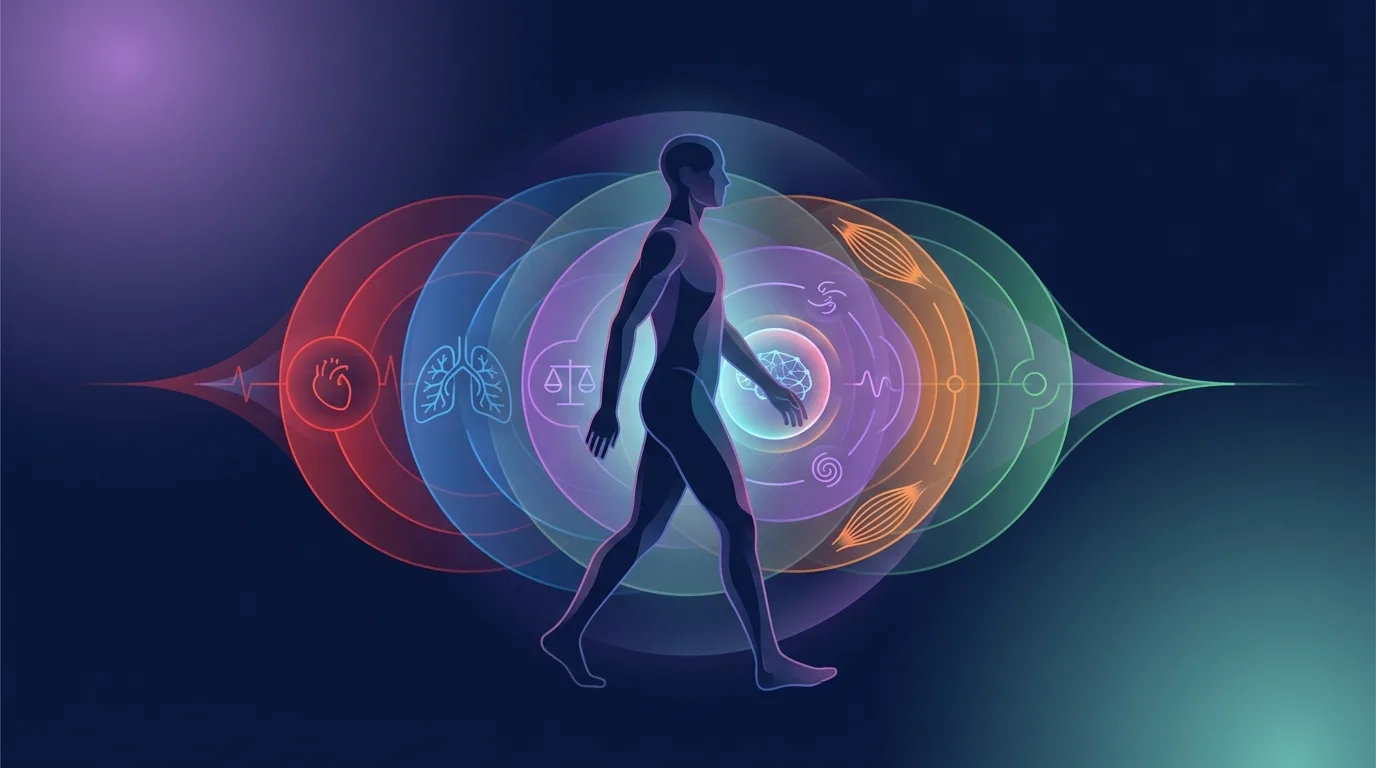
The reason walking pace works so well as a health marker is that it integrates an absurd number of systems into one observable number. To walk briskly you need a working heart and lungs. You need leg muscle and tendon stiffness that can produce force fast. You need balance and proprioception so the brain trusts the body. You need the cognitive bandwidth to plan and adjust each step.
Any one of those systems degrading shows up as a slower pace. So gait speed becomes a kind of poor-person's clinical summary. Cheap, non-invasive, and unusually predictive.
For a younger reader the implications are subtle. You probably are not at the bottom of the curve. But the curve still tilts the same way at your end. The systems that produce a brisk pace, leg strength, aerobic fitness, balance, are the same systems that age over the next several decades. Slowing the decline now is far cheaper than trying to reverse it at 70.
This is the same logic behind cardiorespiratory fitness as a longevity predictor and behind the step-count mortality research. Different measure, same underlying message. Your body in motion, sustained over years, is one of the strongest health interventions ever measured.
How to Apply This in Practice
You can measure your own walking speed at home in about a minute. Mark off 4 meters (or 13 feet, close enough). Stand a few steps behind the start line so you are already at your usual pace when you cross it. Time how long it takes to cover the 4 meters. Divide. That is your gait speed in meters per second.
If you want to be more accurate, the geriatric-clinic version uses 6 meters and you record the middle 4 meters of that walk, ignoring the first and last meter of acceleration and deceleration. Either way, take a few trials and average them.
What if your number is on the slower end? Three things move the needle, all of which the research supports:
- Strength train, especially the lower body. Leg power is the single biggest mechanical input to walking speed. Squats, lunges, step-ups, calf raises. Two sessions a week is the floor that the resistance training and mortality literature consistently identifies.
- Walk more, ideally with some pace variation. Brisk segments improve cardiovascular capacity. A 30-second pace burst every few minutes is enough to count. Pure leisurely walking will improve general health but not push pace upward as fast.
- Train balance and mobility. A lot of slow walking is balance hesitation, not actual leg-weakness. Single-leg stance practice, hip-mobility work, and a regular yoga or mobility session reduce the unconscious caution that drags pace down.
None of this requires a gym. None of it requires equipment beyond what fits in a duffel bag. The barrier is consistency, not knowledge. Which is the part most fitness research keeps circling back to.
Enjoying the article?
Start a new fitness routine today, written by me and coached by the AI I designed.
Take the Free Assessment Free • 2 minutes • No credit cardCommon Misconceptions
Misconception: "Walking speed is just a proxy for age"
It is not. The Studenski pooled analysis stratified by age and the dose-response held within every age band. A 70-year-old walking at 1.2 m/s had a better survival outlook than a 70-year-old walking at 0.8 m/s, after adjusting for sex, body mass, smoking, blood pressure, and prior cardiovascular events. Pace carries information that age alone does not.
Misconception: "Slow walkers can just speed up to get the benefit"
This is the most common misreading of the research. Walking pace is a marker. Forcing yourself to walk faster for 30 minutes a day, without addressing the underlying leg strength, cardiovascular capacity, or balance that produces a pace, is probably not the lever. The Dempsey 2022 Mendelian-randomization data suggests pace itself may contribute causally to telomere length, but the most plausible mechanism is that habitual brisker walking reflects and reinforces the underlying fitness over years. Train the system. Pace follows.
Misconception: "It only matters if you are old"
The Yates UK Biobank study had a mean age of 58. Stamatakis's pooled analysis included middle-aged adults too. The mortality signal showed up clearly in both. The thresholds (0.6, 1.0, 1.2 m/s) come from older-adult research, but the relationship between walking pace and risk is continuous and starts decades before the typical clinical use of the test.
What the Research Suggests Going Forward
Two things are reasonably settled. First, walking pace is one of the most useful low-cost health markers we have. It is on par with handgrip strength as a frailty predictor, and arguably better than it as a population-level mortality signal, with the UK Biobank data showing pace stayed predictive after adjusting for grip.
Second, the systems that drive walking speed (leg strength, cardiovascular fitness, balance) respond to ordinary training. That is the good news buried under all this mortality data. The marker is modifiable. Not magic, not instant, but the trajectory of your pace over the next 20 years is something you can influence.
What is less settled is exactly how much of the longevity benefit comes from the act of walking briskly itself, versus from the fitness that produces the brisk pace. The 2022 telomere data tilts toward "the walking matters too", but the mechanism is not fully nailed down. For practical purposes, this distinction does not change what you should do. Train the underlying fitness. Walk regularly. Pay attention if your pace starts dropping faster than expected. That is enough.
The bigger point is that walking pace gives people a free, honest progress signal. It cannot be gamed. It does not require a wearable. It tracks something that genuinely matters. In a field full of biomarkers that need lab visits and longitudinal blood work, that is rare.

Honest Limitations
A few important caveats. The bulk of this evidence is observational. Even the Mendelian-randomization paper, while methodologically stronger than a typical cohort study, is not a randomized trial. Nobody has randomly assigned people to walk faster for 20 years and measured what happened. The case for causality is built on consistency, dose-response, biological plausibility, and triangulation across study designs. That is the same standard cardiovascular epidemiology uses for things like blood pressure and lipids, but it is not the same as a controlled experiment.
Self-reported pace, which is what the UK Biobank studies used, is a blunt instrument. People answer based on identity and context, not stopwatch precision. The signal still shows up because the categories (slow, average, brisk) correlate strongly with measured pace, but the cutoffs are softer than the Studenski 4-meter test numbers.
And the thresholds were derived in older-adult populations, mostly American and European. They may not transfer cleanly to younger adults or to populations with different body sizes and walking cultures. The direction of the relationship is robust. The exact 1.0 and 1.2 m/s cutoffs are convenient round numbers from one specific analysis.
References
- Studenski S, Perera S, Patel K, et al. "Gait speed and survival in older adults." JAMA 305.1 (2011): 50-58. doi:10.1001/jama.2010.1923
- Yates T, Zaccardi F, Dhalwani NN, et al. "Association of walking pace and handgrip strength with all-cause, cardiovascular, and cancer mortality: a UK Biobank observational study." European Heart Journal 38.43 (2017): 3232-3240. doi:10.1093/eurheartj/ehx449
- Stamatakis E, Kelly P, Strain T, et al. "Self-rated walking pace and all-cause, cardiovascular disease and cancer mortality: individual participant pooled analysis of 50 225 walkers from 11 population British cohorts." British Journal of Sports Medicine 52.12 (2018): 761-768. doi:10.1136/bjsports-2017-098677
- Dempsey PC, Musicha C, Rowlands AV, et al. "Investigation of a UK biobank cohort reveals causal associations of self-reported walking pace with telomere length." Communications Biology 5 (2022): 381. doi:10.1038/s42003-022-03323-x
- Banach M, Lewek J, Surma S, et al. "The association between daily step count and all-cause and cardiovascular mortality: a meta-analysis." European Journal of Preventive Cardiology 30.18 (2023): 1975-1985. doi:10.1093/eurjpc/zwad229
Frequently Asked Questions
How fast is a healthy walking speed?
In the 34,485-adult pooled analysis by Studenski et al. (JAMA, 2011), gait speeds at or above 1.0 m/s (about 2.2 mph) tracked with above-average life expectancy in adults 65 and older. Speeds at or above 1.2 m/s (about 2.7 mph) linked to exceptional life expectancy. Speeds below 0.6 m/s flagged high mortality risk. Each 0.1 m/s faster pace was associated with a 12% lower mortality risk (HR 0.88).
Does walking pace actually predict lifespan?
Yes, with strong consistency across cohorts. The UK Biobank study of 420,727 adults (Yates et al., 2017) found that self-reported slow walkers had roughly twice the all-cause mortality of fast walkers over 6.3 years. A pooled analysis of 50,225 walkers across 11 British cohorts (Stamatakis et al., 2018) found 24% lower all-cause mortality and 21% lower cardiovascular mortality in brisk walkers compared to slow walkers. These are associations, not proven causation, but the dose-response pattern is consistent.
Can I increase my walking speed and live longer?
The observational evidence is suggestive but not definitive. A 2022 Mendelian randomization study of 405,981 UK Biobank participants (Dempsey et al., Communications Biology) found evidence that walking pace causally affects telomere length, a marker of biological aging. That said, walking speed reflects underlying fitness, leg strength, balance, and cardiovascular health. Improving any of those probably matters more than the pace number itself. Training those systems through regular walking, strength work, and mobility tends to raise pace as a side effect.
How do I measure my own walking speed?
Mark off 4 to 6 meters (about 13 to 20 feet) on a flat surface. Walk at your usual comfortable pace. Time the middle portion with a stopwatch, ignoring the first and last meter so you measure steady-state walking. Divide distance by time to get meters per second. A 4-meter walk in 4 seconds equals 1.0 m/s. Researchers call this the "4-meter gait speed test", and it is the same protocol used in geriatric clinics.
Does FitCraft help improve walking speed?
FitCraft does not specifically train walking pace, but the underlying systems that drive walking speed are leg strength, cardiovascular capacity, and mobility. FitCraft programs cover all three with strength training (dumbbells, bands, bodyweight), cardio, and mobility work, with the AI coach Ty demonstrating exercises through interactive 3D models. The gamification layer is designed to help you stay consistent enough for the underlying fitness to actually improve.