- Timing beats duration. Reynolds et al. (Diabetologia, 2016) found 10-minute walks after each main meal lowered post-meal glucose by 12% in adults with type 2 diabetes, beating a single 30-minute walk at any other time of day.
- Even tiny walks work. Buffey et al. (Sports Medicine, 2022), pooling seven trials, found light-intensity walking breaks of just 2 to 5 minutes during prolonged sitting cut postprandial glucose by about 17% versus continuous sitting.
- The after-dinner walk is the most valuable. Evening insulin sensitivity is lower, dinner is usually the biggest meal, and the post-dinner walk drove a 22% drop in 3-hour glucose in Reynolds 2016.
- Three short walks beat one long walk. DiPietro et al. (Diabetes Care, 2013) found three 15-minute postmeal walks improved 24-hour glycemic control in older adults at risk for diabetes, with the post-dinner walk doing most of the work.
- The mechanism is muscle. Walking right after eating recruits leg muscles to pull glucose out of the bloodstream while you're still absorbing the meal. Wait two hours and you miss most of that window.
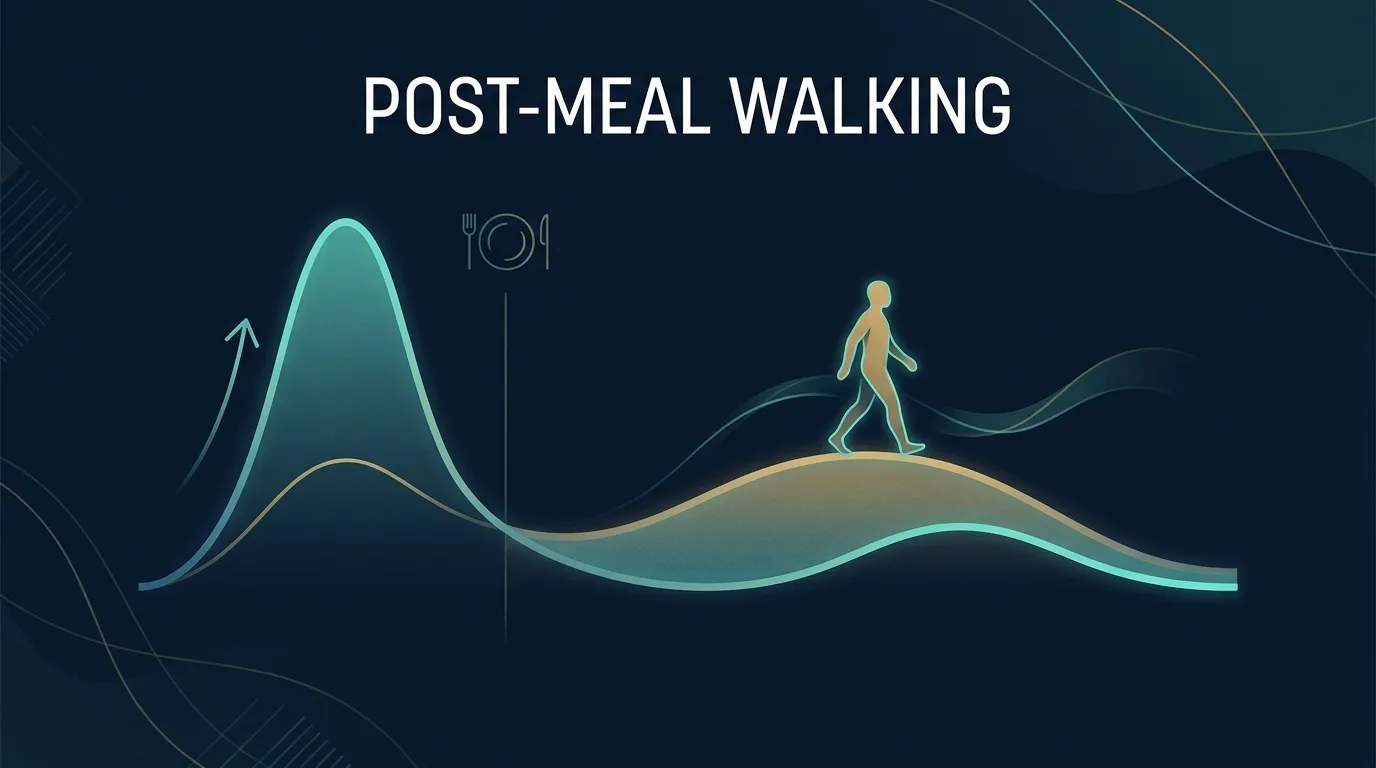
You've probably heard the advice. Walk after dinner. Don't sit right down on the couch. Take a lap around the block. It sounds like one of those bits of folk wisdom that turn out to be mostly vibes. So I went looking for the actual research, and the picture is genuinely interesting. Short walks taken right after eating consistently outperform the same total walking time done in one block earlier or later. Not by a little. By 12 to 22% in the most-cited trials.
And it's not a quirk of one study. Three independent trial designs, in three different populations, point at the same finding. Walking matters most while your body is absorbing the meal. The exact dose is small. 10 minutes. Sometimes even 2 to 5. The catch is the timing.
So here's what we're going to do. We'll walk through the three studies that built the evidence. We'll get into why this works mechanistically. And we'll close with a clean, practical protocol that fits into a normal day without turning every meal into a project.
The Research: What Studies Show
Three trials carry most of the weight here. They're not a perfectly matched set, but together they cover the population span from healthy older adults to people with established type 2 diabetes.
Reynolds 2016: The 10-Minute Rule in Type 2 Diabetes
The cleanest piece of evidence comes from Reynolds and colleagues (2016) in Diabetologia. The team ran a randomized crossover trial in 41 adults with type 2 diabetes (mean age 60). For two weeks, participants got advice to walk 30 minutes a day at any time of day. For another two weeks, they got advice to walk 10 minutes after each main meal. Continuous glucose monitors tracked their actual numbers around the clock.
Post-meal blood glucose levels dropped 12% on average when participants walked after meals, versus walking the same total time at one other point in the day. The bulk of that effect came from the post-dinner walk, where the 3-hour glucose excursion fell by 22%, particularly when the meal was carbohydrate-heavy.
The size of that effect is hard to ignore. Twelve percent off the average daily post-meal glucose, from doing the same total walking but moving the timing, is a result you'd normally associate with a new medication trial. The study had clean continuous glucose data and a within-subject crossover design, which means each participant served as their own control. That removes most of the noise that usually plagues lifestyle research.
DiPietro 2013: Three Short Walks in Older Adults
DiPietro and colleagues (2013), in Diabetes Care, took a different cut at the same question. Their participants were 10 inactive adults over 60 with fasting glucose in the prediabetic range (105 to 125 mg/dL). The team compared three conditions: three 15-minute postmeal walks per day (right after breakfast, lunch, and dinner), a single 45-minute sustained walk in the morning, and a single 45-minute sustained walk in the late afternoon. The total walking time was matched across conditions.
The 24-hour glycemic control was similar between the three-walk and the morning-walk groups. But the post-meal walks were dramatically better at controlling the post-dinner glucose specifically. The post-dinner 3-hour glucose was much lower after the three-walk protocol than after either of the single-bout walks. The dinner walk did the heavy lifting.
The practical takeaway is the same as Reynolds. You don't need more total walking to get more glucose benefit. You need to put some of it right after the biggest meal of the day. The dinner-after-walk is the highest-leverage 15 minutes in your week.
Buffey 2022: Even Two-Minute Walks Help
If Reynolds and DiPietro established that post-meal walking works, Buffey and colleagues (2022) in Sports Medicine asked how small the dose can get. The team ran a systematic review and meta-analysis of seven randomized trials in healthy adults. The trials compared three conditions: prolonged uninterrupted sitting, sitting broken up by short standing breaks, and sitting broken up by short light-intensity walking breaks. The break durations were small, typically 2 to 5 minutes, repeated every 20 to 30 minutes through the day.
Standing breaks reduced postprandial glucose by about 9.5% versus prolonged sitting. Light walking breaks reduced it by about 17%. Insulin dropped too. The total activity time in the walking-break condition averaged 28 minutes across the observation window, but it was split into very short bouts during the period when participants were absorbing meals.
This is the study the news cycle picked up in late 2022 with the headline "two minutes of walking after eating helps blood sugar." The headline is broadly fair. The mechanism Buffey found is identical to the Reynolds and DiPietro mechanism. Move while you're absorbing, and your muscles pull glucose out of the bloodstream before it spikes.
Why This Works: Muscle as a Glucose Sink
The mechanism is more interesting than "exercise burns sugar." It's specifically about the timing of muscle contraction relative to nutrient absorption.
When you eat a meal, especially one with carbohydrate, glucose appears in your bloodstream over a roughly 30 to 120-minute window as it's absorbed from the small intestine. The body responds by releasing insulin from the pancreas, which signals tissues to pull glucose out of the blood. In people with good metabolic health, this happens smoothly and glucose returns to baseline within about two hours. In people with insulin resistance or type 2 diabetes, the glucose curve goes higher and stays elevated longer.
Here's the part that makes post-meal walking work. Contracting skeletal muscle can pull glucose out of the bloodstream without insulin. This is a separate pathway, mediated by a glucose transporter called GLUT4 that translocates to the muscle cell membrane when the muscle contracts. So a working leg muscle is an alternative glucose sink. If you start walking right when glucose is rising, your legs absorb a meaningful share of it directly, taking pressure off the insulin pathway.
This is also why timing matters so much more than total minutes. Walking two hours after a meal, when most of the glucose has already been cleared, doesn't help with that meal's curve. Walking before a meal helps a little (it sensitizes muscle for what's coming) but not as dramatically. Walking during the absorption window is when the GLUT4 pathway lines up with the incoming sugar load.
And it's a piece of why we cover so much non-exercise activity thermogenesis and walking speed and longevity on this site. Light, frequent movement isn't a watered-down version of "real" exercise. It's a different physiological tool that works on different problems. Resistance training and structured cardio build long-term capacity. Post-meal walking handles the day-to-day glucose curve.
Get an evidence-based plan built for you
FitCraft, our mobile fitness app, pairs you with an AI coach who builds you a personalized plan around your goals, schedule, and fitness level. Every FitCraft program is designed by Domenic Angelino, MPH (Brown University) and NSCA-CSCS, with research published in the Journal of Strength and Conditioning Research and Medicine & Science in Sports & Exercise.
Take the Free Assessment Free • 2 minutes • No credit cardHow to Run This in Real Life
The protocol is short enough to fit on a fridge magnet.
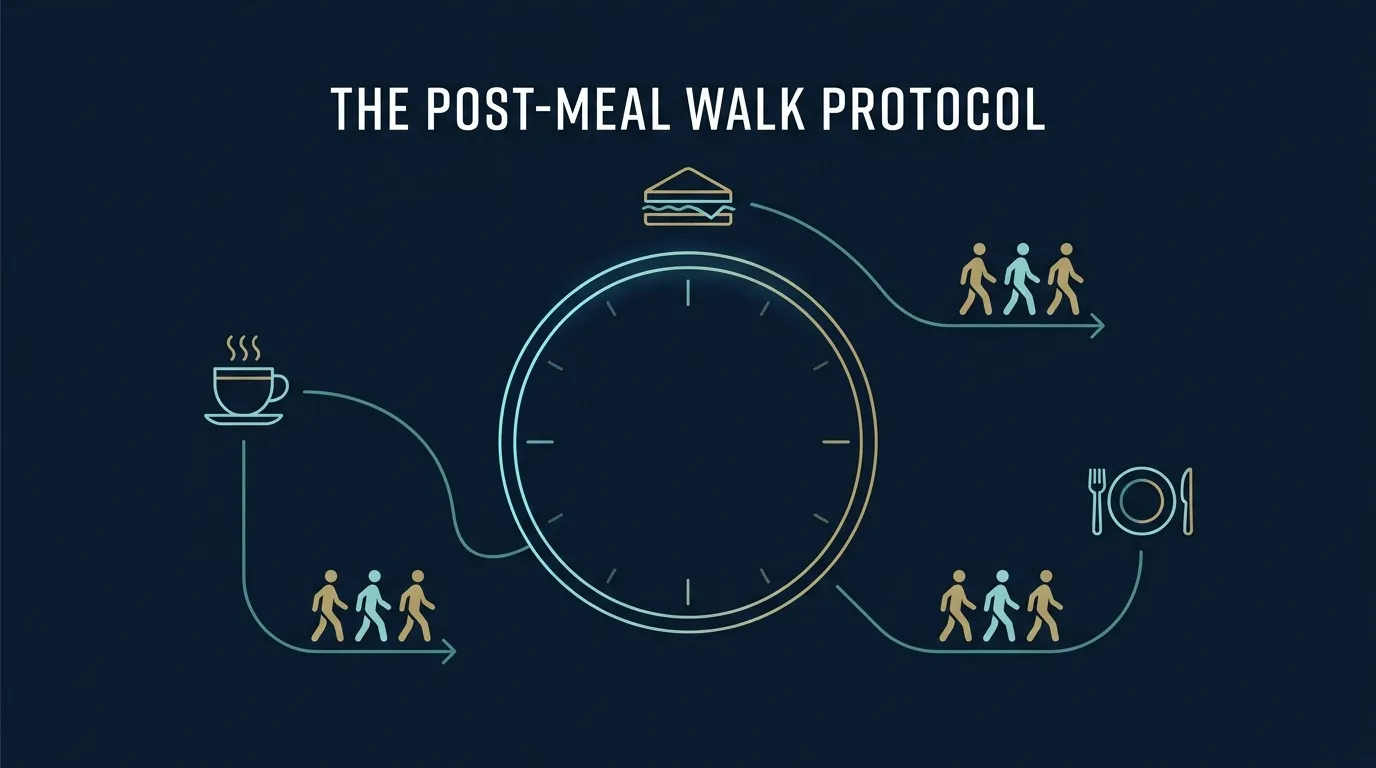
Walk for 10 to 15 minutes within 30 minutes of finishing your meal. That's the whole thing. The pace should be conversational, around 3 mph or a comfortable 20-minute mile. You're not training. You're moving while you absorb.
If you can only do one walk a day, do it after dinner. The post-dinner walk is the highest-leverage 15 minutes because evening insulin sensitivity is lower, dinner is typically the largest carbohydrate meal, and the alternative (sitting on the couch all evening) is the worst case for the glucose curve. The dinner walk does the most because the baseline it's improving is the worst.
If you can do three, do three. Ten to fifteen minutes after breakfast, lunch, and dinner. That's the dose DiPietro 2013 used, and it produced the cleanest 24-hour glycemic profile.
If you can only do two minutes, do two minutes. Buffey 2022 is reassuring on this. The dose-response curve is steep at the low end. Going from zero to two minutes captures more of the benefit, percentagewise, than going from 15 to 30. So a two-minute lap around the kitchen island after a Tuesday-night pasta meal is not symbolic exercise. It's a real metabolic event.
The pace doesn't need to be brisk. The DiPietro trial used 3.0 mph on a treadmill, a casual pace. Buffey 2022 looked at light-intensity walking specifically. The act of repeatedly contracting the leg muscles is what triggers the GLUT4 pathway, not the intensity. A leisurely loop is enough.
Common Misconceptions
Misconception 1: "If I just hit my 10,000 steps, when I take them doesn't matter."
Step counts are useful but the timing premium is real. Reynolds 2016 had participants who hit similar daily step totals in both arms of the study, but the meal-timed walking produced 12% lower post-meal glucose. The total daily steps were the same. The timing was different. Daily step targets are a fine North Star for cardiovascular and longevity reasons (we covered the evidence in our piece on 10,000 steps and what the research actually says), but they're a blunt instrument for glucose control. For glucose specifically, when you walk matters as much as how much.
Misconception 2: "It only works if you have diabetes."
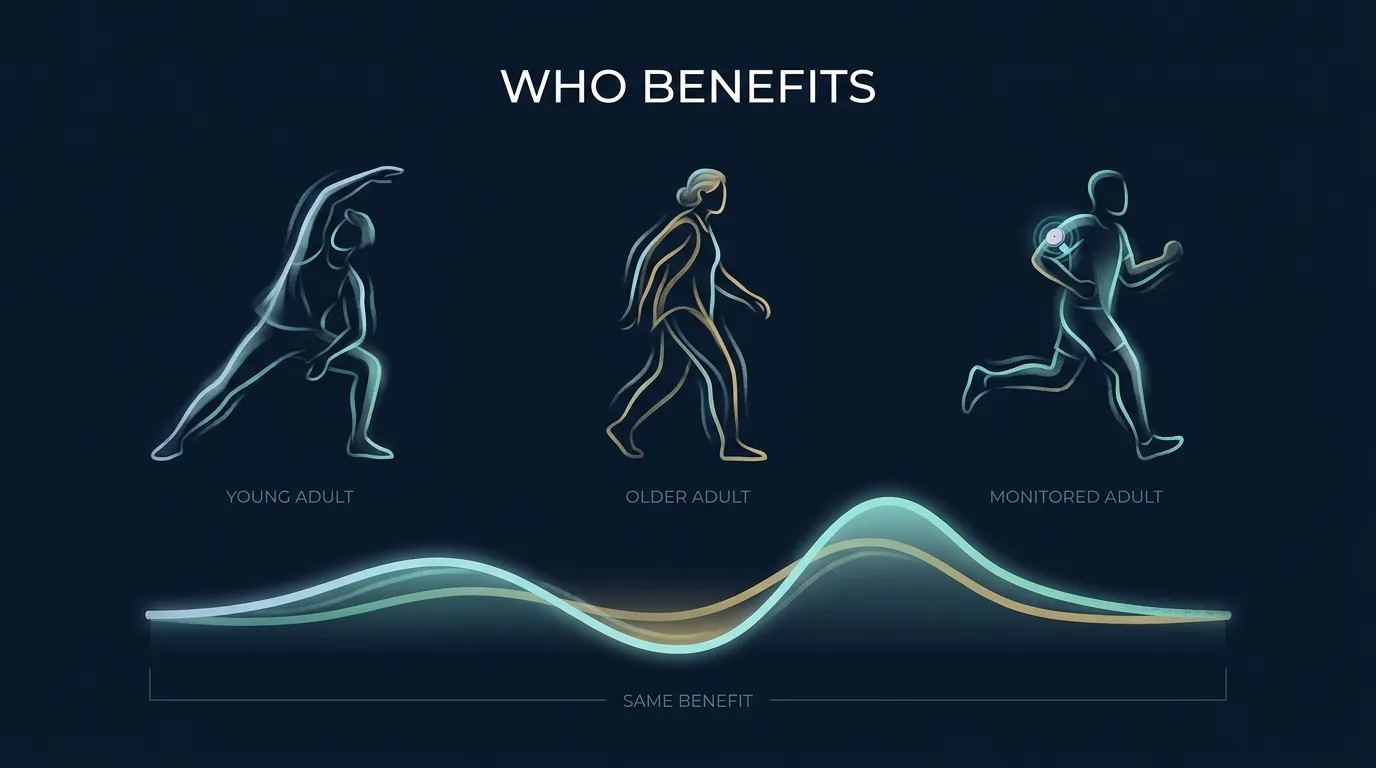
The Engeroff 2023 meta-analysis pooled 81 trials and found post-meal exercise lowered glycemic response in healthy adults too, not just in those with impaired glucose tolerance. The effect size is larger in people with worse baseline control, which makes sense. There's more room to move the needle. But healthy adults still see lower peaks and lower area-under-the-curve. The chronic exposure over years of post-meal glucose spikes is one of the inputs to long-term metabolic disease risk, so flattening the curves matters before any clinical diagnosis appears.
Misconception 3: "I should walk hard to maximize the effect."
The research doesn't support that. The most-studied protocols use light-to-moderate walking, around 2 to 3 mph. Buffey 2022 specifically examined light-intensity walking and saw the 17% glucose drop. High-intensity exercise right after a meal can actually slow gastric emptying and cause GI discomfort, and there's some evidence that very vigorous post-meal exercise can transiently raise blood glucose via stress hormones before lowering it. Stick with comfortable walking. The point is to be moving during absorption, not to push your heart rate.
What the Research Suggests Going Forward
Step back, and the post-meal walking literature is unusually clean. Three independent trial designs (Reynolds randomized crossover, DiPietro within-subject comparison, Buffey systematic review of seven trials) all point at the same conclusion. The mechanism is well-understood (insulin-independent GLUT4 glucose uptake in contracting skeletal muscle). The intervention is essentially free and has no downside. The dose-response curve is steep at the low end, so even minimal compliance pays off.
Two honest caveats. First, the Reynolds and DiPietro trials are small (n of 41 and 10 respectively). The Buffey meta-analysis pools larger samples but is studying a slightly different question (interrupting sitting in general, not specifically meal-timed walks). Larger pragmatic trials would tighten the effect-size estimates. Second, these are acute-glucose-response trials, not long-term outcome trials. Whether years of post-meal walking translates into measurably lower diabetes incidence or cardiovascular events would take a different study design. The mechanism is plausible and the proxy markers move in the right direction, but the long-arc evidence is inferred, not direct.
The practical forward advice is simple. Build a 10-minute walk after dinner into your evening routine. Treat it like brushing your teeth. If you have a desk job, add a two-minute lap a couple of times during the workday. None of this requires equipment, an app, or a plan. The leverage on glucose control per minute invested is hard to beat with anything else in the lifestyle medicine toolbox.
References
- Reynolds AN, Mann JI, Williams S, Venn BJ. "Advice to walk after meals is more effective for lowering postprandial glycaemia in type 2 diabetes mellitus than advice that does not specify timing: a randomised crossover study." Diabetologia 59.12 (2016): 2572-2578. doi:10.1007/s00125-016-4085-2
- Buffey AJ, Herring MP, Langley CK, Donnelly AE, Carson BP. "The Acute Effects of Interrupting Prolonged Sitting Time in Adults with Standing and Light-Intensity Walking on Biomarkers of Cardiometabolic Health in Adults: A Systematic Review and Meta-analysis." Sports Medicine 52.8 (2022): 1765-1787. doi:10.1007/s40279-022-01649-4
- DiPietro L, Gribok A, Stevens MS, Hamm LF, Rumpler W. "Three 15-min Bouts of Moderate Postmeal Walking Significantly Improves 24-h Glycemic Control in Older People at Risk for Impaired Glucose Tolerance." Diabetes Care 36.10 (2013): 3262-3268. doi:10.2337/dc13-0084
- Engeroff T, Groneberg DA, Wilke J. "After Dinner Rest a While, After Supper Walk a Mile? A Systematic Review with Meta-analysis on the Acute Postprandial Glycemic Response to Exercise Before and After Meal Ingestion in Healthy Subjects and Patients with Impaired Glucose Tolerance." Sports Medicine 53.4 (2023): 849-869. doi:10.1007/s40279-022-01808-7
Frequently Asked Questions
How long should you walk after eating to lower blood sugar?
Research suggests 10 to 15 minutes of light walking after a meal is the sweet spot. Reynolds et al. (Diabetologia, 2016) found that adults with type 2 diabetes who walked 10 minutes after each main meal saw a 12% drop in post-meal glucose compared to a single 30-minute daily walk, and a 22% drop after dinner specifically. Buffey et al. (Sports Medicine, 2022) showed even 2 to 5-minute light walks interrupting prolonged sitting blunted glucose response by about 17% on average.
When is the best time to walk after eating?
Within about 15 to 30 minutes of finishing the meal. Glucose typically peaks 30 to 90 minutes after eating, so the goal is to be moving while that absorption is happening. Walking during the rising part of the glucose curve recruits leg muscles to pull glucose out of the bloodstream, blunting the peak. Waiting two hours misses most of the window.
Is walking after dinner more effective than after breakfast or lunch?
Likely yes, especially for the evening meal. The Reynolds 2016 study found the post-dinner walk produced the largest single effect, a 22% reduction in 3-hour glucose levels. Researchers think this is because evening insulin sensitivity is lower than morning insulin sensitivity, dinner is often the largest carbohydrate meal, and people tend to sit immediately afterward. Walking after dinner does the most work because the baseline is the worst.
Does walking after meals help if I don't have diabetes?
Yes. Engeroff et al. (Sports Medicine, 2023), a meta-analysis pooling 81 trials, found post-meal exercise lowered glycemic response in both healthy adults and people with impaired glucose tolerance. The effect is larger in people with worse baseline glucose control, but even people with normal glucose metabolism see a measurable reduction in the peak and the area under the curve.
How fast should you walk after a meal?
Light to moderate is fine. The DiPietro 2013 Diabetes Care trial used a treadmill pace of 3.0 mph (about a 20-minute mile), which is a comfortable, conversational walking speed. Buffey 2022 looked at light-intensity walking specifically, around 2 mph. You don't need to push to a brisk pace. The act of repeatedly contracting the leg muscles is what does the work.