- One large RCT showed a real effect on sick days. Buijze et al. (2016) randomized 3,018 Dutch adults to 30, 60, or 90 seconds of daily cold showering for 30 days. The cold groups reported 29% fewer sick days from work versus control. Actual illness days didn't budge.
- Brown fat is real, and cold turns it on. Modern PET-CT studies show nearly every healthy adult activates brown adipose tissue under mild cold. The metabolic boost is real but small — measured in tens of calories, not hundreds.
- Don't ice-bath right after lifting. Roberts et al. (2015) found cold immersion after strength workouts cut both muscle and strength gains versus active recovery over 12 weeks. The anabolic signal gets blunted.
- Mood and alertness effects are mostly acute. The 2025 PLOS One meta-analysis found short-term mood and alertness boosts but couldn't confirm durable mental-health effects.
- 30 seconds is the dose. Longer wasn't better in the trial data. Start at the end of a warm shower. Don't make it a competition.
If you've been on social media this year, you've heard someone claim cold showers fixed their morning energy, depression, immune system, metabolism, and personal life. Reddit threads stretch into the hundreds of comments. Podcasts dedicate full episodes. The whole thing has a "miracle protocol" tone that makes any reasonable person suspicious. So let's just look at the evidence.
The short version: there's one big randomized trial that found a real effect on self-reported sick days, solid lab evidence for brown fat activation, and decent data on acute mood and alertness. There's also a clear caveat about strength training that nobody on social media mentions. And then there's a lot of hype that doesn't hold up. Below, the actual research, what it shows, what it doesn't, and how to use cold showers without overdoing it.
What the One Real Trial Found
Most claims about cold showers cite tradition or anecdote. There's exactly one large randomized controlled trial that tested the practice directly. It's worth knowing.
Buijze and colleagues (PLOS One, 2016) recruited 3,018 Dutch adults aged 18 to 65 who didn't have a cold-shower habit and didn't have severe medical conditions. They randomized participants to one of four groups: 30 seconds of cold water at the end of a normal warm shower, 60 seconds, 90 seconds, or no cold (control). The cold groups did this every day for 30 consecutive days. After the 30-day period, they could continue (or not) for another 60 days as they liked.
The headline result: a 29% reduction in self-reported sickness absence from work in the cold groups versus control (incident rate ratio 0.71, P=0.003). And here's the nuance everyone skips. The actual number of illness days was not statistically different. People in the cold groups got sick about as often, but they showed up to work anyway. So the effect is real, but it's about how you feel and function while mildly sick, not about avoiding illness.
The other surprise from the trial: dose didn't matter. 30 seconds produced the same benefit as 90. That's a lot more practical than the "1-hour ice bath every morning" framing some people push. Full immersion is a different stimulus with its own evidence base, and our review of ice bath benefits lines up the mood, immune and brown fat trials side by side.
Brown Fat: The Metabolic Story
One reason cold exposure became a fitness conversation is brown adipose tissue. Brown fat is a different tissue from regular white fat. It burns calories to produce heat instead of storing them.
van Marken Lichtenbelt and colleagues (NEJM, 2009) used PET-CT scans to image brown fat in 24 healthy men exposed to mild cold (around 16°C, 61°F) versus a thermoneutral environment. Brown fat lit up in 23 of the 24 participants when cold. Younger and leaner participants had more active brown fat than older or heavier ones. The finding overturned the old assumption that adult humans had only trace brown fat. We have more than we thought, and cold turns it on.
Hanssen and colleagues (Nature Medicine, 2015) took the metabolic story a step further. They cold-acclimated 8 adults with type 2 diabetes for 10 days (6 hours per day at 14-15°C). Non-shivering thermogenesis increased substantially. And here's the headline: insulin sensitivity improved by 43%. That's a clinically meaningful change in a population that struggles with metabolic dysregulation.
The catch. The metabolic boost from brown fat activation is small in absolute terms. Estimates run in the range of tens of kilocalories per day for typical cold exposure, not hundreds. Cold showers help. They don't replace movement. The combined picture matters: cold exposure plus regular exercise plus reasonable food beats any single thing in isolation. We've covered the broader metabolic story in our piece on sauna heat exposure, which sits on the opposite side of the temperature spectrum and tells a similar "small dose of stress, real adaptations" story.

The One Place Cold Backfires: Right After Lifting
Here's the part the cold-evangelist crowd doesn't talk about. If you lift weights and care about hypertrophy, what you do in the hour after your session matters.
Roberts and colleagues (J Physiol, 2015) ran a 12-week trial in 21 trained men. Both groups did the same strength training program twice a week. One group did 10 minutes of cold water immersion (10°C) after every session. The other did 10 minutes of active recovery (light cycling). At the end, the cold-immersion group had gained less muscle (measured by DEXA), less type II fiber size (by muscle biopsy), and less strength on the 1RM leg press and isokinetic testing.
The mechanism is settled. Cold blunts the acute mTOR signaling cascade that triggers muscle protein synthesis after resistance training. The body interprets cold as a stressor and shuts down some of the anabolic response. For endurance athletes who care about recovery between hard sessions and not about muscle growth, that trade-off can be fine. For anyone training for strength or hypertrophy, it's a real cost.
The practical rule. If you lift, don't take a cold shower or ice bath in the four to six hours after your workout. Save the cold for mornings, or for days you didn't train hard. The Roberts paper is the cleanest evidence we have, and it's been replicated. Don't sabotage your gains for a benefit you can get at a different time of day.
Want a training plan that respects recovery science?
FitCraft, our mobile fitness app, builds a personalized plan around your goals, schedule, and recovery. Every FitCraft program is designed by Domenic Angelino, MPH (Brown University) and NSCA-CSCS, with research published in the Journal of Strength and Conditioning Research and Medicine & Science in Sports & Exercise.
Take the Free Assessment Free • 2 minutes • No credit cardMood, Alertness, and the "I Feel Amazing" Effect
Almost everyone who tries cold showers reports the same acute effect. You step in, you gasp, your heart rate jumps, and you finish the shower feeling sharply awake. Is that a real effect or a placebo high?
Both, kind of. Cain and colleagues (PLOS One, 2025) recently pooled the studies on cold-water immersion and mental wellbeing in a systematic review and meta-analysis. The acute findings were consistent: cold exposure spikes norepinephrine and adrenaline, raises subjective alertness, and produces short-term improvements in self-reported mood and stress.
The longer-term picture is murkier. Most trials lasted 30 days or less. Most outcomes were self-reported. The 2025 review couldn't say definitively whether cold exposure produces durable mental-health benefits over months. The biology is plausible. The evidence is preliminary. So treat cold showers as a reliable acute mood and alertness tool, not as proven antidepressant therapy. If exercise is your strongest mental-health lever, this is a complement, not a substitute. We dig into the exercise side of that conversation in our review of exercise and depression research.
The Practical Protocol
Here's what the evidence actually supports.
How to start. Take your normal warm shower. Turn the water to as cold as it will go for the last 30 seconds. Breathe slowly through your nose. Don't fight the gasp reflex. After a week, you'll barely notice it. The Buijze trial used 30, 60, and 90 second protocols. There was no extra benefit from going longer. Start at 30. Stay at 30 unless you want to.
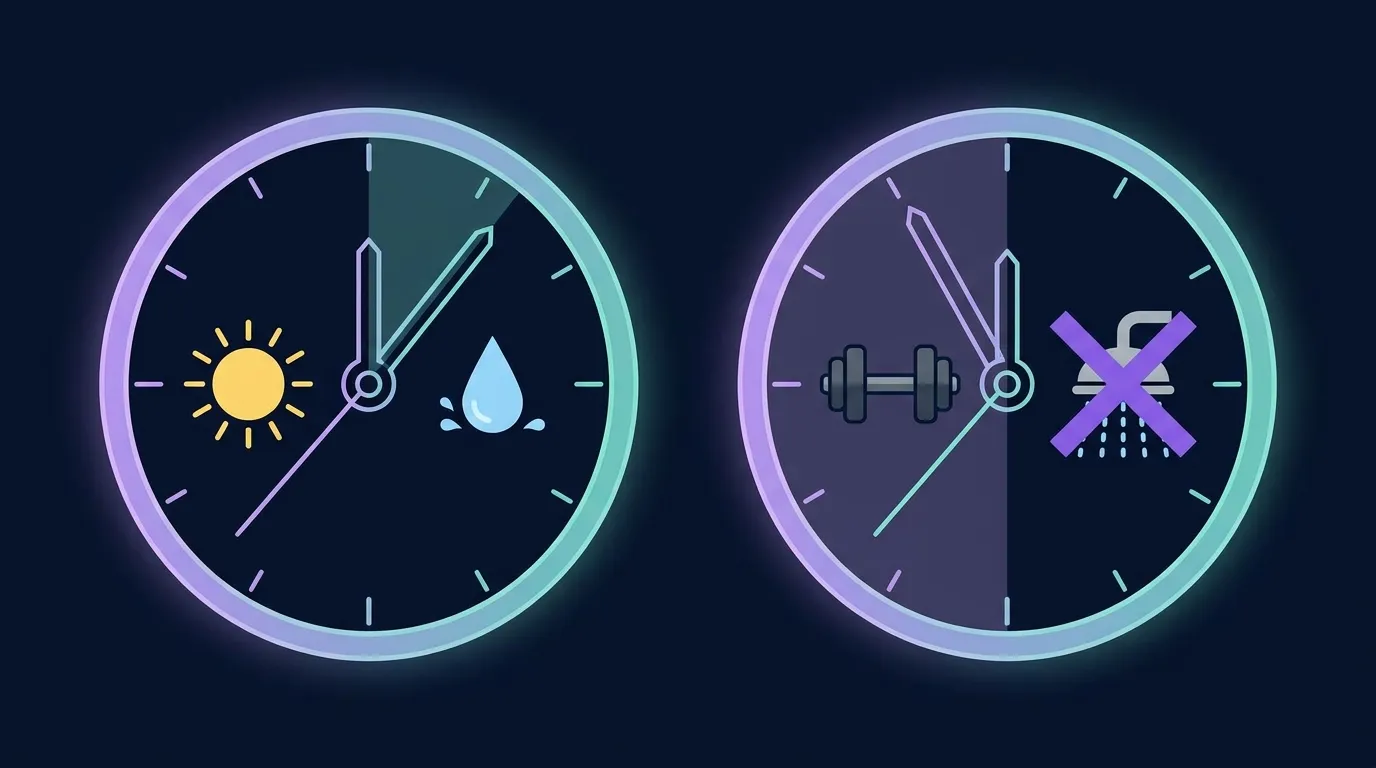
When to do it. Morning is ideal for the alertness effect. The norepinephrine spike helps reset circadian timing and makes you feel sharp. Just avoid the four-to-six-hour post-workout window if you lift seriously. Cold immersion right after strength training is the one clear case where the evidence says "don't."
What to skip. The $4,000 home plunge tubs, the elaborate breathing protocols, the contrast therapy rituals. None of those have evidence beyond a brief cold shower. If you fall in love with the practice and want to graduate to actual cold-water immersion, that's fine. But none of it is necessary. The trial that produced the only solid sick-day finding used a shower.
What the Hype Gets Wrong
Three things people commonly oversell about cold showers, and what the evidence actually says.
"It boosts your immune system." The Buijze trial showed a 29% reduction in self-reported sickness absence. It did not reduce actual illness days. The effect is on how you function while mildly under the weather, not on whether you catch viruses. Important distinction. Cold showers don't make you bulletproof against colds.
"It supercharges fat loss." Brown fat activation is real but small. Cold-induced thermogenesis adds tens of kilocalories a day in typical exposure. That's a rounding error against the calorie math that actually drives fat loss. A 20-minute walk burns more. The metabolic effect of cold is useful as a complement to exercise and nutrition, not as a primary lever.
"It cures depression and anxiety." The acute alertness boost is real. The norepinephrine spike feels good. But there's no high-quality long-term trial showing durable mental-health benefits from cold showers alone. Exercise has that evidence. Cold is a useful nudge. It's not a treatment.
The Honest Bottom Line
Cold showers are one of those rare habits where the upside is small but real and the downside is essentially zero (for healthy adults who aren't sitting in an ice bath right after a workout). You get a 30-second dose of stress that adapts your physiology in modest, useful ways. Sick days drop. Brown fat lights up. Morning alertness sharpens. None of it is dramatic. None of it requires expensive equipment.
The marketing claims around cold exposure have outrun the science by a wide margin. The actual research is more boring and more useful: a small consistent practice with measurable, modest benefits. Like most things that actually work in fitness and health, the protocol is unglamorous. The benefit accumulates over months. The discipline of doing it every day matters more than the duration of any single session. That same logic shows up in our reviews of streak psychology and small habits that change your life. Cold showers are the morning version of the same idea.
So if you want to try it, try it. Start tomorrow. 30 seconds. Don't make it a personality trait. Just notice whether you feel better.
Frequently Asked Questions
Are cold showers actually good for you?
The strongest evidence comes from Buijze et al. (PLOS One, 2016), a randomized controlled trial in 3,018 Dutch adults who took 30 to 90 second cold showers daily for 30 days. The cold-shower groups had a 29% reduction in self-reported sickness absence from work compared to control (incident rate ratio 0.71, P=0.003), though total illness days were not significantly different. Effects on mood and energy are widely reported anecdotally but weakly studied. The clearest verified benefit is on perceived alertness and sick-day frequency, not a long list of dramatic health changes.
Do cold showers really activate brown fat?
Yes, briefly. van Marken Lichtenbelt and colleagues (NEJM, 2009) used PET-CT scans to show that mild cold exposure activates brown adipose tissue in nearly all healthy adults, with the strongest activation in lean younger people. Hanssen et al. (Nature Medicine, 2015) showed that 10 days of cold acclimation increased non-shivering thermogenesis and improved insulin sensitivity 43% in adults with type 2 diabetes. The metabolic uptick is real but small in absolute calorie terms, measured in tens of kilocalories, not hundreds. Cold showers help; they don't replace exercise.
Will cold showers help me build muscle?
Probably the opposite if you do them right after lifting. Roberts et al. (J Physiol, 2015) randomized 21 trained men to 10 minutes of cold water immersion versus active recovery after strength training, twice a week for 12 weeks. The cold-immersion group gained less muscle mass (by DEXA) and less strength (by 1RM and isokinetic testing) than the active recovery group. The mechanism is real: cold blunts the anabolic signaling (mTOR phosphorylation) that triggers protein synthesis. If you lift, skip the cold for at least four to six hours after the session.
How long should a cold shower be?
In the Buijze trial, 30 seconds was as effective as 60 or 90 seconds at reducing sick days. There was no extra benefit to longer cold exposure. Start with the last 30 seconds of an otherwise warm shower. Build to 60-90 seconds if you want, but the data shows more is not better. For brown fat activation, sustained mild cold (15-17°C / 59-63°F) for longer (60-120 minutes) is what the metabolic studies used, which isn't practical at home. A morning cold shower is a manageable proxy.
Do cold showers improve mental health?
The evidence is preliminary. A 2025 PLOS One systematic review (Cain et al.) pooled cold-water immersion trials and found short-term improvements in subjective mood, alertness, and reductions in self-reported stress, but acknowledged that most studies were small and short. There's a clear acute effect: a cold shower spikes norepinephrine and adrenaline, which feels alerting and is sometimes interpreted as mood-lifting. Whether that translates into durable mental health benefits over months isn't well-established yet.
Are cold showers safe for everyone?
For most healthy adults, yes. They're not safe for people with cardiovascular disease, uncontrolled hypertension, recent cardiac symptoms, or Raynaud's-type circulatory issues without medical clearance. The sharp blood pressure spike during cold exposure (the cold pressor response) is the concern. Pregnant people and anyone with cold urticaria should also skip cold immersion. A brief 30-second cold rinse at the end of a normal shower is much less stressful than a full cold plunge, but the rules still apply.
References
- Buijze GA, Sierevelt IN, van der Heijden BC, Dijkgraaf MG, Frings-Dresen MH. "The Effect of Cold Showering on Health and Work: A Randomized Controlled Trial." PLOS One 11.9 (2016): e0161749. doi:10.1371/journal.pone.0161749
- van Marken Lichtenbelt WD, Vanhommerig JW, Smulders NM, et al. "Cold-Activated Brown Adipose Tissue in Healthy Men." New England Journal of Medicine 360.15 (2009): 1500-1508. doi:10.1056/NEJMoa0808718
- Hanssen MJ, Hoeks J, Brans B, et al. "Short-term cold acclimation improves insulin sensitivity in patients with type 2 diabetes mellitus." Nature Medicine 21.8 (2015): 863-865. doi:10.1038/nm.3891
- Cain T, Brinsley J, Bennett H, et al. "Effects of cold-water immersion on health and wellbeing: A systematic review and meta-analysis." PLOS One 20.1 (2025): e0317615. doi:10.1371/journal.pone.0317615
- Roberts LA, Raastad T, Markworth JF, et al. "Post-exercise cold water immersion attenuates acute anabolic signalling and long-term adaptations in muscle to strength training." Journal of Physiology 593.18 (2015): 4285-4301. doi:10.1113/JP270570