
The Reddit post that inspired this article was short. Someone on r/running asked: anyone else run with zero goals? No race, no plan, just... run? The comments split three ways. Some said "yes, that's the whole point." Some said "you're wasting your potential." A third group said "I keep telling myself I need a goal but I don't actually want one." That third group is bigger than most running content acknowledges.
The dominant story in running culture is that a race is what makes running "count." Training cycles, PRs, negative splits, taper weeks. All of it assumes there's a finish line waiting. Which is fine if you love the finish line. It's a problem if you don't, because the culture doesn't leave much room for the runner who just wants to go outside for 40 minutes and come back a better version of themselves.
The research is actually clear on this. Goal-less running is not a lesser form of running. In some ways it's the more sustainable form, because the motivation source lasts longer. Here's what studies on exercise motivation, running and mental health, and long-term adherence say.
The Motivation Research Says Intrinsic Beats Extrinsic Over Time
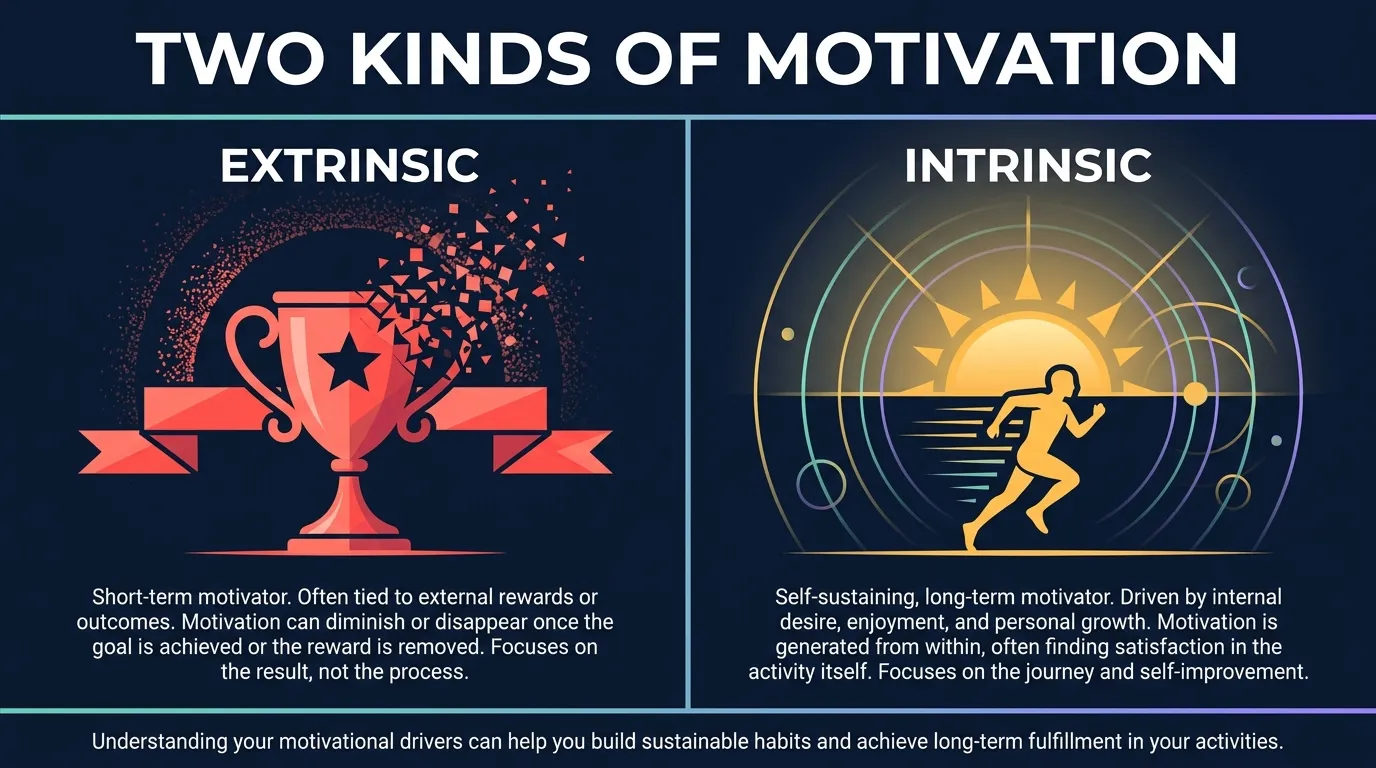
Self-determination theory is one of the most-tested frameworks in exercise psychology. It splits motivation into two rough buckets: extrinsic (I run because of an external reward or pressure, like a race, a coach's expectation, a weight-loss target) and intrinsic (I run because it feels good, because I like being outside, because I like the mental state after).
Teixeira, Carraça, Markland, Silva, and Ryan (2012) in the International Journal of Behavioral Nutrition and Physical Activity systematically reviewed 66 studies on SDT and physical activity. Their most interesting finding for our purposes is a temporal pattern. Identified regulation (I know I should exercise, so I do) and integrated regulation (exercise is part of who I am) predicted short-term adoption most strongly. But intrinsic motivation, the "I like this" flavor, predicted long-term adherence more strongly. In other words: goals are useful for starting. Enjoyment is what keeps you going.
That maps directly onto what happens in most goal-directed running plans. You train for a marathon, you cross the finish line, you feel great, and then you stop. Sometimes for a month. Sometimes forever. The finish line was the motivator, and the motivator is gone. The runner who was just running for the enjoyment doesn't have that problem. There's no cliff, because there was no target.
If you do decide you want a race on the calendar for a season, our 12-week half marathon training plan lays out the whole build, and it works just as well as a structured block you walk away from afterwards.
None of this means goals are bad. They're excellent for a specific job (short-term structure and effort). They're just not the version of motivation that survives ten years.
If you do want a target for one season, a standardised fitness race is a gentler first goal than a marathon, and our explainer on how a HYROX race is put together walks through the format and the realistic finish times before you enter one.
The Mental-Health Research Says the Dose Doesn't Need to Be Heroic
Oswald, Campbell, Williamson, Richards, and Kelly (2020) published a scoping review in the International Journal of Environmental Research and Public Health that covered 116 studies on running and mental health. The picture that emerged is consistent. Runners score lower on depression, anxiety, and stress than sedentary controls in cross-sectional data. Single-run acute bouts produce measurable mood improvements: 22 out of 23 single-bout studies in the review showed positive mental-health effects, often visible within 10 to 40 minutes of finishing. Longer-term running interventions also improve self-esteem and psychological coping.
Two things jump out for the goal-less runner. First, the mental-health benefit doesn't require racing or training peaks. Most of the studies in the Oswald review were on recreational or general-population runners, not competitive athletes. Second, the review flags a real risk on the other end of the spectrum: obligatory or excessive running is associated with worse mental-health outcomes and disordered eating patterns. That's a warning about compulsion, not about running itself. Goal-less running, if it's genuinely for enjoyment, sits comfortably away from that ceiling.
The Verhoeven et al. (2023) MOTAR study in the Journal of Affective Disorders is a striking recent trial. The researchers randomized 141 adults with a diagnosed depressive or anxiety disorder to either an SSRI (escitalopram or sertraline) or 16 weeks of outdoor running therapy at two 45-minute sessions per week. The mental-health outcomes were comparable: around 43% of the running group and 45% of the SSRI group no longer met diagnostic criteria at the end of the trial. The running group additionally improved on weight, waist circumference, systolic and diastolic blood pressure, heart rate, and heart-rate variability. The SSRI group did not.
The MOTAR protocol wasn't a race build. It was two moderate runs a week. That's the shape of most no-goal running: modest, consistent, non-heroic. And it's enough to produce clinically meaningful mental-health gains.
What "No Goal" Actually Looks Like In Practice
The r/running commenters who identified with no-goal running described a pretty consistent pattern. They run 3 to 5 days per week. Sessions run 20 to 60 minutes. Pace is mostly conversational. They vary the route to keep it interesting. They occasionally throw in a harder pickup if they feel like it. They don't track splits. They don't post on Strava. They stop when they want to stop.
That looks like undertrained running only if you compare it to a marathon block. Compared to a sedentary week, it's 90 to 300 minutes of moderate cardio, which lands squarely inside the physical-activity guidelines every major health body publishes. Compared to the average person who "started running" and dropped it inside 6 months, it's a version that has already proven itself sustainable.
If you want a light structural spine to keep it interesting without turning it into a plan, here's a shape that works:
- Most runs easy. If you can hold a conversation, you're at the right pace. This preserves the recovery bandwidth that lets you keep running week after week.
- One run a week that's a little different. Longer, hillier, faster in the middle mile, or a new route. Novelty is what keeps a repeatable habit from getting boring, and light variation preserves fitness better than the identical loop every day.
- Rest days when you want them. Not on a schedule. If the body says take today off, take today off. If the mood says get outside, get outside.
- No metrics you don't enjoy. If Strava makes running feel like a leaderboard, delete Strava. If a watch feels like accountability, keep the watch. This is the whole point of no-goal running: the tools serve you, not the other way around.
Some people do best with a very loose seasonal shape (more running in warmer months, less in colder months). Some people rotate running with walking, cycling, or bodyweight work. Nothing here has to look like a training plan. See our companion piece on the run-walk method for a low-pressure version of running that fits particularly well with a no-goal approach.
Knowing what to do is the easy part.
FitCraft, our mobile fitness app, pairs you with an AI coach who builds you a personalized plan around your goals, schedule, and fitness level. Every FitCraft program is designed by Domenic Angelino, MPH (Brown University) and NSCA-CSCS, with research published in the Journal of Strength and Conditioning Research and Medicine & Science in Sports & Exercise.
Take the Free Assessment Free • 2 minutes • No credit cardWhen a Loose No-Goal Approach Actually Isn't Serving You
The one honest counterpoint: some people find that without any external structure, running quietly slips from four days a week to two, then to one, then to a memory of a habit they used to have. The absence of a goal isn't the problem there; the absence of a structure is.
Loose structure without a race can look like: a specific weekly minimum (say, three runs) that you protect the way you'd protect a work meeting. A regular running partner. A standing appointment on the calendar. Or a very light seasonal target (run every Saturday morning through summer, then reassess) that isn't a race but is a commitment.
These are all still no-race patterns. They're just no-race patterns that acknowledge that pure "I'll run when I feel like it" sometimes decays into "I'll run when it's convenient" and then into never. If your no-goal running is thriving, ignore this section. If it's drifting, add one lightweight commitment. See our take on consistency over intensity for the deeper argument.
Why This Article Even Needs to Exist
Because most running content is written by and for people who race. That's fine. Racing is great. But the running population is much larger than the racing population, and the person running four times a week for 15 years with zero medals on the wall is not a lesser runner. In some ways they've solved the problem that stumps most goal-directed runners. They've built a habit that doesn't need a carrot to survive.
If that describes you, you don't need to justify it, and the research doesn't say you should. If it doesn't describe you and races are the thing that makes you show up, keep racing. Both patterns work. Both patterns produce cardiovascular, metabolic, and mental-health gains. Both patterns are valid. The failure mode is being told there's only one way to do it right.
For a wider look at why running-for-its-own-sake outperforms grinding through workouts you dread, see our article on dopamine and exercise and the piece on why willpower is the wrong tool for building an exercise habit.
Frequently Asked Questions
Is it okay to run without a goal or race?
Yes, and the research on long-term exercise adherence actually points this direction. Teixeira and colleagues (2012, Int J Behav Nutr Phys Act) systematically reviewed 66 studies on self-determination theory and physical activity and found that intrinsic motivation (running because it feels good) is a stronger predictor of long-term adherence than externally-driven motivation (running for a race or a PR). A race can be a useful short-term structure. It's not necessary, and for many people it eventually becomes the thing that ends the habit once the race is over.
Is running without a goal just being lazy?
No. Running steadily 3 to 5 days per week with no race on the calendar is more consistent training than most goal-directed runners actually achieve. The image of a runner grinding toward a marathon PR is compelling, but Oswald et al. (2020) note that recreational, non-competitive running is where most of the mental-health benefits of running live, and it's the pattern most likely to survive a year. Goal-less does not mean effortless. It means self-directed.
Will I lose fitness if I run without a plan?
Only if the plan-free running turns into consistently easy short jogs and nothing else. Fitness stays or improves when the training week includes some variation in pace and duration. A no-goal approach can absolutely produce that variation. Vary your route, occasionally run harder for a mile in the middle, occasionally go longer than usual, and you'll get most of the fitness benefit of a structured plan without the mental overhead. Fitness stalls when every run is identical, whether or not there's a goal.
Can running for mental health work without a training plan?
Yes. The Verhoeven et al. (2023) MOTAR study randomized 141 adults with depression and anxiety disorders to either an SSRI (escitalopram or sertraline) or 16 weeks of running therapy (two 45-minute sessions per week). Mental-health improvements were comparable between the two groups (around 43 to 45% no longer met diagnostic criteria after treatment), and the running group also improved on weight, waist, blood pressure, and heart-rate variability. The running protocol was structured but modest, not race-focused. That's the pattern most no-goal runners already run.
How often should you run if you have no specific goal?
Two to four runs per week, totaling 60 to 150 minutes, is the pattern most closely associated with mental-health and cardiovascular benefits in the observational literature. Verhoeven's MOTAR protocol used two 45-minute sessions per week and produced clinically meaningful results. There's no need to run more than that unless you're enjoying it and recovery keeps up. The safest ramp is to add no more than 10 to 15% of weekly volume week over week, whether you have a goal or not.