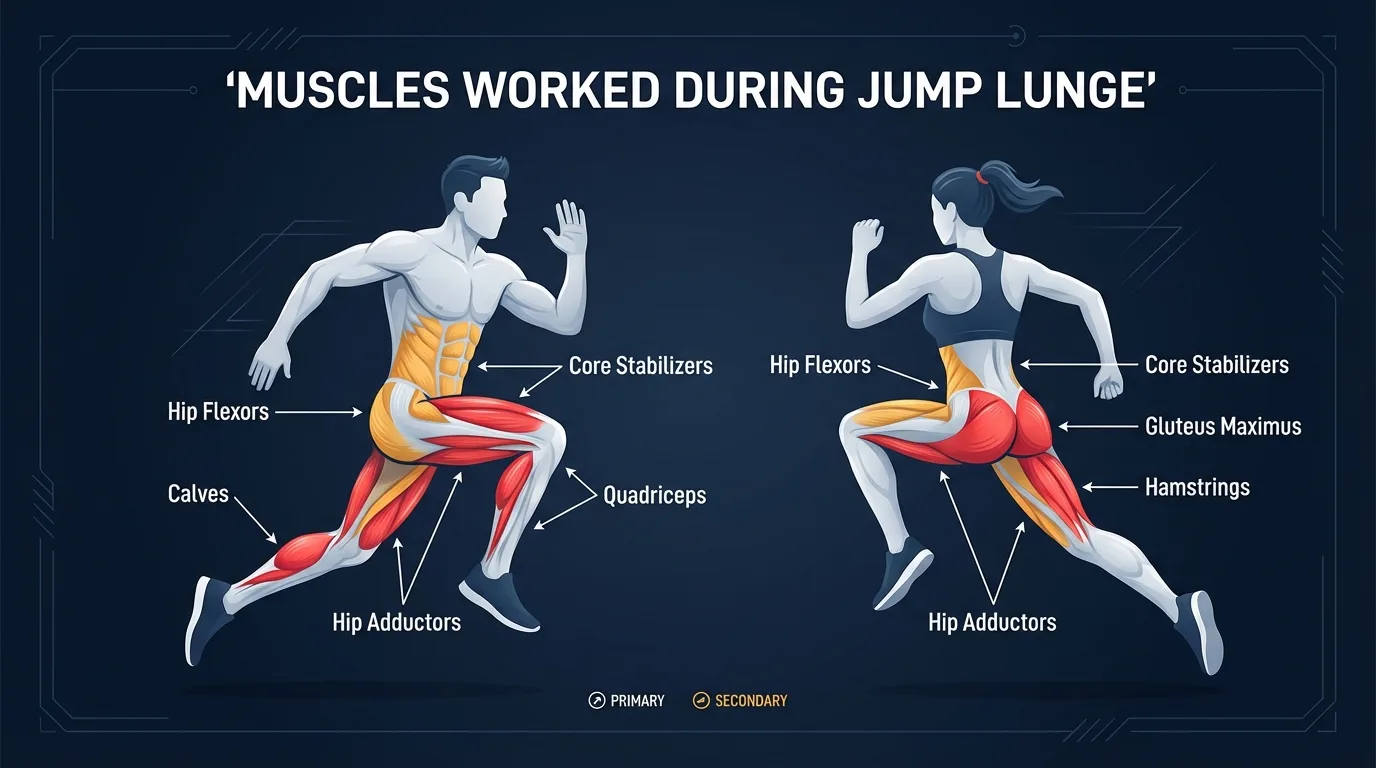
Muscles & Systems Worked
Primary movers. The quadriceps drive knee extension on the takeoff and absorb knee flexion on the landing (the eccentric load on the quads is what makes jump lunges so leg-fatiguing). The gluteus maximus drives hip extension at takeoff and assists the eccentric on the landing. The hamstrings work bi-articularly, extending the hip at takeoff and decelerating knee extension. The gastrocnemius and soleus drive ankle plantarflexion through the ball of the foot and absorb impact on touchdown.
Secondary movers. The hip flexors (iliopsoas, rectus femoris) actively swing the rear leg forward during the mid-air switch. The hip adductors and abductors fire to keep the knees tracking over the toes on landing and to prevent knee valgus collapse. The shoulders and biceps swing the arms upward to generate vertical momentum (arm swing adds 10 to 15 percent to jump height).
Stabilizers. The core (rectus abdominis, transverse abdominis, obliques) braces against trunk rotation and forward pitch on every landing. The spinal erectors maintain an upright torso. The ankle stabilizers (peroneals, tibialis anterior and posterior) control foot strike position so the load travels up the kinetic chain instead of rolling the ankle.
Energy systems and cardiovascular load. Jump lunges are powered primarily by the phosphocreatine and glycolytic systems for the first 15 to 30 seconds of work, with the oxidative system contributing more as sets extend past 30 seconds. Heart rate climbs into the 80 to 95 percent of max range within a few reps because of the large muscle mass recruited (both legs plus the core) and the explosive concentric output. The eccentric landings impose impact forces of approximately 2 to 3 times bodyweight per leg, which is the reason landing mechanics dominate the safety conversation. This is a mechanism description, not a citation claim. We dropped a previously listed citation on this page after verifying the PMID resolved to an unrelated lung-cancer paper.
Quick Facts
Quick Facts: Jump Lunges
- Equipment needed: Bodyweight only. A low box (6-12 inches) for the depth jump lunge variation.
- Difficulty: Advanced (expert-level plyometric, prerequisites apply).
- Modality: Plyometric · bilateral takeoff with alternating-leg landing · lower body power.
- Body region: Lower body (quads, glutes, hamstrings, calves) with core stabilization.
- FitCraft quest category: Strength / Power · HIIT conditioning.
How to Do Jump Lunges (Step-by-Step)
- Start in a lunge position. Step one foot forward into a standard lunge. Both knees bent to approximately 90 degrees. Front thigh parallel to the floor, back knee hovering just above the ground. Torso upright, core braced. Arms at your sides or bent at 90 degrees, ready to swing for momentum.
Coach Ty's cue: "Set the bottom position you want to land in. Your landing will mirror your start."
- Explode upward. Drive through both feet and jump straight up as high as you can. Swing your arms upward to generate momentum. The arm swing is proper plyometric technique and adds real jump height. Both feet should leave the ground completely. Extend your hips and knees fully at the peak of the jump.
Coach Ty's cue: "Jump up, not forward. Pick a spot on the ceiling and try to reach it with your head."
- Switch legs in the air. While airborne, scissor your legs to swap their positions. The front leg moves back and the back leg moves forward. This switch happens at the peak of your jump, not on the way down. If you're switching late, you're not jumping high enough.
Coach Ty's cue: "Switch at the top, not on the way down. Late switch means short jump."
- Land softly in a lunge. Land with the opposite leg forward, immediately bending both knees to absorb the impact. Land on the ball of your front foot first and roll to the heel. Your back knee should hover above the ground, just like it started. The landing should be quiet. If you can hear yourself landing, you're absorbing too much force through your joints instead of your muscles. Loud landing = end the set and rest.
Coach Ty's cue: "Land like a cat, not like a brick. Quiet feet means the muscles are doing the work."
Get this exercise in a personalized workout
FitCraft, our mobile fitness app, uses its AI coach Ty to program conditioning work like this into your plan at the right volume and intensity, based on your level, goals, and equipment. Ty was designed and trained by Domenic Angelino, MPH (Brown University) and NSCA-CSCS, with research published in the Journal of Strength and Conditioning Research and Medicine & Science in Sports & Exercise.
Take the Free Assessment Free · 2 minutes · No credit card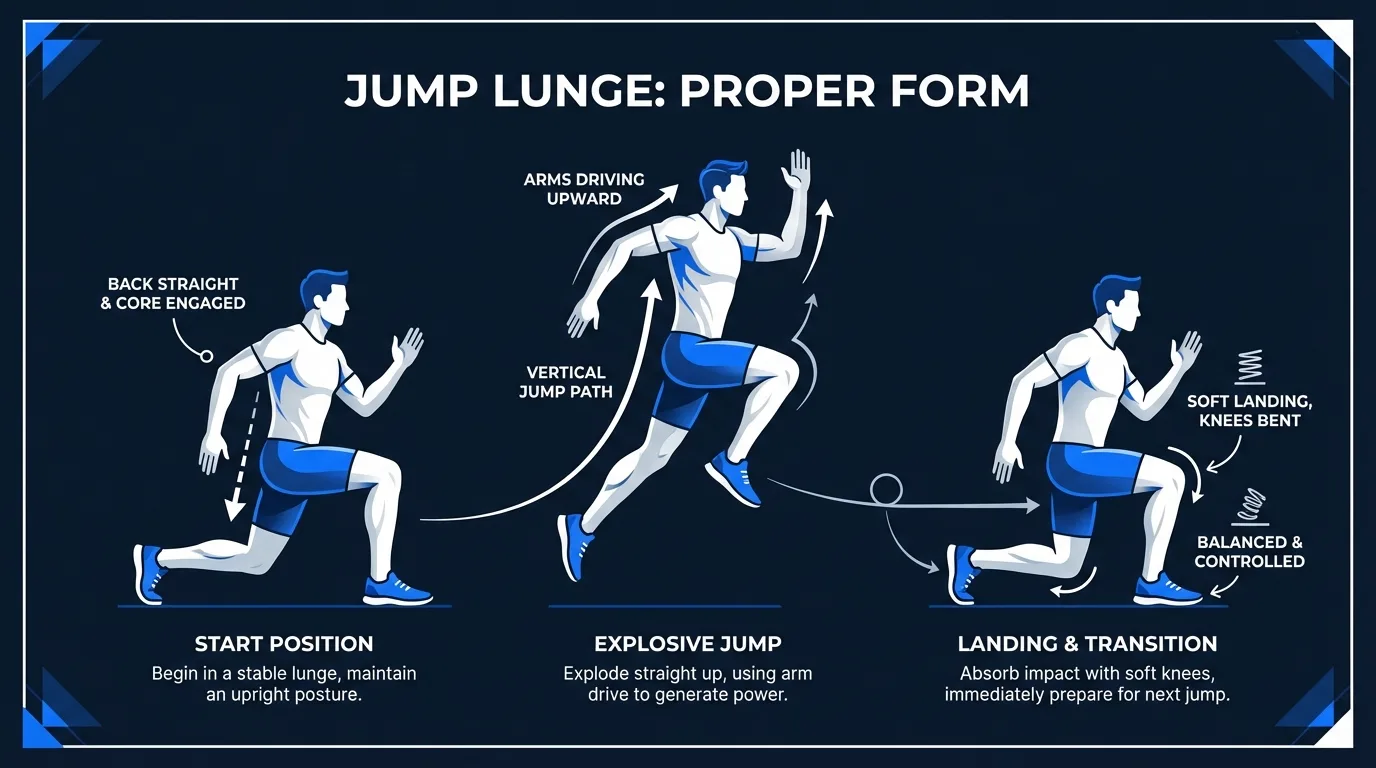
Common Mistakes to Avoid
Jump lunges go wrong fast when fatigue sets in. These are the mistakes that turn a great exercise into a joint-wrecking one.
- Hard, stiff-legged landings. Landing with straight or barely bent knees forces the impact through the joints instead of the muscles. This is the fastest route to knee pain from jump lunges. Bend your knees deeply on every landing. You should finish in a full lunge position, not a half-bent stance.
- Front knee caving inward on landing. Knee valgus under impact is dangerous. When your knee collapses inward during landing, the medial collateral ligament and meniscus take forces they aren't designed for. Push the knee out over the toes as you land. If you can't control it, you're not ready for this exercise.
- Leaning the torso forward. When the torso pitches forward, the lower back takes compressive load on each landing and the glutes disengage. Stay upright. If you're falling forward, your quads are probably too fatigued to control the deceleration. End the set.
- Incomplete leg switch. Barely swapping the legs in the air, resulting in an awkward half-staggered landing. This usually means the jump isn't high enough. Focus on jumping higher and completing the full switch at the top of the jump.
- Going too fast. Treating jump lunges like a speed drill. Each rep should have a distinct jump, switch, land, and reset phase. Rushing eliminates the power development benefit and degrades the landing mechanics. If you want speed, do mountain climbers. Jump lunges are about explosive force.
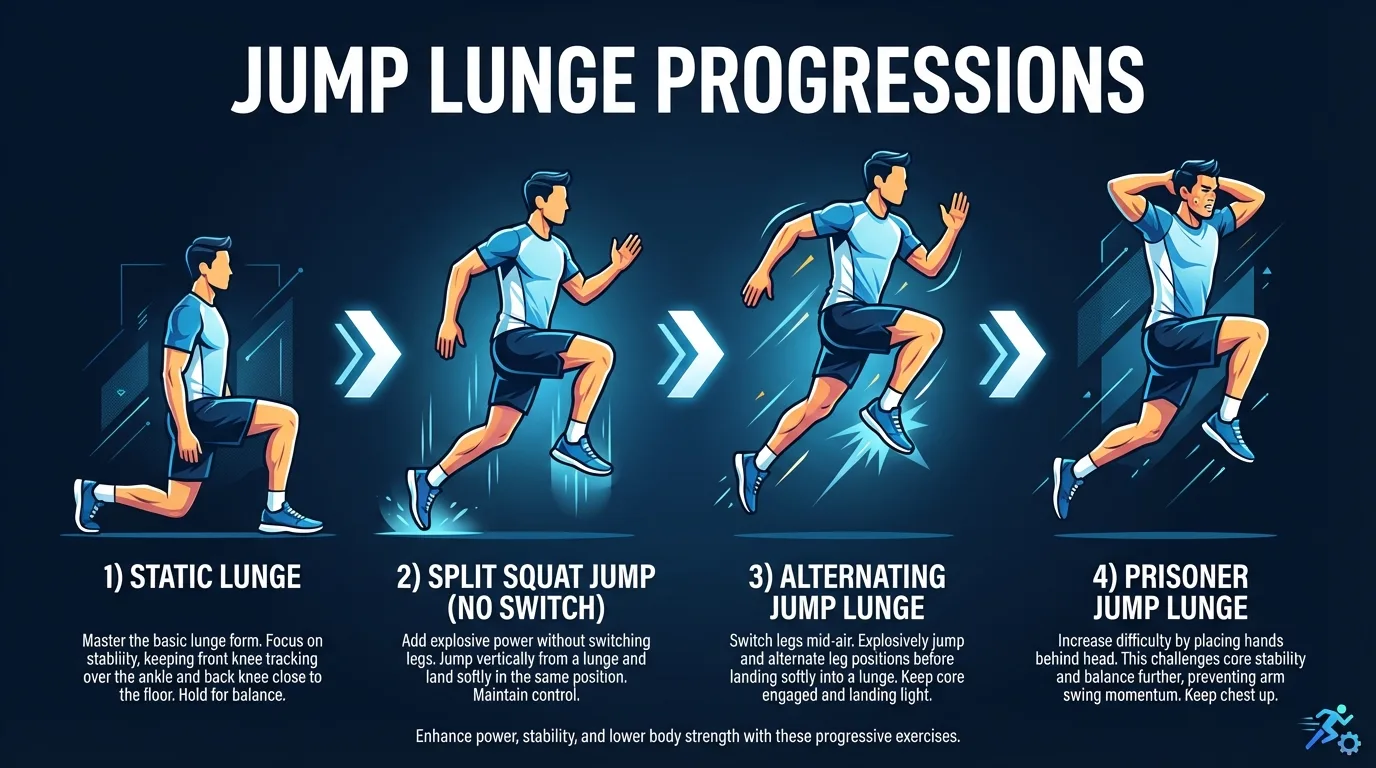
Variations: From Split Squat Jump to Depth Jump Lunge
Split Squat Jump, No Switch (Intermediate-Advanced)
Start in a lunge, jump up, and land in the same lunge position without switching legs. This removes the coordination challenge of the mid-air switch and lets you focus on the explosive jump and soft landing. Complete all reps on one side, then switch. This is the best entry point to plyometric lunge training and the prerequisite for the alternating version.
Alternating Jump Lunge (Advanced)
The standard version described above. Jump, switch legs mid-air, land in a lunge. This is the version Coach Ty programs most in FitCraft. Once you can do 3 sets of 8 per leg with quiet landings, you've built serious lower body power.
Prisoner Jump Lunge (Advanced)
Hands behind your head, fingers interlocked. Removing the arm swing makes the jump harder because you lose 10 to 15 percent of the height that arm momentum provides. This variation increases the power demand on the legs and adds a core stability challenge. Only attempt it after mastering the standard version.
Depth Jump Lunge (Expert+)
Step off a low box (6 to 12 inches), land in a lunge, and immediately explode upward into a jump lunge. The drop adds stored elastic energy that increases the power output of the subsequent jump. This is an advanced plyometric technique used in athletic training. Not appropriate for general fitness.
Alternative Exercises
- Jump squats: If the single-leg balance of jump lunges is too challenging, jump squats provide a similar plyometric stimulus with both feet landing simultaneously, which is more stable.
- Reverse lunges: If you want the lunge movement pattern without impact, standard reverse lunges target the same muscles in a controlled, non-plyometric way.
- Bulgarian split squats: A unilateral strength alternative that builds the single-leg quad and glute strength jump lunges demand.
When to Avoid or Modify Jump Lunges
Jump lunges are appropriate for healthy, conditioned adults, but several conditions warrant modification or full avoidance. Always consult a qualified healthcare provider or physical therapist before starting or returning to plyometric exercise, especially if any of the following apply.
- Current or recent knee pain or injury (patellofemoral pain, meniscus, ACL, MCL, post-surgical). Landing impact forces of 2 to 3 times bodyweight on a single leg aggravate almost every knee condition. Regress to reverse lunges or Bulgarian split squats for non-impact unilateral loading, and only return to jumping after PT clearance.
- Acute ankle, hip, or shin issues (sprained ankle, hip impingement, shin splints, plantar fasciitis). Plyometric loading exposes any lower-extremity weakness. Substitute non-impact alternatives until the tissue is symptom-free for at least two weeks.
- Cardiovascular disease or uncontrolled hypertension. Heart rate climbs into the 80 to 95 percent of max range within seconds. Get cardiologist clearance and stay within prescribed heart-rate zones.
- Second or third trimester of pregnancy, or the first 6 to 12 weeks postpartum. Hormone-driven joint laxity and pelvic-floor recovery prerequisites make jumping inappropriate. Substitute reverse lunges or low-impact step patterns and clear any return-to-impact with a pelvic-floor PT.
- Stress incontinence or pelvic-floor weakness. Jumping movements often trigger leakage. Build pelvic-floor strength with non-impact unilateral work first, or substitute split squats and Bulgarian split squats.
- Vertigo, balance disorders, or vestibular conditions. The mid-air leg switch and single-leg landing demand precise vestibular feedback. Avoid until cleared.
- Insufficient strength or balance base. If you can't perform 3 sets of 15 clean reverse lunges per leg, hold a static split squat at the bottom for 30 seconds, and balance on one leg for 20 seconds, the prerequisites aren't there yet. Build the base with split squats, reverse lunges, and calf raises before returning.
Related Exercises
- Lower-impact alternative within the same pattern: reverse lunges and split squats hit the same musculature without the landing impact.
- Unilateral strength foundation: Bulgarian split squats build the single-leg quad and glute strength jump lunges demand.
- Bilateral plyometric foundation: jump squats are the prerequisite plyometric movement before any unilateral landing.
- Conditioning circuit partners: push-ups, mountain climbers, burpees, and jumping jacks pair well in HIIT circuits.
- Core stability foundation: deadbugs, bird-dogs, and forearm planks build the anti-rotation core control needed for mid-air stability.
- Ankle and calf conditioning: calf raises and calf hops are the graduated-impact ladder into plyometric landing tolerance.
How to Program Jump Lunges
Programming volume and intensity for jump lunges depends on your training goal: power, conditioning, or HIIT circuit work. The ranges below follow the ACSM Position Stand on Resistance Training (Ratamess et al., 2009) adapted for plyometric loading, where rep counts run lower than for traditional strength work to preserve output quality.
| Level | Sets × Reps (per leg) | Rest between sets | Frequency |
|---|---|---|---|
| Beginner (split squat jumps only) | 2-3 × 5-6 | 90-120 seconds | 1-2 sessions/week |
| Intermediate (alternating jump lunges) | 3 × 6-8 | 90-120 seconds | 2 sessions/week |
| Advanced (prisoner or depth jump lunges) | 3-4 × 5-8 | 120-180 seconds | 2 sessions/week |
Where in your workout. Place jump lunges at the beginning of a session when you're fresh, after a thorough warm-up but before any sustained strength work. Power output drops fast when the nervous system is fatigued, so jump lunges done at the end of a workout (when they're often programmed as a "finisher") deliver more joint stress than training benefit. The exception is the HIIT-circuit use case: 20 to 30 seconds of work, 30 to 40 seconds rest, paired with non-impact movements like push-ups or mountain climbers. In that context the goal is metabolic, not power, and lower jump heights are acceptable as long as landing mechanics hold.
Form floor over rep targets. End every set the moment landings get loud, the front knee starts caving, or jump height drops enough that the leg switch becomes incomplete. Continuing past that point is an injury risk with no training benefit. Plyometric training is one of the few contexts where stopping a set with reps "left in the tank" is the right call.
FitCraft's AI coach Ty programs jump lunges based on your assessment results, including lunge strength, balance scores, and training history. Ty selects the appropriate variation (split squat jumps, standard alternating jump lunges, or more advanced progressions) and adjusts volume based on your level. The 3D demonstrations show landing mechanics frame by frame, which is the detail that separates safe execution from injury risk.
Frequently Asked Questions
Can I do jump lunges with knee pain?
Probably not, at least not yet. Jump lunges create landing impact forces of 2 to 3 times bodyweight on a single leg, which aggravates patellofemoral pain, meniscal issues, IT band syndrome, and post-surgical knees. If you have current knee pain, regress to non-impact alternatives like reverse lunges or Bulgarian split squats and get cleared by a physical therapist before introducing any jumping. When you do return, start with split squat jumps without the leg switch, on a low rep cap, and stop the set the moment landings get loud.
What muscles do jump lunges work?
Jump lunges target the quadriceps, gluteus maximus, hamstrings, and calves as primary movers. The core and hip stabilizers fire isometrically to control trunk position mid-air and absorb landing forces. The cardiovascular system is also doing real work: heart rate climbs into the 80 to 95 percent of max range within a few reps because of the high power output and the muscle mass recruited.
How many jump lunges should I do?
For power development, 3 to 4 sets of 5 to 8 reps per leg with 90 to 120 seconds of full rest between sets. For conditioning, 3 sets of 10 to 12 reps per leg with 60 to 90 seconds of rest. Quality of each rep matters more than total volume. When your landing gets sloppy or loud, end the set regardless of rep count.
Are jump lunges good for fat loss?
Jump lunges are one of the most metabolically demanding bodyweight exercises because they combine large muscle group recruitment with explosive effort. Heart rate climbs rapidly and the afterburn (excess post-exercise oxygen consumption) is real. But fat loss is set by overall caloric balance over weeks. No single exercise burns enough calories to outrun a poor diet.
Can beginners do jump lunges?
No. Jump lunges are an advanced plyometric exercise. Before attempting them, you should be able to perform 3 sets of 15 bodyweight reverse lunges with clean form on each leg, hold a static split squat at the bottom for 30 seconds, and balance on one leg for 20 seconds without wobbling. Start with split squat jumps (no leg switch) to build the explosive component, then graduate to alternating jump lunges once the landings are quiet and controlled.
Are jump lunges or jump squats harder?
Jump lunges are harder. The single-leg landing position of a lunge means one leg absorbs most of the impact, and the staggered stance is less stable than the parallel stance of a jump squat. Jump squats are a better entry point to lower-body plyometrics. Once jump squats feel controlled for 3 sets of 10 reps, progress to split squat jumps, then to alternating jump lunges.