The reach up is an advanced bodyweight core exercise that combines a full sit-up with a vertical overhead reach. It primarily trains the rectus abdominis, with help from the obliques, hip flexors, transverse abdominis, diaphragm, pelvic floor, and shoulder flexors. The defining cue is simple: curl up under control, reach straight toward the ceiling, then lower slowly without letting your feet pop up. Scale it by starting with crunches or deadbugs, then progress to standard reach ups, tempo reps, and light loaded variations.
Reach ups belong in the core exercises that move through range. Planks teach you to brace. Deadbugs teach you to keep the ribs and pelvis organized. Reach ups ask whether you can keep that control while your spine flexes and your arms travel overhead.
The exercise is basically a full sit-up with a vertical finish. You curl up from the floor, reach toward the ceiling at the top, and lower with control. That overhead reach makes the lever longer and gives the shoulders a small job, but the core still drives the rep.
Quick Facts: Reach Ups
- Equipment needed: Bodyweight; exercise mat optional
- Difficulty: Intermediate to advanced
- Modality: Core strength
- Body region: Core with light shoulder involvement
- FitCraft quest category: Core
Muscles Worked
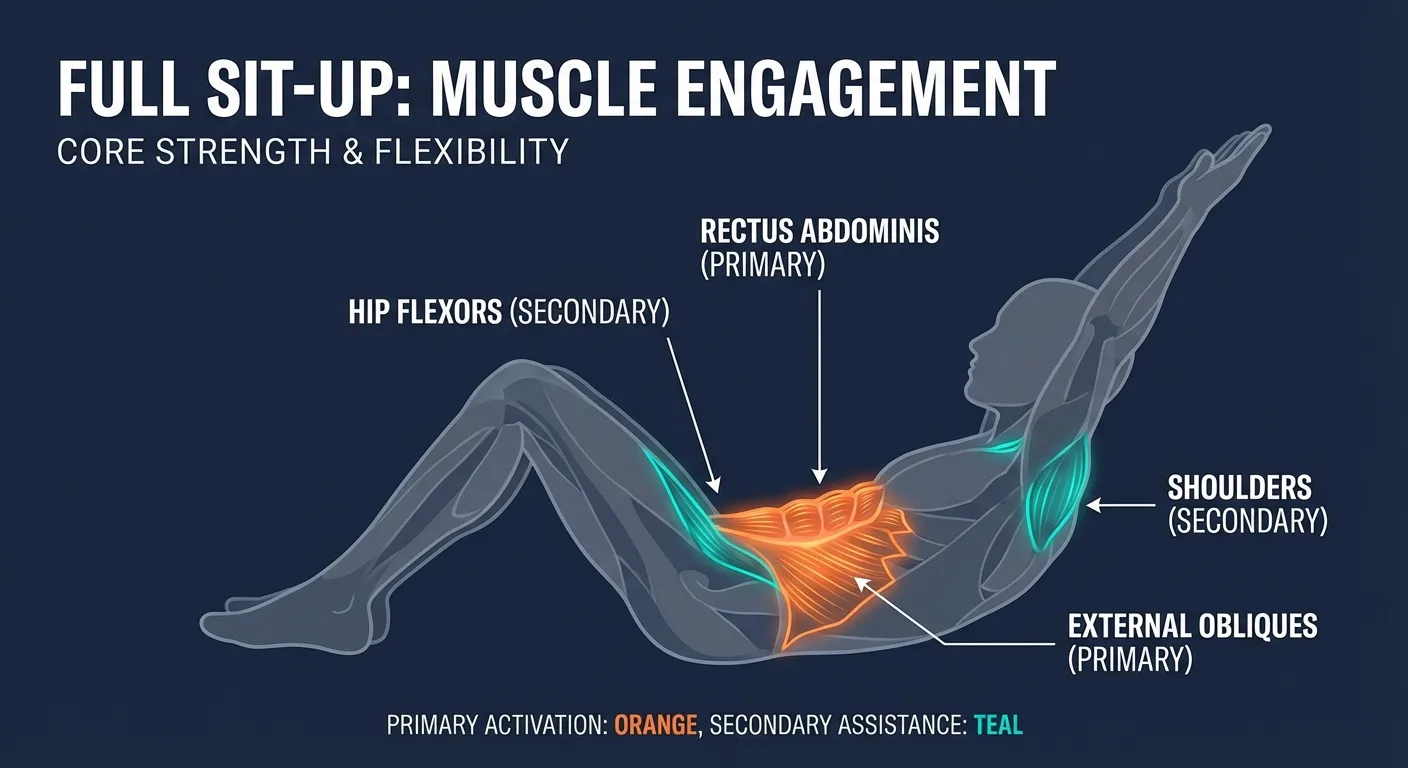
The rectus abdominis is the primary mover. It shortens as you curl your ribs toward your pelvis on the way up, then lengthens under control as you lower back to the floor.
The obliques help keep the trunk from twisting as the arms travel overhead. The hip flexors assist the full sit-up phase, especially once your torso passes the crunch range and moves toward upright.
The transverse abdominis, diaphragm, and pelvic floor create the deep-core brace that keeps the pelvis from dumping forward. The spinal erectors control the descent, while the anterior deltoids and serratus anterior help guide the overhead reach.
No exercise-specific PubMed, PMC, or DOI citation is included for reach ups in the verified FitCraft citation library. The muscle explanation here uses mechanism-based anatomy instead of a proxy citation from a different abdominal exercise.
Step-by-Step: How to Do a Reach Up
- Set your starting position. Lie on your back with knees bent and feet flat on the floor, about hip-width apart. Press your heels into the ground and extend your arms overhead along the floor.
- Brace and start to exhale. Pull your ribs down slightly, brace through your midsection, and begin exhaling as your head and shoulders leave the floor. Keep your neck long instead of tucking hard.
- Sit all the way up, then reach. Curl into a full sit-up while sweeping your arms forward and up. At the top, reach straight toward the ceiling while your feet stay planted.
- Lower with control. Reverse the motion slowly, lowering one segment of the spine at a time. Take two to three seconds on the descent and keep breathing.
- Reset each rep. Let your shoulders touch down with control, reset your breath, and begin the next rep only if your feet and ribs stay controlled.
Get this exercise in a personalized workout
FitCraft, our mobile fitness app, uses its AI coach Ty to program core stability work like this into your plan at the right volume and intensity, based on your level, goals, and equipment. Ty was designed and trained by Domenic Angelino, MPH (Brown University) and NSCA-CSCS, with research published in the Journal of Strength and Conditioning Research and Medicine & Science in Sports & Exercise.
Take the Free Assessment Free • 2 minutes • No credit card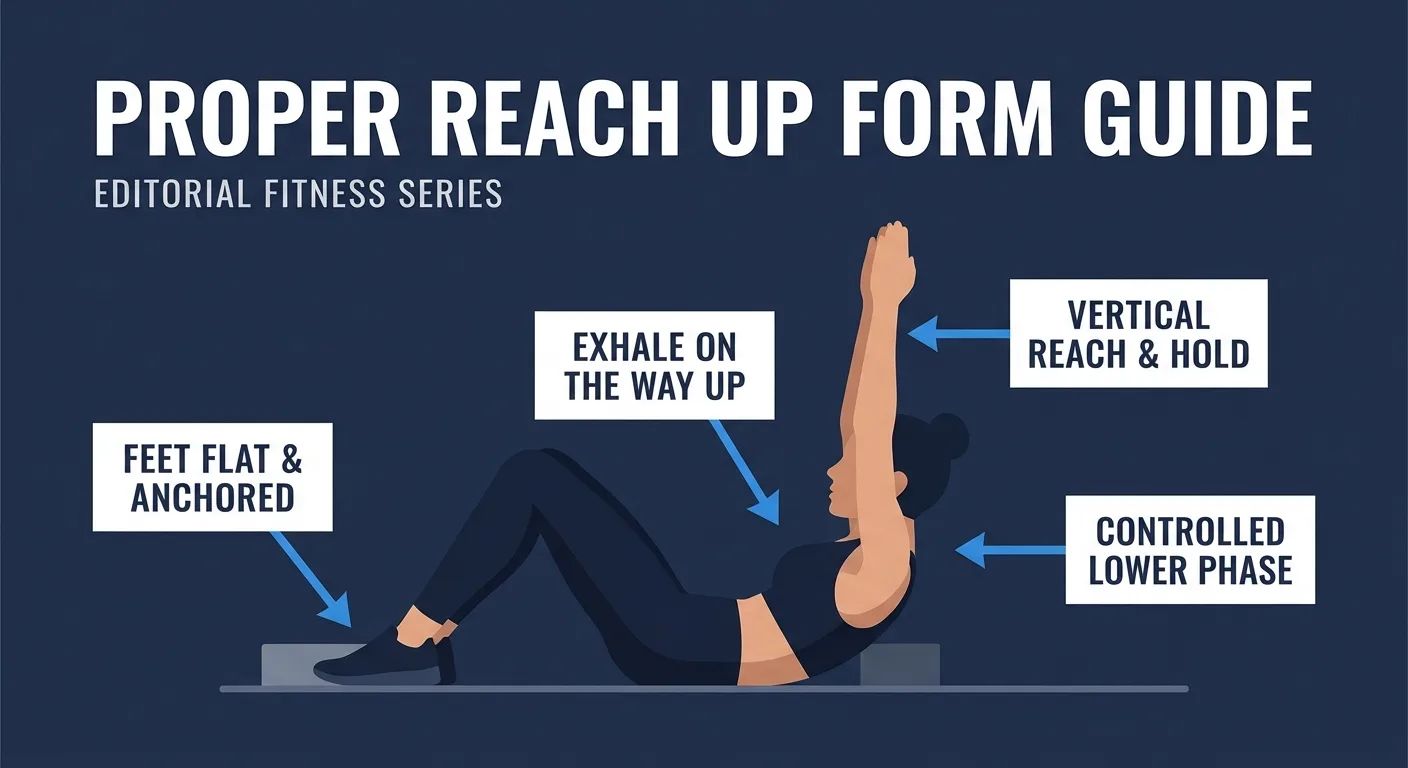
Common Mistakes (And How to Fix Them)
Feet Popping Off the Floor
What it looks like: Your heels come up as you sit up, or your toes leave the ground near the top.
Why it's a problem: Foot lift usually means you're using momentum and hip flexor snap instead of controlled abdominal flexion.
The fix: Press your heels into the floor before every rep. If they still lift, switch to crunches until the curl-up pattern feels clean.
Dropping Back Down Fast
What it looks like: You reach at the top, then let gravity pull you back to the floor.
Why it's a problem: The eccentric phase is where you build control. Skipping it turns the exercise into a momentum drill.
The fix: Count two to three seconds on the way down. End the set once you can't control that descent.
Yanking With the Arms
What it looks like: You fling the arms forward to pull your torso off the floor.
Why it's a problem: The arms should guide the reach. They shouldn't be the engine of the sit-up.
The fix: Start the rep by curling the ribs toward the pelvis. Add the reach after your trunk is already moving.
Straining the Neck
What it looks like: Your chin jams into your chest, or your head reaches forward before the torso moves.
Why it's a problem: Neck tension can create headaches and takes attention away from the core work.
The fix: Keep a small space between chin and chest. Imagine the head riding with the rib cage instead of leading the rep.
Arching at the Bottom
What it looks like: Your ribs flare and your lower back pops away from the floor before the next rep.
Why it's a problem: A flared reset makes the next sit-up start from a weaker brace.
The fix: Exhale before each rep and let the ribs settle. If that doesn't hold, use deadbugs for a few weeks.
Chasing Reps After Form Breaks
What it looks like: The first few reps are crisp, then the set turns into fast half-reps.
Why it's a problem: Reach ups work because of controlled range. Speeding through sloppy reps trains the wrong pattern.
The fix: Stop two reps before your control disappears. Add reps only when every descent stays smooth.
Reach Up Variations: Regressions and Progressions
Easier (Regression)
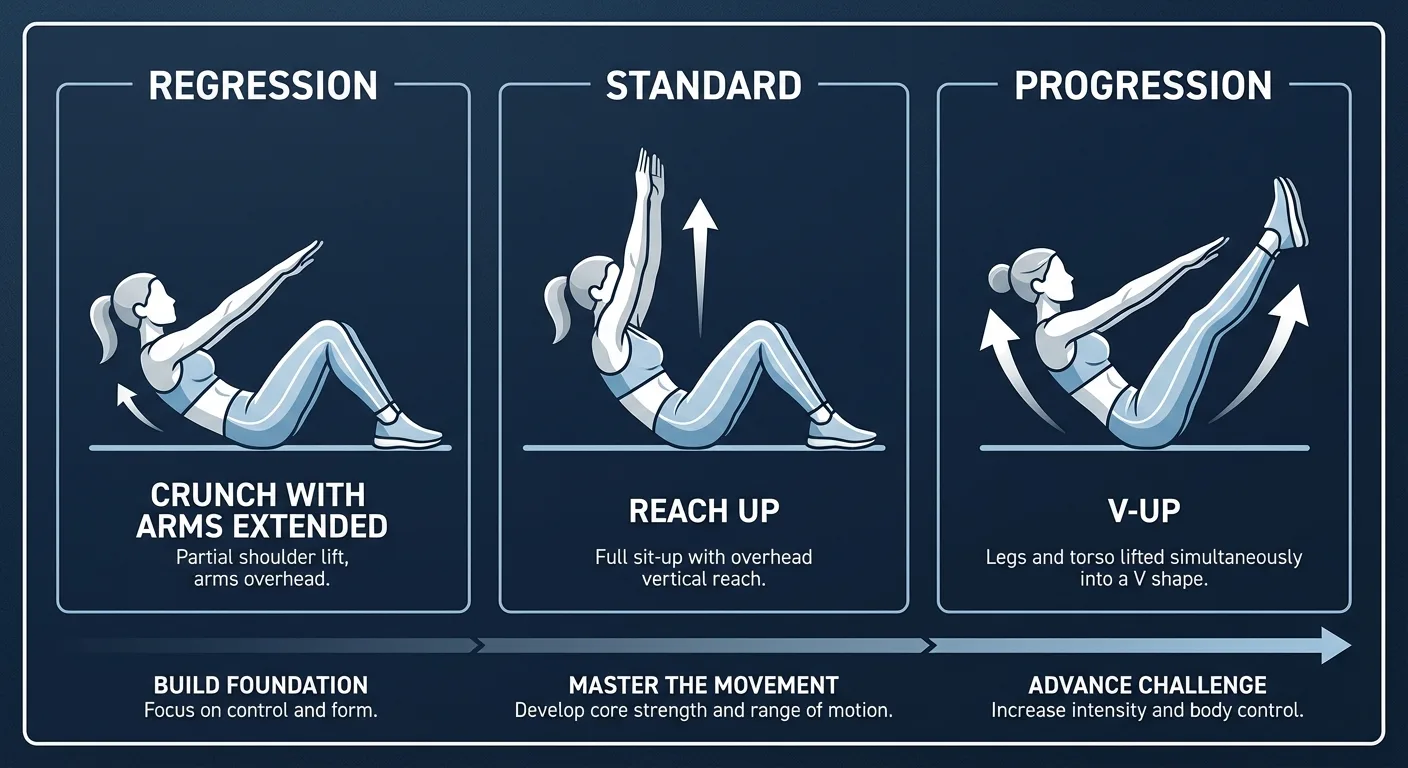
- Crunches. Use a shorter range of motion and focus on curling the ribs toward the pelvis without pulling on the neck.
- Extended-arm crunch. Keep the arms overhead but lift only the shoulder blades. This keeps the long-lever feel without asking for a full sit-up.
- Deadbugs. Use this if your lower back arches or your ribs flare during the reach-up reset.
Standard
- Reach up. Use the full sit-up and vertical reach pattern with feet planted and a two- to three-second lower.
- Tempo reach up. Keep the same movement, but pause for one second at the top and lower for three seconds.
Harder (Progression)
- Weighted reach up. Hold a very light plate or dumbbell in both hands. Keep the load small enough that you can still reach vertically.
- Hollow hold pairing. Pair reach ups with hollow holds when you want a dynamic flexion drill followed by a static bracing drill.
When to Avoid or Modify Reach Ups
Reach ups are safe for many healthy adults, but they load the trunk through repeated spinal flexion. Always consult your physician or a qualified physical therapist before starting or returning to exercise if you have pain, a medical condition, or a recent change in health status.
- Acute lower-back pain or known disc pathology. Skip loaded spinal flexion and use deadbugs, bird-dogs, or forearm planks until a clinician clears more range.
- First 6 to 8 weeks postpartum or active diastasis recti. Restore breathing, pelvic-floor coordination, and transverse abdominis control before adding sit-up patterns.
- Recent abdominal surgery. Get clearance after C-section, hernia repair, appendectomy, or any surgery that involved the abdominal wall.
- Hernia symptoms. Avoid high-pressure core work and ask your physician which positions are appropriate.
- Pregnancy in the second or third trimester. Supine flexion drills usually need to be replaced with side-lying, standing, or supported core work.
- Pelvic-floor dysfunction or pelvic-organ prolapse. Choose lower-pressure options and work with a pelvic-floor physical therapist.
Related Exercises
- Shorter-range regression: Crunches train the curl-up pattern without requiring a full sit-up.
- Bottom-up core pairing: Leg raises train the rectus abdominis and hip flexors from the opposite direction.
- Anti-extension foundation: Deadbugs teach rib and pelvis control before harder flexion work.
- Back-friendly core foundation: Bird-dogs build trunk control with less spinal flexion.
- Static advanced core: Hollow holds pair well with reach ups for anterior-core endurance.
- Bracing benchmark: Forearm planks test whether you can keep the ribs and pelvis stacked under fatigue.
How to Program Reach Ups
Ratamess et al., 2009, the ACSM position stand on resistance training progression, supports matching sets, reps, rest, and frequency to training status. For reach ups, keep the dose tied to form quality because repeated flexion gets sloppy fast when the core is tired.
| Level | Sets x Reps | Rest between sets | Frequency |
|---|---|---|---|
| Beginner | 2-3 x 8-12 using crunches or partial reach ups | 45-60 seconds | 2-4 sessions/week |
| Intermediate | 3 x 10-20 standard reach ups | 45-60 seconds | 3-5 sessions/week |
| Advanced | 3-4 x 15-30 with slow tempo or light load | 60 seconds | 4-6 sessions/week |
Place reach ups near the end of a resistance-training session, in a dedicated core block, or as a controlled finisher after your main lifts. Avoid putting high-rep reach ups before heavy squats, deadlifts, carries, or overhead pressing because core fatigue can reduce spinal stability.
Keep the form floor higher than the rep target. Stop the set when your feet lift, your neck strains, your descent speeds up, or your lower back feels irritated.
How FitCraft Programs This Exercise
Knowing how to do reach ups is step one. Knowing when to use them, how many reps to do, and when to progress is where most people get stuck.
FitCraft's AI coach Ty uses your free assessment to place core stability work into a balanced program based on your level, goals, and available equipment. Ty adjusts the variation and volume to match your progress while keeping the plan built around the larger training week.
Frequently Asked Questions
What muscles do reach ups work?
Reach ups mainly train the rectus abdominis through spinal flexion. The obliques, transverse abdominis, hip flexors, diaphragm, pelvic floor, and shoulder flexors assist and stabilize as you sit up and reach overhead.
How are reach ups different from sit-ups?
A reach up is a full sit-up with a vertical arm reach at the top. The reach lengthens the lever arm, adds coordination, and asks you to keep the ribs stacked instead of collapsing forward.
Are reach ups good for beginners?
Reach ups usually fit intermediate and advanced core training better than beginner plans. Start with crunches, deadbugs, or controlled partial sit-ups if you can't sit up without neck pulling, foot lift, or lower-back strain.
How many reach ups should I do per set?
Most trainees do well with 2 to 4 sets of 8 to 20 controlled reps. Use fewer reps with a slow two- to three-second lowering phase before you add more volume.
Can I do reach ups with lower-back pain?
Avoid reach ups during acute lower-back pain or known disc irritation unless a qualified clinician has cleared loaded spinal flexion for you. Use deadbugs, bird-dogs, or planks as lower-back-friendly core options.