Star crunches are advanced bodyweight core work. You lie in a wide starfish position, brace your trunk, then lift your shoulders and straight legs together so your hands reach toward your feet. The long lever makes the rectus abdominis work hard through spinal flexion while the hip flexors, obliques, and transverse abdominis help control the pelvis. Scale the move from tuck crunches and deadbugs to slow-tempo star crunches, top-position holds, and light weighted reps.
Star crunches take the basic crunch pattern and make the lever longer. Instead of curling only your shoulders off the floor, you start fully extended and bring the upper body and legs toward each other at the same time.
That extra range is why the exercise feels so much harder. It also makes the move easy to overdo. If your lower back arches, your neck yanks forward, or your legs start swinging, the set is done.
Quick Facts: Star Crunches
- Equipment needed: None, with an exercise mat optional for floor comfort
- Difficulty: Advanced
- Modality: Bodyweight core strength
- Body region: Core and hip flexors
- FitCraft quest category: Core
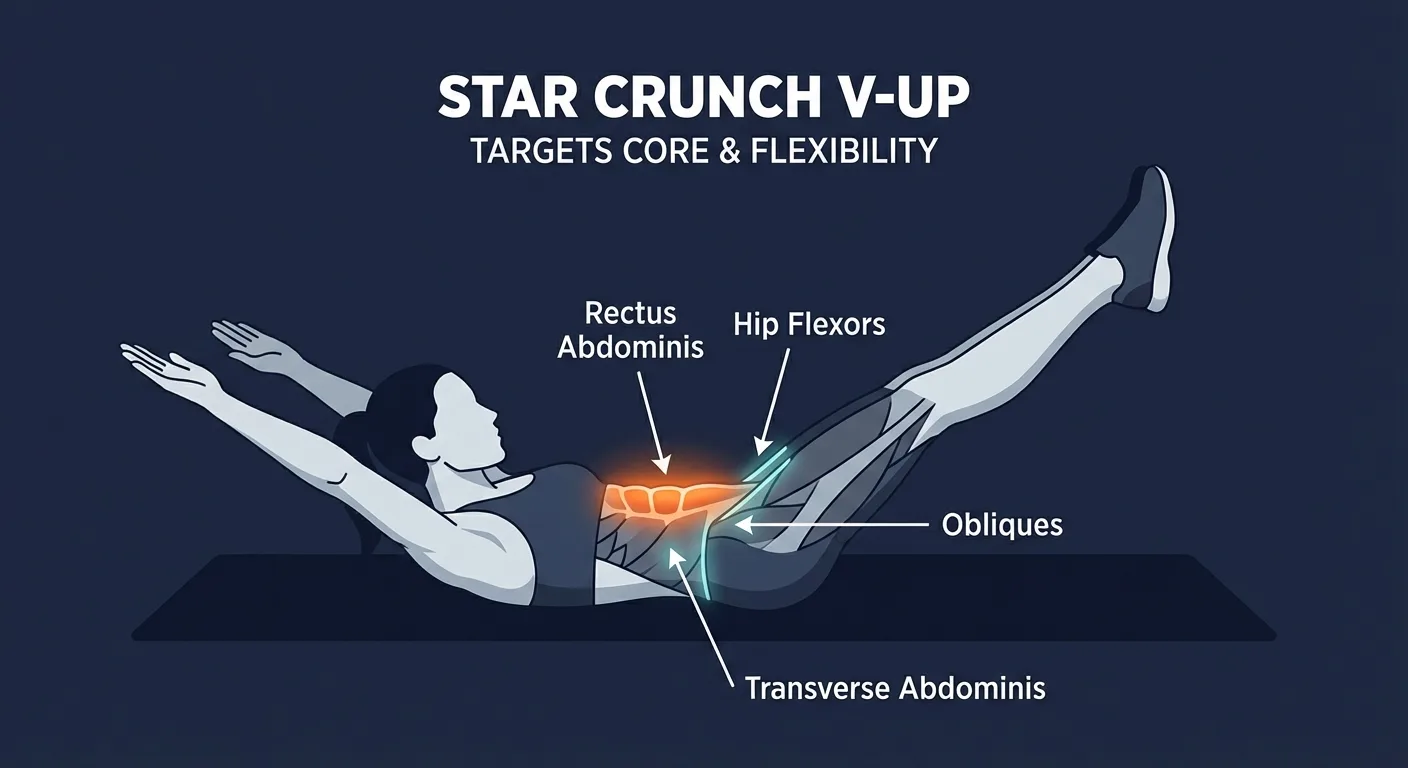
Muscles Worked
Primary movers: The rectus abdominis drives the crunch by flexing the spine as your shoulders lift and your ribs move toward the pelvis. It works concentrically on the way up and eccentrically as you lower back to the starfish position.
Secondary movers: The hip flexors help raise the straight legs, especially near the bottom of the rep where the lever is longest. The obliques assist the curl and keep the trunk from rotating as both arms and both legs move together.
Stabilizers: The transverse abdominis, diaphragm, pelvic floor, and lower spinal stabilizers keep the pelvis from tipping forward. Exhaling during the lift helps reinforce that deep-core brace so the lower back does not take over.
Mechanism: Star crunches combine spinal flexion with straight-leg hip flexion. The fully extended start increases the moment arm, so the abdominal wall has to control both the curl and the return. That is why the exercise belongs after easier crunches, deadbugs, and controlled leg-raise patterns.
Step-by-Step: How to Do a Star Crunch
- Set up the starfish. Lie flat on your back with your arms overhead and your legs stretched straight out. Your body should form a wide X. Press your lower back gently into the floor before you move.
- Brace before the lift. Exhale slightly, draw the ribs down, and keep the pelvis from tipping forward. Coach Ty's cue: "Zip your ribs toward your hips before the reach."
- Crunch up in one motion. Lift your shoulders and straight legs together. Reach your hands toward your feet and think about bringing your chest toward your thighs, not your chin toward your knees.
- Pause at the top. Hold the peak for a brief beat without yanking your neck. If you cannot reach your feet, reach as high as you can while keeping the motion smooth.
- Lower with control. Return to the starfish position over 2 to 3 seconds. Stop the set when the lower back pops up, the legs slam down, or momentum starts doing the work.
Get this exercise in a personalized workout
FitCraft, our mobile fitness app, uses its AI coach Ty to program core stability work like this into your plan at the right volume and intensity, based on your level, goals, and equipment. Ty was designed and trained by Domenic Angelino, MPH (Brown University) and NSCA-CSCS, with research published in the Journal of Strength and Conditioning Research and Medicine & Science in Sports & Exercise.
Take the Free Assessment Free • 2 minutes • No credit card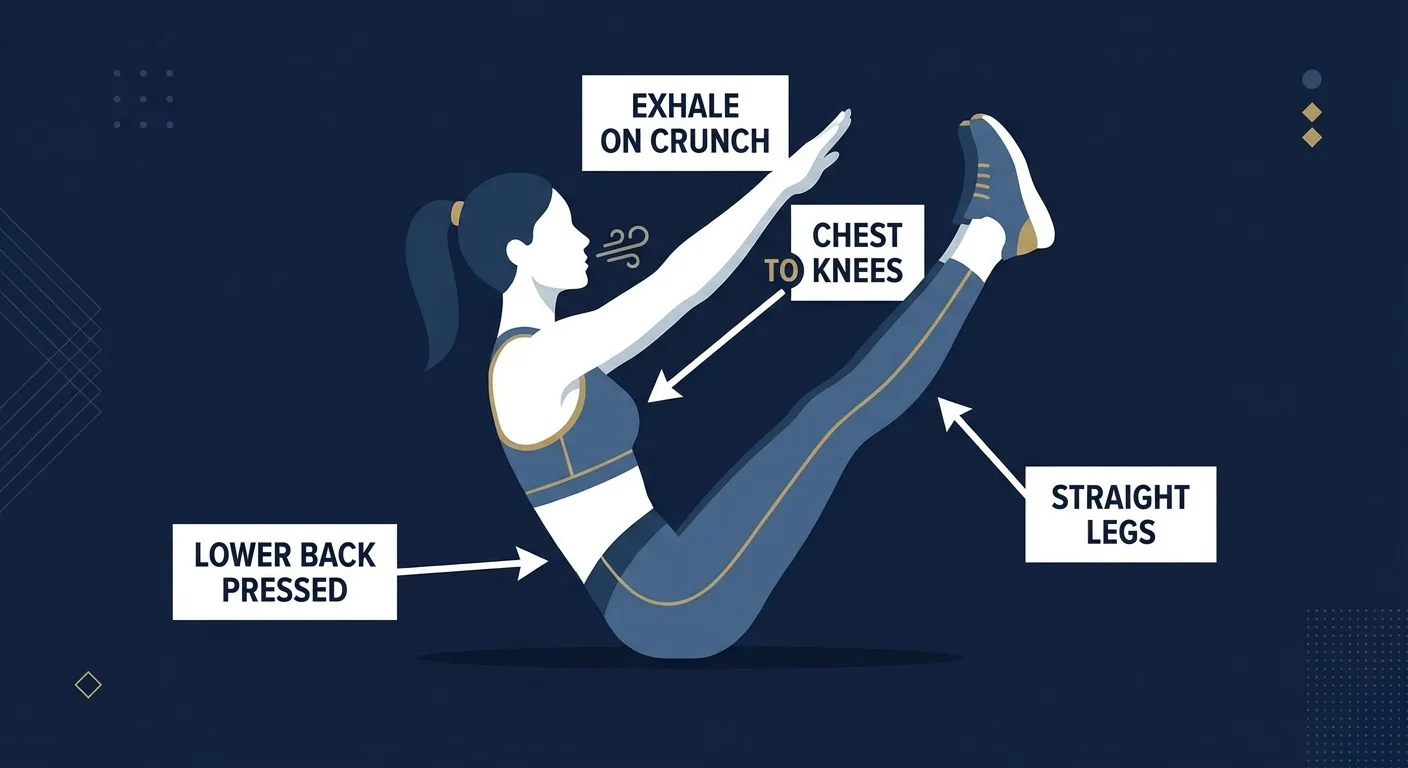
Common Mistakes and How to Fix Them
Yanking the Neck
What it looks like: The chin jams toward the chest and the head leads every rep.
Why it's a problem: Your neck takes stress that should stay in the trunk, and the rep usually turns into a short, rushed curl.
The fix: Look toward the ceiling and let the head follow the rib cage. Think chest toward thighs.
Arching the Lower Back
What it looks like: The lower back lifts off the floor as your legs lower.
Why it's a problem: The pelvis tips forward, the hip flexors dominate, and the lumbar spine gets loaded in a poor position.
The fix: Shorten the range, bend the knees, or switch to deadbugs until you can keep the ribs and pelvis stacked.
Swinging Into the Rep
What it looks like: The arms whip forward and the legs bounce up.
Why it's a problem: Momentum replaces abdominal tension, so the hardest part of the rep disappears.
The fix: Use a 2-second lift and a 3-second lower. If that tempo is too hard, regress.
Forcing Straight Legs Too Soon
What it looks like: You keep the knees locked even though your back arches and the legs drop fast.
Why it's a problem: Straight legs make the lever longer. They are useful only if you can control the pelvis.
The fix: Bend the knees slightly or use a tuck crunch for a few weeks before returning to the full star version.
Doing Too Many Reps
What it looks like: The first few reps are crisp, then the last ten turn into half-range flailing.
Why it's a problem: Star crunches reward control. High-rep fatigue usually breaks the exact position you are trying to train.
The fix: Cap sets at the number of clean reps you can repeat. For many advanced exercisers, that is 6 to 12 reps.
Star Crunch Variations: Regressions and Progressions
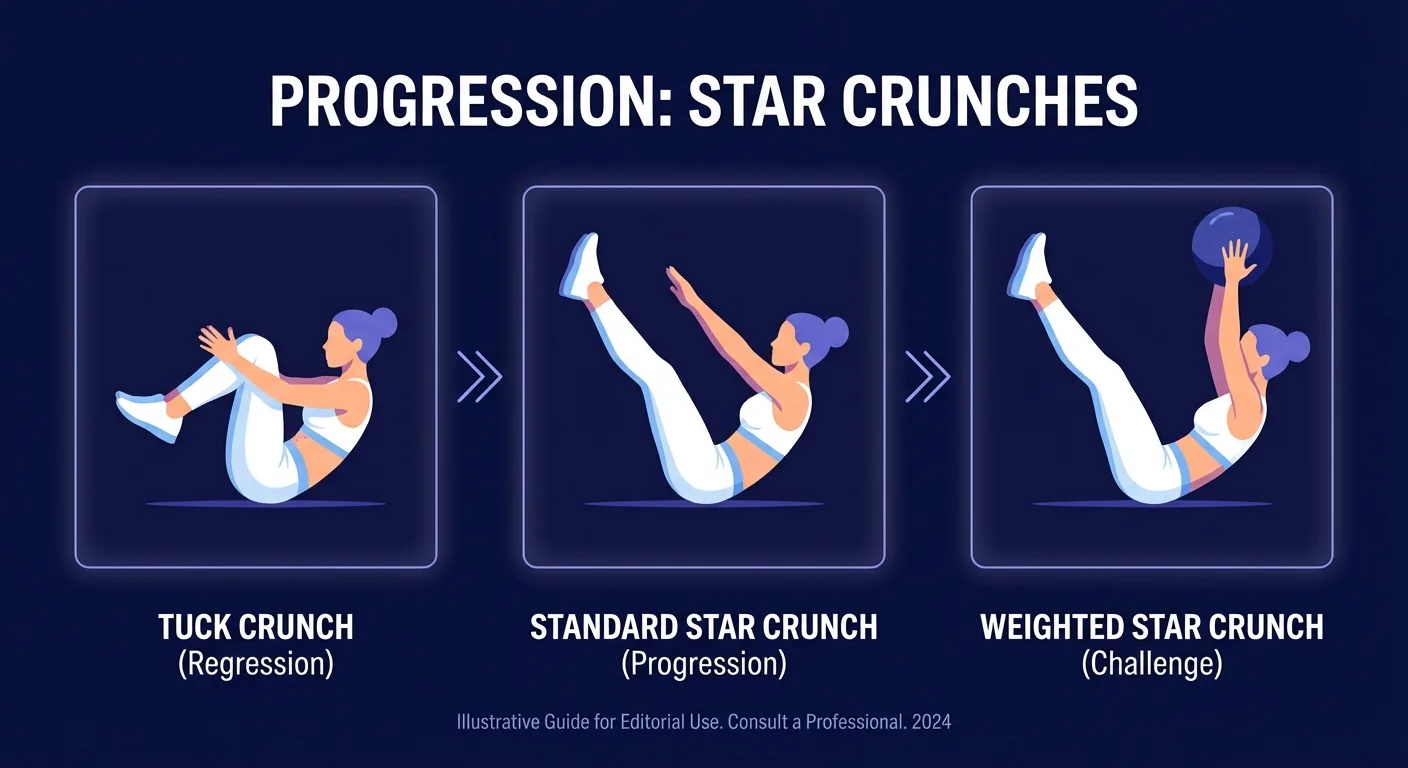
Easier: Tuck Crunch
Keep the knees bent and bring them toward the chest as you crunch. The shorter lever makes the rep easier while preserving the same curl pattern.
Easier: Deadbug
The deadbug trains rib and pelvis control without repeated spinal flexion. Use it if star crunches bother your back or your legs drop out of control.
Standard: Star Crunch
Use straight arms, straight legs, and a slow lower. Make every rep look the same before adding load or pauses.
Harder: Star Crunch With Hold
Pause for 2 to 3 seconds at the top of each rep. The added time under tension makes the same bodyweight rep much harder.
Harder: Weighted Star Crunch
Hold a light dumbbell or medicine ball in your hands. Start very light because the weight sits far from the trunk and raises the demand quickly.
When to Avoid or Modify Star Crunches
Star crunches are safe for many healthy adults, but they are a high-lever spinal-flexion exercise. Modify the range, choose a lower-stress core drill, and consult your physician or physical therapist when any of the situations below apply.
- Acute lower-back pain or known disc pathology. Repeated flexion can aggravate symptoms. Use deadbugs, bird-dogs, or forearm planks instead.
- First 6-8 weeks postpartum or active diastasis recti. Full crunching can increase abdominal pressure and worsen separation. Start with breathing, bracing, and clinician-approved deep-core work.
- Recent abdominal surgery or hernia repair. Get clearance before loaded trunk flexion. Early return should usually start with gentle bracing, not long-lever crunching.
- Current hernia symptoms. Star crunches can spike intra-abdominal pressure. Ask your clinician which core drills are appropriate.
- Pregnancy in the second or third trimester. Supine crunching and high-flexion work are poor choices for most people in this phase. Use side-lying or upright options that your provider approves.
- Pelvic-floor dysfunction or pelvic-organ prolapse. Choose lower-pressure drills and work with a pelvic-floor physical therapist before adding advanced crunch variations.
Related Exercises
- Same movement pattern: Reverse crunches train posterior pelvic tilt and lower-ab control with a shorter upper-body lever.
- Rotational core option: Bicycle crunches add oblique rotation after you have basic crunch control.
- Lower-stress foundation: Deadbugs and bird-dogs build bracing without repeated spinal flexion.
- Advanced hollow-body strength: Hollow holds teach the same rib-down position under a static lever.
- Hip-flexion progression: Leg raises isolate the lower-body lever that makes star crunches difficult.
How to Program Star Crunches
Ratamess et al. (2009) describes progressive resistance training as a process of matching volume, rest, frequency, and exercise difficulty to training status. For star crunches, that means earning the full lever first, then adding tempo, pauses, or light load.
| Level | Sets × Reps | Rest between sets | Frequency |
|---|---|---|---|
| Beginner | 2-3 × 6-10 tuck crunches or partial star crunches | 45-60 seconds | 2-3 sessions/week |
| Intermediate | 3 × 6-12 standard star crunches | 45-60 seconds | 2-4 sessions/week |
| Advanced | 3-4 × 10-15 slow-tempo or paused reps | 60 seconds | 3-5 sessions/week |
Place star crunches near the end of a strength session or in a short core finisher. Heavy compound lifts need fresh trunk stiffness, so save advanced flexion work for after your main lifts.
Use a form floor over rep targets. A set of 6 clean reps beats a set of 15 where your lower back arches, your legs swing, or your neck does the work.
FitCraft's AI coach Ty adjusts exercise difficulty and volume to match your level, goals, and equipment. For advanced core work like star crunches, that means choosing a variation that you can control rather than forcing a progression too early.
Frequently Asked Questions
What muscles do star crunches work?
Star crunches primarily train the rectus abdominis through spinal flexion. The hip flexors help lift the legs, the obliques help keep the trunk from twisting, and the transverse abdominis helps control the pelvis.
Are star crunches harder than regular crunches?
Yes. A regular crunch uses a shorter lever and mostly lifts the shoulders. A star crunch starts with arms and legs extended, so the abs have to shorten the trunk while controlling longer limb levers.
Can I do star crunches with lower-back pain?
Avoid full star crunches during acute lower-back pain or known disc irritation unless a clinician clears them. Use deadbugs, bird-dogs, or forearm planks instead because they train bracing with less repeated spinal flexion.
Why do I feel star crunches in my hip flexors?
The hip flexors work because your legs are straight and extended. Some hip-flexor effort is normal, but if it overpowers your abs, bend the knees, shorten the range, or use tuck crunches until you can keep the pelvis controlled.
How many star crunches should I do?
Most people do best with 2 to 4 sets of 6 to 15 controlled reps. Stop each set when you lose lower-back contact, start swinging, or can no longer reach smoothly.