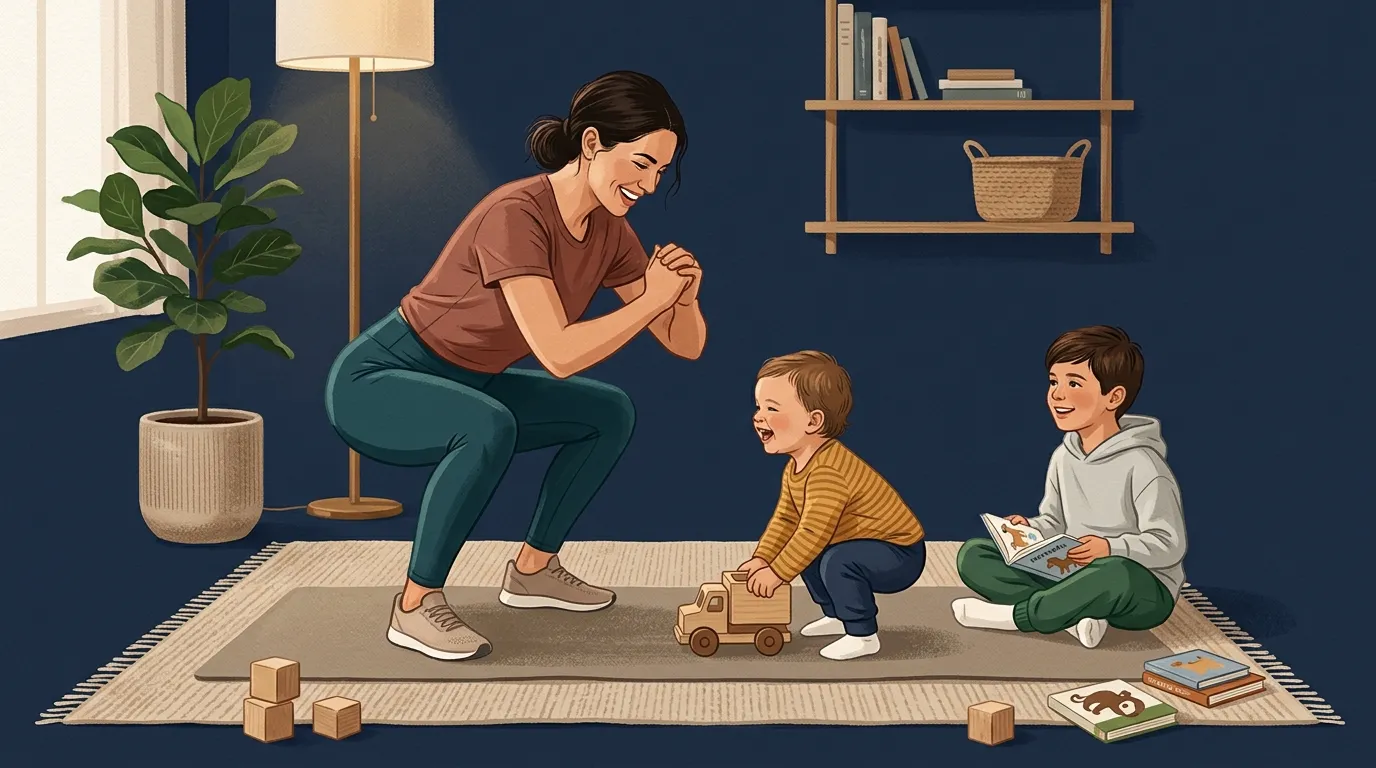
You know you should work out. You want to work out. But between the 6 a.m. wake-ups, the school runs, the meal prep, the bedtime battles, and the 47 other things on your list — there's no time left. Right?
Here's the uncomfortable truth: "I don't have time" is almost never the real problem. The real problem is that most fitness programs weren't built for the way your life actually works.
They assume you have 45 minutes. They assume you have a gym. They assume your schedule is predictable. And the moment your toddler skips a nap or your meeting runs long, the whole plan falls apart — and you feel like a failure.
But what if 15 minutes was genuinely enough? What if the science said so? And what if you had a program flexible enough to meet you wherever your day lands?
That's not wishful thinking. That's what the research actually shows.
The Science: Why 15 Minutes Is More Than Enough
Most people dramatically overestimate how much exercise they need. The fitness industry has spent decades selling hour-long sessions as the gold standard. But the research tells a very different story.
A landmark 2023 systematic review and dose-response meta-analysis published in the British Journal of Sports Medicine pooled 196 studies covering 94 cohorts and more than 30 million participants, and found that even 11 minutes of moderate-to-vigorous physical activity per day (75 minutes per week, half the recommended minimum) was associated with a 23% lower risk of premature death compared to being inactive (Garcia et al., 2023). That's less than the 15 minutes we're talking about here.
More recently, a 2022 study published in the European Heart Journal by Stamatakis et al. tracked over 25,000 adults and found that short bursts of vigorous intermittent activity — as little as 3 to 4 minutes — produced measurable reductions in cardiovascular and cancer mortality risk. The participants weren't doing structured exercise at all. They were just moving intensely in brief windows during their normal day.
What does this mean for you? Fifteen focused minutes is not a compromise. It's above the minimum effective dose for meaningful health improvements. You're not doing "the lite version." You're doing what works.
The key word is focused. Fifteen minutes of thoughtfully programmed exercise — designed by an Ivy League-trained exercise scientist, NSCA-certified strength coach — is fundamentally different from 15 minutes of random YouTube exercises. Structure matters. Progressive overload matters. Exercise selection matters. And that's where most "quick workout" advice falls short.
When to Fit It In: The Parent's Scheduling Playbook
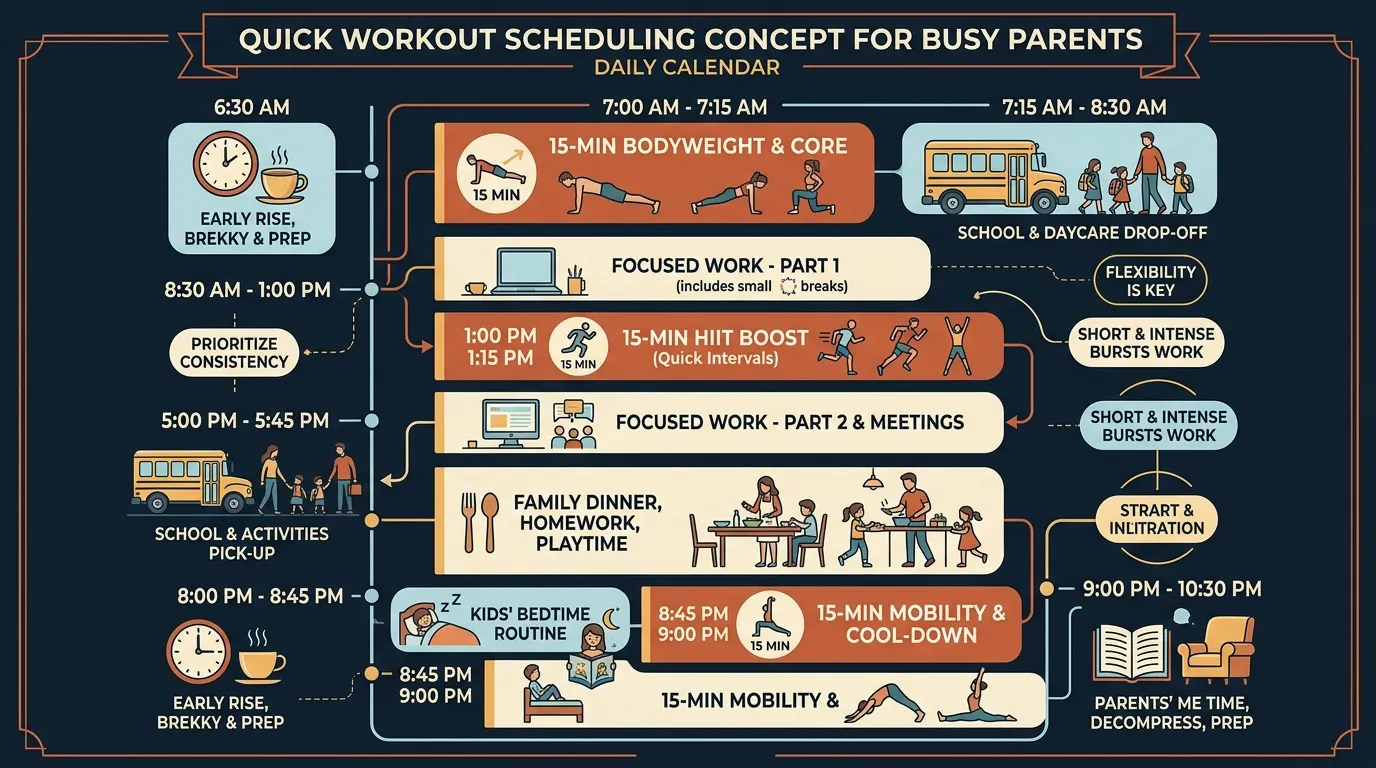
Finding 15 minutes isn't about time management hacks. It's about identifying windows that already exist in your day and protecting them. Here are the slots that work for most parents:
Before the Kids Wake Up
This is the most reliable window. Set your alarm 20 minutes earlier than your kids' usual wake time. You get 15 minutes of exercise plus a 5-minute buffer. No interruptions. No negotiations. No one asking for a snack while you're mid-squat.
The trade-off is obvious: you're waking up earlier. But here's what parents who do this consistently report — the energy boost from that morning session makes the entire day feel more manageable. You've already won before anyone else is awake.
During Nap Time
If your kids still nap, this is a golden window. Instead of defaulting to chores or scrolling your phone (we all do it), carve out the first 15 minutes for yourself. The dishes will wait. Your body won't.
The risk with nap time is unpredictability — some days they sleep 90 minutes, some days they sleep 20. That's why you need a program that adapts. A rigid 45-minute plan is useless here. A program that gives you a complete, effective session in whatever time you have? That changes everything.
After Bedtime
Once the kids are down, the evening is yours. The advantage: it's the most predictable window. The risk: you're tired, and the couch is right there.
This is where the right system matters more than willpower. If your workout feels like a chore, you'll choose Netflix every time. If it feels like a game — with streaks to protect, quests to complete, and rewards to earn — the calculus shifts. The pull of the program competes with the pull of the couch. And that's the point.
The "Stacked" Approach
Don't pick one window. Pick whichever one is available today. Some mornings you'll get up early. Some days it'll be nap time. Some nights it'll be after bedtime. The key is having a program smart enough to give you the right workout regardless of when you show up.
Consistency doesn't mean same time, same place. It means showing up on most days, in whatever window life leaves open.
No Equipment? No Problem.
You don't need a home gym. You don't need dumbbells. You don't even need a yoga mat. Here's what you can accomplish with absolutely nothing but your body and a small patch of floor:
- Lower body: Squats, lunges, Bulgarian split squats (use the couch), glute bridges, single-leg deadlifts, wall sits
- Upper body: Push-ups (and their dozen variations), tricep dips (use a chair), pike push-ups, plank shoulder taps
- Core: Planks, dead bugs, bird dogs, mountain climbers, hollow body holds
- Cardio/full body: Burpees, jumping jacks, high knees, squat jumps, bear crawls
These aren't filler exercises. A well-programmed bodyweight session can build real strength, improve cardiovascular fitness, and create meaningful body composition changes — especially if you're coming back to exercise after a break or starting for the first time since having kids.
The secret is progressive overload. Each week, something should be slightly harder than last week — more reps, slower tempo, a harder variation, less rest. That's what separates a random collection of exercises from an actual program. And it's why having a system that tracks your progression and adjusts automatically makes such a difference.
What a 15-Minute Session Actually Looks Like
Here's a sample structure — the kind of session that's designed by an Ivy League-trained exercise scientist, NSCA-certified strength coach, not pulled from a random Instagram reel:
- 0:00–2:00 — Warm-up. Dynamic movement to wake up your joints and prime your nervous system. Think: leg swings, arm circles, bodyweight squats at an easy tempo.
- 2:00–12:00 — Work block. Three to four compound movements in a circuit or superset format. You're moving through them with minimal rest, keeping your heart rate elevated while building strength. Example: push-ups, goblet squats (or bodyweight squats), plank rows (or bird dogs), reverse lunges.
- 12:00–15:00 — Finisher + cooldown. A brief metabolic burst (30 seconds of burpees or mountain climbers) followed by 90 seconds of stretching the muscles you just worked.
That's it. Fifteen minutes. You're done before your coffee gets cold.
The difference between this and a random YouTube video is intentionality. Every exercise is selected for a reason. The intensity is calibrated to your fitness level. The progression is planned across weeks, not improvised day by day. That's what it means to have programming designed by an actual exercise scientist — it's efficient because nothing is wasted.
Find out what's really holding you back
Take the free 2-minute assessment. It maps your schedule, equipment, and fitness level — then builds a plan that actually fits your life as a parent.
Take the Free Assessment Free · 2 minutes · No credit cardThe Real Reason You Can't Stay Consistent (It's Not Time)
If time were actually the problem, you'd have started exercising the last time your schedule opened up. You didn't. Because time was never the bottleneck.
The real bottleneck is program rigidity. Traditional fitness programs assume your life is predictable. They give you a Monday/Wednesday/Friday split with 45-minute sessions. Miss Monday? You're already behind. Miss two days in a row? You feel like you've failed. And once you feel like you've failed, quitting is easy.
Parents don't need more discipline. They need a program that adapts to chaos.
That means:
- Sessions that adjust to however much time you have — 10 minutes, 15 minutes, 25 minutes
- Programs that don't punish you for missing a day
- Workouts that work with whatever equipment is within arm's reach (or no equipment at all)
- A system that makes you want to come back, instead of guilting you for leaving
That last point is the one most fitness apps miss entirely. Motivation fades. Discipline is finite. But a well-designed reward system? That creates pull. Streaks you don't want to break. Progress you can see. Small wins that compound into real change. If showing up is your sticking point, our roundup of the best workout accountability apps compares how different apps keep you coming back.
What Other Parents Are Saying
This isn't theory. Real parents are making this work right now:
"-28 lbs, 4 months — Lost weight during breakfast while kids ate — worked around my life."
"-22 lbs, 4 months — After my second kid, I needed something stupidly simple."
Barry didn't need a 5 a.m. boot camp. He needed a program that fit into breakfast time. Stacy didn't need a complicated periodization plan. She needed something so simple that exhaustion couldn't talk her out of it. That's the difference between a program designed for real life and one designed for people with unlimited time and energy.
How FitCraft Makes This Work
FitCraft was built for exactly this problem. Here's what makes it different from the 15-minute workout videos cluttering your saved posts:
- Adaptive session length. Tell FitCraft you have 12 minutes today. It gives you a complete, effective session in 12 minutes. Have 25 minutes tomorrow? It adjusts. Your program works around your schedule — not the other way around.
- AI-personalized programming. FitCraft's 32-step diagnostic assessment maps your fitness level, goals, available equipment, and schedule constraints. Your AI coach Ty builds a plan specifically for you — and updates it as your life changes.
- Designed by an Ivy League-trained exercise scientist, NSCA-certified strength coach. Every program follows evidence-based principles of progressive overload, exercise selection, and periodization. You're not getting random exercises. You're getting a real program, compressed into the time you actually have.
- Gamification that creates consistency. Streaks, quests, collectible cards, and avatar progression tap into the same reward loops that keep people playing games for hours. Research shows gamified fitness interventions produce a small-to-medium improvement in physical activity (Hedges g=0.42) (the Journal of Medical Internet Research, 2022). Instead of relying on willpower, FitCraft makes you want to show up.
- No equipment required. FitCraft adapts to whatever you have — bodyweight only, a couple of dumbbells, resistance bands, or a full gym. Your living room floor works just fine.
The result: parents who used to struggle with consistency are working out 4-5 days a week in 15-minute windows they didn't think existed. Not because they suddenly found more time. Because they finally found a program that fit the time they already had. If you're comparing options, see our roundup of the best workout apps for moms.
The Bottom Line
You Have More Time Than You Think
Fifteen minutes is enough. The science confirms it. The parents living it confirm it. The only question is whether you have a program smart enough to make those 15 minutes count.
You don't need to overhaul your schedule. You don't need to join a gym. You don't need to wake up at 4:30 a.m. You need a program that bends to your life — not one that breaks the moment your kid gets a cold.
The "no time" era is over. The era of "no flexible program" is what you've actually been stuck in. And now you know there's a way out.
Frequently Asked Questions
Is 15 minutes of exercise really enough to see results?
Yes. Research published in the British Journal of Sports Medicine (Garcia et al., 2023) found that even 11 minutes of moderate-to-vigorous physical activity per day was associated with a 23% lower risk of premature death. A 2022 study in the European Heart Journal (Stamatakis et al.) confirmed that short bursts of vigorous activity, as little as 3 to 4 minutes, produced measurable health benefits. Fifteen focused minutes is well above the minimum effective dose.
Can I get fit without any equipment at home?
Absolutely. Bodyweight movements like squats, push-ups, lunges, and planks provide enough stimulus for meaningful strength and cardiovascular improvements — especially if you're starting out or returning to exercise. FitCraft's AI coach Ty builds personalized programs around whatever equipment you have, including none at all.
When is the best time for parents to work out?
The best time is whatever window you can consistently protect. Common options include before the kids wake up, during nap time, or after bedtime. The key is choosing a slot that doesn't depend on willpower — and pairing it with an existing routine so it becomes automatic. FitCraft adapts your session length to the time you actually have available on any given day.
How do I stay consistent with workouts as a busy parent?
Consistency comes from removing friction, not adding motivation. That means shorter workouts you can actually complete, no commute to a gym, programs that adapt when your schedule changes, and a system that rewards showing up. FitCraft uses gamification — streaks, quests, collectible cards — to make consistency feel automatic instead of forced.
Is FitCraft good for parents who are just getting back into fitness?
Yes. FitCraft's 32-step diagnostic assessment identifies your current fitness level, available equipment, schedule constraints, and goals. Your AI coach Ty builds a program that meets you where you are — whether that's your first workout in years or a return after pregnancy. Programs are designed by an Ivy League-trained exercise scientist, NSCA-certified strength coach, so progressions are safe and effective.