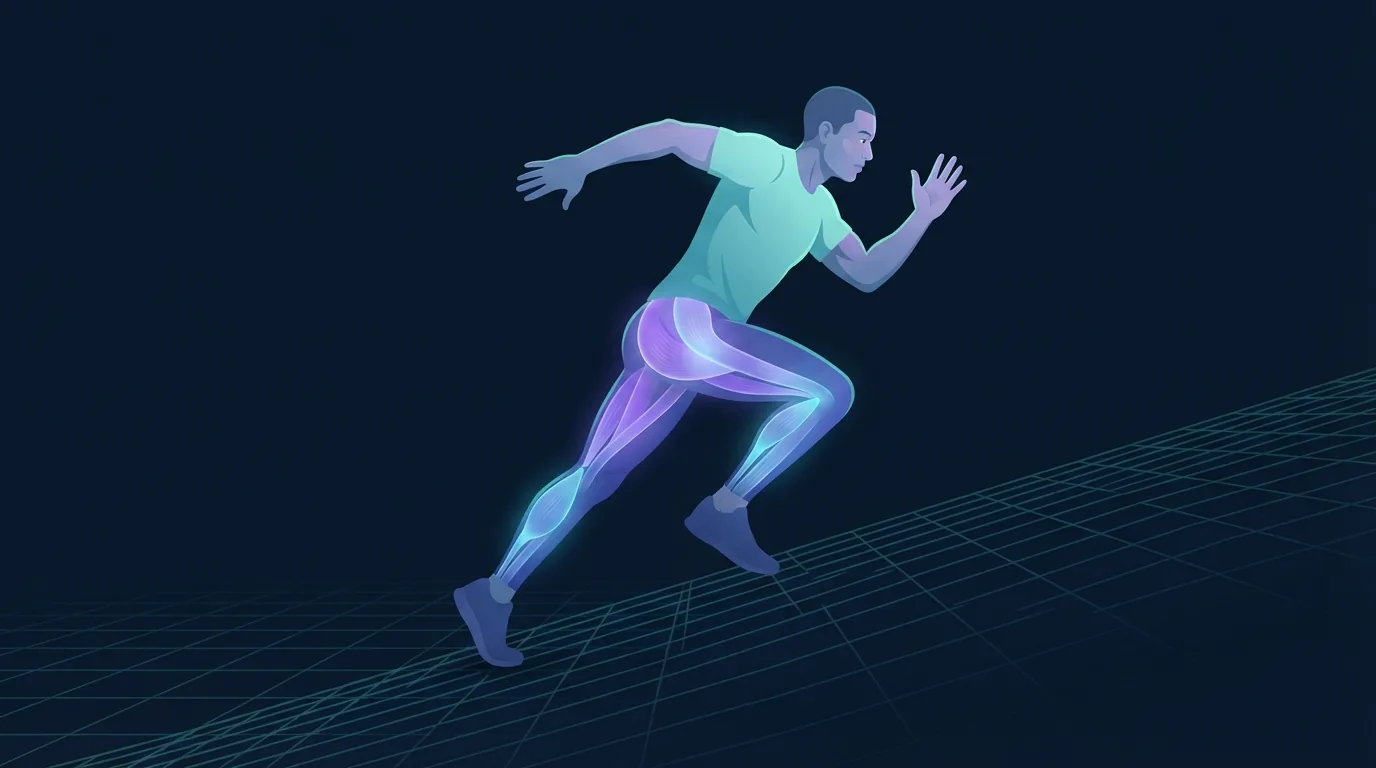
You want to get faster and stronger without joining a gym, buying anything, or signing up for a program. There's a hill somewhere within a mile of where you live, and it will do more for your legs in fifteen minutes a week than most of what you'd find on a machine.
The catch is that hill sprints have a terrible beginner failure rate, and not because they're complicated. People go out, run ten reps because ten sounds like a workout, and spend the next four days unable to lower themselves onto a chair. Then they don't do it again. The session gets blamed for what the dosing did.
So here's the whole thing: what a hill sprint actually is, why the incline is doing you a favour, a first session that's deliberately too easy, a six-week ramp, and the short list of people who shouldn't be doing this at all.
What Hill Sprints Actually Are
A hill sprint is a maximal-effort run up a moderate incline lasting 8 to 10 seconds, followed by a complete recovery before the next one. That's it. Three numbers define the session: the length of the sprint, the length of the recovery, and the number of reps.
The recovery is the number people get wrong. It's two to three minutes, which is roughly how long it takes to walk back down a hill you just sprinted up, and it should feel almost indulgent. You're not trying to be out of breath at the start of the next rep. Every rep should be as fast as the first one. The moment reps start getting slower, the session has changed into something else, and that something else is worse at everything.
This is what separates hill sprints from HIIT. HIIT is built around incomplete recovery and accumulated metabolic stress. Hill sprints are built around full recovery and repeated maximal output. Same word in a headline, opposite design philosophy.
What counts as a hill
A grade of roughly 5 to 10 percent is the sweet spot. Steep enough that you can't reach your flat-ground top speed, shallow enough that you're still running rather than scrambling. If your torso is folded forward and your knees are coming up to your chest, find something gentler. A neighbourhood street, a park path, a parking ramp, a stadium ramp or a treadmill set to 6 to 8 percent all qualify. You need about 60 to 80 metres of it.
Why the Hill Helps: Lower Impact, More Force
Uphill running changes the mechanics of every stride in a way that happens to be ideal for someone who wants a hard session without a lot of pounding.
Gottschall and Kram (2005), publishing in the Journal of Biomechanics, put runners on a treadmill at level grade and at 3, 6 and 9 degrees both up and down, and measured the forces going through the leg. Going uphill, the normal force peaks fell compared with level running, and at the steepest uphill grade the impact peak was sometimes absent entirely. The force that increased instead was propulsive: at 9 degrees uphill, the parallel propulsive peak rose by roughly 75 percent over level running.
That's the trade in one sentence. Less force arriving through the landing, much more force leaving through the push. The review by Vernillo and colleagues (2017) in Sports Medicine describes the muscular consequence: uphill running increases activity across the propulsive muscles, the gastrocnemius, soleus, vastus lateralis, rectus femoris, gluteus maximus and hamstrings, and shifts the emphasis toward concentric work. Downhill running is where the heavy eccentric loading and the muscle damage live. Uphill is the opposite end of that spectrum.
There's a third benefit that isn't about force at all. The hill caps your speed. Flat-ground sprinting reaches stride velocities where the hamstring is loaded hardest during the late swing phase, which is where most sprint-related hamstring strains happen. On a 7 percent grade you physically can't get there. For someone who hasn't sprinted since school, that ceiling is a feature.
The Warm-Up Is Not Optional
An all-out effort from cold muscles is the one genuinely reckless thing you can do in this session. Give it ten to fifteen minutes:
- 8 to 10 minutes of easy jogging. Flat ground, conversational, boring on purpose.
- Two minutes of dynamic movement. Leg swings front to back and side to side, walking lunges, a few skips, ankle circles. No static stretching before sprinting.
- Three build-up efforts on the hill itself. Run 8 seconds up at about 60 percent, then 75 percent, then 85 percent, walking down between each. These aren't reps. They're the difference between your first real rep being fast and your first real rep being a calf strain.
The cool-down is five to ten minutes of easy jogging or walking on the flat. Never finish a hill sprint session by getting straight into a car.
Find out what's really holding you back
FitCraft, our mobile fitness app, pairs you with an AI coach who builds you a personalized plan around your goals, schedule, and fitness level. Every FitCraft program is designed by Domenic Angelino, MPH (Brown University) and NSCA-CSCS, with research published in the Journal of Strength and Conditioning Research and Medicine & Science in Sports & Exercise.
Take the Free Assessment Free • 2 minutes • No credit card
The Beginner Protocol
Your first session is four reps. Not eight, not ten. Four.
This feels absurd while you're doing it, because after four 8-second efforts with three minutes of walking between them you won't feel tired. You'll feel like you could do six more. Do not do six more. Maximal-effort running loads tendons and connective tissue in a way your cardiovascular system won't warn you about, and the bill for an overenthusiastic first session arrives 36 hours later. The people who still do hill sprints in month six are the ones who started with four.
The session, start to finish:
- Warm up for 10 to 15 minutes as described above, including three build-ups.
- Sprint up the hill for 8 seconds at close to maximal effort. Drive your knees, pump your arms, stay tall rather than folding at the waist, and look 10 metres up the hill rather than at your feet.
- Stop at 8 seconds and walk, don't jog, back to the bottom. Take two to three minutes.
- Repeat for the prescribed number of reps. End the session early if a rep feels noticeably slower than the one before it.
- Cool down with 5 to 10 minutes easy on the flat.
Six-week progression
| Week | Sessions | Reps × duration | Recovery between reps |
|---|---|---|---|
| 1 | 1 | 4 × 8 sec | 2-3 min walk down |
| 2 | 1 | 5 × 8 sec | 2-3 min walk down |
| 3 | 1 | 6 × 8 sec | 2-3 min walk down |
| 4 | 1 or 2 | 7 × 8 sec | 2-3 min walk down |
| 5 | 1 or 2 | 8 × 10 sec | 3 min walk down |
| 6 | 1 or 2 | 10 × 10 sec | 3 min walk down |
Ten reps of 10 seconds is a genuinely productive session and a reasonable long-term ceiling for most runners. If you get there and want more, make the reps better rather than more numerous: a slightly steeper hill, or a rep that's as fast at second 10 as it was at second 3. Going to 15 or 20 reps mostly buys you soreness.
Two rules for the whole block. Never do hill sprints on consecutive days. And if a week feels flat, repeat it rather than advancing. Nobody has ever regretted spending an extra week at six reps.
What the Research Says About Short All-Out Sprints
The honest position is that the research base sits next to hill sprints rather than exactly on them. Most sprint interval training trials use 20 to 30 second all-out efforts on a cycle ergometer, which is a considerably larger metabolic dose than an 8-second hill rep. The findings are still worth knowing, because they tell you what short hard efforts can and can't do.
The meta-analytic view comes from Sloth and colleagues (2013) in the Scandinavian Journal of Medicine and Science in Sports, who pooled 13 studies of true all-out sprint interval training in healthy adults and reported a weighted effect size of 0.63 on VO2max, with absolute improvements ranging from 4.2 to 13.4 percent over training periods of two to eight weeks. The landmark time-efficiency trial is Gillen and colleagues (2016) in PLOS ONE, where twelve weeks of three 20-second all-out cycle sprints, three times a week inside a 10-minute session, matched 45 minutes of moderate continuous cycling on VO2 peak, insulin sensitivity and muscle mitochondrial content, at one fifth of the weekly training time.
The most useful finding for programming is the dose ceiling. Vollaard, Metcalfe and Williams (2017), in Medicine and Science in Sports and Exercise, meta-analysed the effect of the number of sprints per session on VO2max change and found that going beyond roughly four to six sprints per session did not proportionately improve the adaptation. In some analyses, sessions with fewer sprints produced slightly larger gains than sessions with more. That's the research backing for a protocol that tops out around 10 short reps rather than 20, and our deeper review of sprint interval training research unpacks the mechanism.
Two caveats keep this honest. Liang and colleagues (2024) in PeerJ found that sprint interval training matched moderate continuous training on systolic blood pressure but underperformed it on diastolic blood pressure and absolute VO2 peak, so sprints are a supplement to easy aerobic volume and not a replacement for it. And on hills specifically, Ferley, Osborn and Vukovich (2013) in the Journal of Strength and Conditioning Research ran 32 well-trained distance runners through six weeks of either uphill or level-grade high-intensity interval training: both groups significantly improved their time to exhaustion at maximal running speed, with the level-grade group showing the greater overall gains. Hills aren't magic. They're a safer, more accessible way to get most of the same stimulus.
How Hill Sprints Fit Next to Strength Training
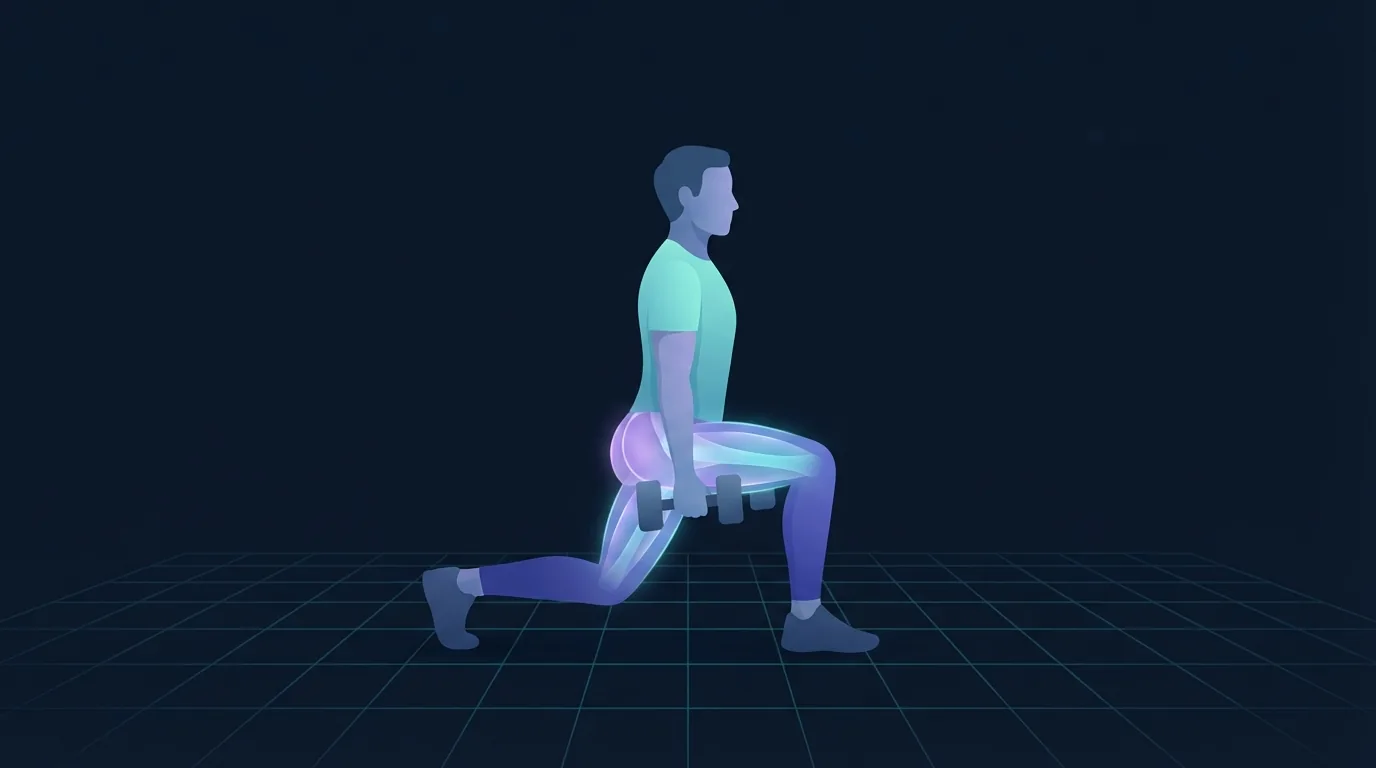
Hill sprints are a lower-body power session. Squats, lunges, split squats, hinges and calf work are lower-body strength sessions. They draw from the same tissue and the same recovery budget, so the scheduling question is real.
Three arrangements that work:
- Same day, sprints first. Do the hill sprints while you're fresh, then the dumbbell or bodyweight strength session an hour or more later, or immediately after. One hard day for the legs, two genuinely easy days after it. This is the cleanest option for most people.
- Separate days, 48 hours apart. Hill sprints Tuesday, lower-body strength Friday. Works well if your week has room.
- Sprints as the power element of a strength day. Warm up, do the hill sprints, then go to the squats. Keep the strength volume slightly lower than normal on that day.
The arrangement that doesn't work is heavy leg day followed by hill sprints the next morning. You'll be running your maximal effort on a fatigued system, which is the exact condition under which people strain things. If you want a structured way to sequence the strength side around your running, our roundup of the best strength training apps compares how each one handles progression and scheduling.
Who Should Not Do Hill Sprints
This is a genuinely high-intensity session, and it isn't for everyone right now. Hold off if any of these apply:
- You have an achilles or calf problem, current or recent. Uphill sprinting loads the calf complex about as hard as anything in running. Resolve it first.
- You haven't run in months. Build several weeks of easy running before adding maximal efforts. Our guide on how to start running when you are out of shape covers that ramp.
- You have uncontrolled high blood pressure, known cardiovascular disease, or chest pain or unusual breathlessness on exertion. Talk to your doctor before doing all-out efforts of any kind.
- You're in the late stages of pregnancy or the early postpartum window. Maximal-effort running isn't a good fit for either, and both warrant individual clinical guidance.
- You have a current lower-limb injury of any kind. Sprinting finds every weak link you have, at speed.
If none of that applies but you're still unsure, the hill will tell you. Do two build-up efforts at 70 percent. If anything pinches, pulls or complains, you have your answer and you've lost nothing.
The Bottom Line
Hill sprints give you a strength and power stimulus with lower landing forces than flat sprinting, they need no equipment, and the whole session including warm-up fits in half an hour. The one thing that decides whether you're still doing them in three months is the dosing in week one. Four reps of eight seconds. Walk back down. Go home feeling like you could have done more.
If you want the other end of the intensity range, the sustained comfortably-hard effort that raises the pace you can hold for a long time, our guide to the tempo run covers it, and the broader stamina guide shows how a hard day and easy days share a week.
Frequently Asked Questions
What are hill sprints?
Hill sprints are short all-out efforts run up a moderate incline, typically 8 to 10 seconds each, with a full walk-down recovery of two to three minutes between reps. The hill limits your top speed and increases the force each stride has to produce, so you get a powerful strength and power stimulus without the extreme stride velocities of flat-ground sprinting.
How many hill sprints should a beginner do?
Start with four reps of 8 seconds in your first session, not eight or ten. Add one or two reps per week and build toward 8 to 10 reps of 8 to 10 seconds over about six weeks. Every rep gets a full walk-down recovery. The most common beginner mistake is doing a full session on day one and being unable to walk down stairs for three days.
Are hill sprints easier on your joints than flat sprinting?
The landing forces are lower. Gottschall and Kram measured ground reaction forces across grades and found that the vertical impact peak decreases during uphill running compared with level running, and at a 9-degree incline the impact peak was sometimes absent entirely. Propulsive force rises sharply instead, so the muscles work harder while the landing is gentler. That trade is the main reason coaches start beginners on hills rather than on the flat.
How steep should the hill be for hill sprints?
A moderate grade of roughly 5 to 10 percent works best, steep enough that you cannot reach flat-ground top speed but shallow enough that you can still run rather than scramble. If you are leaning so far forward that your stride turns into a climb, the hill is too steep. A driveway, a park path, a parking ramp or a treadmill set to 6 to 8 percent all work.
How often can you do hill sprints?
Once or twice a week, on non-consecutive days, and never the day after heavy lower-body strength work. Hill sprints are a neuromuscular stimulus, which means the limiting factor is recovery quality rather than total volume. If your reps are getting slower within a session, you are training fatigue rather than power, and the session should end.
Do hill sprints improve cardiovascular fitness?
Longer all-out sprints do. A meta-analysis by Sloth and colleagues pooled 13 sprint interval training studies and found a weighted effect size of 0.63 on VO2max, with improvements of 4.2 to 13.4 percent over two to eight weeks, using sprints in the 30-second range. Eight-second hill sprints are shorter than that, so treat them as a power and running-economy stimulus first. If aerobic fitness is your main goal, pair them with easy volume and a weekly threshold session.