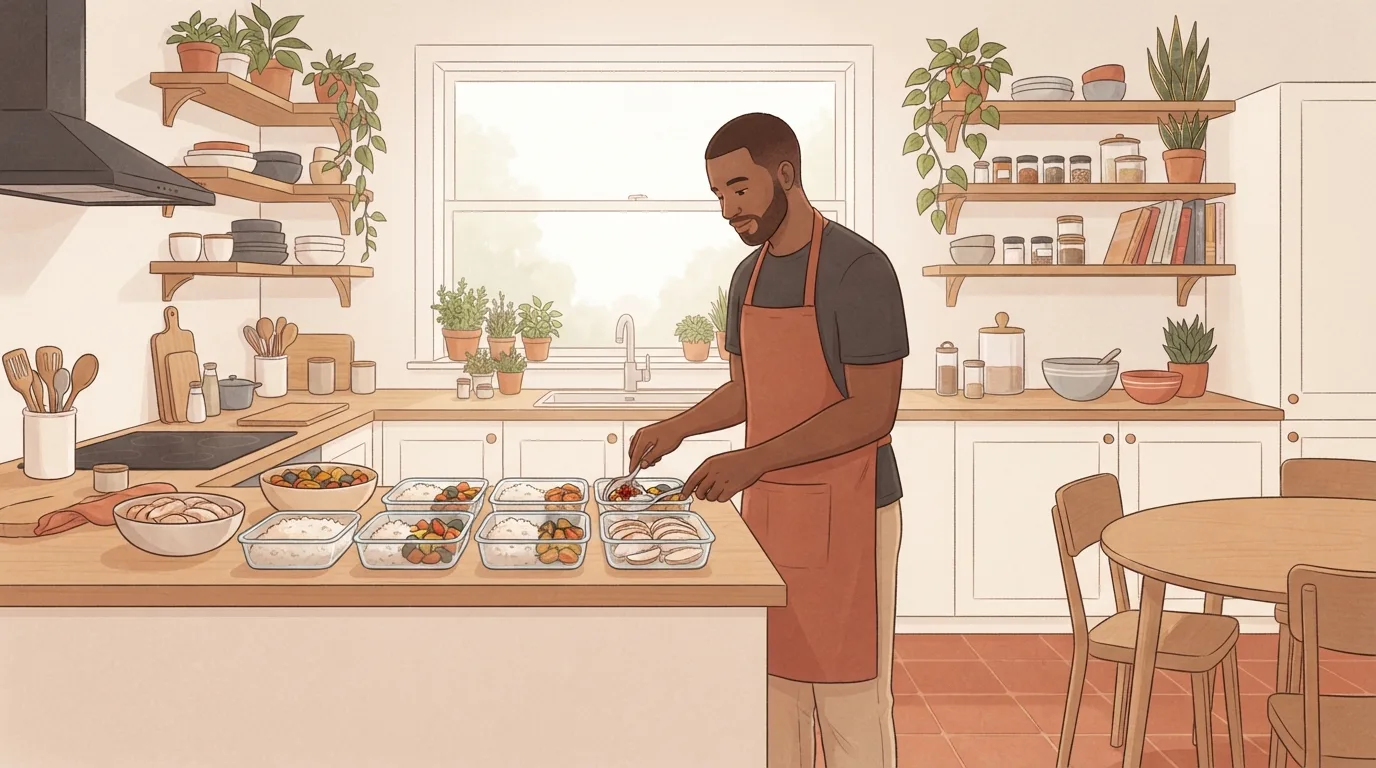
You start on Monday with a plan, a full fridge and real intent. By Thursday a work lunch, a late night and a box of donuts in the break room have bent it, and by Saturday you've decided to restart next Monday. If that loop sounds familiar, you're asking the right question. Knowing how to stick to a diet, or how to stick with a diet once the first week's energy fades, matters more than which diet you choose.
It also starts to feel personal. Each restart chips at the story you tell about yourself: maybe you just don't have the discipline, maybe you're someone who can't do this. Most people who search for this have already tried several diets and blamed themselves when each one ended.
The research points somewhere kinder and more useful. Diets rarely end because people are weak. They end because they're built on rules that only work on a good week, with no plan for the bad ones. That's a design problem, and design problems can be fixed. Below you'll find why the diet you pick matters less than you think, why diets fall apart, nine habits with trials behind them, and what to do the day after you slip.
Why Sticking With a Diet Matters More Than Which Diet You Pick
The clearest evidence comes from a trial that set four famous diets against each other. Dansinger and colleagues (2005), writing in JAMA, randomly assigned 160 adults with overweight or obesity to Atkins, Ornish, Weight Watchers or Zone for one year. Only 53 percent of the Atkins group and 50 percent of the Ornish group finished, against 65 percent for both Weight Watchers and Zone. Average weight loss landed between 2.1 and 3.3 kg in every group, with no meaningful difference between diets.
What did predict results was how closely people actually followed their diet. Self-reported adherence correlated with weight loss at r = 0.60, a strong relationship for a study like this, while the type of diet correlated at r = 0.07, close to nothing. The people who lost the most weight weren't on the best diet. They were on a diet they kept doing.
Bigger studies say the same thing. Johnston and colleagues (2014) pooled 48 randomized trials with 7,286 adults and found that low-carbohydrate and low-fat programs both produced about 7 kg more weight loss than no diet at 12 months (7.25 and 7.27 kg), with small differences between named programs. Their conclusion was practical: recommend whichever diet a person will stick to. The DIETFITS trial (Gardner and colleagues, 2018) then put 609 adults on a healthy low-fat or a healthy low-carb diet for a year. They lost 5.3 and 6.0 kg, a difference of 0.7 kg that wasn't statistically significant.
So stop hunting for the perfect diet. The best one for you is the pattern that survives your actual life: your schedule, your budget, your family's dinners and the foods you genuinely like.
Why Diets Fall Apart
If adherence is the whole game, the next question is what breaks it. Three patterns show up again and again in the research.
Rigid rules turn one slip into a binge
Some dieters run on all-or-nothing rules: no sugar, no bread, never after 8 pm. Others use flexible rules: smaller portions, a planned treat, eat less tomorrow if today ran over. Westenhoefer, Stunkard and Pudel (1999) measured both styles in 54,517 people in a weight reduction program and in a random sample of 1,838 adults. Rigid control went with higher BMI, more frequent and severe binge eating and more disinhibited eating. Flexible control went with lower BMI, less binge eating and a higher chance of losing weight successfully during the program.
The mechanism is familiar to anyone who has tried a strict diet. When the rule is "never," one cookie breaks it, and once it's broken the day feels lost, so the whole sleeve goes. A flexible rule bends instead of breaking.
Slips cluster at home, in the evening and on weekends
Forman and colleagues (2017) had 189 adults in a year-long weight loss program report each dietary lapse on their phones as it happened. The most common lapse was eating a food they'd told themselves was off limits, and lapses happened most at home, in the evening and on weekends. Strong emotions, hunger, feelings of deprivation and simply having tempting food nearby all predicted them. People who lapsed more often early on lost less weight over the program.
That's useful, because it tells you where to aim. Most diets are planned around breakfast and lunch on a weekday. The danger zone is the kitchen at 9 pm on a Friday.
The diet doesn't fit your life
The Dansinger dropout numbers make the third point. The two most restrictive plans, very low carb and very low fat, lost the most people. A diet that asks you to give up whole food groups, cook separately from your family or skip every social meal can work on paper and still fail in practice, because each week it keeps asking for a little more willpower than you have left.

How to Stick to a Diet: 9 Habits That Work
Each of these habits targets one of the failure points above. You don't need all nine on day one. Start with the two or three that match where your last diet broke.
- Pick the diet you could keep on your worst week.
- Change one or two things at a time.
- Write if-then plans for your danger moments.
- Plan the week's meals before it starts.
- Track briefly but often.
- Use flexible rules instead of forbidden foods.
- Eat the same way on weekends.
- Make the evening kitchen work for you.
- Protect your sleep.
1. Pick the diet you could keep on your worst week
Before you start, picture a bad week: a deadline, a sick kid, two dinners out. Could you still follow this plan, more or less? If the answer is no, choose a gentler version. A plan you follow 80 percent of the time beats a perfect one you abandon in week three. Choose by the foods you enjoy and the meals you can realistically make, since the trials above found that the label on the diet barely moves the result.
2. Change one or two things at a time
Big overhauls pile up decisions, and each decision is a chance to drift. Small changes repeated daily become habits that stop costing effort. Lally, Chipperfield and Wardle (2008) gave 104 adults with overweight or obesity a simple leaflet of ten eating and activity habits, plus a checklist to tick off each day. After eight weeks they'd lost an average of 2.0 kg, against 0.4 kg in a waiting-list group. Those who stayed in the study for 32 weeks had lost 3.8 kg on average, and more than half of them had lost at least 5 percent of their body weight. Nothing about it was dramatic. It was the same few behaviors, done in the same context, every day.
3. Write if-then plans for your danger moments
An if-then plan, which psychologists call an implementation intention, links a specific situation to a specific response: "If I get home hungry, then I'll eat the yogurt before I open the pantry." Across 94 tests, Gollwitzer and Sheeran (2006) found these plans had a medium-to-large effect on reaching goals (d = 0.65). For eating specifically, Adriaanse and colleagues (2011) pooled 23 studies and found a medium effect on eating more healthy food (d = 0.51) and a smaller one on eating less unhealthy food (d = 0.29).
That gap is worth noticing. Adding a good behavior is easier to plan than suppressing a bad one, so frame your plans as replacements. Three examples:
- "If there are pastries at the morning meeting, then I'll take a coffee and sit away from the table."
- "If it's after dinner and I want something sweet, then I'll have one planned treat on a plate and close the kitchen."
- "If I'm ordering takeout, then I'll order before I'm starving and add a side of vegetables."
4. Plan the week's meals before it starts
Every unplanned meal is a decision made when you're hungry and tired. Ducrot and colleagues (2017) surveyed 40,554 French adults and found that people who planned their meals ate a more varied, higher-quality diet. Women who planned had 21 percent lower odds of obesity, and men who planned had 19 percent lower odds. It's a survey, so it can't prove planning caused the difference, but it fits everything else on this page. Plan five dinners, two default breakfasts and a lunch you can repeat, then shop from the list.
5. Track briefly but often
Self-monitoring is one of the most consistent findings in weight loss research. Burke, Wang and Sevick (2011) reviewed 22 studies and found a steady link between recording what you eat and losing weight. In the Weight Loss Maintenance trial, Hollis and colleagues (2008) followed 1,685 adults through six months of group sessions. They lost 5.8 kg on average, and the number of food records kept per week was one of the significant predictors of how much each person lost.
Tracking doesn't have to eat your evening. In Harvey and colleagues (2019), 142 adults in an online program spent about 23 minutes a day logging food in the first month and about 15 by the sixth. Time spent didn't predict success. Frequency did: people who lost at least 5 percent of their weight opened their food log about 2.4 times a day, against 1.6 for those who lost less. Quick check-ins through the day beat a long, careful log you dread.
6. Use flexible rules instead of forbidden foods
Swap "never" for "how much and how often." Instead of banning chocolate, plan two squares after dinner. Instead of no bread, have it at one meal. Westenhoefer's data link that flexible style to lower BMI and less binge eating, and it removes the trigger for the all-or-nothing spiral. A simple version many people use is to make most meals the planned kind and leave room each week for foods you love in portions you decide ahead of time.
7. Eat the same way on weekends
Gorin and colleagues (2004) followed 1,429 members of the National Weight Control Registry, people who had already lost weight and kept it off, for a year. Those who ate the same way across the whole week were about 1.5 times as likely to stay within 5 pounds of their weight as those who dieted strictly on weekdays and loosened up on weekends (odds ratio 1.58). Consistency across the year, through holidays and vacations, showed the same pattern. A strict weekday plan plus a free-for-all weekend tends to end with the weekend winning.
8. Make the evening kitchen work for you
Since slips cluster at home in the evening, change the room where they happen. Keep tempting foods out of sight or out of the house, and put fruit and ready-to-eat vegetables at eye level. Eat dinner at a regular time with enough protein and fiber to carry you to bed. Decide on a "kitchen closed" time, and if you want an evening snack, plate it instead of eating from the bag.
9. Protect your sleep
Short sleep makes a diet harder in a measurable way. Nedeltcheva and colleagues (2010) put 10 adults with overweight on the same moderate calorie deficit twice for 14 days, once with 8.5 hours in bed each night and once with 5.5. With short sleep they lost 0.6 kg of fat instead of 1.4 kg, lost more lean mass (2.4 kg instead of 1.5) and reported more hunger. It was a small study, but the direction matches what most dieters notice: the tired days are the hungry days.
Find out what's really holding you back
FitCraft, our mobile fitness app, pairs you with an AI coach who builds you a personalized plan around your goals, schedule, and fitness level. Every FitCraft program is designed by Domenic Angelino, MPH (Brown University) and NSCA-CSCS, with research published in the Journal of Strength and Conditioning Research and Medicine & Science in Sports & Exercise.
Take the Free Assessment Free • 2 minutes • No credit cardWhat to Do After You Slip
You will slip. Everyone in the lapse studies did, and the plan that works is the one that expects it. The goal is to keep a slip at the size of one meal instead of letting it become a lost week.
- Make the next meal a normal one. Not a punishment and not a skipped meal, which only sets up the next round of hunger.
- Don't wait for Monday. The "restart next week" habit turns one meal into five days. Start again at the next meal.
- Name the trigger. Tired, stressed, at home, food in sight? Write one if-then plan for that exact moment.
- Look at the week, not the day. One heavy dinner barely moves a week of planned eating. Judging yourself by single days is what makes a slip feel like failure.
Forman's data cut both ways here. More frequent lapses predicted less weight loss, so fewer is better. But lapses kept happening across the whole year-long program, falling at first and then rising again, so even a diet that works includes them. A slip isn't proof that it's over.

How to Stick to Diet Plans When Your Schedule Is Brutal
One of the questions Google pairs with this search comes from someone who works 9 to 9, lives on snacks and coffee and barely moves. If that's you, the habits above still apply, but the order changes. Start with defaults, because you don't have time for daily decisions.
- Two default breakfasts you can make in five minutes or buy on the way, both with protein, such as Greek yogurt with fruit or eggs on whole-grain toast.
- A desk drawer that helps you: nuts in single portions, fruit, protein bars you've checked, instead of the vending machine.
- One repeatable lunch order near your office that fits your plan, so lunch needs no thought.
- Coffee as coffee: sweet coffee drinks can carry the calories of a meal, so keep them for when you actually want one.
- Movement in slots you already have: a 10-minute walk after lunch, the stairs, a short workout before the day starts.
How Long Until Eating This Way Feels Automatic?
Longer than the 21 days you've probably heard, and with a lot of variation between people. Our piece on how long it takes to break a habit covers the research, including why the median in the best-known study was about two months and why some habits took far longer. The practical point for a diet is that the first weeks are the expensive ones. Repetition in the same context is what eventually makes the planned breakfast or the closed kitchen feel normal.
There's also an end point to plan for. If your diet is a calorie deficit, you'll eventually want to eat at maintenance again. Our review of reverse dieting research looks at what the studies say about adding calories back after a fat loss phase.
Where Exercise Fits
People who lose weight and keep it off tend to move a lot. Wing and Phelan (2005) summarized the National Weight Control Registry: members had lost an average of 33 kg and kept it off for more than five years, and they reported about an hour of physical activity a day, regular breakfast, regular self-weighing and the same eating pattern on weekdays and weekends. The eating habits and the exercise habit share one skill: showing up on ordinary days.
That's also where most people fall off a workout plan, for the same reasons they fall off a diet. Our guide on how to motivate yourself to work out covers the training side of the problem. If you'd like an app to carry part of the load, our roundup of the best fitness apps for staying consistent compares the options. FitCraft is one of them: FitCraft's 3D AI coaches demonstrate each exercise and say your name mid-workout, and streaks and leaderboards make a skipped day feel like it costs something. Katie, a FitCraft user, put it this way: "I've tried everything. This is the first time I've stuck with something past two weeks."
What to Expect
- Weeks 1 and 2: the plan feels new and motivation is high. Use this stretch to set up defaults, if-then plans and the kitchen, not to see how strict you can be.
- Weeks 3 and 4: novelty fades and the first real slips arrive. This is where most diets end, so treat each slip with the next-meal rule.
- Months 2 and 3: the repeated meals start to feel normal and need less thought. Progress on the scale is usually slower than in week one, which is normal.
The Bottom Line
The diet you can keep beats the diet that looks best on paper. Pick a pattern that survives a bad week, change a little at a time, plan for the evenings and weekends where slips happen, use flexible rules, and treat every slip as one meal. You're not broken. You just need a plan built for real life.
Frequently Asked Questions
How do I stick to my diet?
Pick an eating pattern you could keep on your worst week, change one or two things at a time, and write if-then plans for the moments you usually slip, such as the drive home or the office snack table. Plan the week's meals, log what you eat briefly but often, eat the same way on weekends, and treat a slip as one meal rather than a reason to restart on Monday.
How to stick to a 1200 calorie diet?
First check that 1,200 is right for you. US obesity guidelines set 1,200 to 1,500 calories a day as a typical weight loss target for women and 1,500 to 1,800 for men, so 1,200 is the bottom of the range for women and below it for men, and it's too low for many people, especially active ones. If it is your target, build every meal around protein and vegetables, plan the whole day in advance, and work with a clinician or dietitian.
How to control yourself while dieting?
Rely on planning more than on in-the-moment control. Decide in advance what you'll do in your hardest situations, keep tempting food out of sight at home, and don't let yourself get very hungry. Flexible rules help too: people who allow planned treats report less binge eating and have lower BMIs than people who try to ban foods outright.
Why can't I stick to a diet?
Usually because the diet was built for a good week. Rigid rules, big changes all at once, no plan for evenings and weekends, short sleep and a diet you don't enjoy all make slips more likely, and an all-or-nothing mindset turns each slip into a restart. Those are design problems you can fix, not proof that you lack discipline.
Can you learn to stick to a diet fast?
You can make it easier within a week, by setting if-then plans, clearing tempting food from the house and planning meals. Making the new eating feel automatic takes longer, often around two months and sometimes much more, which is why the first few weeks are about repetition, not perfection.
Is it OK to have a cheat day?
A planned treat meal usually works better than a whole cheat day. In a study of 1,429 people who had kept weight off, those who ate the same way on weekdays and weekends were about 1.5 times as likely to stay within 5 pounds over the next year as those who dieted strictly on weekdays only. Build favorite foods into the week in measured portions instead.
What is the easiest diet to stick to?
The one that fits your tastes, budget and schedule. Trials comparing low-carb, low-fat and named commercial diets find small differences in weight loss between them, while how closely people follow a diet predicts results far better. Choose the pattern you could still follow on a busy, stressful week.