
It's 6:40 in the evening. You planned to work out, the clothes have been on the chair since this morning, and now the couch is winning. So you type "how do I motivate myself to workout" into a search bar instead of putting on your shoes.
Then the voice starts. Maybe you're just lazy. Maybe other people got a discipline gene you didn't. Every skipped session turns into evidence for a story about who you are, and the story makes the next session harder to start.
That story gets the order backwards. In the research, motivation to exercise behaves less like fuel you need before a workout and more like something the workout produces once it's underway. People who train on bad days usually have a better plan for the first ten minutes, and that plan can be learned. This page is that plan: ten tactics for the specific moment of not feeling like it, each one tested in a study.
Why Can't I Motivate Myself to Workout?
You can't motivate yourself to workout because your brain forecasts the whole session from its worst part, the first few minutes, and that forecast is reliably wrong.
Ruby and colleagues (2011), in Health Psychology, ran four studies with 279 adults and found people significantly underestimated how much they would enjoy exercising. The bias showed up for group and solo sessions, for moderate and hard workouts, and for everything from yoga and Pilates to aerobic classes and weight training. The researchers called the cause forecasting myopia: when you imagine a workout, you put most of the weight on the beginning, which is usually the least pleasant part.
The second piece is how you feel while you're moving. Rhodes and Kates (2015) reviewed 24 studies in the Annals of Behavioral Medicine and found that feeling better during moderate exercise was linked to doing more exercise later, while how people felt afterwards wasn't. A session that feels miserable while you're in it makes the next one harder to start. So the job on a low day is a workout that feels decent from the inside. That's a design problem you can solve, and it has nothing to do with your character.
How to Motivate Yourself to Workout Today: 10 Tactics
Every tactic below targets the first ten minutes, the part your brain is forecasting from. You don't need all ten. Pick two or three that fit how you train and keep them ready for the days you'd rather skip.
1. Commit to ten easy minutes, with permission to stop
Tell yourself you'll do ten easy minutes and then decide. Most days you'll keep going, and on the days you don't, ten minutes still counts.
This works because the mood lift arrives fast. Reed and Ones (2006) meta-analysed 158 studies with 13,101 participants in Psychology of Sport and Exercise and found a single bout of aerobic exercise raised energetic, positive mood (effect size 0.47), with consistent gains at low intensity and for sessions up to about 35 minutes. The lift was largest in people who started below their usual mood, and it lasted at least 30 minutes after they stopped. The day you feel flattest is the day ten minutes does the most.
Make the permission real. If you feel worse after ten minutes, stop and log it as a win. Keeping that promise is what makes the deal believable the next time you offer it to yourself.
2. Go easy enough that you could hold a conversation
On a low day, cap the intensity at a pace where you can still speak in full sentences. Ekkekakis, Parfitt and Petruzzello (2011), reviewing 33 studies in Sports Medicine, found pleasure during exercise drops mainly once intensity passes the ventilatory threshold, the point where your breathing changes gear. Below it, most people feel better as they go. Above it, almost everyone feels worse. They also found people tolerated harder work when they chose the intensity themselves.
The talk test is the practical version of that threshold. Save the hard efforts for days you feel good, because the session that feels okay is the one you'll come back for.
3. Put your favourite exercise first
Because you judge a workout by its opening, change the opening. In the third of the Ruby studies, gym-goers expected to enjoy their whole workout more when they were encouraged to move one of their favourite exercises to the start. If you like goblet squats, open with them. If you like the bike, start there. The burpees can wait until minute twelve, when you're warm and already committed.
4. Pick the workout you'll enjoy today, not the "best" one
Woolley and Fishbach (2017), in Personality and Social Psychology Bulletin, found that immediate rewards such as enjoyment predicted how long people kept at goals like exercise and New Year's resolutions, while delayed rewards such as better health didn't, even though people said they exercised for the health benefits. The reason you started matters less than whether today's session is pleasant. A walk you like beats an interval session you skip, and a yoga flow beats a leg day you dread when the alternative is nothing.
5. Bundle it with something you only get while training
Choose one thing you love, such as a gripping audiobook, a podcast or a show, and allow it only during workouts. Milkman, Minson and Volpp (2014), in Management Science, gave gym members access to page-turner audiobooks that could only be played at the gym. At first those members visited the gym 51 percent more often than controls, and a group simply encouraged to save their audiobooks for the gym went 29 percent more often. The effect faded over the following weeks, especially after the Thanksgiving break, and 61 percent of participants chose to pay for gym-only access to their audiobooks once the study ended.
The fade is useful information. Refresh the bundle every few weeks with a new series or a new show so the pull stays strong.
Find out what's really holding you back
FitCraft, our mobile fitness app, pairs you with an AI coach who builds you a personalized plan around your goals, schedule, and fitness level. Every FitCraft program is designed by Domenic Angelino, MPH (Brown University) and NSCA-CSCS, with research published in the Journal of Strength and Conditioning Research and Medicine & Science in Sports & Exercise.
Take the Free Assessment Free • 2 minutes • No credit card6. Press play on fast music before you decide anything
Start the playlist while you're still on the couch. Terry and colleagues (2020) pooled 139 studies and 3,599 participants in Psychological Bulletin and found music improved how people felt during exercise (g = 0.48), improved performance (g = 0.31) and lowered perceived exertion (g = 0.22). Fast tempos helped performance more than slow or medium ones. The music changes the forecast before you've moved, which is exactly the point where you're deciding whether to go.
7. Train next to someone slightly fitter than you
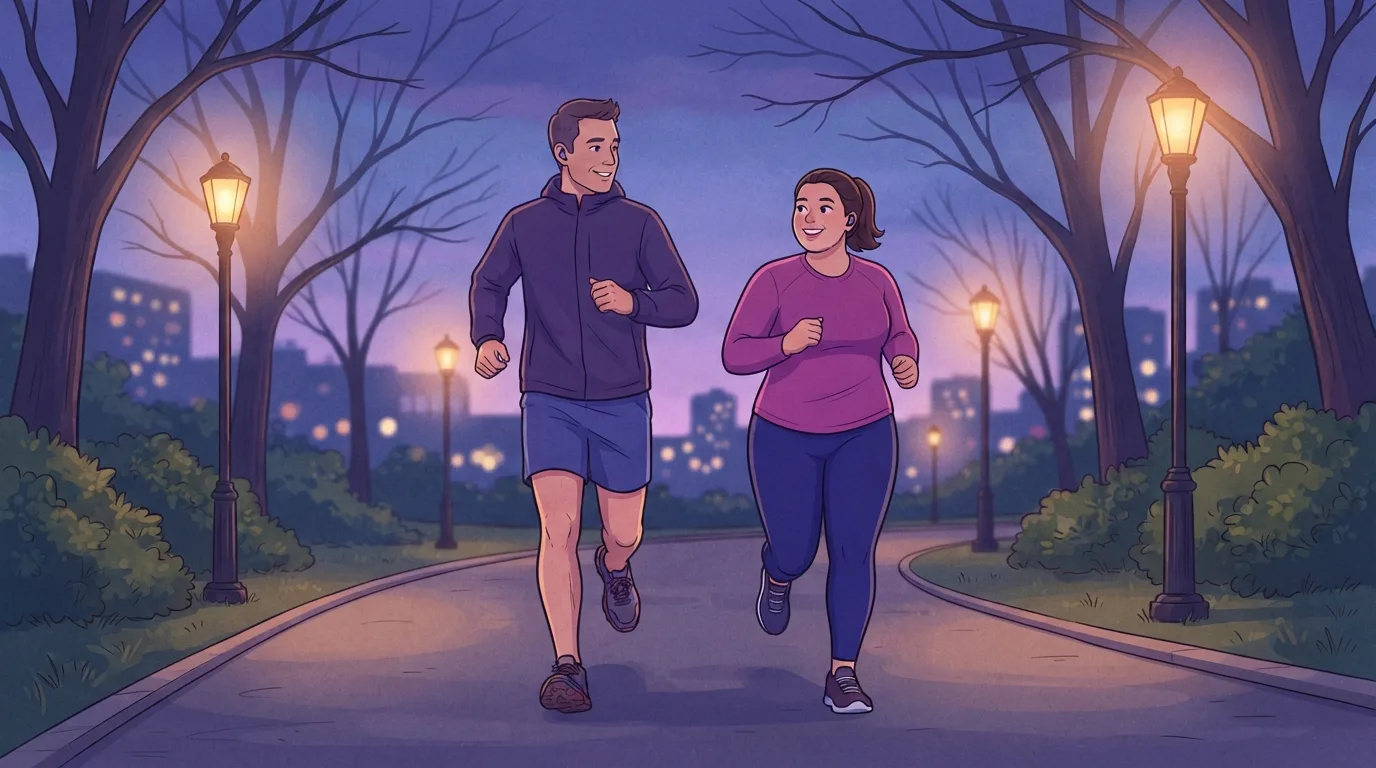
A partner who's a little better than you pulls more effort out of you than training alone. Irwin and colleagues (2012), in the Annals of Behavioral Medicine, had 58 women ride stationary bikes at a moderate intensity on six separate days. Riding alone, they lasted 10.6 minutes on average. Paired with a virtually present, slightly fitter partner, where the team's score depended on whoever stopped first, they lasted 21.9 minutes. Simply riding alongside a partner got them to 19.8 minutes.
The partner doesn't even have to be human. Feltz and colleagues (2014), in the Games for Health Journal, ran 120 students through plank exercises and found a software-generated partner also raised persistence, though less than a partner people believed was a real person. In practice that means a friend who's a bit fitter, a class where you can see the person next to you, or a session with someone on a video call.
8. Talk to yourself like a coach, using your name
When the inner voice says "I don't want to", answer it in the second person. "Sam, you've done harder things than ten minutes of squats." Kross and colleagues (2014), in the Journal of Personality and Social Psychology, ran seven studies with 585 people and found that using your own name or "you" instead of "I" during self-talk helped people perform better and feel less distressed under stress, and made upcoming stressors feel more like a challenge than a threat. Those studies used stressful social tasks rather than workouts, but the reluctant moment before a session is the same kind of self-regulation problem, and the switch costs nothing to try.
9. Protect the streak with a minimum session
Decide in advance what the smallest session is that still counts, and make it the ten easy minutes from tactic 1. A streak only survives a bad day if the bar for keeping it alive is low.
Game mechanics like streaks, points and levels have decent evidence behind them. In the STEP UP trial, Patel and colleagues (2019) enrolled 602 adults in a 24-week gamified program with points and levels and found the competition version raised daily steps by 920 over controls, with the support and collaboration versions adding 689 and 637. The competition group still walked 569 more steps a day during the 12 weeks after the game ended. Mazeas and colleagues (2022) pooled 16 randomised trials with 2,407 participants in the Journal of Medical Internet Research and found a small to medium effect of gamified programs on physical activity (g = 0.42).
10. Make the comeback the thing you reward
The day after a missed workout is when motivation is lowest and guilt is highest, so put the reward there. In a megastudy in Nature, Milkman and colleagues (2021) tested 54 four-week programs designed by 30 scientists on 61,293 members of a US gym chain. Nearly half of the programs raised weekly gym visits, by 9% to 27%, and the best performer gave small rewards for returning after a missed workout. Your version can be simple: the session after a miss earns your favourite playlist, a good coffee or the episode you've been saving.
How to Make Yourself Work Out When You're Tired
When you're tired, make yourself work out by shrinking the session and dropping the intensity, because easy exercise tends to raise energy rather than drain it. Puetz, Flowers and O'Connor (2008), in Psychotherapy and Psychosomatics, randomised 36 sedentary young adults who reported persistent fatigue to six weeks of low-intensity exercise, moderate-intensity exercise or no exercise, three days a week. Both exercise groups felt more energetic, the low-intensity group got the larger drop in fatigue, and the changes had nothing to do with fitness gains. Tired is often a reason to go easier. Our guide to working out when you're tired covers the 10-minute decision rule and the signs that tiredness means rest instead.
How to Motivate Yourself to Go to the Gym or Work Out at Home
Going to the gym and working out at home stall at different points, so they need different fixes.
- The gym: the hard part is the trip, so take the decision out of it. Keep a packed bag in the car or by the door, go straight from work before you sit down at home, and save your audiobook for the drive and the gym floor. The Milkman audiobook trial ran in a gym, which is where temptation bundling has its best evidence.
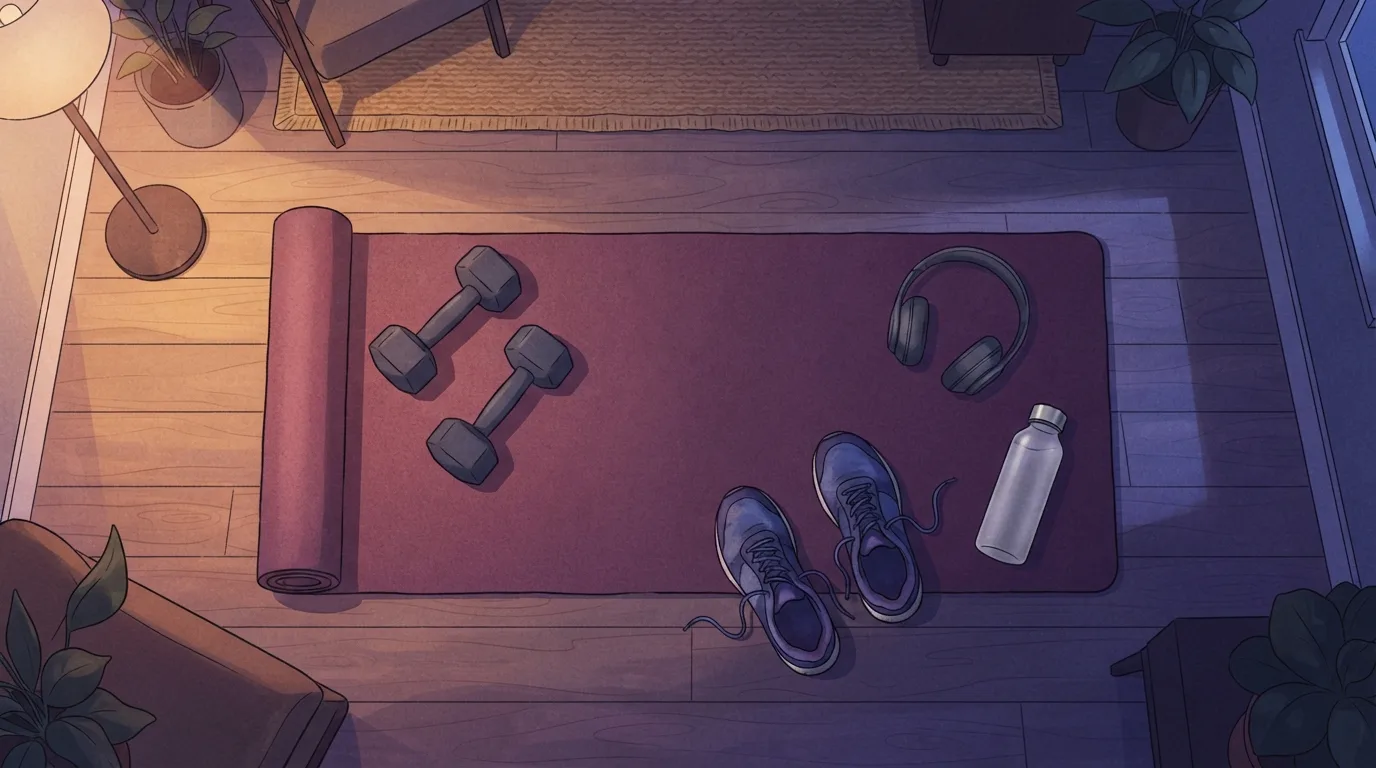
- At home: the hard part is the couch. Lay the mat and dumbbells out where you'll see them, start the first exercise before you change clothes, and follow a guided session so you aren't deciding what comes next while you're still deciding whether to go.
- Either way: the training partner from tactic 7 is the strongest single lever. A friend at the gym or a video-call partner at home both count.
How to Overcome Laziness to Exercise
What feels like laziness about exercise is usually a bad forecast, an intensity that feels punishing or a plan that's too big, and each one has a fix in the list above. The longer-term fix is choosing training you actually value. Teixeira and colleagues (2012) reviewed 66 studies through the lens of self-determination theory and found that exercising for reasons you own, because you enjoy it or because it matters to you, predicted more exercise than exercising out of guilt or pressure. Feeling competent, the sense that you're getting better at something, also predicted participation. So pick movements you can see yourself improving at, and drop the ones you only do because you feel you should.
Where Today's Tactics Hand Off to Habit
These tactics get you through one hard day. Getting through months of them is a different problem, and it's solved by habit and routine rather than by motivation. If you want the system that makes training happen without a daily negotiation, our guide on how to stay consistent with working out lays out a four-week protocol, and how to make exercise a habit without willpower covers environment design and cue planning. If you're three weeks in and the novelty has worn off, that's a predictable stage with its own fixes, explained in the week 3 motivation dip.
How FitCraft Uses Streaks, Leaderboards and Your Name
Several of the tactics above are built into FitCraft. Your AI coach is a 3D character who coaches you through each workout, demonstrates the exercises, motivates you and says your name, which puts tactic 8 in someone else's voice. Streaks and calendar rewards make the minimum session in tactic 9 visible, leaderboards add the competitive pull that did best in STEP UP, and XP, levels and collectible cards give each session an immediate reward of the kind Woolley and Fishbach found predicts persistence. Workouts also adapt as you progress.
None of the studies on this page tested FitCraft itself, and no app removes the first decision to start. What an app can do is make starting easier and keeping going more fun. If that's what you're after, here's how FitCraft works as a workout app that keeps you motivated past the first few weeks. As Mike, 23, put it after four months: "The streak system got me hooked. I didn't want to break my chain."
What to Expect When You Start Using These
The first ten minutes won't stop being the hardest part, and that's normal. What changes is how much you believe the forecast. After a few sessions where ten reluctant minutes turned into a full workout you enjoyed, the "I don't feel like it" voice still shows up, but it loses most of its authority. Expect the tactics that work best for you to be the ones that match your personality: social people lean on the partner, competitive people on the streak and the leaderboard, and everyone gets something from the ten-minute start.
The Bottom Line
What you need before a workout is a start small enough and pleasant enough that motivation has a chance to show up. Ten easy minutes, your favourite exercise first, music on, a slightly fitter partner beside you and a streak with a low bar will carry you through most of the days you'd rather skip.
The voice that calls you lazy is only making a forecast, and forecasts can be corrected.
Frequently Asked Questions
How do I find the motivation to work out?
Find the motivation to work out by starting before you feel it: commit to ten easy minutes, put your favourite exercise first and pair the session with music or a show you only allow while training. Ruby and colleagues (2011) found people underestimate how much they'll enjoy exercise because they judge it by the first few minutes, so motivation usually arrives after you begin rather than before.
What is the 3-3-3 rule for workout?
The 3-3-3 rule is an informal template rather than a research finding, and it circulates in at least three versions: three exercises for three sets, three days a week; three sets of three heavy reps; or three strength days and three cardio days a week. Its real value for motivation is that it removes decisions on low days. If you're new, the three exercises, three sets, three days a week version is the sensible one.
What do 2 weeks of no gym do?
Two weeks off costs much less than it feels like. Hwang and colleagues (2017) found trained men kept their leg-press strength through a two-week break, and Coyle and colleagues (1984) measured about a 7 percent drop in aerobic capacity in endurance athletes over the first 21 days of stopping. The bigger risk is losing the routine, so restart with short, easy sessions instead of trying to make up for lost time.
How do you motivate yourself to work out when you're depressed?
Start smaller than you think you need to and count a ten-minute walk or a short strength session as a full win. Noetel and colleagues (2024), in a BMJ network meta-analysis of 218 trials, found walking or jogging, yoga and strength training all reduced depression symptoms, with strength training and yoga the best tolerated. Low motivation is itself a symptom of depression, so talk to a doctor or therapist and use exercise alongside treatment.
How do you motivate yourself to work out in the morning?
Make the first ten minutes of a morning workout as easy as possible: clothes out the night before, your favourite movement first and a pace you could talk at until you warm up. Most people feel stiff and slow early in a morning session, and that feeling says nothing about how the rest of it will go. Fast music helps here too: Terry and colleagues (2020) found music lowered perceived effort across 139 studies.
Can a workout app help with motivation to exercise?
Yes, when it uses mechanisms with evidence behind them. Mazeas and colleagues (2022) pooled 16 randomised trials with 2,407 participants and found gamified programs increased physical activity with a small to medium effect (g = 0.42). FitCraft builds in streaks, leaderboards and a 3D AI coach who says your name during workouts, though no app replaces the decision to start the first ten minutes.