
You finish a workout and you honestly don't know whether it was enough. The plan said "moderate intensity," the treadmill said 180 calories, and your watch put you in zone 3 for part of it. None of those numbers told you how hard to go while you were doing it.
So most people guess. On good days they push every session into a grind, and on tired days they feel guilty for backing off. Both patterns end the same way: workouts that feel like punishment and a routine that slips by week three.
The fix is a measurement you already carry. Your sense of effort pulls together your heart rate, breathing, muscle burn and fatigue into one reading, and researchers have spent more than 50 years showing how well it tracks the real thing. Learn to put a number on it and you can pace any workout, on any day, without a gadget.
What Does Rate of Perceived Exertion Mean?
Rate of perceived exertion means how hard you feel your body is working, expressed as a number. The Swedish psychologist Gunnar Borg introduced the idea in 1970 (Borg, 1970) and set out both of today's scales in a 1982 paper (Borg, 1982). His own term is "rating of perceived exertion," and you'll see both phrasings. They mean the same thing.
When people ask what RPE is in fitness, the answer is that it's a whole-body reading rather than a single signal. It blends:
- Breathing: how fast and deep you're breathing, and whether you can still talk.
- Heart rate: the pounding you can feel, even without a monitor.
- Muscle sensations: burn, heaviness and how much your legs or arms are slowing down.
- Overall fatigue: how long you think you could keep going.
That blend is the point. A heart rate monitor sees one signal. Your rating sees all of them at once, which is why it still works in the gym, in the pool and on a bike, where a single sensor can mislead. For a one-paragraph definition you can share, see our RPE glossary entry.
The Borg Rating of Perceived Exertion Scale (6 to 20)
The original Borg scale runs from 6 to 20. The odd range is deliberate: Borg designed it so that, for healthy adults doing steady work, the rating times 10 lands roughly near heart rate. A 13 suggests about 130 beats a minute, and a 15 about 150.
| Rating | Borg's label | What it feels like |
|---|---|---|
| 6 | No exertion at all | Sitting still |
| 7 to 8 | Extremely light | Barely moving, like a slow stroll |
| 9 to 10 | Very light | An easy walk you could keep up for hours |
| 11 to 12 | Light | Warm and breathing more, still fully conversational |
| 13 to 14 | Somewhat hard | Clearly working, talking in sentences takes effort |
| 15 to 16 | Hard (heavy) | Short phrases only, you want to slow down |
| 17 to 18 | Very hard | A few words at a time, only sustainable briefly |
| 19 | Extremely hard | The hardest effort you've ever kept going |
| 20 | Maximal exertion | All-out, you can't go any harder |
Don't lean on the times-10 shortcut too hard. Maximum heart rate falls with age, so a 55-year-old's 15 usually sits at a lower heart rate than a 25-year-old's. And a meta-analysis by Chen and colleagues (2002) found the average correlation between Borg ratings and heart rate across studies was 0.62, well below the 0.80 to 0.90 often quoted. The scale tracks heart rate, but it doesn't convert to it exactly.
Rate of Perceived Exertion Scale 1 to 10: Borg's CR10
Borg's second scale runs from 0 to 10 and is called the CR10, short for category-ratio. He built it so that the numbers behave more like ratios: a 4 is meant to feel about twice as strong as a 2. That makes it useful for sensations that climb steeply, such as breathlessness and muscle burn, and it's the version many clinics use.
| Rating | Borg's label | What it feels like |
|---|---|---|
| 0 | Nothing at all | Resting |
| 0.5 | Very, very weak (just noticeable) | You can barely tell you're moving |
| 1 | Very weak | An easy stroll |
| 2 | Weak (light) | Easy walking, warming up |
| 3 | Moderate | Brisk walk or easy jog, breathing deeper |
| 4 | Somewhat strong | Working steadily, conversation gets choppy |
| 5 to 6 | Strong (heavy) | Hard, sustainable for a while with focus |
| 7 to 9 | Very strong | Very hard, short phrases at most |
| 10 | Very, very strong (almost maximal) | Close to the hardest effort you can make |
Here's where people get confused. Many coaches, apps and running plans use a simpler everyday 1-to-10 scale where moderate sits around 4 to 6 and vigorous around 7 to 8. Lifters use yet another 1-to-10 scale built on reps in reserve, covered below. When someone says "RPE 7," check which scale they mean.
Rate of Perceived Exertion Chart: Both Scales Side by Side
This chart lines the scales up against the intensity levels in the American College of Sports Medicine's exercise guidelines (Garber and colleagues, 2011). The 6-to-20 and heart rate columns come from the guidelines. The everyday 1-to-10 column is an approximate match, and the talk test column is a practical guide.
| Level | Borg 6 to 20 | Everyday 1 to 10 | % of max heart rate | Talk test |
|---|---|---|---|---|
| Very light | Below 9 | 1 | Below 57% | You could sing |
| Light | 9 to 11 | 2 to 3 | 57 to 63% | Easy full conversation |
| Moderate | 12 to 13 | 4 to 6 | 64 to 76% | You can talk, but not sing |
| Vigorous | 14 to 17 | 7 to 8 | 77 to 95% | Short phrases only |
| Near-maximal to maximal | 18 to 20 | 9 to 10 | 96% and above | You can't talk |
Health guidelines are written in these terms. The ACSM recommends at least 150 minutes a week of moderate exercise or 75 minutes of vigorous exercise, or a mix of the two, so a rating gives you a way to know which minutes count. To put your own heart rate numbers beside the chart, our heart rate zone calculator works them out from your age or your measured maximum.
Does RPE Track Heart Rate and Lactate? What the Research Shows
Yes, closely enough to train by. The biggest single test of the scale comes from Scherr and colleagues (2013), who had 2,560 men and women do step-by-step exercise tests on treadmills or bikes. At the end of each stage they recorded heart rate, blood lactate and a 6-to-20 rating at the same moment.
- RPE and heart rate correlated at r = 0.74.
- RPE and blood lactate correlated even more strongly, at r = 0.83.
- The lactate threshold, where lactate first starts to rise, came at an average rating of 10.8.
- The individual anaerobic threshold, roughly the hardest pace you can hold for a long effort, came at 13.6. Fixed lactate levels of 3 and 4 mmol/L landed at 12.8 and 14.1.
- None of it changed with sex, age, activity level, heart disease or whether people ran or cycled.
The authors' practical advice follows directly: a rating of 11 to 13 suits less-trained people, and 13 to 15 suits harder training that stays aerobic. Chen's meta-analysis adds the honest caveat. Across many smaller studies the correlations ran lower, between 0.57 for lactate and 0.72 for breathing rate, and they varied with the type of exercise and how the rating was taken. Treat your rating as a strong guide that gets sharper with practice, not a lab measurement.

How to Estimate RPE
Rating effort is a skill. These five habits make your numbers consistent from one workout to the next:
- Anchor both ends. The bottom is sitting still. The top is the hardest effort you've ever made, like the end of a race or a sprint you couldn't hold another second. Rate everything against those two memories.
- Rate your whole body, not one part. Breathing, heart, muscles and fatigue together. If your legs burn but your breathing is easy, the overall number sits in the middle.
- Read the words, then pick the number. Find the label that fits ("somewhat hard," "strong") and take its number. People rate more consistently from the labels than from guessing a digit.
- Rate at the right moment. For steady cardio, rate after 3 to 5 minutes at a pace, once your breathing settles. For a lifting set, rate the moment you finish. To rate a whole workout, wait about 30 minutes: Foster and colleagues (2001) validated this "session RPE" method against heart rate across cycling and basketball.
- Write it down. A number next to each session for a few weeks is how the scale becomes yours. It also shows fatigue building before your performance drops.
Session RPE gives you a simple training load too: multiply the session rating on a 0-to-10 scale by its minutes. A 40-minute run rated 4 scores 160, and a 30-minute interval session rated 8 scores 240. Watching that total week to week shows when you're piling on too much, too fast.
Find out what's really holding you back
FitCraft, our mobile fitness app, pairs you with an AI coach who builds you a personalized plan around your goals, schedule, and fitness level. Every FitCraft program is designed by Domenic Angelino, MPH (Brown University) and NSCA-CSCS, with research published in the Journal of Strength and Conditioning Research and Medicine & Science in Sports & Exercise.
Take the Free Assessment Free • 2 minutes • No credit cardRPE vs Reps in Reserve for Lifting
For a set of 10 goblet squats, "somewhat hard" is too vague to plan with. So strength coaches adapted the 1-to-10 scale to count reps in reserve (RIR): how many more good reps you could have done when you stopped. Zourdos and colleagues (2016) published this version and tested it in 29 lifters doing squats.
| RPE | What it means | Reps left |
|---|---|---|
| 10 | Maximum effort | 0 |
| 9.5 | No more reps, but you could have added a little weight | 0 |
| 9 | One more rep was possible | 1 |
| 8.5 | Definitely 1, maybe 2 | 1 to 2 |
| 8 | Two more reps were possible | 2 |
| 7.5 | Definitely 2, maybe 3 | 2 to 3 |
| 7 | Three more reps were possible | 3 |
| 5 to 6 | Moderate effort | 4 to 6 |
| 3 to 4 | Light effort | Many |
| 1 to 2 | Little to no effort | Many |
The ratings matched what the bar was doing. As the weight got heavier, lifters' ratings rose and their bar speed fell, with a strong inverse link in both experienced lifters (r = -0.88) and novices (r = -0.77). The experienced group rated their one-rep max closer to a true 10 than the novices did, which suggests the skill improves with training years.
Two more studies show how well it works in practice. Helms and colleagues (2018) ran trained men through 8 weeks of matched programs, one loaded by percentages of their max and one by target RPE. Both worked, and the RPE group had a small, likely strength advantage. On accuracy, Halperin and colleagues (2022) pooled 12 studies with 414 people and found lifters underestimated how many reps they had left by about 1 rep on average. Their guesses got more accurate closer to failure and in sets with fewer reps to go.
The takeaway is simple. If you're new, your "2 left" is probably 3, so err on the side of pushing a little harder. If you want the research on how close to failure you need to go to build muscle, our review of training to failure vs reps in reserve covers the trials.
How Hard Should RPE 7 Be?
RPE 7 means you stopped with about 3 good reps left. The last couple of reps slow down a little, your form holds, and you could keep going if you had to. It's a good target for technique work, warm-up sets, the first weeks of a new program and exercises you're still learning.
How Hard Is RPE 8?
RPE 8 means 2 reps left. The final rep is clearly slower and takes real effort, but you aren't grinding or losing form. For most people most of the time, 7 to 9 is the sweet spot for working sets: hard enough to drive muscle and strength gains, with enough in reserve to keep good form and recover by the next session.
How to Use RPE for Cardio
For cardio, pick the effort first and let the pace follow. These targets use the 6-to-20 scale with the everyday 1-to-10 equivalent in brackets:
- Easy and recovery sessions: 10 to 11 (2 to 3). You can hold a full conversation. Most of your weekly minutes belong here, especially if you're building up.
- Steady aerobic work: 12 to 13 (4 to 5). You can still talk in sentences, but you'd rather not. This sits just above the lactate threshold rating in Scherr's data, and it's the effort many people mean by "moderate."
- Tempo or threshold work: 14 to 15 (7 to 8). Comfortably hard, short phrases only. This lines up with Scherr's individual anaerobic threshold at about 13.6 and the 4 mmol/L lactate mark at 14.1. Our tempo run guide uses the same 7-to-8 effort and shows how to hold it for 20 minutes.
- Hard intervals: 16 to 18 (8 to 9). A few words at most. Keep the work bouts short, from 30 seconds to 4 minutes, with easy recovery between.
An example for a beginner's week: two 30-minute walks or easy jogs at 11, one 30-minute steady session at 13, and one session of 6 one-minute efforts at 16 with two easy minutes between. On a day when your usual pace feels like a 15 instead of a 13, slow down to the rating, not the pace. That's the whole advantage of training by feel.
How to Use RPE for Dumbbell Training at Home
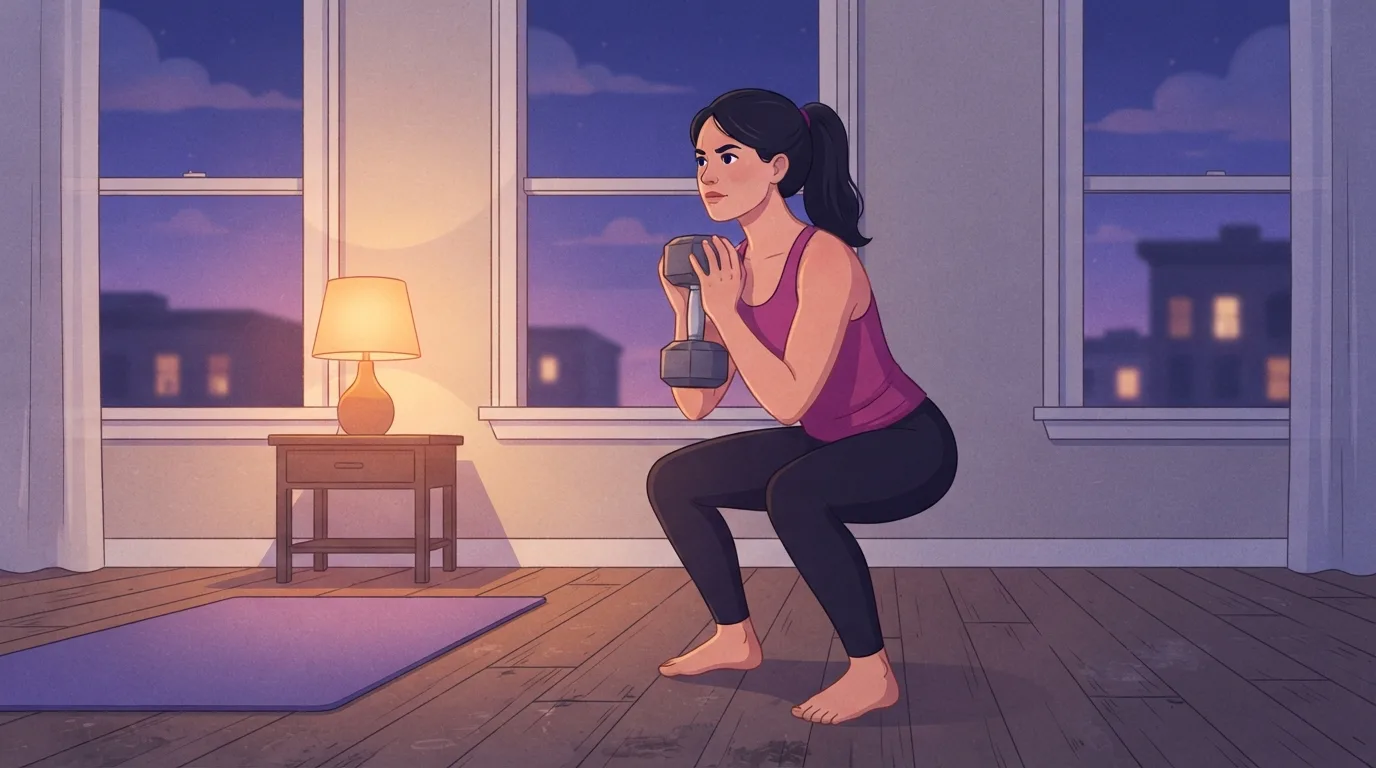
RPE solves the biggest problem with a home dumbbell set: you only own a few weights. You can't add 2.5 pounds to a goblet squat when the next dumbbell up is 10 pounds heavier. With a target RPE, the reps and the speed of each rep become your dial instead.
Here's a full-body session built that way. Pick a dumbbell you can lift with good form for the low end of the rep range, then let the target RPE decide where in the range you stop:
| Exercise | Sets x reps | Target RPE |
|---|---|---|
| Goblet squat | 3 x 8 to 15 | 7 to 8 (2 to 3 reps left) |
| One-arm dumbbell row | 3 x 8 to 15 per side | 7 to 8 |
| Dumbbell floor press | 3 x 8 to 15 | 7 to 8 |
| Dumbbell Romanian deadlift | 3 x 8 to 15 | 7 (3 reps left) |
| Push-up, or incline push-up on a sturdy surface | 2 sets, stop at the target | 8 (2 reps left) |
Then let the ratings run your progress:
- If a set rates 6 or lower at the top of the range, you're ready to progress. Add 2 reps next time, slow the lowering phase to about 3 seconds, pause at the bottom, or move to the next dumbbell up.
- If a set rates 9.5 or 10 before the bottom of the range, the weight is too heavy for now. Drop a dumbbell size or switch to an easier variation.
- If the same weight and reps feel 1 to 2 points harder than last week, treat it as a recovery signal. Sleep, stress and a hard week all show up here first. Keep the session but trim a set.
The Talk Test: The Quickest RPE Check
When you're unsure of your number, talk. Say a sentence out loud, such as a line of a song you know or your address. If it comes out comfortably, you're at or below a moderate effort. If you have to break it up to breathe, you've crossed into vigorous.
The test has solid backing. Persinger and colleagues (2004) tested 16 healthy adults on a treadmill and a bike and found that the point where speech first became difficult matched the ventilatory threshold almost exactly. When speech was no longer comfortable, the intensity was consistently above that threshold. Foster and colleagues (2008) confirmed the match held up even after training raised people's thresholds. A review by Reed and Pipe (2014) found the test consistent across walking, jogging, cycling, elliptical and stair stepping, though less practical for hard interval training.
What Changes Your RPE
Your rating is honest, but it isn't fixed. A few things shift how hard the same work feels, and knowing them keeps you from misreading a day:
- Caffeine makes work feel easier. A meta-analysis by Doherty and Smith (2005) found caffeine lowered RPE during exercise by about 5.6% compared with a placebo, which may be part of why it improves performance.
- Music does too. Pooling 139 studies, Terry and colleagues (2020) found music lowered perceived exertion by a small amount and improved performance, with no meaningful change in heart rate.
- Heat, poor sleep and stress make it feel harder. On those days, a lower pace at your usual rating is the right call, not a failure.
- Short intervals fool heart rate, not RPE. Heart rate takes a minute or more to catch up with a hard effort, so in a 30-second sprint your rating is the better live guide.
- Some medicines change the heart rate link. Beta blockers, for example, hold heart rate down during exercise, which is one reason clinical programs lean on RPE instead of heart rate targets.
- Inexperience runs low. As the lifting studies showed, newer exercisers tend to underestimate how much they have left.
The Bottom Line
Rate of perceived exertion turns "go moderate" into a number you can hit on any day. Use the 6-to-20 scale or an everyday 1-to-10 for cardio, aiming for 12 to 13 on steady days and 14 to 15 for tempo work, and use the reps-in-reserve scale for lifting, with most working sets at RPE 7 to 9. Check yourself with the talk test, and write your numbers down until they feel automatic.
The ratings get better with practice, and practice means showing up week after week. That's the part most plans leave to willpower. If you'd rather have the structure handled, our page on building a personalized training program walks through what a plan you'll actually finish looks like. FitCraft's dumbbell and bodyweight programs adjust as you progress, and a 3D AI coach demonstrates every exercise so you can focus on effort and form. As Tim put it: "I didn't think an app could replace my trainer. My AI coach proved me wrong."
Frequently Asked Questions
What are the levels of exertion?
The American College of Sports Medicine uses five levels on the 6-to-20 Borg scale: very light (below 9), light (9 to 11), moderate (12 to 13), vigorous (14 to 17) and near-maximal to maximal (18 and above). On an everyday 1-to-10 scale, those land at roughly 1, 2 to 3, 4 to 6, 7 to 8 and 9 to 10. Most health guidelines are written for the moderate and vigorous levels.
What does the Borg RPE scale 1 to 10 represent?
Borg's 0-to-10 scale, called the CR10, rates the strength of an effort or sensation, from 0 for nothing at all to 10 for very, very strong, almost maximal. A 3 is moderate, a 5 is strong or heavy, and a 7 is very strong. In lifting, a separate 1-to-10 RPE scale counts reps in reserve instead, where 10 means you couldn't have done another rep.
How hard should RPE 7 be?
On the lifting scale, RPE 7 means you finished the set with about 3 more good reps in you. The last reps slow down a little but your form holds. In cardio on an everyday 1-to-10 scale, a 7 is comfortably hard: you can speak in short phrases but not hold a conversation, which is about tempo-run effort.
How hard is RPE 8?
In lifting, RPE 8 means you could have done 2 more reps with good form. The final rep is clearly slower and takes real effort. It's a common target for working sets because it's hard enough to build muscle and strength while leaving enough in reserve to keep your form and recover for the next session.
Does 7 reps cause hypertrophy?
Yes, sets of 7 can build muscle when they're taken close to failure. A meta-analysis of 21 studies found similar muscle growth with heavy and light loads when every set was taken to failure, so the effort matters more than the rep count. Sets of 7 at RPE 7 to 9, meaning 1 to 3 reps short of failure, sit well inside the range that works.
Is RPE better than heart rate for measuring intensity?
Neither is better in every case, and they work best together. In 2,560 exercise tests, RPE tracked heart rate and blood lactate closely. RPE reacts instantly in short intervals and works when medication or heat distorts heart rate, while a heart rate monitor gives an outside check on days when caffeine, music or fatigue skew how hard things feel.