Personalized Training Program · Built Around Your Week
The personalized training program you'll actually finish.
You've had a good plan before. Then week three arrived, your schedule broke, and the plan didn't bend with it. Finding the right program was never the hard part. Staying on one was.
median time for a daily behavior to feel automatic
Lally et al., 2010
g = 0.42
pooled effect of gamification on physical activity
Mazeas et al., 2022 (16 RCTs)
4 types
Strength, cardio, yoga, and mobility in one program
Why the Last One Died
Programs fail at the calendar, not the spreadsheet.
The last plan you followed probably wasn't wrong. Sets, reps, and progressions are close to a solved problem, and you can find a defensible template for free in about four minutes. What no template solves is the Tuesday you get home at nine, the week you travel, and the month the whole thing quietly stops. That's where programs actually die, and almost nobody designs for it.
A Plan That Can't Bend, Breaks
A PDF assumes a week that never changes. Real weeks change constantly. The first time yours does, the plan is out of date and you're improvising, which is the state you were trying to get out of.
Nobody Tells You What to Change
Miss three sessions and you're left guessing. Resume where you left off? Repeat the week? Start over? The guessing is what makes people close the app rather than reopen it.
Week One Is Designed. Week Nine Isn't.
Most programs spend all their thinking on the start, where you're motivated anyway. The weeks that decide whether you get a result are the ones nobody bothered to design for.
The Four Inputs
What a personalized training program should actually account for.
"Personalized" gets used loosely enough to be meaningless. Here's the working definition: a plan is personalized when four specific inputs change what you're asked to do tomorrow. If swapping any of them wouldn't change your program, it isn't personalized, it's a template with your name on it.
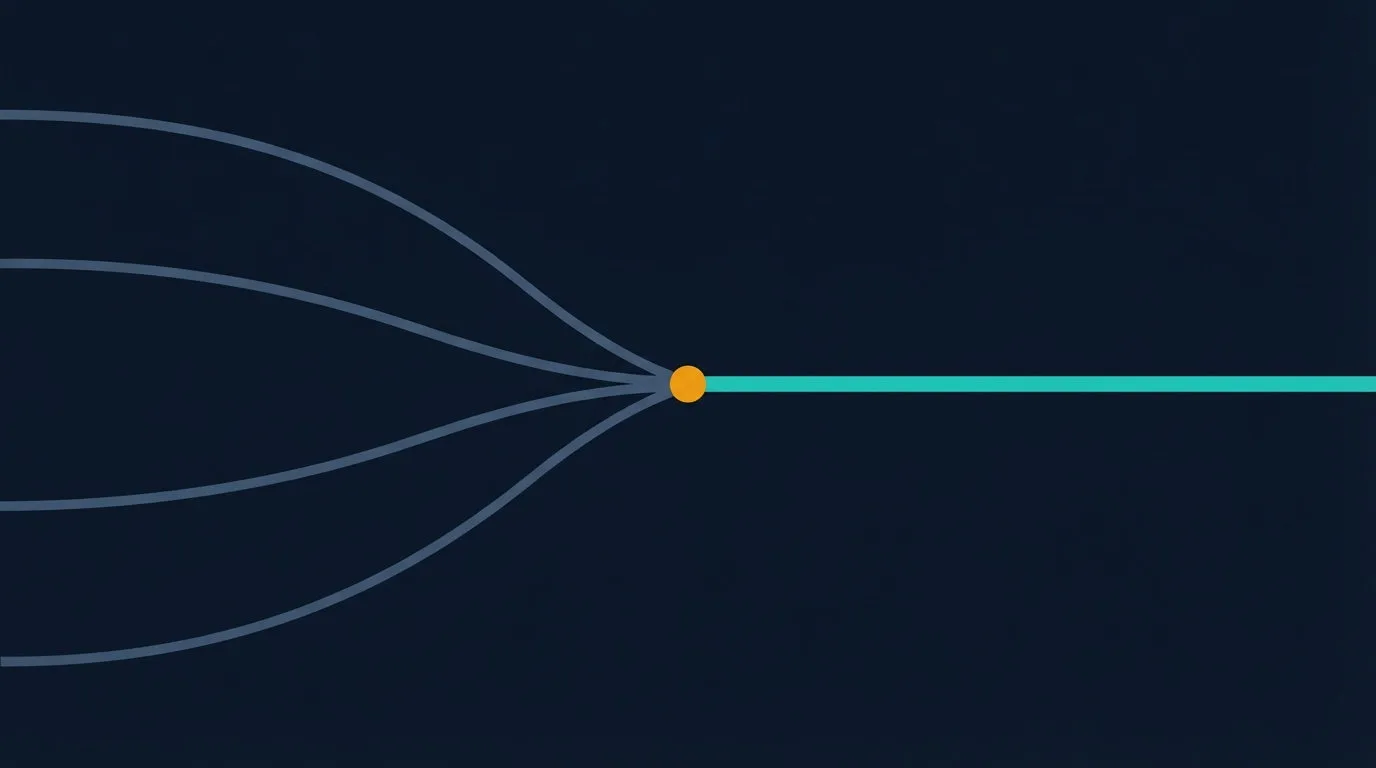
Four inputs, one output. Personalization is what happens at the merge point, not at the finish line.
1. Your Goal, as a Training Variable
"Get in shape" isn't a program input. Building strength, adding muscle, losing fat, and improving conditioning pull rep ranges, weekly volume, and rest periods in different directions. The goal has to be translated into those numbers before anything downstream is personal.
2. Your Real Schedule, Not Your Ideal One
A five-day split you'll hit twice is worse than a three-day plan you'll hit three times. The number of days that survive contact with your actual week is the most load-bearing input there is, and it's the one people overstate most.
3. The Equipment In Front of You
A barbell program in a living room is a program you don't do. Dumbbells, bands, a bench, a full gym, or nothing at all each change exercise selection and how load gets added. This is an input, never a prerequisite.
4. Your Starting Point and Your Rate of Change
Two people on the same program get wildly different results. Pooled data from 287 untrained adults found average strength gains of 21 percent after supervised training, with individuals ranging from minus 8 percent to plus 60 percent (Ahtiainen et al., 2016). A plan that never reacts to where you land is guessing.
The Part Everyone Skips
The best program on paper loses to the one you keep doing.
Here's the number that should reframe how you shop for a program. A retrospective study tracked 5,240 members of a single fitness center over nine years and found that 63 percent stopped before the third month, and fewer than 4 percent were still training continuously at twelve months (Sperandei et al., 2016). Those people didn't all pick bad programs. They stopped executing good ones.
So the honest ranking of what determines your result looks like this: whether you keep going, then whether the program roughly fits your goal, then the finer programming details. Most of the fitness industry sells you the third thing. We think the first two are where the leverage is, which is why every FitCraft program is built around consistency rather than intensity, and why we publish the full workout adherence statistics rather than quietly routing around them.
Personalization helps here in a way that isn't obvious. It isn't just that a matched program produces better physiology, though it does. In one randomized controlled trial, participants whose intensity was prescribed from their individual ventilatory threshold all improved their VO2max, 12 out of 12, while only 5 of 12 in the group prescribed by a standard percentage of heart rate reserve responded at all (Wolpern et al., 2015). The second effect is behavioral: a plan that fits your week gives you fewer reasons to skip, and a plan that visibly responds to your effort gives you a reason to come back.
That second effect is measurable too. A 2022 systematic review and meta-analysis in the Journal of Medical Internet Research pooled 16 randomized controlled trials covering 2,407 participants and found gamified interventions produced a small-to-medium improvement in physical activity (Hedges g = 0.42, 95% CI 0.14 to 0.69), with participants averaging roughly 1,610 more steps a day than controls (Mazeas et al., 2022). A smaller effect persisted at follow-up, 12 to 24 weeks after the intervention ended. Points, levels, and reward signals are not a gimmick bolted onto training. They're the mechanism that carries you through the stretch where the behavior isn't automatic yet.
See what FitCraft would build for you
FitCraft, our mobile fitness app, pairs you with an AI coach who builds you a personalized plan around your goals, schedule, and fitness level. Every FitCraft program is designed by Domenic Angelino, MPH (Brown University) and NSCA-CSCS, with research published in the Journal of Strength and Conditioning Research and Medicine & Science in Sports & Exercise.
Cancel anytime. We earn your stay, not your lock-in
Programs designed by an NSCA-certified exercise scientist
Program Length
What a 12 week workout plan actually buys you.
Twelve weeks is the most common length for a training program, and it's not arbitrary. It's roughly the shortest block that reliably contains a measurable physical change and a durable behavioral one.
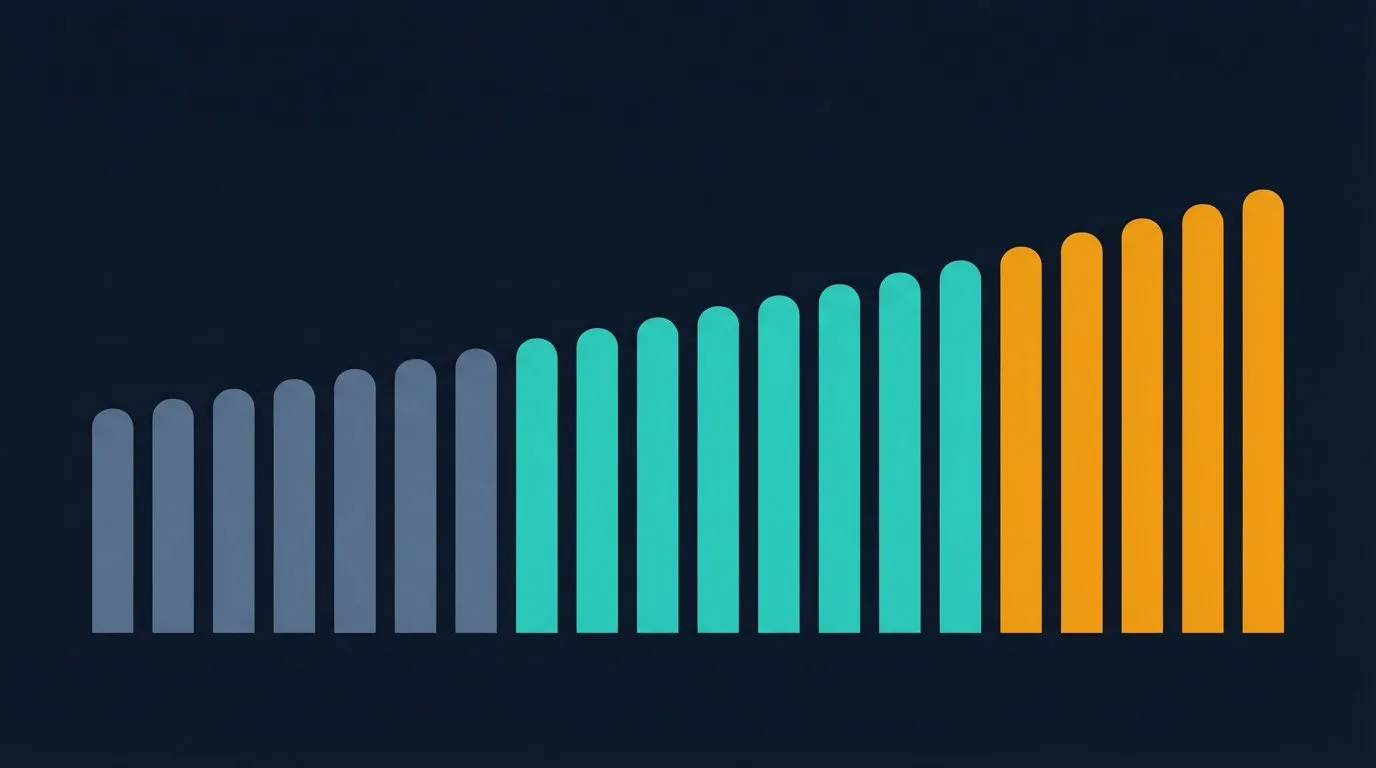
The point of a 12 week block is the slope, not any single session. Each week only has to be slightly harder than the last.
A systematic review and meta-analysis pooled 111 resistance training studies covering 1,927 participants and found interventions averaged about 10 weeks and produced roughly 1.5 kg of whole-body muscle mass (Benito et al., 2020). That's the research consensus on how long a block has to run before the change is big enough to measure reliably. Twelve weeks sits just past it, with room for a week that goes badly.
Inside those twelve weeks, a well-built plan doesn't do the same thing three times. It moves through phases:
Weeks 1 to 4: build the pattern
Loads stay conservative and the emphasis is on movement quality and turning up on the days you said you would. Most of your early strength gain here is neural rather than structural. The real objective is a repeatable weekly rhythm, because everything after this compounds on top of it.
Weeks 5 to 8: apply real load
This is where progressive overload does the work. Weight, reps, or sets climb week over week within your rep ranges. It's also where boredom usually shows up, since the novelty is gone and results are not yet visible in the mirror. A program that can't hold you here doesn't get to have a week 12.
Weeks 9 to 12: push, then consolidate
Volume or intensity peaks, then backs off. This is the part generic plans skip entirely, and it's why periodization exists as a concept at all. Cumulative fatigue is real by week nine, and a planned lighter week is what lets the adaptation actually surface.
If you're comparing plans by their length alone, 12 weeks is the safe answer. If you're comparing them by whether you'll finish, the length matters far less than whether week nine was designed with the same care as week one.
The Shorter Commitment
Is a 2 month workout plan long enough?
Two months gets you most of the way around the loop. The gap is the part where the behavior still needs deliberate effort.
Short answer: it's long enough to change your body a little and not quite long enough to change your defaults. Here's the arithmetic that decides it.
In a real-world habit study, 96 volunteers picked one daily eating, drinking, or activity behavior and repeated it in a consistent context for 12 weeks while rating how automatic it felt. The median time to reach the automaticity plateau was 66 days, with a range across individuals from 18 to 254 days (Lally et al., 2010). The popular "21 days to a habit" figure has no support in that data.
A 2 month workout plan is 56 days. That's just short of the median. A 12 week plan is 84 days, comfortably past it for most people. Which means the two most common program lengths sit on opposite sides of the line where training stops requiring a decision every single day. That's the single best argument for the longer block, and it has nothing to do with sets and reps.
None of which makes 8 weeks a bad choice. A 2 month plan you'll actually commit to beats a 12 week plan you won't start, and it's the right call if you're returning after a long layoff, testing whether a training style suits you, or working around a fixed deadline. Just go in knowing what you're buying: real early adaptations, a solid rhythm, and a habit that still needs deliberate effort on the other side. Plan the next block before the current one ends, and if the week three motivation dip is your usual failure point, that's the stretch to design for, not the finish line.
Honest Fit Check
Is FitCraft the right home for your program?
Plenty of apps will hand you a personalized training program. They're not interchangeable, and the differences are mostly about what happens after week one.
FitCraft fits if
You keep starting programs and stalling out somewhere in the first two months. You want a plan built around your real schedule and equipment, an AI coach who demonstrates every movement and teaches the technique, and a reward layer that carries you through the weeks where motivation doesn't. You train at home, in a gym, or both, across strength, cardio, yoga, and mobility.
Something else may fit better if
You want a live human coach reviewing your week over messages, or instructor-led classes on a schedule. Those are real strengths of other products. If you're weighing the AI-programming options specifically, we map the trade-offs in FitCraft vs Zing Coach and across the best AI fitness coach apps.
Real People, Real Results
From Starting Over Again to Finishing a Block.
Picture the version of this where week nine is unremarkable. You train, you log it, you move on with your day. The program is just something you do now. Here are people who got there.
"I've tried so many fitness apps and always quit after a few weeks. FitCraft is the first one that actually makes me want to work out. The game aspect is genius!"
Katie
2 weeks to a 90-day streak
"Having Ty guide me through the workouts is a game-changer. It feels like having a personal trainer who's actually encouraging. I'm finally seeing real progress."
Matt
Lost 32 pounds in 4 months
"As a gamer, this is the perfect app. It uses reward mechanics I already love and applies them to something genuinely good for me. Highly recommend."
Tim
Zero flexibility to completing a yoga program in 60 days
Another Program. Another Week Nine You Never Reach.
Another January plan. Another folder of PDFs. Another year of starting over from the same place you started from last time.
Sperandei S, Vieira MC, Reis AC. Adherence to physical activity in an unsupervised setting: Explanatory variables for high attrition rates among fitness center members. Journal of Science and Medicine in Sport. 2016;19(11):916-920. PubMed
Lally P, van Jaarsveld CHM, Potts HWW, Wardle J. How are habits formed: Modelling habit formation in the real world. European Journal of Social Psychology. 2010;40(6):998-1009. doi:10.1002/ejsp.674
Mazeas A, Duclos M, Pereira B, Chalabaev A. Evaluating the Effectiveness of Gamification on Physical Activity: Systematic Review and Meta-analysis of Randomized Controlled Trials. Journal of Medical Internet Research. 2022;24(1):e26779. PMC8767479
Ahtiainen JP, Walker S, Peltonen H, et al. Heterogeneity in resistance training-induced muscle strength and mass responses in men and women of different ages. Age. 2016;38(1):10. doi:10.1007/s11357-015-9870-1
Wolpern AE, Burgos DJ, Janot JM, Dalleck LC. Is a threshold-based model a superior method to the relative percent concept for establishing individual exercise intensity? A randomized controlled trial. BMC Sports Science, Medicine and Rehabilitation. 2015;7:16. doi:10.1186/s13102-015-0011-z
Benito PJ, Cupeiro R, Ramos-Campo DJ, Alcaraz PE, Rubio-Arias JA. A Systematic Review with Meta-Analysis of the Effect of Resistance Training on Whole-Body Muscle Growth in Healthy Adult Males. International Journal of Environmental Research and Public Health. 2020;17(4):1285. doi:10.3390/ijerph17041285
Questions
Frequently Asked
What is a personalized training program?
A personalized training program is a structured, multi-week plan built around four things that are specific to you: the goal you are training for, the days and times you can actually train, the equipment you have access to, and your current starting point. A generic template assumes all four. The programming difference is real, but the bigger difference is that a plan matched to your actual week is a plan you are far more likely to still be running in month three.
How is a personalized training program different from a generic workout plan?
A generic workout plan is fixed at the moment it is written. A personalized training program starts from your inputs and keeps adjusting as your results come in. That matters because responses to the same program vary enormously. In pooled data from 287 previously untrained adults doing supervised resistance training, the average strength gain was 21 percent, but individual results ranged from minus 8 percent to plus 60 percent (Ahtiainen et al., 2016). A plan that never reacts to which end of that range you land on is guessing.
How long should a personalized training program be?
Long enough to outlast the quit window and reach a measurable adaptation. Published resistance training interventions average roughly 10 weeks (Benito et al., 2020), and in real-world habit research a new daily behavior took a median of 66 days to feel automatic (Lally et al., 2010). Twelve weeks clears both marks, which is why a 12 week workout plan is the default length rather than an arbitrary one.
Is a 12 week workout plan better than a 2 month workout plan?
For most people yes, and the reason is the calendar rather than the training. A 2 month workout plan is 56 days, which lands just short of the 66-day median for a behavior to feel automatic (Lally et al., 2010). A 12 week workout plan is 84 days, which clears it. A 2 month plan is still a good commitment if a longer one would stop you from starting at all. If you can commit to 12 weeks, take the 12.
Do I need a gym for a personalized training program?
No. Equipment is one of the inputs, not a prerequisite. A properly personalized program builds around whatever you actually have, whether that is a full gym, a pair of dumbbells, resistance bands, or nothing at all. FitCraft programs cover strength with dumbbells, barbells, bands, or bodyweight, plus cardio, yoga, and mobility, so a home setup gets a real program instead of a stripped-down one.
Can an app really personalize a training program?
It can personalize the parts that are measurable: your goal, your available days, your equipment, your experience level, and how you are progressing session to session. What an app cannot do is watch your body the way a coach standing next to you would. FitCraft narrows that gap with interactive 3D exercise demos you can rotate and zoom to check position from any angle, and with an AI coach who demonstrates the movement and cues the technique. Programming and consistency are the parts an app does genuinely well.
Get the Program. Then Get to Week Twelve.
FitCraft is a gamified AI fitness coach app for iOS and Android that makes working out easy to stick with. Take the free 2-minute diagnostic and get your personalized plan.