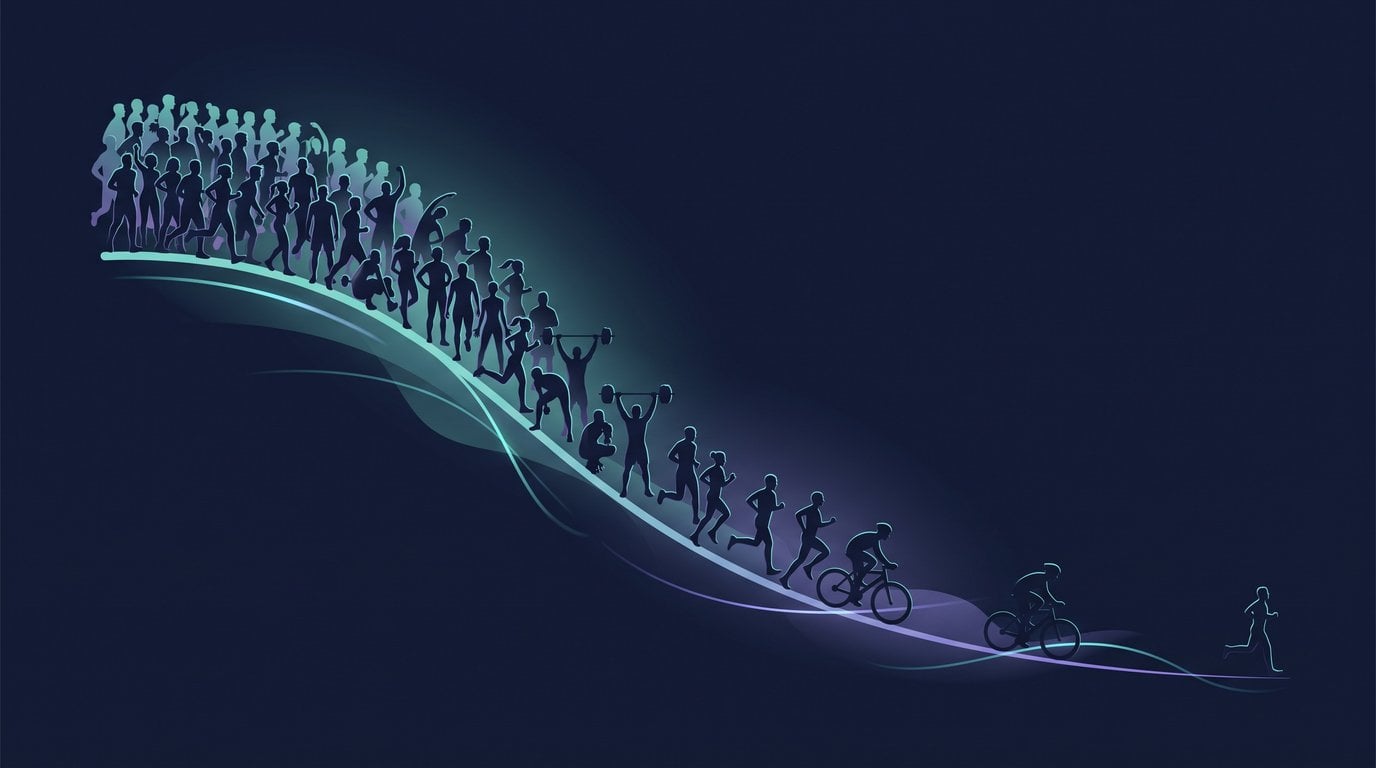
Here's the uncomfortable truth about getting in shape: the hard part was never the workout. It's showing up again next week, and the week after that, long after the motivation that got you started has worn off. Workout adherence, the science of who keeps exercising and who quits, is the single most important variable in fitness, and it's the one almost nobody measures honestly.
So we pulled the numbers. Real ones, from randomized controlled trials, longitudinal studies, and industry retention data. This page is a reference: the dropout rates, the timing, the reasons people give, and the interventions that actually move adherence. Every statistic carries a named source you can check.
One number for context before we start. In 2022, about 31% of adults worldwide, roughly 1.8 billion people, were not active enough to meet basic health guidelines, and that figure is projected to reach 35% by 2030 (Strain et al., 2024, Lancet Global Health). Inactivity isn't a niche problem. It's the default state most people are fighting against.
How many people quit the gym, and how fast?
Fast. Faster than the gym industry likes to admit. The cleanest peer-reviewed number comes from Sperandei et al. (2016), published in the Journal of Science and Medicine in Sport, which tracked new members at a fitness center in an unsupervised setting. The finding: 63% abandoned their activities before the third month, and fewer than 4% remained active continuously past 12 months.
Read that again. Not "attendance dropped." Fewer than 1 in 25 new members was still consistently training a year after signing up. The widely repeated industry figure, that about half of new gym members quit within six months, actually understates how early the collapse begins. The steepest losses happen in the first eight to twelve weeks.
Why does this happen in an unsupervised setting specifically? Because nobody's expecting you. There's no coach, no scheduled session, no one who notices when you don't show. That absence of structure is a recurring theme in the adherence research, and it's a big part of why the numbers look so different when supervision or accountability enters the picture. More on that below.
What retention rates do fitness apps actually have?
If you assumed apps solved the dropout problem, the data will disappoint you. Health and fitness apps have some of the worst retention of any app category. Industry benchmarks for 2024 through 2026 put 30-day retention for the category at roughly 3% to 8%, depending on how you define the segment. The broad health-and-fitness bucket sits near 3%. Dedicated, well-built fitness apps do somewhat better, in the 8% to 12% range, and a handful of standouts push higher. But the headline holds: more than 90% of people who download a fitness app have stopped using it within a month (Business of Apps, Health & Fitness App Benchmarks).
The drop-off is steepest right at the start. Day-one retention for the category typically lands around 20% to 35%, and it bleeds out fast through the first week. By the time you reach the 30-day mark, the curve has mostly flattened, because almost everyone who was going to quit already has.
| Time after install | Typical retention (health & fitness apps) | What it means |
|---|---|---|
| Day 1 | ~20% to 35% | Most installs never come back after the first session |
| Day 7 | ~7% to 20% | The first week is where the routine either forms or dies |
| Day 30 | ~3% to 8% | Over 90% of downloaders are gone within a month |
Ranges reflect converging industry benchmarks for 2024 to 2026 (Business of Apps, AppsFlyer). The broad health-and-fitness category clusters near the low end; dedicated fitness apps near the high end.
There's an obvious pattern connecting the gym data and the app data. Whether the tool is a treadmill or a smartphone, the failure point is the same: the transition from "I started" to "this is just something I do now." Most people never make it there. We dug into the app-specific version of this in our breakdown of whether fitness apps actually work.
When do most people quit a new workout routine?
There are two danger zones, and they're both earlier than you'd hope. The first is a matter of days. The second is the three-month cliff.
For resolutions, the collapse is almost comically fast. Strava, analyzing hundreds of millions of logged activities from its users, coined the term "Quitter's Day" for the second Friday of January, the single day when the most people abandon their fitness resolutions. That's less than two weeks in. Survey data backs up the short lifespan: a Forbes Health and OnePoll survey of 1,000 US adults found the average New Year's resolution lasts under four months (about 3.74 months). We covered the behavioral reasons in depth in why New Year's resolutions fail.
The second danger zone is subtler and more universal. It's the stretch around weeks three to twelve, when the novelty is gone, the early soreness has faded, and visible results still haven't shown up. This is the window where the Sperandei gym data shows most quitting happens. It's also the window we mapped out in our guide to the week-three motivation dip and the corresponding week-three checkpoint in the first-90-days timeline. If you can see the dip coming, you're far more likely to ride it out.
How long does it actually take to build a workout habit?
Here's where the timing gets cruel. The most-cited real study on habit formation is Lally et al. (2010), published in the European Journal of Social Psychology. Researchers at University College London followed 96 people as they tried to turn a new daily behavior, things like eating fruit with lunch or doing a short run, into an automatic habit.
The result that everyone should know: it took a median of 66 days for the behavior to become automatic. Not 21 days. That popular figure is a myth with no research behind it. And the range was enormous, from 18 days at the fast end to 254 days at the slow end, depending on the person and the difficulty of the behavior. One more finding buried in that paper matters more than the headline: missing a single day did not meaningfully reset the process. Consistency beat perfection.
Now line up the two facts. Most people quit before month three (Sperandei). But the median habit doesn't lock in until roughly day 66, which is right around that same two-to-three-month mark. In other words, a huge share of people quit in the exact window just before the behavior would have become automatic. They stop one hill short of the summit, then conclude they're "just not a fitness person." They're not lacking willpower. They're lacking a system that carries them through the 66-day valley.

Get an evidence-based plan built for you
FitCraft, our mobile fitness app, pairs you with an AI coach who builds you a personalized plan around your goals, schedule, and fitness level. Every FitCraft program is designed by Domenic Angelino, MPH (Brown University) and NSCA-CSCS, with research published in the Journal of Strength and Conditioning Research and Medicine & Science in Sports & Exercise.
Take the Free Assessment Free • 2 minutes • No credit cardWhy do people quit exercising?
Ask people why they stopped and you'll hear the same short list: no time, lost motivation, wasn't seeing results, too expensive, got bored. Those are real, and they show up consistently in the research on why patients drop out of even medically supervised programs. But the more interesting question is what predicts quitting before it happens.
The Sperandei et al. (2016) analysis ran the numbers and found a clear risk profile. The people most likely to drop out were driven mainly by extrinsic goals, especially weight loss, and tended to have lower prior activity levels and higher body mass. That's a crucial and counterintuitive finding. The exact motivation most beginners lead with, "I want to lose weight," is statistically one of the weakest anchors for actually sticking around.
Why would that be? Extrinsic goals put the payoff far away and outside your control. The scale doesn't move on your schedule, and when results lag behind effort, which they always do at first, the motivation collapses. Enjoyment and autonomy, by contrast, pay off every single session. You either liked the workout or you didn't, and that verdict lands immediately. We unpack the behavioral mechanics of this in our guide to why people quit fitness apps.
- Results lag effort. Visible change takes weeks to months, but motivation is spent daily. The gap is where quitting lives.
- Extrinsic goals are fragile. Weight-loss-driven members had a higher dropout risk than those training for enjoyment or health (Sperandei et al., 2016).
- No accountability. In unsupervised settings, nobody notices when you skip. The missed session has no cost, so it repeats.
- All-or-nothing thinking. One missed day gets read as failure and triggers a full stop, even though the research says a single lapse barely matters.
- Boredom. A repetitive, un-engaging routine gives the brain no reason to come back once novelty fades.
Does supervision or accountability improve adherence?
Substantially, yes. This is one of the clearest signals in the whole adherence literature, and it explains why the same person can flake on a solo gym membership yet show up faithfully for a class or a coach.
A 2024 systematic review and meta-analysis of exercise in older adults (Gómez-Redondo et al., 2024) found supervised and unsupervised programs had broadly similar attendance during the intervention (around 81%), but supervised training produced better physical outcomes. The more telling detail comes from studies that follow people across both phases: in one included trial, adherence ran about 72% while training was supervised, then fell to roughly 43% once participants were left to exercise on their own. Same people. Same exercises. The supervision was doing the heavy lifting.
Structured, supervised interventions also hold onto people better than the free-for-all of a solo membership. Adherence to supervised high-intensity interval training programs is high, with dropout around 13% in a pooled analysis (systematic review of HIIT compliance, 2023), a world away from the 63% early-quit rate of unsupervised gym members.
| Setting | Adherence / retention | Source |
|---|---|---|
| Supervised program (during supervision) | ~72% to 81% | Gómez-Redondo et al., 2024 PMC11258164 |
| Same participants, once unsupervised | ~43% to 67% | Gómez-Redondo et al., 2024 PMC11258164 |
| Supervised HIIT (dropout) | ~13% dropout | HIIT compliance review, 2023 PMC10664287 |
| Unsupervised new gym members (early quit) | 63% quit by month 3 | Sperandei et al., 2016 PMID 26874647 |
The lesson isn't "hire a trainer." It's that accountability and structure, in whatever form, are what convert intention into attendance.
The practical takeaway is not that everyone needs a personal trainer. It's that the ingredient supervision provides, someone or something that expects you and adjusts the plan, is what beginners are usually missing. That's exactly the gap that well-designed coaching and gamification are built to fill.
Do gamified fitness apps improve adherence?
This is where the data turns genuinely hopeful, and where it comes from randomized controlled trials rather than app-store promises. Gamification, the use of game mechanics like points, streaks, competition, and goals in a non-game setting, has been tested repeatedly against real activity outcomes.
The clearest single number: a 2022 meta-analysis in the Journal of Medical Internet Research (Mazeas et al.) pooled 16 randomized controlled trials with 2,407 participants and found gamification produced a moderate, statistically significant increase in physical activity, a Hedges' g of 0.42. A 2024 systematic review in eClinicalMedicine (Nishi et al.) sharpened the point by comparing digital health apps with and without gamification directly, and the gamified versions came out ahead for physical activity.
The individual trials show how large the effect can get, and which mechanics do the work. Daily step gains versus control ran from roughly 600 to over 2,000, with the biggest numbers coming from competition and, above all, self-chosen goals.
| Trial | Year | Population | Steps/day vs control | Source |
|---|---|---|---|---|
| MapTrek | 2018 | Adults, gamified walking race | +2,183 | PMC6064890 |
| ENGAGE | 2021 | Adults, self-chosen goals (n=500) | +1,384 | PMC8411363 |
| GAMEPAD | 2025 | Adults, gamification RCT | +1,074 | PMC12826907 |
| BE FIT | 2017 | Families, gamified support | +953 | PMC5710273 |
| STEP UP | 2019 | Overweight/obese adults, competition (n=602) | +920 | PMC6735420 |
| ALLSTAR | 2025 | Cancer survivors | +759 | PMC12805409 |
| iDiabetes | 2021 | Adults with type 2 diabetes | +606 | PMC8144928 |
Step gains represent the difference versus control during the active intervention. For the full breakdown, see our gamification statistics reference.
Two patterns stand out. Competition is durable: in the STEP UP trial (n=602), competition-based gamification not only beat collaboration but was the only social mechanic that held its effect at follow-up. And autonomy is powerful: the ENGAGE trial's self-chosen goals produced the largest step increase of any study here, which lines up perfectly with the earlier finding that intrinsic, self-directed motivation predicts staying. We wrote more about the competition effect in why competition makes you fitter.

What actually keeps people going?
Put the whole evidence base together and a short, practical playbook emerges. None of it is about being more disciplined. All of it is about designing the odds in your favor.
- Choose your own goals. Self-selected, autonomous goals produced the single largest activity increase in the trials (ENGAGE, +1,384 steps/day). Pick targets that matter to you, not ones handed to you. Our take on choosing your own goals goes deeper.
- Lead with enjoyment, not weight loss. Extrinsic weight-loss motivation predicted dropout; enjoyment and health-driven motivation tracked with staying (Sperandei et al., 2016). Do a version of exercise you'd repeat even if the scale never moved.
- Build in accountability. Supervision roughly doubled sustained adherence versus going it alone (Gómez-Redondo et al., 2024). A coach, a class, a friend, or an app that expects you all count.
- Use streaks and small wins. Habits form through repetition, a median of 66 days (Lally et al., 2010), and a single missed day doesn't reset the clock. Track the streak, and forgive the lapse.
- Add friendly competition. Competition was the most durable social mechanic in the trials (STEP UP), holding its effect long after other approaches faded.
- Expect the dip. Plan for weeks three through twelve to feel hard and unrewarding. Knowing the valley is coming, and that it ends, is half the battle.
Notice that these levers are precisely the ones gamified coaching is built around: autonomy, accountability, streaks, and competition. That's not a coincidence. The apps and programs that work aren't the ones with the best exercises. They're the ones designed for the 66-day valley, the part where willpower runs out and everyone else quits.
Frequently Asked Questions
How many people quit the gym in the first year?
The peer-reviewed data is stark. A 2016 study in the Journal of Science and Medicine in Sport (Sperandei et al.) tracked new fitness-center members and found that 63% abandoned their activities before the third month, and fewer than 4% were still training continuously after 12 months. Industry retention reports describe a similar pattern, with roughly half of new members lapsing within the first six months.
What percentage of fitness app users stop using the app?
Health and fitness apps have some of the lowest retention of any app category. Industry benchmarks for 2024 to 2026 put 30-day retention for the category at roughly 3% to 8%, meaning more than 90% of people who install a fitness app are no longer using it a month later. Day-one retention typically sits around 20% to 35%, and it falls steeply through the first week.
How long does it take to make exercise a habit?
Longer than the popular 21-day myth suggests. In a University College London study (Lally et al., 2010), 96 people forming a new daily behavior reached automaticity after a median of 66 days, with a wide range of 18 to 254 days depending on the person and the behavior. Missing a single day did not meaningfully derail the process, which means consistency matters more than perfection.
When do most people give up on New Year fitness resolutions?
Much earlier than people expect. Strava, analyzing hundreds of millions of logged activities, named the second Friday of January "Quitter's Day," the point when most people abandon their fitness resolutions. Survey data from Forbes Health and OnePoll found the average resolution lasts under four months (about 3.74 months). The three-month mark is a recurring danger zone across gyms, apps, and resolutions alike.
Do gamified fitness apps actually improve adherence?
Yes, and the evidence comes from randomized controlled trials, not marketing. A 2022 meta-analysis in the Journal of Medical Internet Research (Mazeas et al.) pooled 16 RCTs with 2,407 participants and found gamification produced a moderate increase in physical activity (Hedges' g = 0.42). Individual trials show daily step gains of roughly 600 to 2,200 versus control, with the largest effects from competition and self-chosen goals.
What is the single biggest predictor of sticking with exercise?
Motivation quality matters more than motivation quantity. In the Sperandei et al. (2016) analysis, members driven mainly by extrinsic goals like weight loss, along with those who had low prior activity and higher body mass, were most likely to drop out. Enjoyment, autonomy, and self-chosen goals track with staying. In the ENGAGE trial, letting people pick their own goals produced the single largest step increase of any gamification study, about 1,384 steps per day.
References
- Sperandei S, Vieira MC, Reis AC. "Adherence to physical activity in an unsupervised setting: explanatory variables for high attrition rates among fitness center members." Journal of Science and Medicine in Sport. 2016;19(11):916-920. PMID 26874647 · doi:10.1016/j.jsams.2015.12.522
- Lally P, van Jaarsveld CHM, Potts HWW, Wardle J. "How are habits formed: Modelling habit formation in the real world." European Journal of Social Psychology. 2010;40(6):998-1009. doi:10.1002/ejsp.674
- Strain T, Flaxman S, Guthold R, et al. "National, regional, and global trends in insufficient physical activity among adults from 2000 to 2022." The Lancet Global Health. 2024;12(8):e1232-e1243. doi:10.1016/S2214-109X(24)00150-5
- Gómez-Redondo P, Valenzuela PL, Morales JS, et al. "Supervised Versus Unsupervised Exercise for the Improvement of Physical Function and Well-Being Outcomes in Older Adults: A Systematic Review and Meta-analysis of Randomized Controlled Trials." 2024. PMC11258164
- Systematic review and meta-analyses of rates of compliance and adherence to high-intensity interval training. 2023. PMC10664287
- Mazeas A, Duclos M, Pereira B, Chalabaev A. "Evaluating the Effectiveness of Gamification on Physical Activity: Systematic Review and Meta-Analysis of Randomized Controlled Trials." Journal of Medical Internet Research. 2022;24(1):e26779. PMC8767479 · doi:10.2196/26779
- Nishi SK, Kavanagh ME, et al. "Effect of digital health applications with or without gamification on physical activity and cardiometabolic risk factors: a systematic review and meta-analysis of randomized controlled trials." eClinicalMedicine. 2024. PMC11701442
- Patel MS, Small DS, Harrison JD, et al. "Effectiveness of Behaviorally Designed Gamification Interventions With Social Incentives (STEP UP)." JAMA Internal Medicine. 2019;179(12):1624-1632. PMC6735420
- Patel MS, Polsky D, Kennedy EH, et al. "Goal-Setting Approaches Within Gamification (ENGAGE)." JAMA Cardiology. 2021. PMC8411363
- Patel MS, et al. "A Randomized Trial of Social Comparison Feedback and Financial Incentives (BE FIT)." JAMA Internal Medicine. 2017. PMC5710273
- MapTrek gamified walking trial. Journal of the American Heart Association. 2018. PMC6064890
- iDiabetes gamification trial. 2021. PMC8144928
- ALLSTAR gamification trial in cancer survivors. JACC: CardioOncology. 2025. PMC12805409
- GAMEPAD gamification trial. Journal of the American Heart Association. 2025. PMC12826907